Appendix B — The Deleted Paragraph
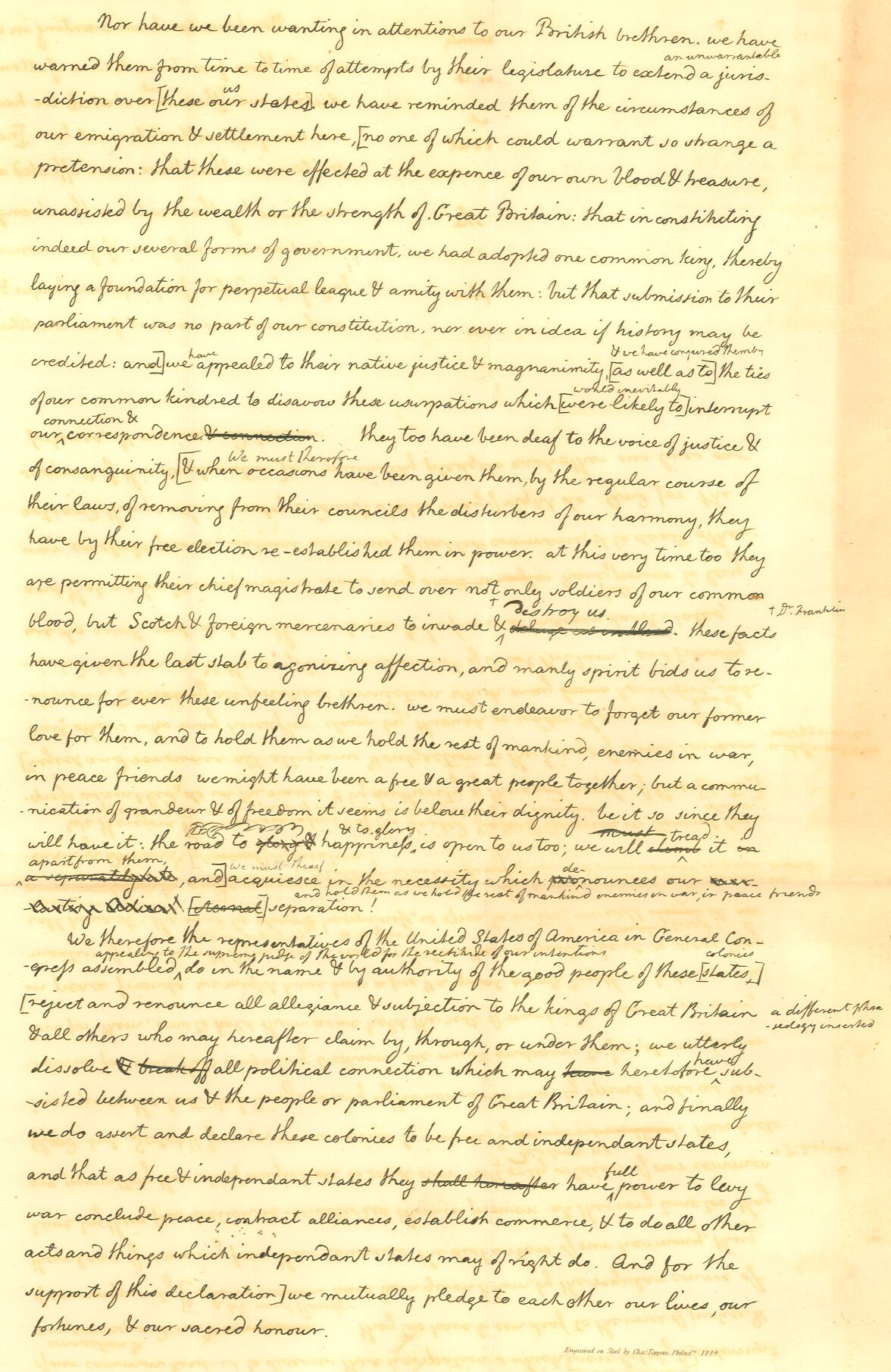
In Thomas Jefferson’s original draft, he included a long passage directly attacking the King for the transatlantic slave trade. This passage came after the grievance about “exciting domestic insurrections.” It was removed by the Continental Congress on July 2 and 3, 1776, during the editing process — primarily to appease the delegations from South Carolina and Georgia.
The original passage read:
He has waged cruel war against human nature itself, violating its most sacred rights of life and liberty in the persons of a distant people who never offended him, captivating and carrying them into slavery in another hemisphere, or to incur miserable death in their transportation hither. This piratical warfare, the opprobrium of infidel powers, is the warfare of the Christian king of Great Britain. Determined to keep open a market where MEN should be bought and sold, he has prostituted his negative [veto power] for suppressing every legislative attempt to prohibit or restrain this execrable commerce.
Jefferson’s draft blamed the King for the slave trade, despite the fact that the colonies themselves had actively participated in and profited from slavery for generations. Congress cut the entire passage — not because the delegates supported slavery (many were uncomfortable with it), but because removing it was necessary to maintain colonial unity. South Carolina and Georgia made clear they would not accept the Declaration with that clause intact.
Jefferson himself was a slaveholder who owned over 600 enslaved people during his lifetime. The contradiction was not lost on his contemporaries. The final Declaration ignites a debate that continues to this day: how could a nation founded on the principle that “all men are created equal” permit chattel slavery?
The deleted passage was rediscovered and published in the 1820s by journalist William Lloyd Garrison, who used it as a rallying cry for the abolitionist movement. Lincoln later referenced the ideals of the Declaration — not the deleted passage itself — to argue that the Founders intended liberty to be extended to all people.
Modern Translation: Even as Jefferson wrote that slavery was “war against human nature,” he personally owned enslaved people. And the Congress that voted for liberty voted to remove any criticism of slavery to keep the Southern colonies on board. This contradiction is the original sin of the American experiment.
📚 Complete Bundle
Get all three editions at a special bundle price
Complete Bundle
All 3 Editions · One Low Price
View the Bundle
The Declaration of Independence
Annotated • Simple English • 15-Minutes
Bundle Price $XX.XX
Save XX% vs buying separately
Annotated Edition
- Full Literary Annotations
- Detailed explanations of themes, symbols, and historical context on every page.
- Vocabulary Support
- Difficult words defined with simple explanations and example sentences.
- Chapter Summaries
- Concise summaries at the start of each chapter for quick orientation.
Simple English Edition
- Easy-to-Read Language
- Classic text rewritten with simpler vocabulary and sentence structures.
- Side-by-Side Format
- Original text alongside simplified version for comparison and learning.
- Ideal for Learners
- Perfect for ESL students, young readers, or anyone wanting a gentler read.
15-Minutes Edition
- Quick Chapter Overviews
- Each chapter condensed into a 15-minute read with all key plot points.
- Exam-Ready Format
- Ideal for test preparation, quick reviews, or busy readers.
- Key Quotes & Analysis
- Essential passages with brief analytical notes for discussion prep.
Get the Complete Bundle: All 3 editions for one low price. Start with any edition, switch anytime.
Buy Complete Bundle →