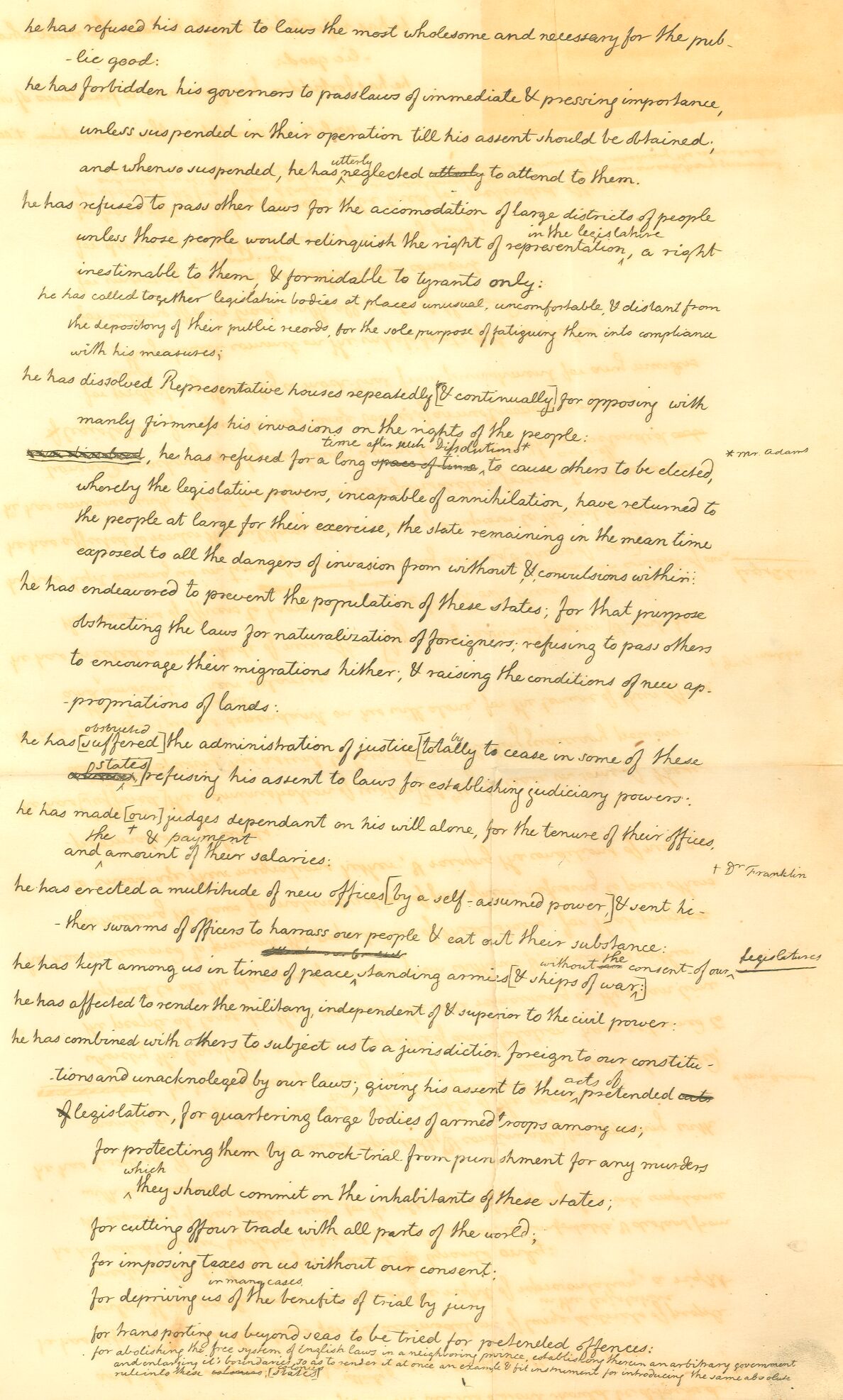
By 1774, years of tension between the Thirteen Colonies and King George III had reached a breaking point. Parliament passed the Coercive Acts (called the Intolerable Acts in the colonies) to punish Boston for the Tea Party, closing the port and dissolving the colonial government. The First Continental Congress met in September 1774 at Carpenters’ Hall in Philadelphia to coordinate a response, but fighting had already begun at Lexington and Concord in April 1775.
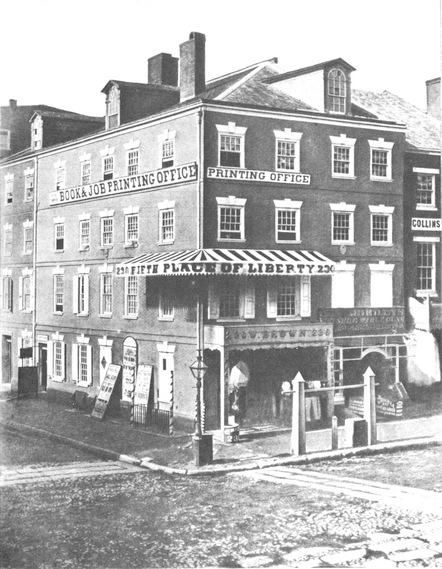
By the spring of 1776, two things shifted American opinion decisively. First, Thomas Paine’s pamphlet Common Sense (January 1776) argued for independence in plain language that ordinary colonists could understand. It sold hundreds of thousands of copies and was read aloud in taverns and meeting houses across the colonies. Second, King George hired Hessian mercenaries (German soldiers) to fight the colonists and declared the colonies in rebellion, dashing hopes of reconciliation.
On June 7, 1776, Richard Henry Lee of Virginia introduced a resolution to Congress declaring independence. Congress delayed the vote to allow delegates to seek new instructions from their colonies, but appointed a Committee of Five — Thomas Jefferson, John Adams, Benjamin Franklin, Roger Sherman, and Robert R. Livingston — to draft a document explaining the decision.
Jefferson wrote the first draft in isolation between June 11 and June 28, 1776, from the second floor of a boarding house at 700 Market Street in Philadelphia (now called the Declaration House). He wrote on a portable writing desk of his own design. Adams and Franklin reviewed the draft, and Jefferson incorporated minor changes before presenting it to Congress on June 28.
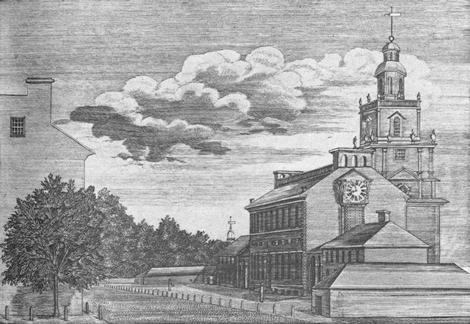
Congress debated the draft for three days, removing nearly a quarter of the text. The most significant deletion was a passage condemning the King for the transatlantic slave trade — removed to appease South Carolina and Georgia. Congress approved the final text on July 4, 1776. The famous signed parchment copy was engrossed (written in clear handwriting) by Timothy Matlack and signed primarily on August 2, 1776.
The 56 signers committed an act of high treason against the Crown, punishable by hanging and quartering. Benjamin Franklin reportedly said, “We must all hang together, or assuredly we shall all hang separately.”
The Declaration has five parts: an Introduction explaining why they are publishing their reasons, a Preamble stating the philosophical basis for revolution, an Indictment listing the King’s abuses, a Denunciation of the British people for ignoring their pleas, and a Conclusion formally declaring independence.
The unanimous Declaration of the thirteen united States of America
When in the Course of human events, it becomes necessary for one people to dissolve the political bands which have connected them with another, and to assume, among the Powers of the earth, the separate and equal station to which the Laws of Nature and of Nature’s God entitle them, a decent respect to the opinions of mankind requires that they should declare the causes which impel them to the separation.
Modern Translation: When history forces a group of people to break away from their country and become independent — something they have a right to do under natural law — it is polite to explain to the rest of the world exactly why they are doing it.
Definition: Dissolve – To end or break apart (in this case, the political ties to Britain).
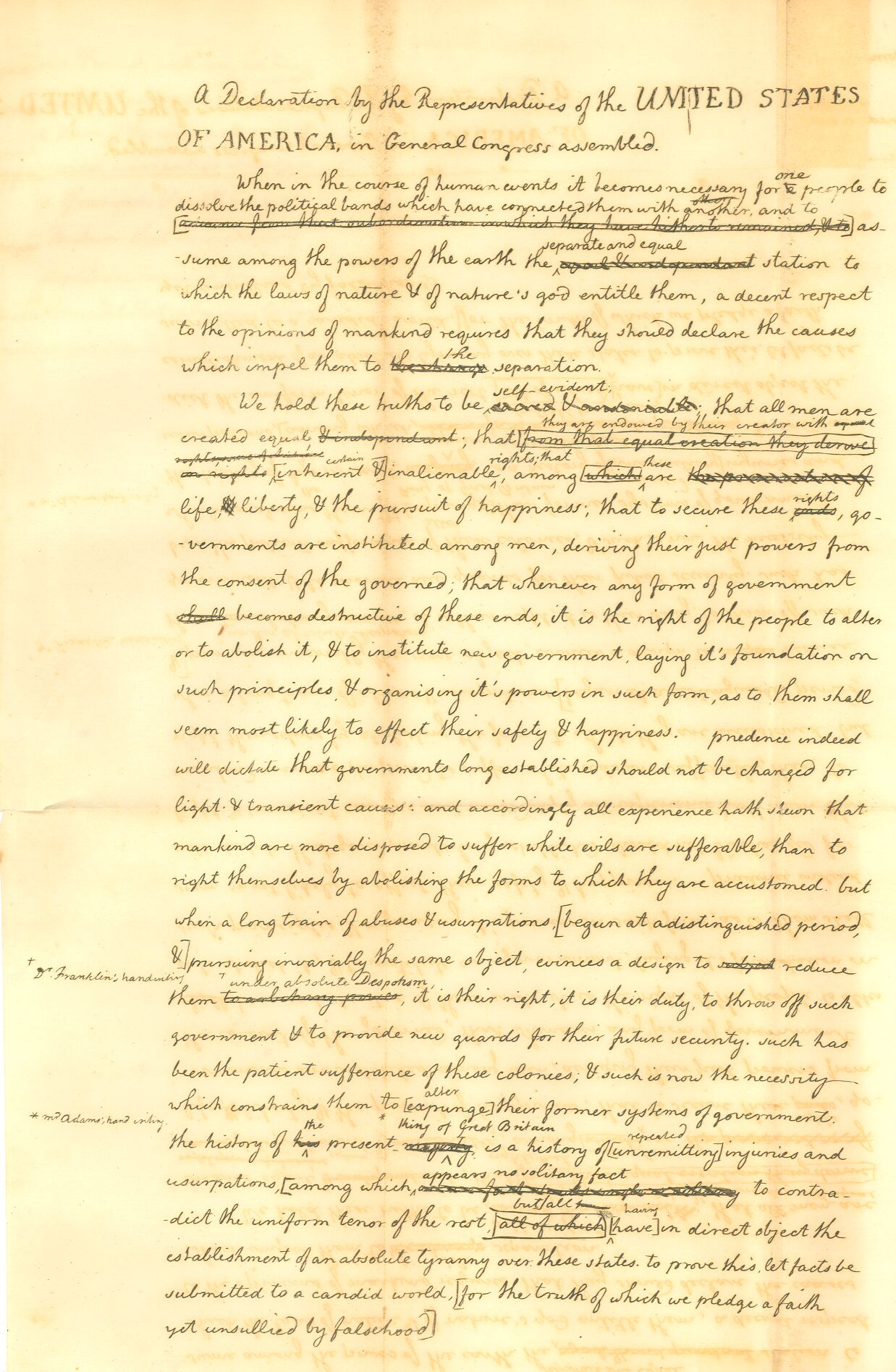
We hold these truths to be self-evident, that all men are created equal, that they are endowed by their Creator with certain unalienable Rights, that among these are Life, Liberty, and the pursuit of Happiness. — That to secure these rights, Governments are instituted among Men, deriving their just powers from the consent of the governed, — That whenever any Form of Government becomes destructive of these ends, it is the Right of the People to alter or to abolish it, and to institute new Government, laying its foundation on such principles and organizing its powers in such form, as to them shall seem most likely to effect their Safety and Happiness.
Definition: Unalienable Rights – Rights that cannot be taken away or given up.
Definition: Consent of the governed – The idea that a government’s legitimacy comes only from the permission of the people it rules.
Prudence, indeed, will dictate that Governments long established should not be changed for light and transient causes; and accordingly all experience hath shown, that mankind are more disposed to suffer, while evils are sufferable, than to right themselves by abolishing the forms to which they are accustomed. But when a long train of abuses and usurpations, pursuing invariably the same Object evinces a design to reduce them under absolute Despotism, it is their right, it is their duty, to throw off such Government, and to provide new Guards for their future security. — Such has been the patient sufferance of these Colonies; and such is now the necessity which constrains them to alter their former Systems of Government. The history of the present King of Great Britain is a history of repeated injuries and usurpations, all having in direct object the establishment of an absolute Tyranny over these States. To prove this, let Facts be submitted to a candid world.
Modern Translation: You should not overthrow a government just because you are annoyed about small things. People usually prefer to suffer bad treatment rather than risk the chaos of a revolution. However, if a government keeps abusing power over and over again to create a dictatorship, it is your duty to overthrow it. We have been patient, but King George III has proven himself to be a tyrant. Here is the evidence.
Definition: Despotism – A system of government where a single ruler holds absolute power.
Definition: Usurpations – Illegal acts of taking power or authority.