Deep analysis of Moby-Dick covering its symbolism, narrative structure, and themes. Discover why literary critics consider it the greatest American novel ever written.
🐋
Moby-Dick Analysis: The Great American Novel Decoded
Deep analysis of Moby-Dick covering its symbolism, narrative structure, and themes. Discover why literary critics consid...
Why Moby-Dick Is Considered the Great American Novel
Critics call Moby-Dick the Great American Novel not because it is perfect, but because it is complete. It contains multitudes: a thrilling adventure, a whaling encyclopedia, a literary tragedy, a comedy, a philosophical dialogue, and a spiritual autobiography.
The phrase “Great American Novel” was first coined by John William De Forest in 1868, more than fifteen years after Moby-Dick was published. He defined it as a novel that would portray “the American soul” — the nation’s character, its contradictions, its restless energy. By that definition, no novel has come closer than Moby-Dick.
What makes Moby-Dick the Great American Novel is not any single quality but the sheer ambition of its scope. Melville wanted to write a book that contained everything: the physical reality of whaling, the metaphysical terror of existence, the comedy of human interaction, the tragedy of obsession. He wanted to create an American epic that could stand alongside the Iliad, the Divine Comedy, and Paradise Lost. He did not entirely succeed — no one could — but the attempt itself produced something extraordinary: a novel that reaches beyond its own limitations and grasps at the infinite.
The novel also captures something essential about the American character: the restless drive to push further, to conquer the unknown, to sail beyond the edge of the map. Ahab’s monomaniacal pursuit of the white whale is a dark mirror of the American dream — the belief that with enough will, enough determination, enough sheer force of personality, any obstacle can be overcome. The tragedy is that the obstacle in this case is not a mountain or a continent. It is nature itself, vast and indifferent, beyond the reach of human ambition.
The Narrative Structure
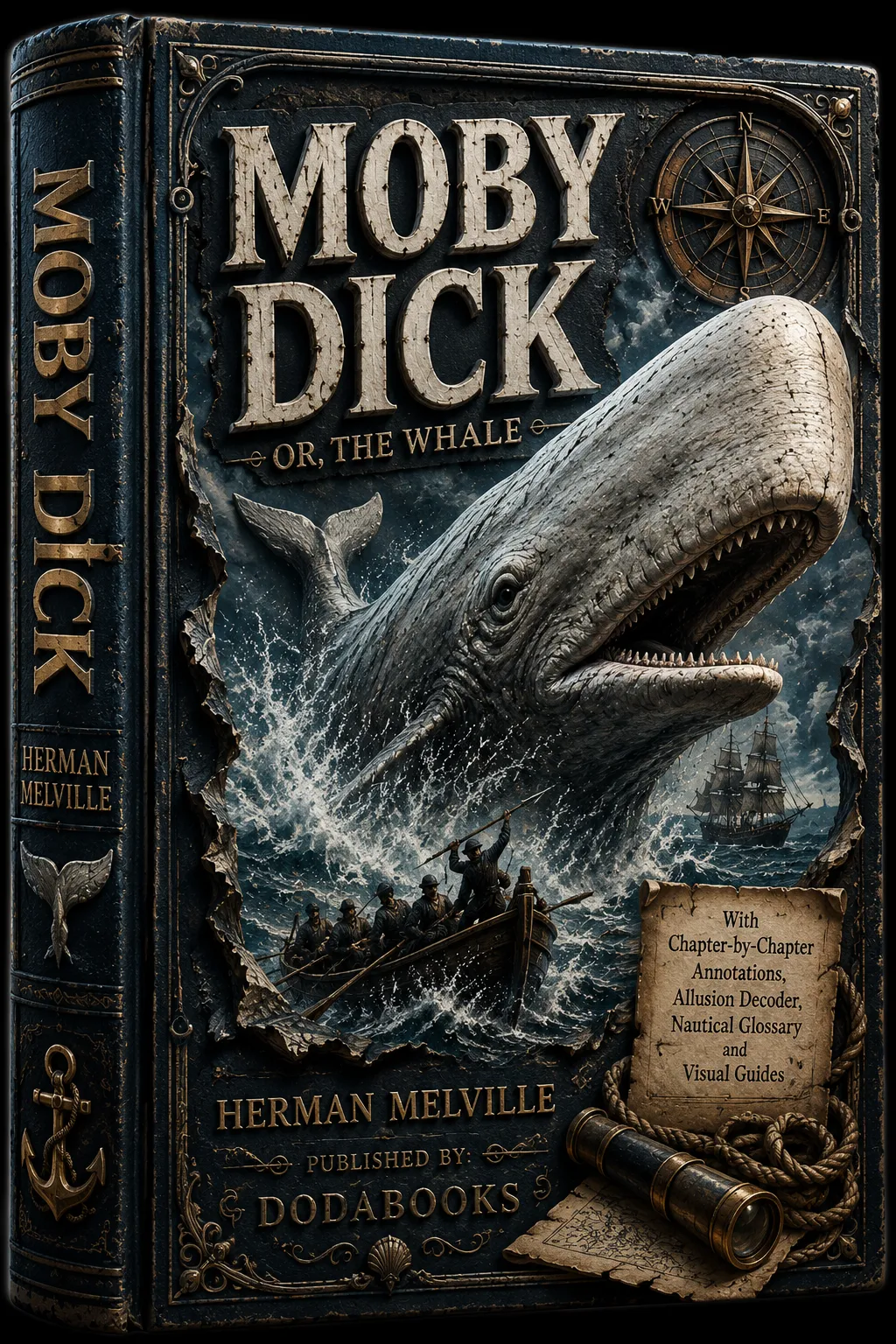
📖 Want the complete annotated experience?
👉 Get the Annotated EditionMelville uses an extraordinary range of techniques: first-person narration, dramatic monologue (in “The Town-Ho’s Story”), stage directions (in “The Quarter-Deck”), scientific discourse in the cetology chapters, and even a play-within-a-novel structure. This deliberate fragmentation mirrors the shattering of certainty that the 19th century was experiencing.
The novel’s structure is deliberately disorienting. Chapters shift without warning from narrative to essay to drama. A chapter about whale anatomy may be followed by a philosophical meditation, which may be followed by a scene of high comedy, which may be followed by an extended metaphor that spirals into abstraction. The reader is never allowed to settle into a single mode of reading. This is not a flaw. It is Melville’s most radical artistic choice: the form of the novel enacts the experience of trying to understand a world that refuses to be reduced to a single meaning.
Consider “The Quarter-Deck,” one of the novel’s most celebrated chapters. Melville abandons prose entirely and writes the scene as a play, complete with stage directions. Ahab paces the deck, addresses his crew, nails the doubloon to the mast, and declares his quest. The shift to dramatic form gives the scene an intensity that conventional narration could not achieve. We are no longer reading about Ahab. We are watching him, standing on the deck of the Pequod, feeling the pull of his charisma and the chill of his madness.
The cetology chapters — the extended digressions on whale anatomy, whale taxonomy, and the history of whaling — are often cited as the novel’s greatest obstacle. But they serve a crucial structural purpose. They slow the narrative to a crawl, forcing the reader to inhabit the world of whaling at the same pace as the crew. The experience of reading Moby-Dick is meant to mirror the experience of being at sea: long stretches of monotony punctuated by moments of terror. The cetology chapters are the monotony. They make the terror possible.
The Symbolic Framework
Everything in Moby-Dick operates on two levels. The Pequod is both a 19th-century whaling ship and a microcosm of human society. Ahab is both a crippled captain and a Faustian figure. The whale is both a biological specimen and a symbol of the inscrutable forces of nature and fate.
This dual operating system is what gives Moby-Dick its extraordinary richness. The novel never resolves into allegory. The whale is never reduced to a single meaning. In “The Whiteness of the Whale,” Ishmael catalogs the many associations of the color white — purity, death, blankness, the void — and concludes that the whale’s whiteness is terrifying precisely because it can mean everything and therefore means nothing. The whale is a mirror, reflecting whatever the observer brings to it. For Ahab, it is evil. For Starbuck, it is merely a whale. For Ishmael, it is the unknowable center of a universe that refuses to explain itself.
The doubloon chapter, “The Doubloon,” dramatizes this multiplicity brilliantly. Each character looks at the Ecuadorian doubloon Ahab has nailed to the mast and sees something different. Ahab sees his own will reflected back. Starbuck sees a “pasteboard mask” — a surface hiding nothing. Stubb sees omens in the zodiac symbols. Flask sees only money. Pip, the mad cabin boy, sees “the figure of a milky way” — a vision of infinite space that terrifies the others. The doubloon is the novel in miniature: a single object that means different things to different people, and whose ultimate meaning is the meaning each viewer projects onto it.
The Cetology Chapters
The chapters on whale anatomy are not digressions. They are Melville’s attempt to create a total work of art that encompasses all knowledge about its subject. This encyclopedic ambition is part of what makes the novel so overwhelming and so rewarding.
Melville’s cetology chapters are modeled on the great encyclopedic works of the Renaissance — Leonardo’s notebooks, Montaigne’s essays, Burton’s Anatomy of Melancholy. The ambition is not merely to tell a story but to create a complete account of a world. Melville wanted to know everything about whaling: the biology of the whale, the history of the hunt, the tools and techniques of the trade, the economic forces that drove the industry, the physical experience of being at sea. And he wanted to put all of this knowledge into a single book.
This encyclopedic impulse is deeply American. The 19th century was an age of catalogs and compendiums, of botanical surveys and geological expeditions, of libraries and museums that attempted to contain the entire natural world within their walls. Melville’s cetology chapters belong to this tradition. They are a claim that literature can be as comprehensive as science, that a novel can contain all of knowledge and still be a work of art.
The chapters also serve a philosophical purpose. By cataloging everything that can be known about the whale, Melville simultaneously demonstrates the limits of human knowledge. We can classify the whale’s anatomy, describe its behavior, measure its size. But we cannot know what the whale means. The cetology chapters build toward “The Whiteness of the Whale,” which is essentially an admission that all this knowledge amounts to nothing — that the whale remains, after everything we have learned about it, fundamentally unknowable.
The Ending
The sinking of the Pequod, with a sea hawk nailed to the mast by Ahab, is one of the most powerful endings in literature. Ishmael’s survival suggests that the storyteller, the one who bears witness, always remains.
The ending is both apocalyptic and redemptive. The Pequod goes down “like a stone,” dragged under by the whirlpool created by the sinking whale. Every soul on board perishes — except Ishmael, who survives by clinging to Queequeg’s coffin, which has been converted into a life buoy. The image is extraordinary: death becomes salvation, the coffin becomes a cradle, the end becomes a beginning.
Ishmael’s survival is not merely a plot device. It is a statement about the nature of storytelling itself. The novel is, after all, a story — and stories require survivors. Someone must live to tell the tale. Ishmael survives because he is the narrator, because the act of bearing witness is the one act that the forces of destruction cannot touch. The whale destroys the ship, the crew, the captain, the quest. But it cannot destroy the story. The story survives, carried by the one man who was open enough, flexible enough, humble enough to live.
The final image of the novel — Ishmael floating on the coffin, “tossed upon a lazy, lazy sea” — is one of the most haunting in all of literature. He is alone. The Pequod is gone. His companions are dead. And yet there is a strange peace in the image, a sense of having passed through destruction and emerged on the other side. Ishmael has been stripped of everything: his shipmates, his purpose, his illusions. What remains is the bare fact of existence — and the story that will give that existence meaning.
Discover the depth of Melville’s masterpiece with our annotated edition of Moby-Dick. Complete text with explanatory notes, historical context, and literary analysis.
📚 Related Articles
🎯 Stop Struggling. Start Understanding.
The annotated edition of Moby-Dick gives you everything you need to finally get Melville’s masterpiece:
- ✅ Complete, unabridged text — every word of the original 1851 edition
- ✅ Hundreds of explanatory footnotes — no more Googling every other page
- ✅ Historical context — the Essex disaster, Nantucket whaling, Melville’s life
- ✅ Literary analysis — chapter-by-chapter commentary on themes and symbols
- ✅ Victorian vocabulary — obsolete words and nautical terms defined inline
- ✅ Biblical & literary references — every allusion traced to its source