Who is Captain Ahab in Herman Melville’s Moby-Dick? Captain Ahab is the tyrannical, monomaniacal commander of the whaling ship Pequod, driven to mutual destruction by an obsessive quest for vengeance against the white whale that severed his leg.
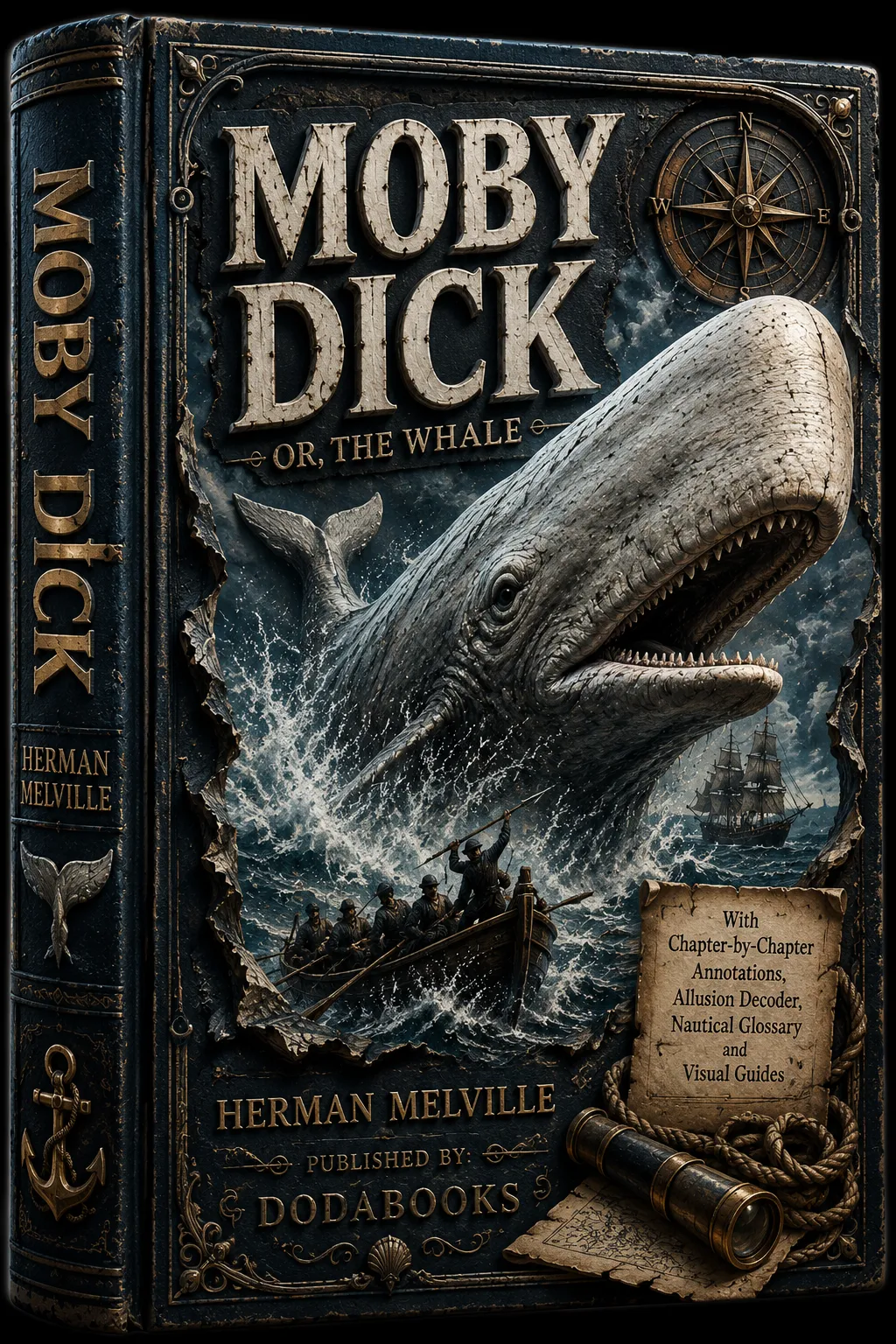
This article is part of our annotated Moby-Dick guide, designed to help readers unlock the full depth of Melville’s masterpiece through comprehensive notes and analysis.
🐋
Captain Ahab: The Tragic Hero of Moby-Dick — Full Character Analysis
In-depth analysis of Captain Ahab from Moby-Dick. Explore his psychology, his obsession, his tragic flaw, and why he rem...
Who Is Captain Ahab in Moby-Dick? (Quick Facts)
| Feature | Detail |
|---|---|
| Role | Captain and absolute commander of the whaling ship Pequod |
| Origin | Nantucket, Massachusetts (Quaker background, though ungodly) |
| Physical Appearance | Livid scar from crown to sole; prosthetic leg carved from polished sperm-whale jawbone |
| The Injury | Leg severed and chewed off by Moby Dick on the previous voyage in the Pacific |
| Tragic Flaw (Hamartia) | Monomania and pride (hubris) — projecting all cosmic malice onto the whale |
| Biblical Allusion | King Ahab of Israel (1 Kings), who turned to idolatry and met a doomed end |
| Famous Quote | “To the last I grapple with thee; from hell’s heart I stab at thee; for hate’s sake I spit my last breath at thee.” |
Captain Ahab is the monomaniacal commander of the Pequod and one of the most formidable tragic figures in American literature. On the surface, he is a seasoned Nantucket whaling captain bent on vengeance after a catastrophic encounter in the Pacific. Yet Melville transforms this sea captain into a mythic archetype akin to Shakespeare’s King Lear, Macbeth, and Milton’s Satan from Paradise Lost. He is not merely an angry sailor hunting an animal; he is a wounded titan waging a spiritual and philosophical war against the universe itself.
Ahab’s Ivory Leg and Physical Scars
Ahab’s physical trauma serves as the outer reflection of his inner spiritual devastation:
- The Ivory Prosthesis: Rather than a common wooden peg, Ahab’s false leg is fashioned directly from the jawbone of a sperm whale. When Ahab paces the quarter-deck at night, the bone leg drives rhythmic, hollow dents into the ship’s timbers, unnerving his sleeping crew. Symbolically, he walks on the very creature that maimed him.
- The Livid Scar: Melville describes a pale, lightning-like mark that streaks down Ahab’s grey head, neck, and torso. The crew whispers whether it was an inborn birthmark or the fiery scar of a lightning strike sustained at sea. Either way, it marks him as an elemental, doomed figure touched by celestial fire.
The Biblical Allusion: King Ahab and Elijah’s Warning
Melville deliberately named his captain after King Ahab of the Old Testament (1 Kings), notorious for turning away from God, marrying Jezebel, and establishing pagan worship:
- Before the Pequod even departs Nantucket, a ragged, mysterious prophet named Elijah corners Ishmael and Queequeg, warning them that their captain is cursed and asking if anything about his soul has been signed away.
- Just as biblical Ahab met a violent end and dogs licked his blood according to prophecy, Captain Ahab’s relentless idolatry of revenge seals the fatal destruction of himself, his ship, and his entire thirty-man crew.
Ahab’s Entrance: Why Melville Delays
📖 Want the complete annotated experience?
👉 Get the Annotated EditionOne of the most notable aspects of Ahab’s presentation is that he does not appear until Chapter 28 — nearly a third of the way into the novel. Melville builds anticipation through the whispers and rumors of the crew. When Ahab finally emerges from his cabin, the moment is electric. The delayed entrance is a classic dramatic technique: Ahab’s arrival transforms the story.
Before Ahab appears, the Pequod is an ordinary whaling ship on an ordinary voyage. After Ahab appears, it is a ship on a mission of revenge — a ship sailing toward its own destruction.
The Psychology of Obsession
Ahab’s obsession with the white whale is not simple revenge. He tells Starbuck that the whale is not merely an animal but a mask for “some unknown but still reasoning thing” behind the visible world. “He tasks me; he heaps me,” Ahab says. “I see in him outrageous strength, with an inscrutable malice sinewing it.”
This is the key to Ahab’s psychology. He does not hate the whale because it hurt him. He hates the whale because he sees in it the embodiment of all the inscrutable forces that govern human life — fate, nature, God, the universe. By killing the whale, he believes he is striking back against the cosmos itself. It is not revenge. It is rebellion.
Melville traces the pathology of this obsession with clinical precision. Ahab isolates himself from his officers. He manipulates the crew through charisma and coercion. He rejects every warning — the prophecies of Fedallah, the pleas of Starbuck, the natural omens of storms and damaged compasses. His obsession consumes everything, including himself.
Ahab as Tragic Hero
Aristotle defined the tragic hero as a noble figure brought down by a flaw in his own character — hamartia. Ahab fits this pattern perfectly. He is a man of extraordinary qualities: courage, intelligence, force of will. His flaw is not that he seeks revenge but that his monomania blinds him to all other values.
The novel asks a difficult question: is Ahab heroic, or is he insane? Melville refuses to settle for either answer. Ahab is both. His defiance is magnificent; his destructiveness is terrible. We admire his courage even as we recoil from his cruelty.
This ambiguity is what makes Ahab a tragic hero rather than a mere villain. He is not evil — he is a man who has sacrificed everything, including his humanity, to a single purpose. When he refuses to help the Rachel find its lost sailors — including the captain’s own son — we see the full cost of his obsession.
Ahab’s Language
Melville gives Ahab speeches of extraordinary power. His language is biblical, prophetic, and intensely poetic. “I’d strike the sun if it insulted me” — this is Promethean defiance on a cosmic scale. “The little lower layer” is his motto: there is always a deeper truth beneath conventional wisdom.
His final speech — “Towards thee I roll, thou all-destroying but unconquering whale; to the last I grapple with thee; from hell’s heart I stab at thee; for hate’s sake I spit my last breath at thee” — is one of the most powerful passages in literature. Ahab dies as he lived: defiant, unrepentant, and utterly committed to his obsession.
Why Ahab Matters
Ahab endures as a literary figure because he represents something universal: the human capacity for obsession and the destruction it can cause. He is a warning about what happens when a single idea takes over a life completely. He is also, paradoxically, an inspiration — a man who refuses to surrender to forces larger than himself.
The annotated edition of Moby-Dick at DodaBooks includes detailed analysis of Ahab’s speeches, tracing Melville’s use of dramatic language and biblical imagery. For readers who want to understand the full depth of Melville’s tragic hero, these notes are invaluable. Explore the annotated edition →
🏛️ Ahab and the Shakespearean Shadow
Melville could not have written Ahab without Shakespeare. In 1849, shortly before he began Moby-Dick, he bought a seven-volume set of the plays and read them with the excitement of a man discovering a new continent — writing in the margin of Lear that the storm scene made him feel “as though I were reading a play by some new, grand, majestic hand.” The influence reshaped his prose entirely. Before Shakespeare, Melville’s style ran to racy, Beckky-eyed adventure; after, it rises into the blank-verse cadences and long soliloquies that give Ahab his theatrical power.
That is why Ahab feels so deliberately staged. He is Lear on the heath, Macbeth toppling his own house, Milton’s Satan declaring that the mind is its own place. He enters the book like an actor stepping into the light of the quarter-deck, and his speeches — “I’d strike the sun if it insulted me” — come in the cadence of a man who has been rehearsing his grievance for years. The specific genealogies of those echoes are the subject of a whole study in itself, and our guide to Shakespeare’s influence on Moby-Dick traces the parallels play by play. What matters for the character is simpler: by writing Ahab in the grammar of Elizabethan tragedy, Melville announces that his whale-man is not a sea captain to be managed — he is a figure from the tragic stage, doomed from his first entrance.
💀 Why Ahab Still Haunts Us
Ahab endures because modern readers recognize him instantly. He is the job that eats a life, the cause that outgrows its reason, the leader whose certainty cancels every doubt around him. When Ahab refuses to help the Rachel search for its lost sailors, he is not only committing a cruelty — he is demonstrating what happens when one idea passes a certain threshold in a human mind. The rest of the world becomes scenery. That pattern, which Melville charts with terrifying patience, is now a recognizable pathology: the monomaniac whose clarity is indistinguishable from blindness.
And yet Ahab is not simply a warning, which is what keeps him alive as a literary figure. He is also magnificent. His defiance of a universe he cannot comprehend has drawn readers for 175 years because it flatters a real human wish — the wish to answer fate at full volume rather than accept it quietly. The greatness of the character, and of the novel, is that both readings are true. Moby-Dick will not tell you whether Ahab is heroic or insane, because Melville refuses to choose, and that refusal is the point. The same ambiguity is traced through the novel’s other themes in our analysis of obsession, revenge, and fate, and in Ahab’s own final lines, examined line by line in From Hell’s Heart: Ahab’s Last Words.
🧭 Reading Ahab for the First Time
If you are approaching Moby-Dick for the first time, meet Ahab on his own schedule: he does not appear until Chapter 28, and the wait is the design. Let Melville build the rumor of him through the crew’s whispers first, then read his entrances in Chapter 36 and Chapter 37 aloud — Ahab’s speeches are verse on the page, and they land harder in the voice. Keep a pencil for the “quarter-deck” scenes and the quiet chapters like “The Symphony,” where a tired Ahab nearly softens; these are the passages where the annotations earn their keep, because Melville’s biblical and Shakespearean references cluster around exactly these moments.
You will hear critics say the whaling chapters are skip-pable. Don’t skip them, but do let them read fast — they are Melville’s breathing room between Ahab’s storms, and they make the ending land ten times harder. When you reach the final chase, remember what Ahab believes: the whale is not an animal to him but a mask for every inscrutable force in existence. The ending hits hardest for readers who have been tracking that belief all along. For the broader map of who is on the Pequod and what each mariner is fleeing, our character guide to Moby-Dick is the place to look.
Experience Moby-Dick Like Never Before
Don’t struggle through Melville’s masterpiece alone. Our annotated edition of Moby-Dick includes:
- Complete, unabridged text of the novel
- Hundreds of explanatory footnotes clarifying obscure references
- Historical context on 19th-century whaling and Nantucket culture
- Literary analysis of key chapters and passages
- Victorian vocabulary definitions and nautical terminology
- Biblical and literary allusion guides
Get the annotated edition at DodaBooks →
📚 Related Articles
Frequently Asked Questions
Is Captain Ahab a tragic hero or a villain?
Ahab is a classical tragic hero with monomaniacal hubris; his towering intellect and charisma are destroyed by uncontrollable vengeance against the white whale.
What is Captain Ahab's fatal flaw (hamartia)?
His fatal flaw is monomania—an obsessive, narcissistic conviction that he can conquer nature and divine mystery through brute willpower.
How does Shakespeare influence Ahab's character?
Melville modeled Ahab on King Lear and Macbeth, utilizing dramatic soliloquies, elevated blank verse cadence, and tragic fatalism.
What does Ahab's ivory leg symbolize?
The ivory leg, carved from sperm whale jawbone, serves as a physical reminder of his dismemberment and his spiritual entrapment by the creature he hunts.
How does the DodaBooks annotated edition illuminate Ahab's speeches?
It includes line notes explaining Elizabethan idioms, mythological references, and philosophical parallels across all of Ahab's major soliloquies.
🎯 Stop Struggling. Start Understanding.
The annotated edition of Moby-Dick gives you everything you need to finally get Melville’s masterpiece:
- ✅ Complete, unabridged text — every word of the original 1851 edition
- ✅ Hundreds of explanatory footnotes — no more Googling every other page
- ✅ Historical context — the Essex disaster, Nantucket whaling, Melville’s life
- ✅ Literary analysis — chapter-by-chapter commentary on themes and symbols
- ✅ Victorian vocabulary — obsolete words and nautical terms defined inline
- ✅ Biblical & literary references — every allusion traced to its source