What is Moby-Dick about? Herman Melville’s 1851 epic follows Ishmael, a wandering schoolteacher who signs aboard the Nantucket whaling ship Pequod. Commanded by the monomaniacal Captain Ahab, the voyage turns from a commercial whaling expedition into a vengeful suicide mission across the global oceans to destroy Moby Dick—the colossal white sperm whale that severed Ahab’s leg.
| Author | Herman Melville |
| Published | 1851 |
| Genre | Adventure, Classic, Literary Fiction |
| Narrator | Ishmael |
| Main Theme | Obsession and Revenge |
| Setting | The Pacific Ocean aboard the Pequod |
| Reading Time | ~18–22 hours (full novel) |
| Summary Time | 8 minutes |
🐋
Master the Great American Novel
From “Call me Ishmael” to the final dive — the complete plot of Melville’s masterpiece, explained for modern readers.
💡 Before You Read This Summary
- ⭐ Difficulty: 4/5 — dense prose, extensive digressions, 19th-century vocabulary
- 📖 Best for: Literature students, classic fiction lovers, philosophy readers, adventure fans
- ⏱️ Summary: 8 minutes
- 📚 Full book: ~635 pages, 135 chapters, ~206,000 words
- 💡 Best read with annotations? Yes — because the novel contains extensive 19th-century whaling terminology, biblical references, philosophical digressions, and a complex narrative structure that modern readers often find challenging
🌊 The Opening: Ishmael Goes to Sea
Moby-Dick begins with the most famous three-word opening in American literature: “Call me Ishmael.” The narrator, a young man with a restless soul, explains that he goes to sea whenever the world feels grim — “a way I have of driving off the spleen, and regulating the circulation.”
Ishmael arrives in New Bedford, Massachusetts, then the whaling capital of the world, and finds lodging at the Spouter-Inn. He is forced to share a bed with a tattooed harpooneer named Queequeg — a “cannibal” from a Pacific island who becomes, improbably, the emotional anchor of the entire novel. Their instant friendship across racial and cultural lines is one of the most underrated relationships in 19th-century literature.
Together they travel to Nantucket and sign onto a whaling ship called the Pequod. The owners warn Ishmael about the captain — a man named Ahab who has been “brooding” ever since losing his leg to a white whale.
Note
The Ishmael-Queequeg friendship is the emotional heart of the novel. In a story about obsession and destruction, their bond is the one thing that remains warm and human. The annotated edition unpacks how Melville used this relationship to challenge the racist assumptions of his 19th-century audience.
⚓ The Captain Emerges
The Pequod departs Nantucket on a cold Christmas Day. For the first several chapters, Captain Ahab remains below deck — unseen, unnamed, but felt. Melville builds suspense masterfully. The crew whispers. The officers exchange uneasy glances. What kind of captain hides from his own ship?
Important
This is the moment the novel transforms from a sea adventure into a psychological thriller. Ahab does not want whales — he wants one whale, and he will sacrifice everything — including his crew — to get it.
When Ahab finally appears in Chapter 28, the description is electric. He looks “like a man cut away from the stake, when the fire has overrunningly wasted all the limbs without consuming them.” A livid white scar runs down his face and body. His missing leg has been replaced by a prosthetic carved from the jaw of a sperm whale.
He nails a gold Spanish doubloon to the mast and reveals his true purpose: the Pequod is not a commercial whaling ship. It is a ship of revenge. Only Starbuck, the first mate, dares to object — and Ahab crushes him with a speech about “the little lower layer,” the dark truth beneath conventional morality.
📘 Annotated Insight — Ahab’s “doubloon” speech in Chapter 36 (“The Quarter-Deck”) is one of the most important scenes in the novel. He nails a gold coin to the mast as a reward for the first man to sight the white whale — but the real meaning is deeper: Ahab is forcing every crew member to share in his obsession. By the time they toast to the hunt, the entire ship is complicit. The annotated edition traces the biblical and theatrical parallels Melville wove into this scene.
🌍 The Voyage
The Pequod sails across the Atlantic, around the Cape of Good Hope, and into the Indian and Pacific Oceans. Melville uses the voyage as a framework for everything he wanted to say: whaling techniques, whale anatomy, philosophical meditations on fate and free will, and encounters with other ships — “gams” — each bearing news of the white whale.
As the voyage deepens, Ahab’s obsession becomes terrifying. He refuses to help the Rachel — a whaling ship whose captain begs for help finding his lost son. “I will not do it,” Ahab says, one of the most chilling lines in literature. He smashes his quadrant. A typhoon strikes. The compass breaks. Still, Ahab presses on.
If you’re reading Moby-Dick for the first time, this middle section is where most readers get lost — the cetology chapters, the 19th-century whaling jargon, the obscure biblical references. That’s where an annotated edition becomes indispensable.
🐋 The Three-Day Chase
The final confrontation spans three days. Melville’s pacing here is flawless — a masterclass in building unbearable tension before release.
Ahab's boat approaches the white whale. Moby-Dick surfaces, smashes the boat to pieces, and vanishes. The crew is rescued. Ahab is undeterred.
The whale destroys two boats. Ahab's ivory leg shatters. He bleeds. He refuses treatment. The whale swims away, unharmed.
Moby-Dick changes tactics. Instead of attacking the boats, it rams the Pequod itself. The ship begins to sink. Ahab hurls his harpoon — but the line catches him around the neck and drags him into the depths.
His final words are pure defiance:
“Towards thee I roll, thou all-destroying but unconquering whale; to the last I grapple with thee; from hell’s heart I stab at thee; for hate’s sake I spit my last breath at thee.”
Tip
Read that speech aloud — it’s meant to be heard, not just read. Melville wrote Ahab’s lines as dramatic soliloquies. The annotated edition provides context for Melville’s literary influences and the biblical allusions woven into Ahab’s final moments.
🏝️ The Epilogue: Ishmael Survives
Ishmael, thrown from Ahab’s boat on the first day, survives by clinging to Queequeg’s coffin — converted into a life buoy when Queequeg recovered from an illness. He floats alone on the open sea before being rescued by the Rachel — the same ship whose captain Ahab refused to help.
The novel ends with one of the most haunting sentences in American literature:
“It was the devious-cruising Rachel, that in her retracing search after her missing children, only found another orphan.”
📘 Annotated Insight — The coffin is one of the novel’s most powerful symbols. An instrument of death becomes the means of survival. A tool meant for one man saves another. The annotated edition explores the full symbolic meaning — how Melville uses the coffin to suggest that death and life, loss and survival, are inseparable.
✨ Why this matters — Ahab dies because he cannot accept a world he cannot control. Ishmael survives because he can witness, and the novel itself is proof that bearing witness matters. Melville’s true subject is not whaling — it is obsession, fate, and the limits of human knowledge. Every cetology chapter, every sermon, every digression is part of this larger design.
📖 Major Themes in Moby-Dick
The deep-dive analysis of these themes is beyond the scope of this summary. For full thematic exploration, see our dedicated articles on Moby-Dick Themes and White Whale Symbolism.
👤 Character Guide
Role: Captain of the Pequod Fate: Dies in the final chase, dragged overboard by his own harpoon line
Ahab is one of the most unforgettable characters in all of literature. He is not a hero or a villain — he is a tragic figure whose greatness and flaw are the same thing: an absolute refusal to accept a world he cannot control. His obsession with the white whale is not simple revenge. He sees in the whale the embodiment of all the inscrutable forces that govern human life — fate, nature, God, the universe.
Role: Narrator and sole survivor Fate: Survives by clinging to Queequeg’s coffin
Ishmael is the consciousness through which we experience the voyage. His name is significant — in the Bible, Ishmael is the son of Abraham and Hagar, cast out into the wilderness, a wanderer and a survivor. His survival makes the story possible.
Role: Ishmael’s closest friend Fate: Dies (offscreen) from illness; his coffin saves Ishmael
Queequeg is a prince in his own land who left his island kingdom to learn about the Western world. He is supremely skilled, deeply loyal, and morally upright — arguably the most admirable character in the novel. His coffin becoming a life buoy is one of the novel’s most beautiful symbols.
Role: First mate of the Pequod Fate: Killed along with the crew when the Pequod sinks
Starbuck is the moral center of the novel — the only officer who openly objects to Ahab’s quest. “Vengeance on a dumb brute!” he exclaims. “To be enraged with a dumb thing, Captain Ahab, seems blasphemous.” He represents the rational, humane worldview that Ahab’s obsession overwhelms.
Role: Ahab’s secret harpooneer Fate: Killed on Day Two of the chase; his body is lashed to the whale
Fedallah is a mysterious Parsee harpooneer who serves as Ahab’s dark double. He delivers prophecies about Ahab’s death that prove eerily accurate. His death foreshadows Ahab’s own.
For a complete character guide with analysis of every major and minor character, see Moby-Dick Characters.
📚 Moby-Dick Ending Explained
The ending of Moby-Dick raises more questions than it answers. Here are the most common ones:
Why does Ahab die? Ahab dies because he cannot stop. His obsession has consumed everything — his crew, his ship, his own life. In his final moments, he hurls his harpoon at the whale but is dragged overboard by his own line. He dies as he lived: defiant, unrepentant, utterly committed to his obsession.
Why does Ishmael survive? Ishmael survives because he was thrown from Ahab’s boat on the first day of the chase. He clings to Queequeg’s coffin — an instrument of death that becomes a means of survival. Ishmael’s survival is not luck; it is the novel’s final statement that bearing witness matters.
What does the coffin symbolize? The coffin is the novel’s most powerful symbol: an instrument of death becomes the means of life. A tool meant for one man saves another. Melville suggests that death and life, loss and survival, are inseparable.
What does the white whale symbolize? The white whale is deliberately ambiguous — it can represent nature, fate, evil, God, or the unknowable. No single reading exhausts it. That ambiguity is the point.
For a full analysis of the ending, see Moby-Dick Ending Explained.
❓ Frequently Asked Questions
Is Moby-Dick difficult to read?
Yes. Moby-Dick is widely considered the most challenging classic in American literature. It is long (135 chapters, 200,000 words), contains extensive chapters about whale anatomy, uses dense 19th-century prose, and shifts without warning between narrative, essay, drama, and poetry. An annotated edition makes the experience dramatically more accessible.
How long is Moby-Dick?
The full novel is approximately 635 pages and 206,000 words — roughly the length of five modern novels. Most readers finish in 3–6 weeks reading a chapter or two a day. The audiobook runs about 24–26 hours.
Who survives at the end of Moby-Dick?
Only Ishmael survives. Every other member of the Pequod’s crew — including Ahab — dies when the white whale rams and sinks the ship. Ishmael survives by clinging to Queequeg’s coffin, which had been converted into a life buoy.
Why does Ahab hate Moby Dick?
Ahab does not hate the whale as an animal. He hates what it represents — the inscrutable forces that govern human life: fate, nature, God, the universe. “He tasks me; he heaps me,” Ahab says. “I see in him outrageous strength, with an inscrutable malice sinewing it.” By killing the whale, Ahab believes he is striking back against the cosmos itself.
What is the symbolism of the white whale?
The white whale is deliberately ambiguous. It can represent nature (vast, indifferent, powerful), fate (appearing at precisely the moments it is prophesied), evil (Ahab’s interpretation), God (whiteness as purity and transcendence), or the unknowable (that which resists explanation). The novel refuses to settle on a single meaning.
Is Moby-Dick based on a true story?
Yes. The novel was inspired by the real-life sinking of the whaleship Essex in 1820, when a sperm whale attacked and sank the ship in the Pacific Ocean. The survivors endured 90 days at sea, starvation, and cannibalism. Melville met the son of the Essex’s first mate and read the published narrative. For the full story, see The Real Moby-Dick.
Should beginners read Moby-Dick?
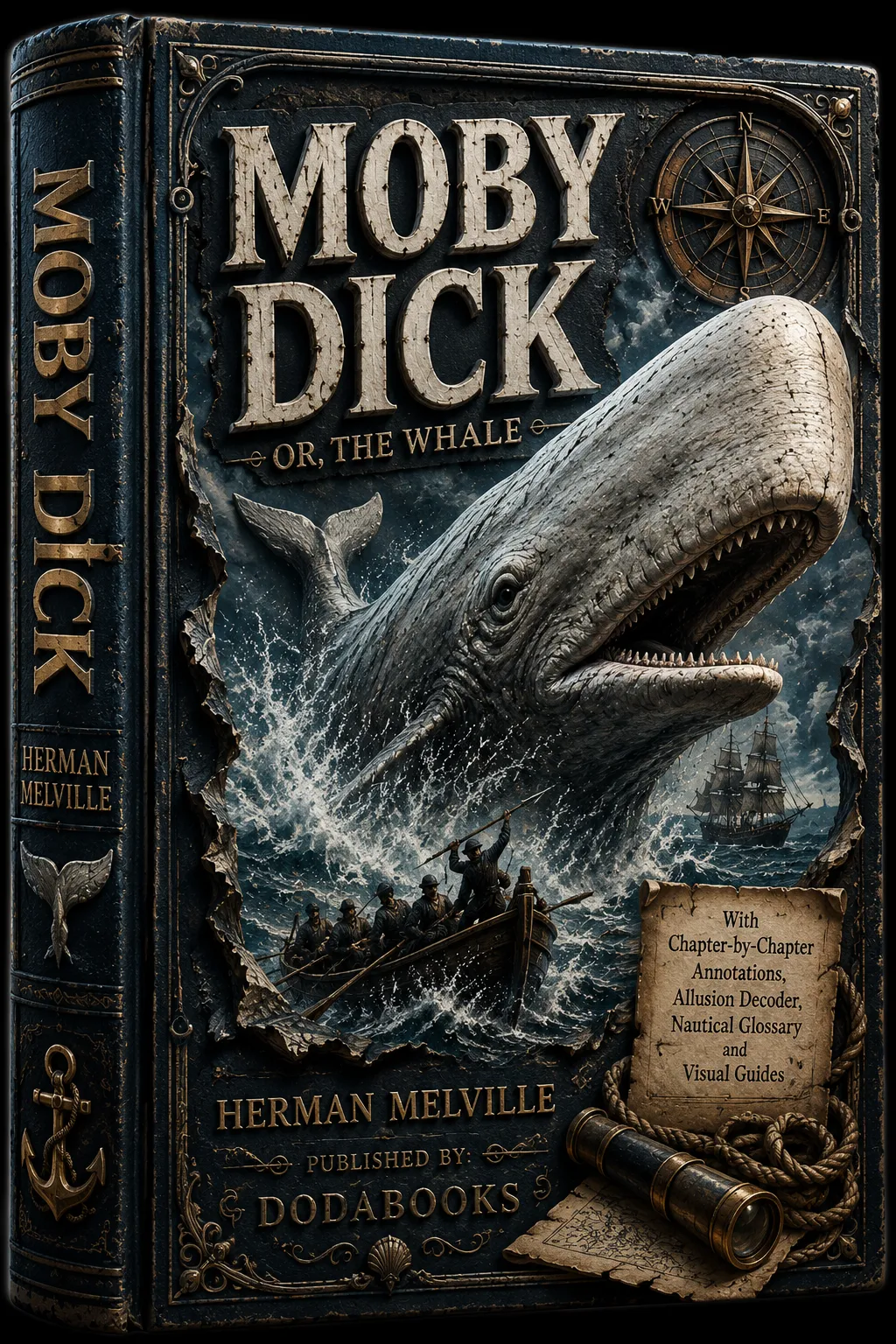
With an annotated edition, absolutely. The novel is rewarding for readers of all levels when they have the right support. Without annotation, most first-time readers struggle and give up. The annotated edition at DodaBooks is designed specifically for first-time readers, with footnotes, historical context, and literary analysis on every page.
📊 Compare: If You Liked Moby-Dick
📚 What the Annotated Edition Unlocks
Hundreds of Footnotes
Whaling terms, Victorian vocabulary, nautical jargon — nothing left unexplained
Biblical References
Every allusion to Job, Jonah, and the Old Testament kings traced and explained
Historical Context
The real Essex disaster, Nantucket whaling, and Melville's influences documented
Literary Analysis
Chapter-by-chapter commentary on Melville's techniques and themes
Maps & Illustrations
The Pequod's voyage mapped — visual guides to the world of whaling
Symbolism Guide
The white whale, the Pequod, the coffin-buoy — every symbol decoded
📚 Related Articles
🎯 Stop Struggling. Start Understanding.
The annotated edition of Moby-Dick gives you everything you need to finally get Melville’s masterpiece:
- ✅ Complete, unabridged text — every word of the original 1851 edition
- ✅ Hundreds of explanatory footnotes — no more Googling every other page
- ✅ Historical context — the Essex disaster, Nantucket whaling, Melville’s life
- ✅ Literary analysis — chapter-by-chapter commentary on themes and symbols
- ✅ Victorian vocabulary — obsolete words and nautical terms defined inline
- ✅ Biblical & literary references — every allusion traced to its source