Complete biography of Herman Melville, author of Moby-Dick. From his early life at sea to his literary rise, his devastating failure, and his posthumous triumph as America’s greatest novelist.
This article is part of our annotated Moby-Dick guide, designed to help readers unlock the full depth of Melville’s masterpiece through comprehensive notes and analysis.
🐋
Herman Melville Biography: The Life of the Moby-Dick Author
Complete biography of Herman Melville, author of Moby-Dick. From his early life at sea to his literary rise, his devasta...
The Early Years
Herman Melville was born in New York City on August 1, 1819, into a family of distinguished lineage but declining fortune. His father, Allan Melville, was an importer of French luxury goods. His mother, Maria Gansevoort, came from a prominent Dutch colonial family. The family lived comfortably until 1830, when Allan’s business failed. He died two years later, leaving the family in debt.
The sudden reversal marked Melville for life. He left school at 12 to work as a clerk. The contrast between his family’s social standing and their financial desperation gave him a lifelong sensitivity to class and injustice.
Life at Sea
📖 Want the complete annotated experience?
👉 Get the Annotated EditionAt 19, Melville signed onto a merchant ship bound for Liverpool. The experience of the sea was transformative. He discovered a world beyond the narrow confines of New York society — a world of diverse races, cultures, and languages.
In 1841, he joined the crew of the whaler Acushnet, sailing for the South Pacific. The voyage took him around Cape Horn and into the Pacific. After 18 months, he jumped ship in the Marquesas Islands and lived briefly among the Typee people — a Polynesian tribe with a reputation for cannibalism.
Melville’s experiences became the material for his early novels. Typee (1846) and Omoo (1847) were based on his time in the Marquesas and Tahiti. They were adventure stories with exotic settings, and they were popular successes.
The Rise to Fame
Melville returned to New York and married Elizabeth Shaw, the daughter of the chief justice of Massachusetts. He settled in the Berkshires, where he became friends with Nathaniel Hawthorne, the most celebrated American novelist of the era.
Under Hawthorne’s influence, Melville’s ambitions deepened. He began to see literature not as entertainment but as a calling. He wanted to write something that would last — a book as great as the literary masterpieces he was reading with such intensity.
The Writing of Moby-Dick
Melville began Moby-Dick in early 1850. Originally conceived as a straightforward adventure story about whaling, the novel transformed under his hands into something far stranger and more ambitious. He completed the 135-chapter novel in about 18 months, writing with feverish intensity.
The book that emerged was unlike anything published before. It mixed genres, voices, and tones. It was part novel, part encyclopedia, part play. It contained chapters of whale anatomy, philosophical meditations, dramatic monologues, and a three-day chase that rivals any thriller.
Melville dedicated the book to Hawthorne “in token of my admiration for his genius.”
The Failure
Moby-Dick was published in 1851. The reception was devastating. British reviewers called it “wild” and “weird.” American critics were harsher — one called it “sad stuff, dull and dreary.” The public stayed away. Melville’s next novels — Pierre (1852), Israel Potter (1855), and The Confidence-Man (1857) — sold progressively worse.
Melville was deeply wounded. He felt that he had given everything to his art and that the world had rejected him. He stopped writing fiction at 38. He turned to poetry — long narrative poems about the Civil War and a monumental 16,000-line poem about the Holy Land (Clarel, 1876). These too were ignored.
The Long Obscurity
Melville spent his final decades working as a customs inspector on the New York docks — a job he held for 19 years. He continued to write, but for a tiny audience. When he died in 1891, his obituary in the New York Times mentioned him as the “author of Typee.” Moby-Dick was not even cited.
He left behind an unpublished manuscript: Billy Budd, Sailor. It was discovered among his papers and published in 1924. It is now considered one of the greatest novellas in English.
The Rediscovery
In the 1920s, a generation of critics and writers rediscovered Moby-Dick. D.H. Lawrence called it “one of the strangest and most wonderful books in the world.” By the 1940s, the novel was established as a masterpiece of American literature.
Today, Moby-Dick is widely considered the Great American Novel. It is taught in universities worldwide. It has never gone out of print since its rediscovery. The story of Melville’s life — his ambition, his failure, his vindication — adds a dimension of tragedy to the novel itself.
Reading Melville Today
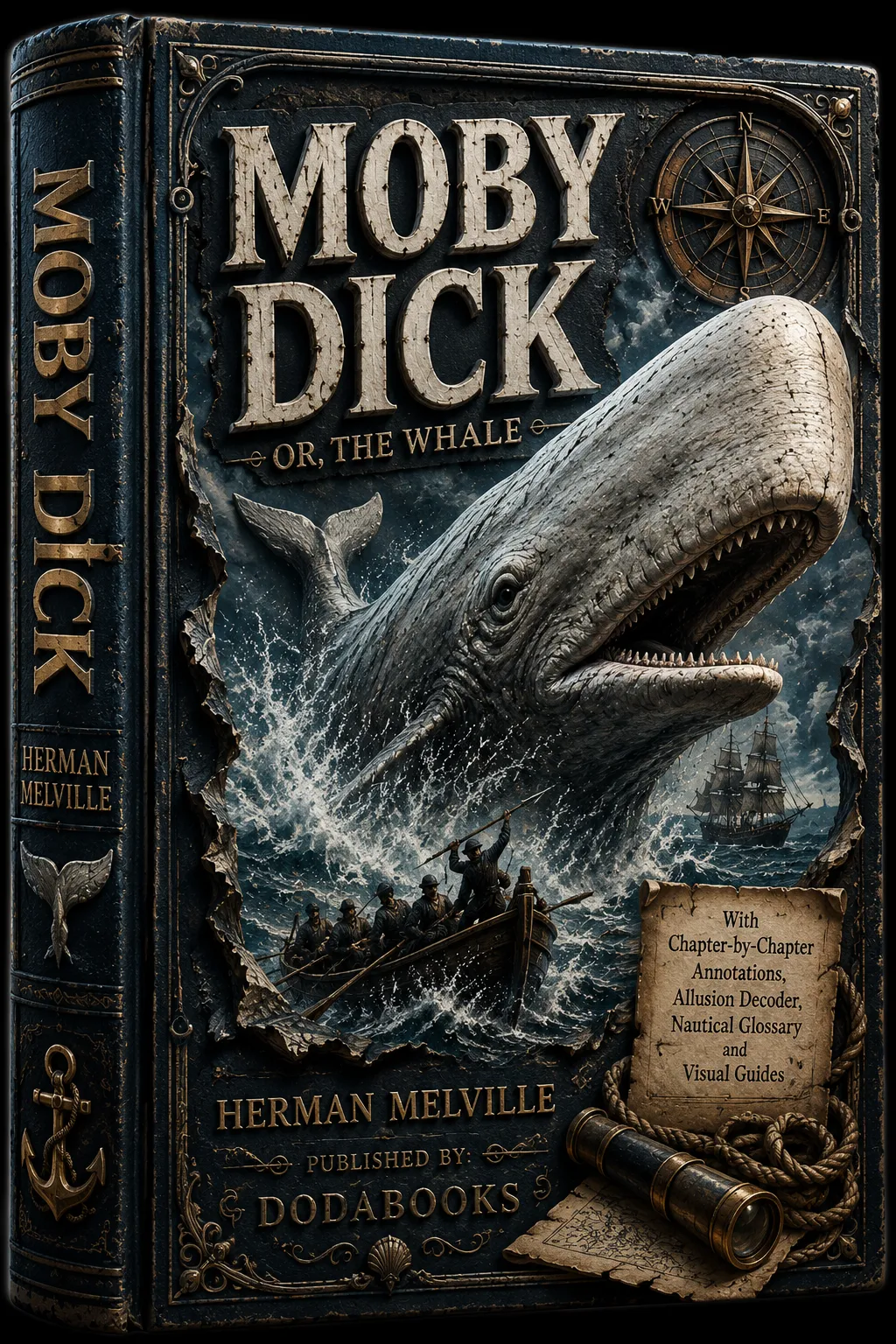
The annotated edition of Moby-Dick at DodaBooks includes a comprehensive biographical introduction that traces Melville’s life in detail, showing how his experiences at sea shaped the novel and how his friendship with Hawthorne influenced its creation. For readers who want to understand the man behind the masterpiece, this introduction is essential. Explore the annotated edition →
Experience Moby-Dick Like Never Before
Don’t struggle through Melville’s masterpiece alone. Our annotated edition of Moby-Dick includes:
- Complete, unabridged text of the novel
- Hundreds of explanatory footnotes clarifying obscure references
- Historical context on 19th-century whaling and Nantucket culture
- Literary analysis of key chapters and passages
- Victorian vocabulary definitions and nautical terminology
- Biblical and literary allusion guides
Get the annotated edition at DodaBooks →
📚 Related Articles
🎯 Stop Struggling. Start Understanding.
The annotated edition of Moby-Dick gives you everything you need to finally get Melville’s masterpiece:
- ✅ Complete, unabridged text — every word of the original 1851 edition
- ✅ Hundreds of explanatory footnotes — no more Googling every other page
- ✅ Historical context — the Essex disaster, Nantucket whaling, Melville’s life
- ✅ Literary analysis — chapter-by-chapter commentary on themes and symbols
- ✅ Victorian vocabulary — obsolete words and nautical terms defined inline
- ✅ Biblical & literary references — every allusion traced to its source