Who is Ishmael in Moby-Dick? Analysis of the novel’s famous narrator, his role as survivor, and why Melville chose him to tell the story.
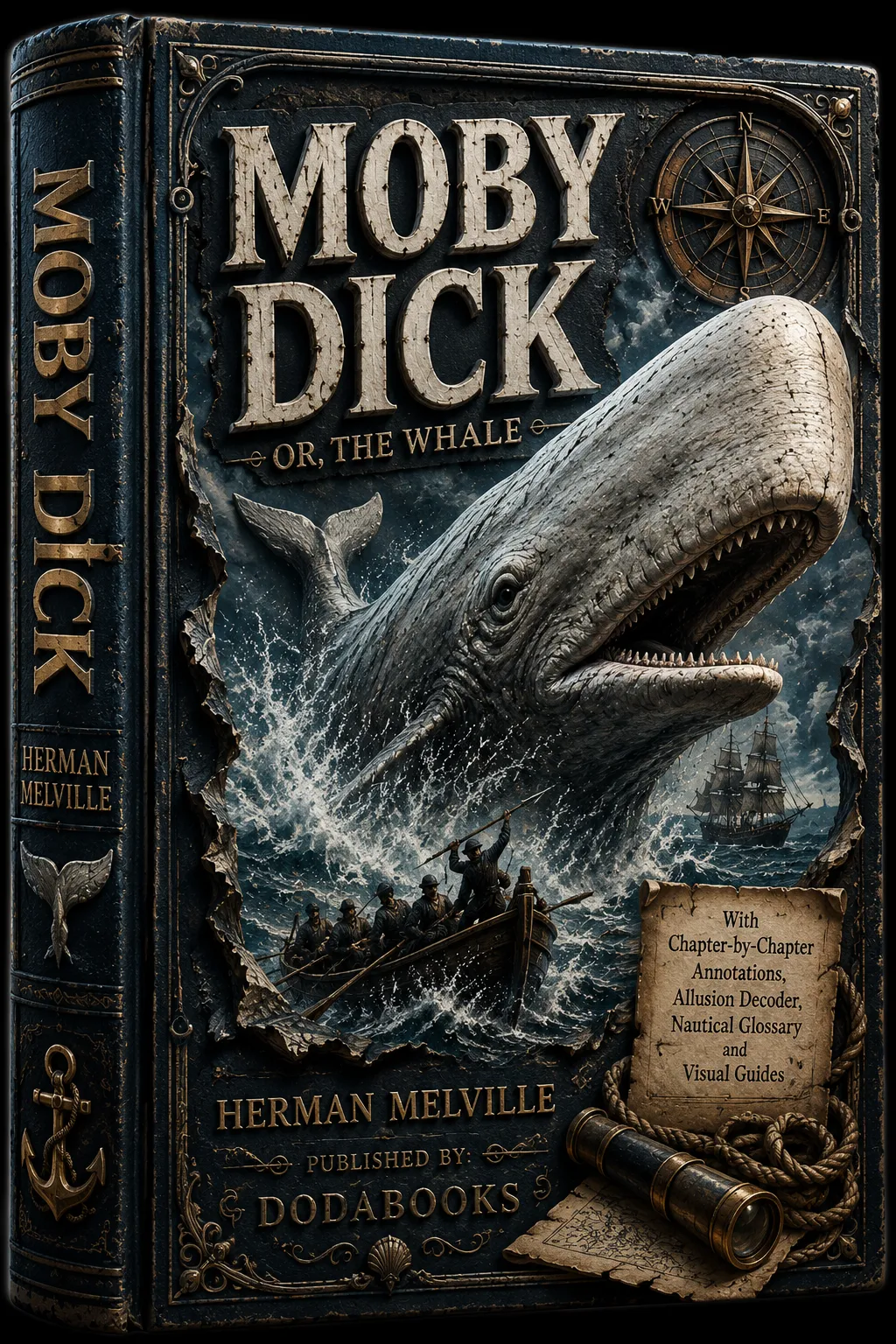
🐋
Ishmael: The Narrator of Moby-Dick Explained
Who is Ishmael in Moby-Dick? Analysis of the novel's famous narrator, his role as survivor, and why Melville chose him t...
The Famous First Line
“Call me Ishmael.” Three words that open Moby-Dick. In the Bible, Ishmael is the son of Abraham cast out into the wilderness — a wanderer, an exile, a survivor. The narrator identifies himself with this figure from the first sentence, establishing from the outset that this is a story told by a man who has survived something catastrophic and is looking back on it from a distance.
The phrase “Call me” is itself significant. It is not “My name is Ishmael” — it is an invitation, a request, a suggestion. The narrator does not assert his identity; he offers it for consideration. This ambiguity sets the tone for the entire novel. Everything in Moby-Dick is provisional, perspectival, open to interpretation. The narrator does not claim to know the truth — he claims only to have witnessed what happened and to be doing his best to make sense of it.
The opening also establishes the novel’s relationship to the biblical tradition. Ishmael, the outcast, the wanderer, the survivor — this is the archetype Melville invokes. The novel will be a story of exile and survival, of a man who is cast out from the ordinary world and who returns bearing a message. Whether that message is hopeful or devastating is something the reader must decide.
Ishmael’s Role
📖 Want the complete annotated experience?
👉 Get the Annotated EditionIshmael is the first-person narrator, but he is not the main character. That is Ahab. Ishmael’s role is to observe, to reflect, and to survive. He is our eyes and ears on the Pequod, the consciousness through which we experience the voyage. Without Ishmael, we would have only Ahab’s madness — and madness, unchecked by a sane observer, becomes incoherent.
This narrative strategy is one of Melville’s most brilliant decisions. By placing a relatively ordinary man at the center of an extraordinary story, he creates a bridge between the reader and the mythic events. Ishmael is intelligent, curious, and philosophically inclined, but he is not larger than life. He is a man who went to sea because he was depressed, who signed onto a whaling ship because it seemed like an adventure, who found himself caught up in a catastrophe he could not control. His ordinariness is his greatest asset as a narrator — it allows the reader to identify with him, to share his wonder and his horror.
Ishmael also serves as the novel’s moral compass. While Ahab descends into obsession, Ishmael maintains his capacity for wonder, for empathy, for reflection. He admires Ahab — how could he not? — but he also recognizes the madness. He participates in the hunt, but he never loses sight of its absurdity. His narration is a constant tension between fascination and judgment, admiration and horror. This tension is what makes Moby-Dick not just a great adventure story but a great moral novel.
The Friendship with Queequeg
Ishmael’s relationship with Queequeg is one of the most touching threads in 19th-century American literature. They share a bed, a room, and a whaling boat. Ishmael describes Queequeg as a “soothing” presence, and their friendship develops with a naturalness that is remarkable for its time. Within days of meeting, they are sharing their life stories, their fears, their hopes. Within weeks, they are bound together so tightly that Ishmael declares Queequeg’s coffin — the very object that will save his life — to be a symbol of their bond.
Their friendship crosses racial and cultural boundaries in a way that was radical for its time. Queequeg is a Pacific Islander, a “cannibal” by the standards of Ishmael’s New England culture. Ishmael is a white American. Yet their friendship is presented as the most natural thing in the world — more natural, in fact, than the relationships Ishmael has with his fellow white Americans. “I’ll try a pagan friend,” Ishmael declares early in the novel, “since Christian kindness has proved but hollow courtesy.”
The friendship also serves a narrative function. Queequeg’s calm, steady presence balances Ishmael’s tendency toward anxiety and speculation. Where Ishmael worries, Queequeg acts. Where Ishmael philosophizes, Queequeg simply lives. Their complementary temperaments make them ideal partners — and Queequeg’s eventual death, and the conversion of his body into a life raft, becomes one of the novel’s most powerful symbols. The friend who was an outcast in life becomes the savior in death.
Why Ishmael Survives
Ishmael must survive so he can write the book. His survival on Queequeg’s coffin suggests that the storyteller always remains. The act of bearing witness is the only victory possible in a story that otherwise ends in total destruction. Everyone else on the Pequod dies — Ahab, Starbuck, Stubb, Flask, all the harpooners, all the crew. Ishmael alone escapes, floating on a coffin in the middle of the Pacific, waiting for rescue.
This survival is not a reward for virtue. Ishmael does not survive because he is better or smarter or more deserving than the others. He survives because of Queequeg’s love — because Queequeg, knowing he was dying, ordered his coffin to be made watertight and converted into a life raft. The survival is a gift, an act of friendship that transcends death. It is also, in a deeper sense, a statement about the nature of storytelling itself: someone must survive to tell the tale.
The image of Ishmael floating on the coffin is one of the most powerful in all of literature. He is alone, surrounded by the wreckage of the Pequod, the bodies of his companions sinking into the deep. The sea is calm. The sky is empty. He is the last man alive, and his only purpose now is to bear witness. This is what stories are, Melville suggests — acts of survival, testimonies of what happened, attempts to make meaning from destruction. Ishmael survives so that the story can be told, and the story is told so that we can understand what it means to be human in a universe that does not care whether we live or die.
🐋 The Story in Brief
Ishmael, weary of the land and the gloom that has settled on him, decides to go to sea — not as a passenger or a captain, but as a common sailor. He signs onto the whaler Pequod in Nantucket, and it is there he meets the tattooed harpooner Queequeg, a friendship that becomes the moral heart of the voyage. The ship’s captain, Ahab, does not even appear until nearly a third of the way through the book, and when he finally does, Ishmael understands this is no ordinary whaling voyage: the Pequod is hunting one specific whale, the white whale that took Ahab’s leg.
Ishmael is present for all of it — the cetology lectures, the grim forebodings of the crew, and finally the three-day chase that ends with the whale destroying the Pequod. He is the only one who survives to describe the disaster. For the full arc, our chapter-by-chapter summary guide walks through every section, and the ending explained analysis unpacks the final chase in detail.
🏛️ Historical Context — Melville’s Own Voyage
Melville did not invent Ishmael’s world. The narrator’s account of shipboard life and whaling routines draws directly on Melville’s own experience — he shipped aboard the whaler Acushnet in 1841 and spent the better part of four years at sea. Ishmael’s observations about the arbitrary power of captains and the strange brotherhood of the forecastle all carry the authority of a man who had been there, which is why the novel feels so convincing even in its strangest chapters. Our companion piece on 19th-century whaling history traces the industry Melville knew so well, and the true story of the whaleship Essex — a real ship sunk by a whale, the event that seeded the novel — shows how closely Ishmael’s voyage rhymes with history.
🧭 Why the Ordinary Narrator Matters
The choice of Ishmael as narrator is not incidental — it is the engine of the entire book. Had Melville written from Ahab’s point of view, the novel would have been the unbroken howl of a madman. Had he written from an omniscient, godlike narrator, he would have lost the vulnerability and wonder that make the story human. Ishmael is the middle register, the man on deck who feels both awe and terror and answers to neither god nor demon.
That ordinariness is why readers keep returning to him. Ahab is magnificent, but he is not relatable — nobody can follow him to the depths of his obsession. Ishmael, by contrast, is someone we recognize: curious, anxious, funny, brave in fits and starts. He models the only sane response to the unknowable — to observe it, to tell it, and to survive it.
🎓 Reading Tips for First-Time Readers
Ishmael’s story jumps between thrilling adventure chapters and long, digressive essays on everything from whale anatomy to the color white. Do not fight this rhythm — it is deliberate. On a first read, let the cetology chapters wash over you and cling to the throughline of Ahab, Queequeg, and the chase. On a second read, the digressions reveal themselves as the real subject. If you find the allusions heavy going, our guide to reading Moby-Dick as a beginner and the biblical allusions analysis can help.
❓ Frequently Asked Questions
Why does Ishmael survive when everyone else dies?
Ishmael survives because someone must live to tell the story. His survival on Queequeg’s coffin — a gift of friendship — allows Melville to frame the entire novel as a survivor’s testimony rather than a mere adventure tale.
Is Ishmael the same character as the biblical Ishmael?
The name invokes the biblical Ishmael — Abraham’s son, cast out as a wanderer to the wilderness — without matching him exactly. Melville uses the name to signal the narrator’s status as an exile and survivor, a man temporarily outside the ordinary order of things.
Why is Ishmael not the main character?
Because Ahab is. Ishmael’s role is to observe, reflect, and survive — to be the sane consciousness through which we experience Ahab’s obsession. His ordinariness is what makes the extraordinary events comprehensible and morally legible.
How reliable is Ishmael as a narrator?
He is honest but necessarily partial. He reports what he witnessed and heard, regularly admits gaps in knowledge, and offers hypotheses rather than certainties. This humility is precisely what makes him trustworthy — he never claims to know more than he does.
What happens to Ishmael after the story ends?
The novel closes with Ishmael adrift in the Pacific, the sole survivor of the Pequod, awaiting rescue by the ship Rachel. The impression is that Ishmael returns to land, “another orphan,” to write the book we have just read.
📚 Related Articles
Central to Ishmael’s perspective is his profound bond with the Polynesian harpooner; explore the dynamics in our guide to the Ishmael and Queequeg Friendship in Moby-Dick.
🎯 Stop Struggling. Start Understanding.
The annotated edition of Moby-Dick gives you everything you need to finally get Melville’s masterpiece:
- ✅ Complete, unabridged text — every word of the original 1851 edition
- ✅ Hundreds of explanatory footnotes — no more Googling every other page
- ✅ Historical context — the Essex disaster, Nantucket whaling, Melville’s life
- ✅ Literary analysis — chapter-by-chapter commentary on themes and symbols
- ✅ Victorian vocabulary — obsolete words and nautical terms defined inline
- ✅ Biblical & literary references — every allusion traced to its source