Meet the unforgettable crew of the Pequod in Moby-Dick. From Queequeg’s noble spirit to Starbuck’s quiet resistance, these characters make the novel timeless.
🐋
Queequeg, Starbuck and the Pequod Crew: The Heart of Moby-Dick
Meet the unforgettable crew of the Pequod in Moby-Dick. From Queequeg's noble spirit to Starbuck's quiet resistance, the...
The Multicrew
One of the most remarkable and forward-thinking aspects of Moby-Dick is the extraordinary diversity of its crew — Pacific Islanders, Native Americans, Africans, Europeans, Americans, and men from dozens of other nations and cultures, all crowded together on a single wooden ship sailing across the vast Pacific. Melville populates the Pequod with characters from Kokovoko, Nantucket, Cape Verde, the Azores, Madagascar, and a dozen other locations, creating a microcosm of humanity united under a single doomed purpose. This was radical in 1851 — Melville was writing decades before the great waves of immigration that would diversify America, decades before the civil rights movements that would challenge racial hierarchies, and yet he presents the Pequod’s multicultural crew not as a curiosity but as a fact, not as a problem to be solved but as a reality to be observed and described. The crew’s diversity serves a narrative function — each character brings a different perspective, a different set of skills, a different relationship to Ahab’s monomaniacal quest — and a philosophical function, suggesting that the human condition, in its terror and its beauty, is universal. The Pequod is not just a whaling ship; it is humanity itself, sailing toward catastrophe under the command of a leader whose vision, however brilliant, is fundamentally distorted.
Queequeg
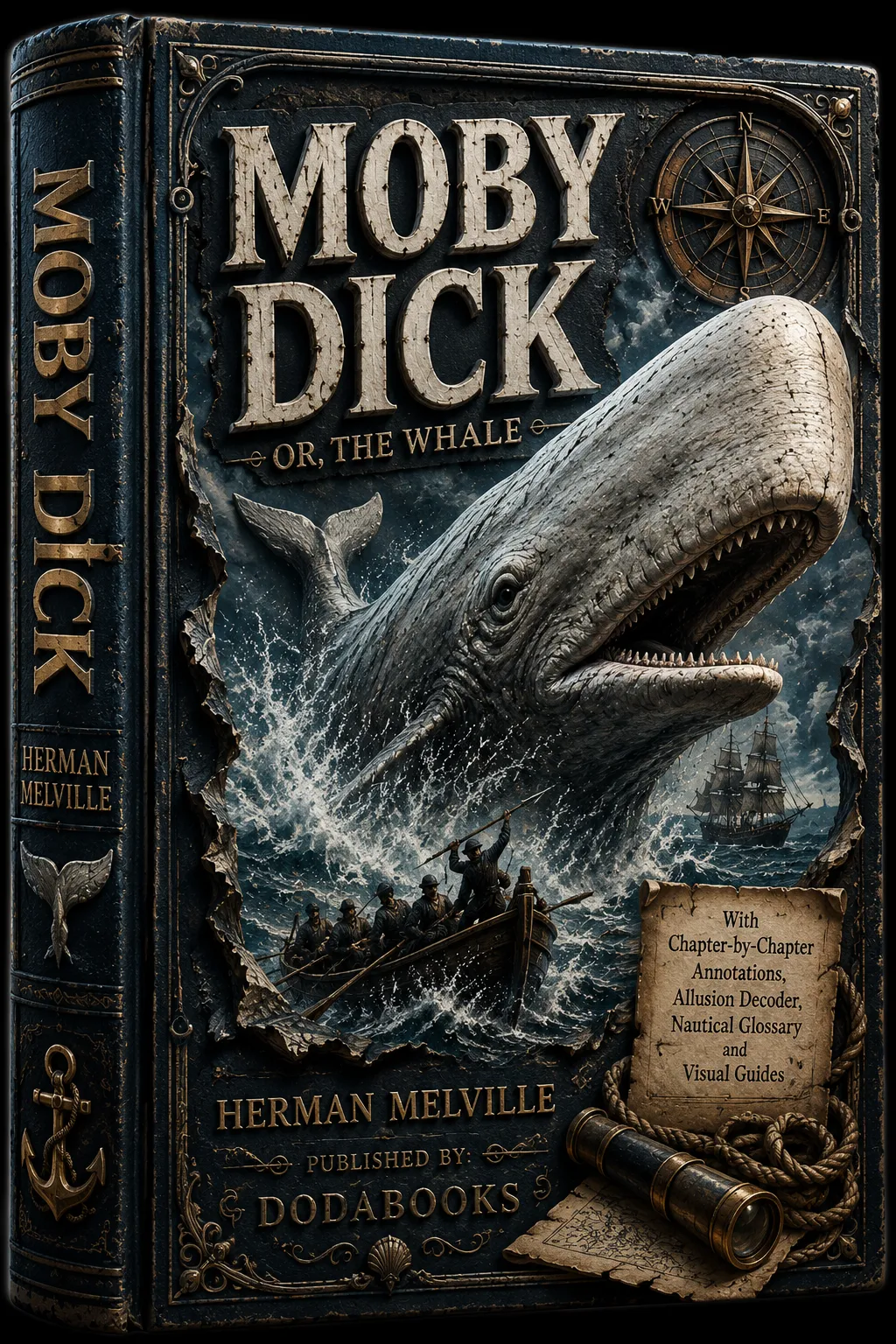
📖 Want the complete annotated experience?
👉 Get the Annotated EditionThe tattooed harpooneer from Kokovoko is, by nearly every measure, the most morally upright character in the entire novel — a remarkable distinction for a man whom Ishmael initially fears as a cannibal. Queequeg is a prince in his own land, descended from a long line of tribal kings, who chose to leave his island and take to the sea in search of knowledge and experience. He is skilled, courageous, and deeply loyal — a combination of qualities that makes him the novel’s most complete human being. When he falls ill and believes he is dying, he asks the ship’s carpenter to build him a coffin, a request that shocks the crew but proves to be among the most important events in the novel. Queequeg recovers from his illness, but the coffin remains, later sealed and caulked into a life preserver. When the Pequod sinks, it is this coffin that keeps Ishmael afloat, saving his life in the moment of greatest peril. The symbolism is beautiful and profound: the friend he loved in life saves him even in death, and the object designed to contain a corpse becomes an instrument of survival. Queequeg’s coffin is the novel’s most powerful symbol of love’s persistence beyond death, of friendship’s capacity to transcend the physical and endure.
Starbuck
The first mate is a Nantucket Quaker who embodies the novel’s most sustained moral resistance to Ahab’s monomania. Starbuck is a man of intelligence, integrity, and genuine courage — the kind of man who signs on for a whaling voyage to support his wife and young son back on Nantucket, who believes in the value of human life, who trusts that reason and decency will prevail even in dangerous circumstances. He alone among the officers questions Ahab’s authority, and their confrontations are among the most dramatically powerful scenes in the novel. In their great confrontation in Chapter 32, Starbuck argues passionately that the crew signed on for whaling profit, not for a personal vendetta against a whale — that Ahab has no right to risk their lives for his private obsession. Ahab dismisses him with a terrifying speech about the “little lower layer” — the idea that beneath the surface of civilized behavior lies something deeper, more primal, more dangerous, something that will not be denied. Starbuck is not defeated by Ahab’s logic; he is defeated by Ahab’s will. He knows the quest is madness, but he lacks the authority or the ruthlessness to stop it. His moral clarity makes him the novel’s most tragic figure — a good man who sees catastrophe coming and cannot prevent it. In the novel’s most agonizing moment of potential reversal, Starbuck stands alone in Ahab’s cabin with a loaded musket, contemplating murder as the only way to save the crew. He cannot do it. His Quaker faith, his fundamental decency, his horror at the thought of killing a man in cold blood — all of these conspire to paralyze him. He lowers the weapon and walks away, and in that moment, the fate of every soul on the Pequod is sealed.
Stubb and Flask
Stubb, the second mate, is perpetually cheerful, his pipe clenched between his teeth even as disaster looms on every horizon. Where Starbuck sees moral crisis, Stubb sees an interesting problem; where Starbuck agonizes over Ahab’s sanity, Stubb shrugs and lights his pipe. His cheerfulness is not ignorance — he is fully aware of the danger they face — but a philosophical stance, a decision to face catastrophe with good humor rather than despair. In Chapter 87, “The Grand Armada,” Stubb reflects on the nature of fate with remarkable equanimity, comparing human life to a “dull, dusty, rambling, piece of argufication” and concluding that the best response is to smoke and let things take their course. Flask, the third mate, represents a different response entirely: small in stature but fierce in temperament, he is aggressively profit-minded, viewing every whale primarily as a quantity of oil and a source of income. Where Stubb philosophizes and Starbuck moralizes, Flask simply calculates. Together, these three officers — the moralist, the philosopher, and the pragmatist — represent the range of human responses to Ahab’s extraordinary quest, and Melville uses them to explore the different ways human beings process danger, meaning, and the possibility of catastrophe.
Pip
The fate of Pip — a young Black cabin boy from Tolland County, Connecticut — is among the most devastating episodes in Moby-Dick and one of the novel’s most searing indictments of the human cost of Ahab’s monomania. Pip is introduced as a cheerful, innocent figure, a boy of about fourteen who performs the ship’s comic business with endearing awkwardness. He plays the fiddle, he prays in the galley, he brings a lightness to the Pequod’s grim atmosphere that is sorely needed. His very name — Pip — suggests something small, fragile, incomplete, a being whose personhood is barely recognized by the hierarchy of the ship.
Everything changes when Pip is left behind in a whaleboat during a hunt. In Chapter 93, “The Castaway,” Pip falls overboard in the open ocean, abandoned by the crew who are too busy chasing whales to notice his absence. For hours he floats alone in the vast Pacific, a tiny figure adrift in an immensity of water and sky. The experience shatters his mind. When the crew finally retrieves him, Pip is no longer the cheerful boy he was. He has seen something — or rather, he has experienced the absolute indifference of the universe — and it has broken him. He begins speaking in riddles, laughing at nothing, addressing the empty ocean as if it were a living companion. “I looked, and looked, but there was no bottom to it,” he tells Starbuck, describing his hours alone in the water. The line is one of the most haunting in the novel: Pip has stared into the void, and the void has stared back.
Ahab understands Pip’s madness immediately and with terrible intimacy, because Ahab has stared into the same void — and responded not with madness but with monomania. In one of the novel’s most poignant scenes, Ahab takes Pip into his cabin and speaks to him with a tenderness he shows no other character. “There is that in thee, poor lad, which I feel too curing to my malady,” Ahab tells him, recognizing in Pip’s broken innocence a mirror of his own shattered faith. But Ahab’s compassion is temporary — he cannot afford to let Pip’s vulnerability deflect him from his purpose, and he sends the boy away. Pip’s fate after this point is ambiguous and heartbreaking: he continues to wander the Pequod, a ghostly, half-present figure whose madness serves as a constant reminder of the human devastation that Ahab’s quest has already produced, and a prophecy of the greater devastation to come. Pip is not merely a character in Moby-Dick — he is the novel’s conscience, its most eloquent witness to the cost of a quest that treats human life as expendable in the service of an abstraction.
Discover the depth of Melville’s masterpiece with our annotated edition of Moby-Dick. Complete text with explanatory notes, historical context, and literary analysis.
📚 Related Articles
Frequently Asked Questions
What does Queequeg represent in Moby-Dick?
Queequeg represents natural nobility, spiritual purity, and genuine brotherhood, subverting 19th-century colonial stereotypes of the 'savage.'
Why is Starbuck the most tragic crew member aboard the Pequod?
Starbuck clearly foresees the catastrophic destruction Ahab is leading them toward, yet cannot bring himself to mutiny or assassinate Ahab to save innocent lives.
How do the three mates (Starbuck, Stubb, Flask) represent different worldviews?
Starbuck represents solemn moral conscience, Stubb represents carefree fatalism and humor, and Flask represents mindless, unthinking aggression.
What is the significance of the multicultural crew on the Pequod?
The crew includes Native Americans, Africans, Polynesians, Europeans, and Americans, representing the entire human race united in an ill-fated enterprise.
Where can I find in-depth commentary on the Pequod's crew dynamics?
The DodaBooks annotated edition highlights character symbolism, historical maritime demographics, and social commentary across every chapter.
🎯 Stop Struggling. Start Understanding.
The annotated edition of Moby-Dick gives you everything you need to finally get Melville’s masterpiece:
- ✅ Complete, unabridged text — every word of the original 1851 edition
- ✅ Hundreds of explanatory footnotes — no more Googling every other page
- ✅ Historical context — the Essex disaster, Nantucket whaling, Melville’s life
- ✅ Literary analysis — chapter-by-chapter commentary on themes and symbols
- ✅ Victorian vocabulary — obsolete words and nautical terms defined inline
- ✅ Biblical & literary references — every allusion traced to its source