Bidwell’s Travels is one of the most audacious true crime memoirs ever written — the first-person account of a man who defrauded the Bank of England, fled across continents, and lived to tell the tale from behind bars. If you are looking for a Victorian con artist story that reads like a thriller, this is the original memoir.
🕵️
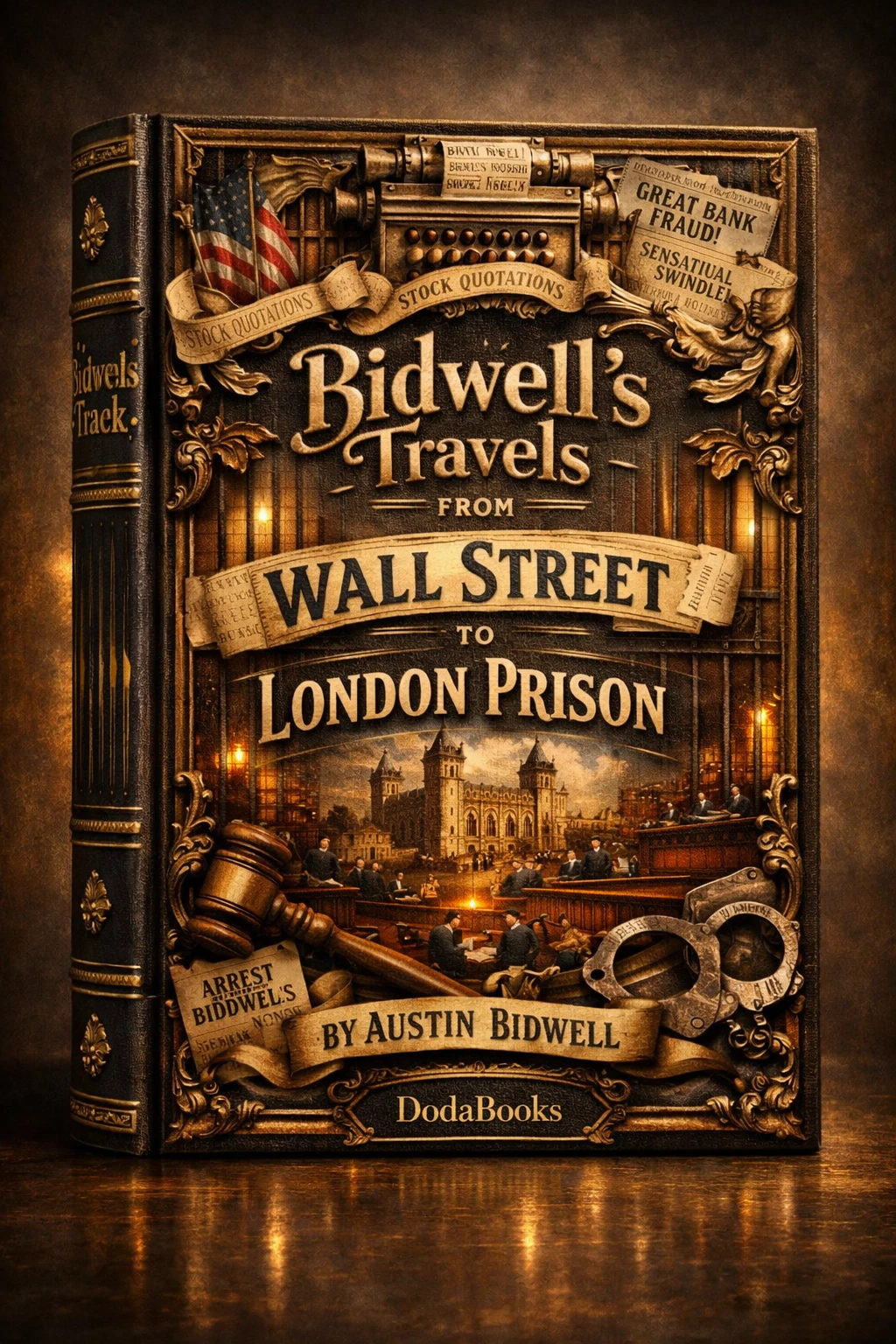
Bidwell's Travels: From Wall Street to London Prison
The incredible true story of Austin Bidwell — Wall Street speculator, international fraudster, and the man who nearly broke the Bank of England.
| Author | Austin Bidwell (pseudonym) |
| Published | 1895 |
| Genre | True crime memoir |
| Setting | Wall Street, London, penal colonies |
| Crime | Bank of England check fraud |
| Verdict | A gripping, surprisingly literary account of Victorian financial crime |
🕵️ Who Was Austin Bidwell?
Austin Bidwell was not his real name. The author behind this memoir was actually one of four brothers from Liverpool who descended upon Wall Street in the 1880s and made fortunes through increasingly reckless speculation. The Bidwell brothers were dazzling, charming, and utterly ruthless — the kind of men who could walk into a bank, convince the manager they were worth millions, and walk out with borrowed capital they had no intention of returning.
Austin was the writer of the family, and Bidwell’s Travels, published in 1895, is his confessional account of a life spent on the razor’s edge between legitimate finance and outright fraud. Written from a British prison, the memoir is part autobiography, part courtroom drama, and part survival guide for men on the wrong side of the law.
What makes Bidwell fascinating is not just the scale of his crimes but his voice. He writes with the easy confidence of a man who genuinely believed the financial system was a game — and that anyone who lost money to him simply played badly. There is no remorse in these pages, but there is plenty of insight.
💰 The Wall Street Scheme
The Bidwell brothers arrived in New York during the Gilded Age, when Wall Street was less a regulated market than a gentlemen’s casino. They started with legitimate stock speculation, borrowing money against shares they intended to buy and selling before the loans came due. The system worked as long as the market kept rising and the brothers kept moving.
Their method was straightforward: borrow heavily from one bank, use the funds to buy stock, sell the stock at a profit, repay the loan, and repeat. When the market cooperated, the Bidwells made enormous sums. When it did not, they simply borrowed more — from different banks, using the same collateral, hoping to cover the gap before anyone noticed.
The scheme depended entirely on trust, speed, and the assumption that no one would check too carefully. In the 1880s, interbank communication was slow, record-keeping was manual, and a well-dressed man with a confident manner could walk into any bank in Manhattan and walk out with a loan. The Bidwells exploited every one of these weaknesses.
📖 Want to read the full memoir?
👉 Get the Book at DodaBooks🏦 The Bank of England Fraud
The Bidwell brothers’ most audacious crime targeted the Bank of England itself — the most powerful financial institution in the world. Their scheme involved forged checks and the systematic exploitation of the British banking system’s信任 in American financiers.
The plan was simple in concept and devastating in execution. The Bidwells used their reputation as wealthy American speculators to open accounts and establish credit lines at major London banks. They then forged checks drawn on the Bank of England, using expertly duplicated signatures and high-quality printing to make the documents appear legitimate. The checks were presented through intermediaries, converted to cash, and the brothers vanished before the fraud was discovered.
The scale of the operation was staggering. The Bidwells managed to extract tens of thousands of pounds — equivalent to millions in today’s money — from institutions that should have been immune to such deception. The crime shook the British financial establishment to its core and led to sweeping reforms in check verification and banking security.
Austin Bidwell’s account of the fraud is remarkably detailed. He describes the technical process of forging the checks, the social engineering required to establish credibility with bank officials, and the elaborate escape routes the brothers prepared in case things went wrong. It reads less like a confession and more like an instruction manual — which is part of what makes the memoir so compelling and so troubling.
🔒 Life in London Prison
After his arrest and conviction, Austin Bidwell was sentenced to penal servitude in a British prison. His account of prison life is one of the most valuable sections of the memoir, offering a detailed portrait of the Victorian penal system from the inside.
Bidwell describes the monotony of prison routine, the hierarchy among inmates, the treatment of prisoners by guards, and the psychological toll of long-term confinement. He writes about the food (terrible), the work (mind-numbing), the company (mixed), and the漫长的等待 for release or escape.
What sets Bidwell’s prison narrative apart from other Victorian convict memoirs is his analytical eye. He observes the prison system with the same calculating intelligence he once applied to financial fraud. He notes which inmates are genuinely reformed and which are merely waiting for their next opportunity. He describes the unwritten rules that govern prison society — who holds power, who is despised, and how survival depends on understanding and navigating these invisible structures.
The prison sections also reveal a more vulnerable Bidwell than the confident swindler we meet in the earlier chapters. Behind bars, stripped of his charm and his resources, he is forced to confront the consequences of his choices. The memoir does not become a redemption narrative — Bidwell never pretends to be sorry — but it does develop a depth of self-awareness that is genuinely surprising.
📚 Literary Significance
Bidwell’s Travels occupies a unique place in the literature of Victorian crime. It is neither a sensationalist tabloid account nor a dry legal record. It is a literary memoir written by a man who understood narrative, pacing, and the power of a well-told story.
The book sits alongside other great Victorian criminal autobiographies — Jack Sheppard’s confessions, the memoirs of James Hardy Vaux, and the prison writings of Oscar Wilde — but it differs from these in one crucial respect. Bidwell writes not as a victim of the system but as its exploiters. He is not asking for sympathy. He is offering entertainment, information, and a kind of dark education in the mechanics of fraud.
The prose is surprisingly accomplished. Bidwell writes with clarity and wit, and his descriptions of Wall Street culture, London society, and prison life are vivid and memorable. The book has been cited by historians studying the development of white-collar crime, the evolution of banking security, and the culture of the Gilded Age.
For modern readers, Bidwell’s Travels offers something rare: a window into a world where financial crime was as much about personality as about technology. The Bidwell brothers succeeded not because they were brilliant mathematicians or sophisticated programmers but because they were charming, confident, and utterly willing to lie. In an era of cryptocurrency scams and digital fraud, their story feels remarkably contemporary.
✨ What Makes the DodaBooks Edition Special
This isn’t a reprint — it’s a carefully prepared digital edition of the original 1895 memoir, designed for modern readers who want the authentic text without distractions.
Zero Distractions
No ads, no license pages, no project boilerplate — just the original text, clean and uninterrupted.
Smart Typography
Curly quotes, em-dashes, proper ellipsis — typeset with care for a premium reading experience.
Clean Endnotes
Linked endnotes with easy back-navigation — no intrusive footnotes breaking the flow.
Chapter Navigation
Full table of contents with back-to-chapter links in every section.
Cleaned & Polished
All Gutenberg boilerplate stripped, consistent formatting throughout.
No DRM
You own your copy — read on any device, anytime, forever.
❓ Frequently Asked Questions
Is Bidwell's Travels a true story?
Yes. The memoir is a first-person account of real events. Austin Bidwell was a pseudonym for one of the Bidwell brothers, who were convicted of defrauding the Bank of England in the 1890s. The memoir was written from prison and published in 1895.
How much money did the Bidwell brothers steal?
The total amount is difficult to determine precisely, but estimates place the fraud at tens of thousands of pounds — equivalent to millions in modern currency. The Bidwells extracted funds from multiple institutions across both America and Britain.
Is the book suitable for modern readers?
Absolutely. While the language is Victorian, the story reads like a modern thriller. The DodaBooks edition offers clean formatting that makes the narrative easy to follow.
How does Bidwell's Travels compare to modern true crime?
It is remarkably similar in tone and structure. Bidwell writes with the same combination of self-justification, technical detail, and narrative flair that characterizes the best modern true crime. The difference is that Bidwell never pretends to be sorry.
What happened to the Bidwell brothers after prison?
The brothers served their sentences and were eventually released. Austin Bidwell, the author, disappeared from public records after his release. The memoir remains his most lasting legacy.
Why is this book important for understanding financial crime?
Bidwell’s Travels is one of the earliest detailed first-person accounts of white-collar crime. It documents techniques, vulnerabilities, and social dynamics that remain relevant to understanding modern financial fraud. Historians and criminologists continue to cite it as a primary source.
📚 Related Articles
📖 Read the Original Memoir
Bidwell’s Travels is a gripping true crime memoir that reads like a thriller. The DodaBooks edition preserves the complete original text in a clean, distraction-free format:
- ✅ Complete original text — every word of the 1895 edition
- ✅ Smart typography — curly quotes, em-dashes, proper ellipsis
- ✅ Chapter navigation — full table of contents with back-links
- ✅ DRM-free — read on any device, anytime
- ✅ Instant download — EPUB + PDF + AZW3 formats
- ✅ Lifetime access — your copy, forever