Complete guide to every major character in Moby-Dick — Captain Ahab, Ishmael, Queequeg, Starbuck, and the diverse crew of the Pequod.
🐋
Moby-Dick Characters: Complete Guide to Ahab, Ishmael, Queequeg and the Pequod Crew
Complete guide to every major character in Moby-Dick — Captain Ahab, Ishmael, Queequeg, Starbuck, and the diverse crew o...
Captain Ahab
One of the most powerful characters in American literature. The one-legged captain of the Pequod is driven by obsessive revenge against the white whale. He is charismatic, terrifying, and ultimately tragic — a man whose single-minded pursuit destroys everyone around him.
Ahab is Melville’s greatest creation because he contains contradictions that cannot be resolved. He is a tyrant who inspires genuine devotion. He is a madman who speaks with the eloquence of a prophet. He is a killer who commands our sympathy. When he nails the doubloon to the mast and declares his quest, we are horrified — and riveted. We know he is leading his crew to destruction. We cannot look away.
What makes Ahab truly tragic is that he is not simply evil. He is damaged. The loss of his leg to Moby Dick has left him with a wound that goes beyond the physical. He rages against the whale not merely because it maimed him, but because it revealed the fragility of human power. Ahab was once a man who believed in his own invincibility. The whale shattered that belief, and the shattering left him with nothing but rage.
In “The Quarter-Deck,” Ahab addresses his crew in language that echoes the Bible: “He tasks me; he heaps me; I see in him outrageous strength, with an inscrutable malice sinewing it.” The speech reveals a man who sees himself locked in a cosmic struggle — not merely against a whale, but against the forces that the whale represents: indifference, randomness, the utter lack of meaning in a universe that permits innocent suffering. Ahab’s quest is, at its deepest level, a theological rebellion. He is raging against a God who would create a world in which such a creature as Moby Dick can exist.
Ishmael
📖 Want the complete annotated experience?
👉 Get the Annotated EditionThe narrator and sole survivor. Ishmael is curious, philosophical, and open-hearted. His friendship with Queequeg — crossing racial and cultural boundaries — is one of the novel’s warmest threads. He is the consciousness through which we experience the voyage.
Ishmael is not merely a narrator. He is a way of seeing. His openness, his willingness to look at the world without judgment, his ability to find beauty in the unfamiliar — these qualities make him the ideal observer of the Pequod’s doomed voyage. Where Ahab sees only an enemy in the whale, Ishmael sees mystery. Where Starbuck sees only profit, Ishmael sees wonder. His perspective is the novel’s moral compass, even when he himself is uncertain of his direction.
The relationship between Ishmael and Queequeg is one of the most radical things Melville ever wrote. In the novel’s opening chapters, Ishmael arrives in New Bedford and is forced to share a bed with a tattooed Polynesian stranger at the Spouter Inn. He is terrified. He has never encountered anyone so different from himself. But by the time they leave the inn, they have become blood brothers — Ishmael declares, “I’ll try a pagan friend,” and Queequeg responds by placing his hand in Ishmael’s and calling him “brother.”
This friendship is revolutionary for its time. In 1851, racial boundaries were rigidly enforced, and the idea that a white American and a Polynesian islander could become intimate companions was radical. Melville uses the friendship to make a larger point about human connection: that it transcends the boundaries of culture, race, and language. In the world of the Pequod, the only thing that matters is the quality of a man’s character — not the color of his skin or the place of his birth.
Ishmael’s survival is also thematically significant. He survives because he is the one character who does not try to control or conquer the whale. He watches, he listens, he bears witness. In a novel about the dangers of obsession, Ishmael represents the alternative: open-mindedness, humility, the willingness to accept that some things are beyond human understanding. He survives because he is willing to be changed by what he sees.
Queequeg
A tattooed harpooneer from a Pacific island. Queequeg is a skilled whaleman and a deeply noble character. His calm wisdom stands in contrast to Ahab’s destructive intensity. When he falls ill, he asks for a coffin to be built — which later becomes Ishmael’s life buoy.
Queequeg is one of the most sympathetic characters in American literature. He is brave, gentle, loyal, and possessed of a quiet dignity that commands respect from everyone around him. His tattoos, which cover his entire body, tell the story of his people’s history — they are, in effect, a book written on his skin. When Ishmael first sees him, he is terrified by the tattoos. By the end of the novel, he recognizes them as what they are: a record of a life fully lived.
Queequeg’s illness and death are among the novel’s most moving passages. When he falls sick, he calls for a carpenter to build him a coffin — not out of despair, but out of a clear-eyed acceptance of his own mortality. He asks Ishmael to place his tomahawk pipe and other possessions in the coffin, and to record his death in a book so that his people will know what became of him. The request is practical, dignified, and profoundly moving. Queequeg faces death with the same quiet courage he brings to everything else.
The coffin that Queequeg requests becomes, after his unexpected recovery, a life buoy on the Pequod. And after the ship’s destruction, it becomes Ishmael’s means of survival — the only thing that keeps him afloat in the aftermath of the catastrophe. The symbolism is extraordinary: Queequeg’s death becomes Ishmael’s life. The coffin that was meant to carry one man to his grave instead carries another man to safety. Melville is making a point about the interconnectedness of human lives — the way that one person’s loss can become another person’s salvation.
Starbuck
The first mate, a Nantucket Quaker. He alone questions Ahab’s quest. He is the conscience of the ship — and Ahab explicitly rejects him. Their confrontation in “The Quarter-Deck” is the novel’s moral center.
Starbuck represents reason, prudence, and moral clarity. He is a family man, a devout Christian, and a competent sailor. He understands the economics of whaling: the Pequod was sent to hunt whales for oil, not to chase a single white whale across the ocean. His opposition to Ahab is not cowardice. It is sanity. He sees, clearly and completely, the madness of Ahab’s quest — and he is powerless to stop it.
The confrontation between Starbuck and Ahab in “The Quarter-Deck” is one of the great dramatic scenes in American literature. Starbuck pleads with Ahab to turn back: “Ahab, for God’s sake, be not obstinate. Vengeance on a dumb brute… that simply smote thee from blindest instinct! Madness! To be enraged with a dumb thing, Captain Ahab, seems blasphemous.” The speech is logical, compassionate, and absolutely right. Ahab’s response is to accuse Starbuck of cowardice and to redouble his commitment to the quest.
What makes the scene so devastating is that we know Starbuck is right. Every word he says is true. Ahab is mad. The quest is futile. The crew will die for nothing. And yet Ahab’s charisma, his conviction, his sheer force of will are so powerful that even Starbuck — who knows better — cannot resist them. The scene dramatizes one of the novel’s central themes: the terrifying power of obsession to overwhelm reason, even when reason is clearly right.
The Crew
Stubb (second mate) is jovial and fatalistic; Flask (third mate) is small and aggressive. Fedallah is a mysterious Parsee who serves as Ahab’s dark shadow. Pip, a Black cabin boy, goes mad after being left alone in the ocean. The multinational crew represents the entire world.
The crew of the Pequod is Melville’s portrait of humanity in miniature. They come from every corner of the globe: Africa, Asia, Europe, the Pacific Islands, the Americas. They speak different languages, practice different religions, and bring different traditions to the ship. Yet they work together, bound by the shared labor of whaling and the authority of their captain. The Pequod is, in this sense, a microcosm of the human community — diverse, fractious, and ultimately united by forces beyond individual control.
Stubb is the novel’s most intriguing minor character. His fatalism is total: he accepts everything that happens with a philosophical shrug, whether it is a whale attack or a storm. His laughter in the face of danger is both admirable and disturbing. Is his cheerfulness a sign of courage, or is it a form of denial? Melville leaves the question open, allowing Stubb to remain one of the novel’s most ambiguous figures.
Pip is perhaps the novel’s most heartbreaking character. A young Black cabin boy, he is left alone in the ocean after a whale flips his boat. The experience shatters his mind. When he is recovered, he is no longer the cheerful, helpful boy he was. He has seen something in the ocean — something vast, empty, and terrifying — that has destroyed his ability to function in the ordinary world. Pip’s madness is the novel’s most direct statement about the cost of Ahab’s quest. It is not only Ahab who suffers. The innocent suffer too, and their suffering is no less real for being unnamed.
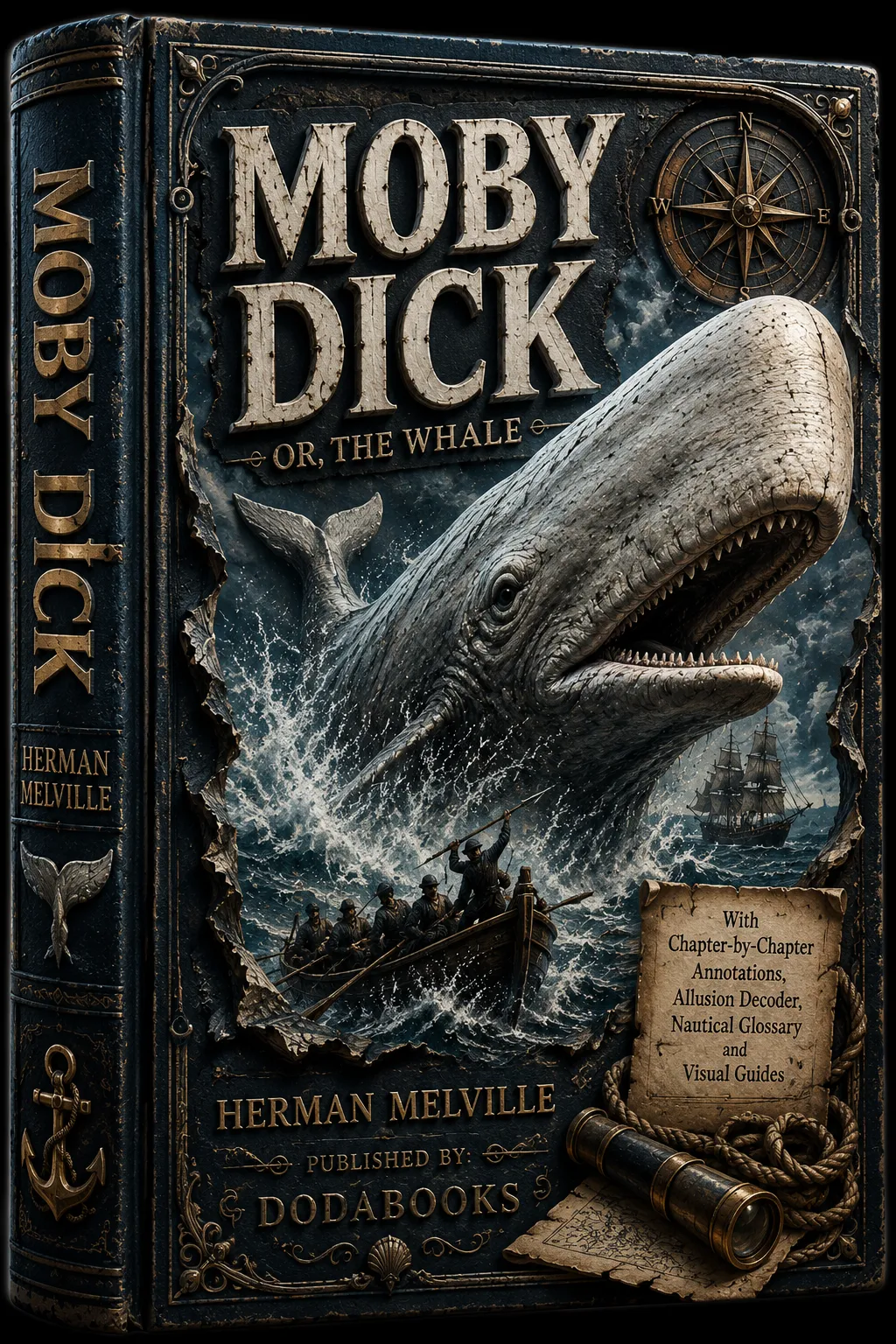
Discover the depth of Melville’s masterpiece with our annotated edition of Moby-Dick. Complete text with explanatory notes, historical context, and literary analysis.
📚 Related Articles
🎯 Stop Struggling. Start Understanding.
The annotated edition of Moby-Dick gives you everything you need to finally get Melville’s masterpiece:
- ✅ Complete, unabridged text — every word of the original 1851 edition
- ✅ Hundreds of explanatory footnotes — no more Googling every other page
- ✅ Historical context — the Essex disaster, Nantucket whaling, Melville’s life
- ✅ Literary analysis — chapter-by-chapter commentary on themes and symbols
- ✅ Victorian vocabulary — obsolete words and nautical terms defined inline
- ✅ Biblical & literary references — every allusion traced to its source