The ending of Herman Melville’s Moby-Dick explained in full detail: The catastrophic three-day chase, how the white whale rams and sinks the Pequod, Captain Ahab’s demise, and why Ishmael alone survives to be rescued by the Rachel.
This article is part of our annotated Moby-Dick guide, designed to help readers unlock the full depth of Melville’s masterpiece through comprehensive notes and analysis.
🐋
Moby-Dick Ending Explained: The Three-Day Chase and the Sinking of the Pequod
The ending of Moby-Dick explained in detail. The three-day chase, Ahab's final moments, the sinking of the Pequod, and w...
The Most Famous Ending in American Literature
The ending of Moby-Dick — the three-day chase, the sinking of the Pequod, and Ishmael’s lone survival — is one of the most powerful conclusions in all of literature. After 134 chapters of buildup, Melville delivers a finale that is brief, violent, and devastating.
Day One: The First Encounter
📖 Want the complete annotated experience?
👉 Get the Annotated EditionThe white whale is sighted on a clear morning in the Pacific Ocean. “There she blows!” The cry goes up, and the crew scrambles into the whaleboats. Ahab commands his own boat, steering directly toward the whale.
Moby-Dick is described as enormous — a “grand temple” of a whale — with a distinctive white hump and wrinkled forehead. He does not flee. He turns and faces the boats. Ahab hurls his harpoon. The whale dives and surfaces directly beneath Ahab’s boat, smashing it to pieces.
Miraculously, all the crew members are rescued. Ahab returns to the Pequod, shaken but not deterred. The whale has won the first round.
Day Two: The Destruction of the Boats
On the second day, the pattern repeats. The whale is sighted. The boats are lowered. This time, Moby-Dick destroys two boats before Ahab can even throw his harpoon. Ahab’s ivory leg is broken. He is bleeding. He refuses treatment.
The whale sounds — dives deep — and disappears. The crew searches for hours before returning to the Pequod. Ahab’s obsession has now cost him his only means of walking and has destroyed two of the ship’s five whaleboats. Still, he does not waver.
It is on this second day that the reader realizes what is happening: Ahab is not trying to kill the whale. He is trying to defeat something he cannot defeat. The chase has become a ritual, a dance toward death.
Day Three: The Final Confrontation
On the third day, everything happens at once. The whale is sighted close to the Pequod. Ahab lowers his boat one last time. But Moby-Dick has changed tactics. Instead of attacking the boats, the whale swims directly toward the Pequod itself.
“It was a terrific, most tremendous whale,” Melville writes. The whale rams the ship with its enormous head. The hull splinters. The Pequod begins to sink. Ahab, realizing that his ship is doomed, makes a final desperate attempt. He hurls his harpoon at the whale. The line catches him around the neck and drags him overboard. He disappears beneath the waves.
But he does not go quietly. His final words: “Towards thee I roll, thou all-destroying but unconquering whale; to the last I grapple with thee; from hell’s heart I stab at thee; for hate’s sake I spit my last breath at thee.”
The Pequod sinks, pulling the entire crew down with it. A red flag and a sea hawk nailed to the mast are the last things visible before the water closes over.
Ishmael’s Survival
Ishmael, who was thrown from Ahab’s boat on the first day of the chase, has been floating on Queequeg’s coffin for two days. He watches the Pequod sink from a distance. He is alone on the open sea.
The epilogue — which was omitted from the first British edition, causing confusion among early readers — describes his rescue. He floats for a day and a night before being spotted by the Rachel, the same ship whose captain had begged Ahab for help. “The devious-cruising Rachel, that in her retracing search after her missing children, only found another orphan.”
🎯 Chapter 135: The Chase Bleeds Into Ritual
It is worth reading the third-day chase (Chapter 135) as the moment the novel’s meaning fully resolves — through action rather than explanation. The three days are structured like a ritual: each day the whale appears, each day boats are lowered, each day they fail. By the third day, the reader understands that the chase is not about commerce or victory but an inevitability Ahab walks into with his eyes open. He does not hunt for oil; he hunts for a private reckoning with something he cannot name.
The chapter also returns to the whale’s indifference. Moby-Dick does not fight with malice; it simply swims toward the ship, the way a force of nature moves. That is the quiet horror of the ending: Ahab has built a mythology around the whale as a personal enemy, but the whale behaves as a whale always has. Ahab needs it to be evil — or his whole quest collapses into meaninglessness — and the impossibility of that demand is what the final pages dramatise.
🌪️ The Vortex and the Harpooneers
As the Pequod sinks, Melville’s imagery becomes apocalyptic. The ship is drawn down into a great whirlpool — the vortex — that swallows the vessel and nearly drags Ishmael with it. The vortex is the clearest symbol of the fate closing around Ahab’s quest: a spiral of destruction that no will or defiance can reverse, until the sea closes smoothly over the wreck.
Within that collapse, Melville makes a deliberate point about the crew. The three harpooneers — Queequeg, Tashtego, and Daggoo — are the novel’s great exemplars of non-Christian humanity, and they die with the very Ahab whose obsession condemns them. They are innocent of his project, bound to it only by the contract of the voyage, and their fate is a quiet indictment of pursuing one man’s obsession at the expense of everyone around him. Our analysis of the crew and their fates explores each harpooneer’s role in more detail.
🦅 Tashtego and the Sky-Hawk
The most haunting image of the sinking is the fate of Tashtego and the sky-hawk. As the ship goes down, Tashtego hammers a flag to the mast so the Pequod will go down with colours flying. A sky-hawk, drawn by the commotion, sweeps down and seizes the flag in its beak; Tashtego’s hammer, swung to nail the flag, instead pins the bird’s wing to the mast. Hawk, flag, and ship plunge together into the sea.
The image has been read as many things — and that multivalence is the point. A sky-hawk, symbol of the freedom of the upper air and the American nation, dragged down to the bottom by a dying ship: it is hard not to see a statement about the collision of the sublime and the doomed. Like Ahab himself, the hawk is exalted one moment and annihilated the next.
“Now small fowls flew screaming over the yet yawning gulf; a sullen white surf beat against its steep sides; then all collapsed, and the great shroud of the sea rolled on as it rolled five thousand years ago.”
⚖️ Fate, Free Will, and the Unanswered Ending
The final chapters raise the deepest question the novel asks: was Ahab’s doom inevitable, or did he choose it? Melville never settles the question. On the one hand, Fedallah’s prophecies map out Ahab’s end with terrible precision, suggesting a fate sealed long before the chase. On the other, Ahab is constantly given chances to turn back — Starbuck begs him to abandon the quest — and he refuses every one, choosing his course with terrible lucidity. The novel holds both possibilities in tension, leaving us a man who is both fated and free, destroyed by a destiny he also seems to have authored.
That ambiguity is Melville’s point about how human agency works: we are shaped by forces we cannot control, yet we still experience ourselves as choosing. Ahab embodies both truths, and the ending refuses to resolve them neatly. For a fuller picture of how this runs through the whole novel, our study of religion and fate in Moby-Dick traces the threads from the opening chapters onward.
❓ Frequently Asked Questions
What actually happens in the ending of Moby-Dick?
After a three-day chase, the white whale rams the Pequod and sinks it. Ahab is caught in the whale line and dragged to his death. The entire crew drowns except Ishmael, who survives by floating on Queequeg’s coffin and is rescued by the ship Rachel.
Why does Ishmael survive when everyone else dies?
Melville makes Ishmael the survivor deliberately: someone must live to tell the story. The epilogue frames survival itself as meaningful — as long as the tale is told, the storyteller endures. His rescue by the Rachel (a ship that had lost children of its own) closes the book on a note of witness rather than victory.
What is the significance of Tashtego and the sky-hawk?
As the ship sinks, harpooneer Tashtego nails a flag to the mast and accidentally pins a diving sky-hawk’s wing in the same blow. The bird, the flag, and the ship all go down together — a haunting image of the sublime and the high being dragged to the bottom, and one of the most analysed images in the novel.
Is the ending tragic or hopeful?
It is deliberately both. On one level it is a total catastrophe — ship, crew, and captain destroyed. But Ishmael’s survival and his role as narrator give the ending a thread of hope: the story survives, and with it the possibility of meaning. The final line about the sea rolling on “as it rolled five thousand years ago” insists that life goes on after the drama.
Why was the epilogue left out of the first British edition?
The epilogue, which explains Ishmael’s survival, was omitted from the first British edition, leaving some early readers confused about how the narrator could tell the tale. Later editions restored it. It is now recognised as essential to making the ending work.
What the Ending Means
The ending of Moby-Dick is deliberately ambiguous. The whale wins, but at what cost? Ahab dies defiant, refusing to repent even in his final moment. The Pequod sinks, but Ishmael survives to tell the story.
The final line is both tragic and hopeful. The Rachel searched for its own lost children and found only Ishmael — another orphan, another survivor. The implication is clear: the story will be told. The act of bearing witness is the only victory possible in a world defined by loss.
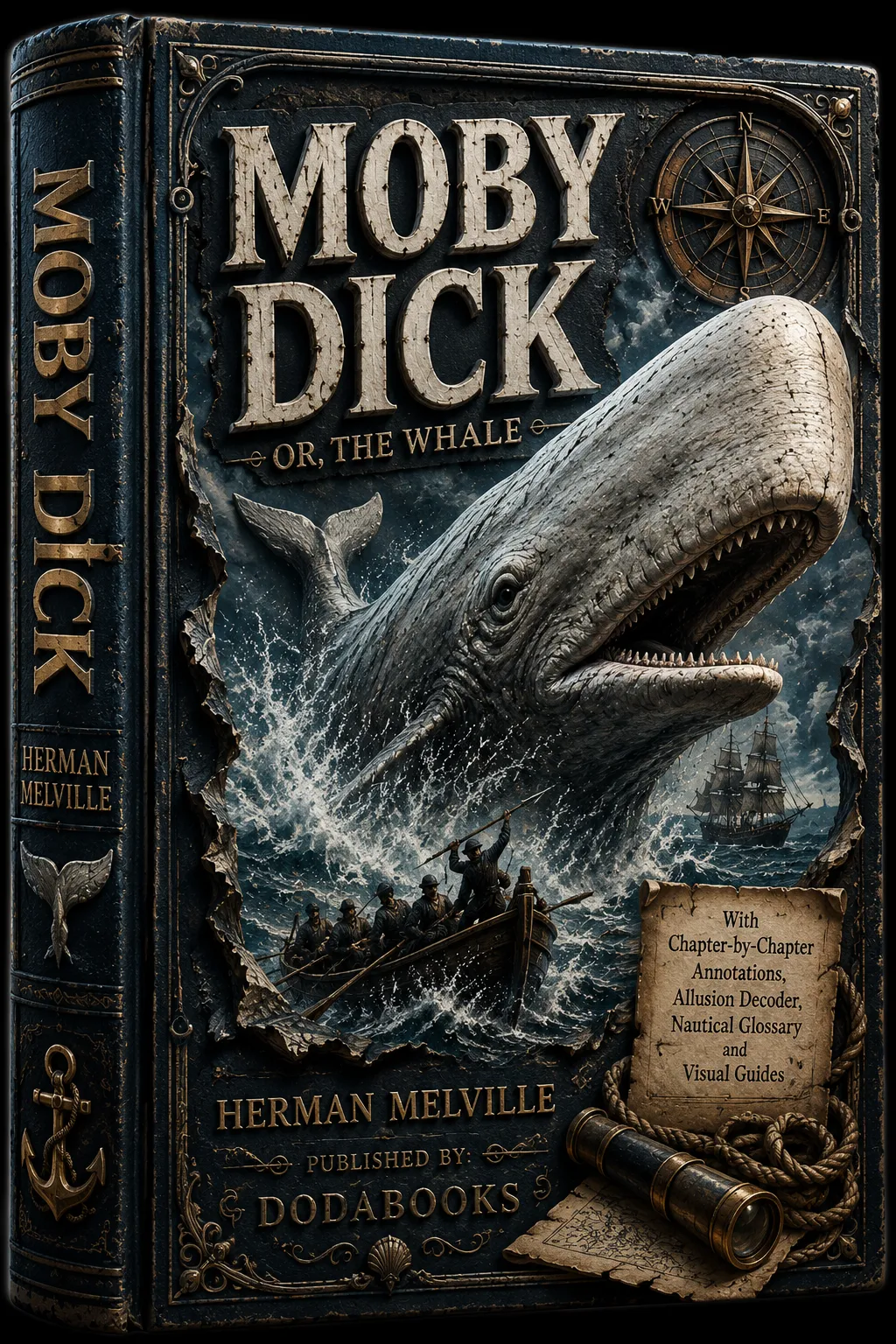
For modern readers who want to understand the full richness of Melville’s ending — the biblical echoes, the literary resonances, the philosophical implications — an annotated edition is essential. The DodaBooks edition includes detailed notes on the ending, tracing its sources and its influence on later literature. Get the annotated edition →
Experience Moby-Dick Like Never Before
Don’t struggle through Melville’s masterpiece alone. Our annotated edition of Moby-Dick includes:
- Complete, unabridged text of the novel
- Hundreds of explanatory footnotes clarifying obscure references
- Historical context on 19th-century whaling and Nantucket culture
- Literary analysis of key chapters and passages
- Victorian vocabulary definitions and nautical terminology
- Biblical and literary allusion guides
Get the annotated edition at DodaBooks →
📚 Related Articles
🎯 Stop Struggling. Start Understanding.
The annotated edition of Moby-Dick gives you everything you need to finally get Melville’s masterpiece:
- ✅ Complete, unabridged text — every word of the original 1851 edition
- ✅ Hundreds of explanatory footnotes — no more Googling every other page
- ✅ Historical context — the Essex disaster, Nantucket whaling, Melville’s life
- ✅ Literary analysis — chapter-by-chapter commentary on themes and symbols
- ✅ Victorian vocabulary — obsolete words and nautical terms defined inline
- ✅ Biblical & literary references — every allusion traced to its source