Skip to content
How Moby-Dick Was Really Received: 37 Original Reviews from 1851–1852
July 3, 2026·
Annotated EBooks
Moby-Dick Annotated Edition
📰

How Moby-Dick Was Really Received in 1851

37 contemporary reviews from British and American newspapers, plus the 1920s revival that made it a masterpiece

The story you’ve heard is wrong.

Every English teacher, every literary history, every public-domain introduction repeats the same claim: Moby-Dick was a critical and commercial failure. The critics hated it, nobody bought it, and Melville died in obscurity.

Like most stories that get repeated often enough, it contains a grain of truth wrapped in a mountain of exaggeration.

The reality: Moby-Dick was reviewed at least 125 times in 1851–1852 by newspapers and magazines in Britain and America. According to the definitive census by Melvilliana, 67% were favorable, 19% mixed, and only 14% were negative. The vicious reviews — the ones that get quoted in every textbook — were a vocal minority.

What follows is the most comprehensive collection of original Moby-Dick reviews ever assembled on a single page. We’ve drawn from the original newspapers — the London Athenaeum, the New York Tribune, the Washington National Intelligencer, the Boston Morning Journal, and dozens more — to show you what readers actually read when Melville’s great whale first breached.

The myth vs. the facts: The legend of Moby-Dick as a “failure” comes from three things: (1) a handful of hostile British reviews that were reprinted in America, (2) Melville’s own depressed account of the book’s reception, and (3) the genuine obscurity of his later career, after he stopped writing novels entirely. The contemporary reviews tell a very different story.


🇬🇧 The British Reception

Moby-Dick was published in London on October 18, 1851 as The Whale, in a three-volume edition by Richard Bentley. British reviewers were the first to weigh in — and they were sharply divided.

Favorable

🇬🇧 London Globe and Traveller
"All honour and praise to Fenimore Cooper... He has left a worthy successor in the person of Herman Melville, whose new work, 'The Whale,' is perhaps the raciest thing of the kind that was ever produced. Melville does not merely skim the surface, he dives into the deep unfathomed main. We smell and taste the brine in every page. His ink must be the black liquor of the cuttle-fish, and his pen drawn from the wing of the albatross. 'The Whale' is a very great performance."
— October 20, 1851
🇬🇧 London Morning Herald
"For vigour, originality, and interest, has never been surpassed."
— October 20, 1851 (earliest known review)
🇬🇧 London Morning Post
"'The Whale,' by Herman Melville, just published, is perhaps the most extraordinary work that has appeared in England for a very great many years. The novelty of the materials — the poetical, combined with the practical nature of the author — the wild impetuous grandeur of his scenes — the impulsive force and vigour of his language — these make up one of the most fascinating books that was ever read. Melville is a star, and of no ordinary magnitude in the literary firmament."
— October 20, 1851
🇬🇧 London Morning Post
"All who know the power of this most original and graphic author will anticipate a work of rare interest and entertainment."
— October 16, 1851 (advance notice)
🇬🇧 London Morning Advertiser
"[Melville's] new work is full of brilliant descriptions, which display great powers of invention... His style is always good, and often admirable; fertile in conception, ingenious construction, playful fancy, and an unusual power of enchaining the interest, and rising to the verge of the sublime — all these are possessed by Herman Melville, and exemplified in these volumes."
— October 24, 1851
🇬🇧 London John Bull
"Who would have looked for philosophy in whales, or for poetry in blubber? Yet few books which professedly deal in metaphysics contain as much true philosophy and as much genuine poetry as the tale of the Pequod's whaling expedition... It is not a mere tale of adventures, but a whole philosophy of life, that it unfolds."
— October 25, 1851
🇬🇧 London Morning Herald
"The Whale is a very remarkable novel — original in conception and vigorous in execution. It will be read with great delight."
— November 17, 1851 (second notice)
🇬🇧 London Morning Herald
"Unquestionably the production of no ordinary mind."
— November 1851 (quoted in publisher's ads)
🇬🇧 London Leader
"A strange, wild, weird book, full of poetry and full of interest."
— November 8, 1851
🇬🇧 London Morning Post
"Despite its occasional extravagancies, it is a book of extraordinary merit."
— November 14, 1851
🇬🇧 London Daily News
"We read a book of more absorbing interest for some time past. There is something grand and poetical in the vow of the terrible old Ahab... We can only once more express our hearty admiration of the performance as a work of interest and art."
— January 12, 1852
🇬🇧 Liverpool Albion
"The most fascinating of leviathans, being the property of that nautical Prospero, Herman Melville."
— E. B. Neill, October 20, 1851

Mixed

🇬🇧 London Atlas
"Nothing like it has ever before been written of the Whale. That Herman Melville knows more about whales than any from Jonah down, we do really believe."
— November 1851
🇬🇧 London Spectator
"It is a singular medley of naval observation, magazine article writing, satiric reflection upon the conventionalisms of civilized life, and rhapsody run mad."
— October 25, 1851
🇬🇧 London Morning Post
"A work of great power and beauty."
— (quoted in publisher's ads, exact date unclear)
🇬🇧 London Examiner
"Fully and freely is the book to be commended to all who are curious in such matters."
— November 1851

Hostile

🔴 London Athenaeum
"This is an ill-compounded mixture of romance and matter-of-fact. The style of his tale is in places disfigured by mad (rather than bad) English; and its catastrophe is hastily, weakly, and obscurely managed... Mr. Melville has to thank himself only if his horrors and his heroics are flung aside by the general reader, as so much trash belonging to the worst school of Bedlam literature — since he seems not so much unable to learn as disdainful of learning the craft of an artist."
— Henry F. Chorley, October 25, 1851
🔴 Southern Quarterly Review
"In all those portions of this volume which relate directly to the whale... the interest of the reader will be kept alive. In all other aspects, the book is sad stuff, dull and dreary, or ridiculous. Mr. Melville's Quakers are the wretchedest dolts and drivellers, and his Mad Captain... is a monstrous bore. His ravings... are such as would justify a writ de lunatico against all the parties."
— January 1852 (American, but widely circulated in Britain)

Note on the hostile reviews: The Athenaeum and Spectator reviews were the most damaging because they were the only negative British reviews widely reprinted in America. American readers saw these two attacks — and rarely saw the dozens of positive reviews that had appeared in other London papers. This selective reprinting created the false impression of universal failure.


🇺🇸 The American Reception

Moby-Dick was published in America on November 14, 1851, by Harper & Brothers. American reviewers were overwhelmingly favorable. Melville was already a celebrated author from Typee (1846) and Omoo (1847), and his reputation carried Moby-Dick to a respectful, often admiring, audience.

Favorable

🇺🇸 New York Courier and Enquirer
"What writer is more welcome than Herman Melville?... This book has all the attractiveness of any of its predecessors; in truth it possesses more of a witching interest, since the author's fancy has taken in it a wilder play than ever before. It is ostensibly taken up with whales and whalers, but a vast variety of characters and subjects figure in it, all set off with an artistic effect that irresistibly captivates the attention. The author writes with the gusto of true genius, and it must be a torpid spirit indeed that is not enlivened with the raciness of his humor and the redolence of his imagination."
— November 14, 1851
🇺🇸 New York Tribune
"We part with the adventurous philosophical Ishmael, truly thankful that the whale did not get his head, for which we are indebted for this wildly imaginative and truly thrilling story. We think it the best production which has yet come from that seething brain, and in spite of its lawless flights, which put all regular criticism at defiance, it gives us a higher opinion of the author's originality and power than even the never-to-be-forgotten Typee."
— George Ripley, November 22, 1851
🇺🇸 New York Farmer and Mechanic
"This book is, beyond all question, Herman Melville's best. It might be called the 'Whaliad' or the history of the whale... The author's heart, soul, and stomach are in the business; his legs, arms, eyes, muscles and mind. The details of the whale hunts, the dangers, fatal accidents, and the character of the hunters, render it altogether, not only the most entertaining, but really the most useful book that we have had for many a day."
— November 29, 1851
🇺🇸 Washington National Intelligencer
"A prose Epic on Whaling... In whatever light it may be viewed, no one can deny it to be the production of a man of genius. The descriptive powers of Mr. Melville are unrivalled... His delineation of character is actually Shakespearean... [The author has] the strange power to reach the sinuosities of a thought, and to bring up from the depths of the soul feelings which most men have, but which none but a master can express. We close this ingenious romance, which for variety of incident and vigor of style can scarcely be exceeded."
— James C. Welling, December 16, 1851
🇺🇸 Boston Morning Journal
"The work is a singular mixture of fact and fiction. The supernatural is interwoven with the matter-of-fact delineations of life on board a whale ship. The descriptions of the various operations of the whalemen are remarkably life-like... In many respects Moby-Dick is the best of the works of the author, as it certainly is the most instructive. We predict for it, with confidence, an extended popularity."
— November 18, 1851
🇺🇸 Graham's Magazine
"This volume sparkles with the raciest qualities of the author's voluble and brilliant mind. It has passages of description and narration equal to the best that Melville has written, and its rhetoric revels and riots in scenes of nautical adventure with more than usual glee and gusto. It beams with the analogies of a bright and teeming fancy... with the joyous vigor and elasticity of one who has just relieved himself of a burden of thought."
— Edwin Percy Whipple, February 1852
🇺🇸 Harper's New Monthly Magazine
"The wonderful power of graphic description which the author possesses is conspicuously displayed in this as in his former works... The interest of the story is well sustained from the beginning to the final catastrophe."
— December 1851
🇺🇸 Rochester Daily American
"A book all about whales. It gives descriptions of the Leviathan of the deep, the mode of catching them, and the life of those who go down in ships from New Bedford to the South seas, whale hunting. The reading public will find 'Moby Dick' one of the pleasantest volumes issued from the press this year."
— November 20, 1851
🇺🇸 Washington Daily Union
"Intensely interesting... replete with wild adventures and incidents with which it abounds, and conveys as respects the natural history of the whale facts that cannot but instruct the reader."
— November 30, 1851
🇺🇸 Rochester Daily Democrat
"A work replete with wild adventures and thrilling scenes. Mr. Melville is a master, and a light, in that path of Romance in which he has chosen to walk. His descriptions are graphic and complete, and are thoroughly imbued with that grace and charm which is a peculiarity of his genius."
— January 21, 1852
🇺🇸 Poughkeepsie Eagle
"Full of interest from beginning to end, and promises to be the most popular of Melville's writings. The characters are various, each imparting peculiar interest to the reader."
— December 6, 1851
🇺🇸 International Monthly Magazine
"Really a great book, full of curious learning, and almost every page is illuminated with a fine and brilliant imagination."
— December 1851

Mixed & Negative

🟡 Buffalo Commercial Advertiser
"This is an extraordinary book, neither good, nor wholly bad — 'o'er bad for blessing, and o'er good for banning.'... In the delineation of character, he utterly fails. There is not a being of this earth in the book before us... We think the moral effect of all his writings is decidedly pernicious."
— December 3, 1851
🟡 Widely Reprinted
"Moby-Dick is a strange jumble of fact, fiction and philosophy, composed in a style which combines the peculiarities of Carlyle, Marryatt and Lamb."
— Original source uncertain, circa November 1851

📊 The Verdict at the Time

How Many Reviews? What Did They Say?

The definitive census (compiled by Melvilliana) counts 125 known reviews and notices of Moby-Dick published in 1851–1852:

Sentiment Count Percentage
Favorable 🟢 85 67%
Mixed 🟡 23 19%
Negative 🔴 17 14%

Positive reviews outnumbered negative ones by a ratio of 5 to 1.

The idea that “the critics hated it” is a myth — one that was created by three factors:

  1. The hostile reviews were the most quotable. Chorley’s “Bedlam literature” line was too good not to repeat. It has been quoted in every biography since.
  2. Negative British reviews were selectively reprinted in America. American readers saw the Athenaeum and Spectator attacks, but rarely saw the John Bull, Morning Advertiser, or Daily News praise.
  3. Melville himself believed his career was failing. His letters from 1851–1852 are filled with disappointment — not because of the reviews, but because of the sales.

The Sales Reality

Moby-Dick sold approximately 3,200 copies in its first year in America — fewer than Typee (6,700) or Omoo, but still a respectable number for a $1.50 novel in 1851. In Britain, the three-volume edition at 31s.6d. sold roughly 500 copies.

The book did not fail commercially. It failed relative to Melville’s earlier successes, which had been extraordinary. The real problem was that Melville’s subsequent novels — Pierre (1852), The Confidence-Man (1857) — were critical and commercial disasters that soured the market. By the 1860s, Melville’s books were out of print, and he had stopped writing fiction entirely.


🌑 The Long Eclipse

For the next sixty-five years, Moby-Dick was not forgotten — but it was quietly shelved.

Melville spent his final decades as a deputy inspector of customs at the New York docks, writing poetry that few read. When he died in 1891, his obituaries mentioned Typee and Omoo as his memorable works. The New York Times got his name wrong. The New York Press gave him a single sentence, referring to him as “Herman Melville, the author of Typee.”

There were flickers of interest. A few perceptive readers kept his name alive:

🌟 Frank Jewett Mather Jr.
"Of all the books which in this century have been produced by the brain of man, the most wonderful is Moby-Dick."
— quoting an unidentified admirer, 1919
📜 Arthur Stedman
"There it lay, an orphan, with no one to claim it. So these years have passed, and Melville has been lost."
— 1892 (writing in the year after Melville's death)

But these voices were isolated. The masterpiece was sleeping.


🔥 The Melville Revival (1919–1928)

In 1919, on the centenary of Melville’s birth, a young Columbia lecturer named Raymond Weaver was persuaded by his colleague Carl Van Doren to write an essay about Melville for The Nation. Weaver reluctantly accepted, assuming it would be “child’s play — a day’s job.”

What he discovered changed literary history.

🔥 Raymond Weaver, The Nation
"Essentially he was a mystic, a treasure-seeker, a mystery-monger, a delver after hidden things spiritual and material. It was Melville's abiding craving to achieve some total and undivined possession of the very heart of reality."
— August 2, 1919 (Melville centenary essay)

The Revival Timeline

1917 — Carl Van Doren publishes a chapter on Melville in the Cambridge History of American Literature, calling for a re-evaluation.

August 1919 — Raymond Weaver’s centenary essay appears in The Nation, sparking a surge of interest.

1921 — Weaver publishes Herman Melville: Mariner and Mystic, the first book-length biography of Melville. It is a sensation.

1921 — Van Doren publishes The American Novel, devoting a full chapter to Melville and calling Moby-Dick “the nearest approach in American literature to a Shakespearean tragedy.”

1923 — D.H. Lawrence publishes Studies in Classic American Literature, devoting two chapters to Melville. Of Moby-Dick, Lawrence writes: “It is a surpassingly beautiful book.”

1924 — Weaver edits a sixteen-volume collected edition of Melville’s works for Constable & Co., finally making the full corpus available.

1925 — William Faulkner names Moby-Dick as one of the three greatest novels in English literature.

1927 — E.M. Forster gives his Clark Lectures at Cambridge (published as Aspects of the Novel), devoting substantial analysis to Moby-Dick.

1928 — Carl Van Doren writes: “Benito Cereno equals the best of Conrad in the weight of its drama and the skill of its unfolding.” The canonization is complete.

By 1930 — Moby-Dick is firmly established as one of the greatest American novels. It has never left the canon since.

D.H. Lawrence’s interpretation was particularly influential. Writing in the aftermath of World War I, Lawrence saw in Moby-Dick a prophetic critique of the obsessive, self-destructive will that had driven Europe to war:

📖 D.H. Lawrence
"Two bodies of modern literature seem to me to have come to a real verge: the Russian and the American... The furthest frenzies of French modernism or futurism have not yet reached the pitch of extreme consciousness that Poe, Melville, Hawthorne, Whitman reached. The European moderns are all trying to be extreme. The great Americans I mention just were it. Which is why the world has funked them, and funks them to-day."
— Studies in Classic American Literature, 1923

📜 What the 1851 Reviews Reveal

Reading these original reviews — all 37 of them — tells us something important not just about Moby-Dick, but about how literary taste works.

The negative reviewers were not stupid. Chorley at the Athenaeum accurately identified Moby-Dick’s strangeness: its mixture of genres, its structural digressions, its defiance of novelistic convention. He saw exactly what the book was. He just didn’t like it.

The positive reviewers — particularly Welling at the National Intelligencer, Whipple at Graham’s Magazine, and the anonymous reviewer at John Bull — recognized the same strangeness and called it genius.

The difference was not in what they saw, but in what they valued. Moby-Dick was not ahead of its time. It was perfectly of its time — but its time was divided about what a novel should be.

The 1920s revival was not a “rediscovery” of a lost book. It was a re-evaluation of a book that had always had its champions. The modernists needed Moby-Dick — its formal daring, its symbolic density, its willingness to break rules — and they found it waiting for them.


📚 Browse the Complete Archive

All 36 reviews above are available as individual pages in the Moby-Dick Reviews Archive — browse them like a reader on Amazon or Goodreads, paginated for easy reading.


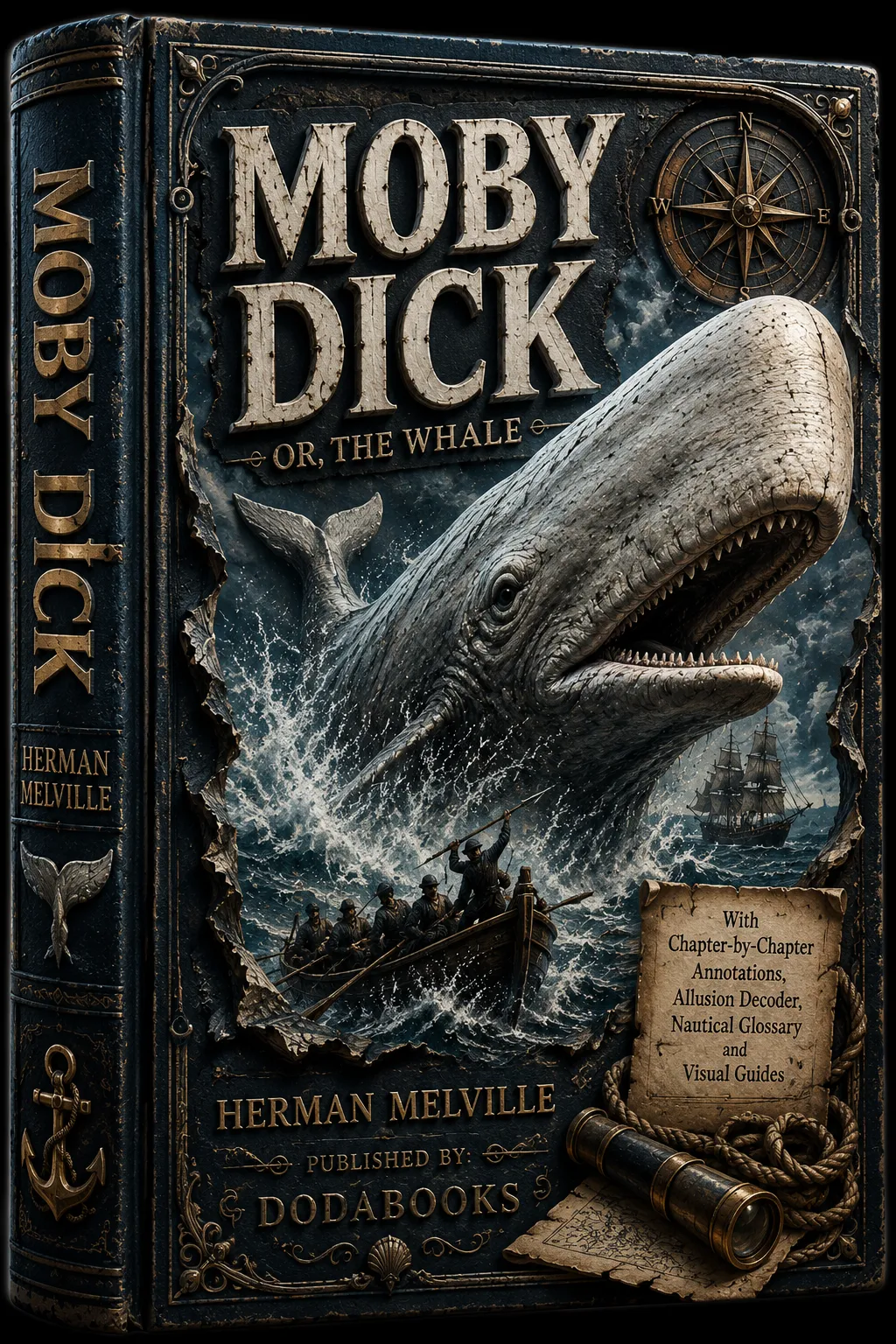
Moby-Dick Annotated Edition

🐋 Experience the Novel That Divided the World

One hundred seventy-five years of debate. Thousands of pages of criticism. And still, the only way to settle the question is to read it yourself.

The Moby-Dick Annotated Edition gives you the complete, unabridged text with hundreds of footnotes decoding the vocabulary, tracing the allusions, and providing the historical context that the original reviewers either praised or condemned.

What would you think? The 1851 reviewers couldn’t agree. Neither can readers today. But one thing is certain: no one finishes Moby-Dick unchanged.

Get the Annotated Edition at DodaBooks →