Comprehensive review of the Moby-Dick Annotated Edition — literary analysis, edition quality, features, and verdict. See how it compares to other editions and whether it’s right for you.
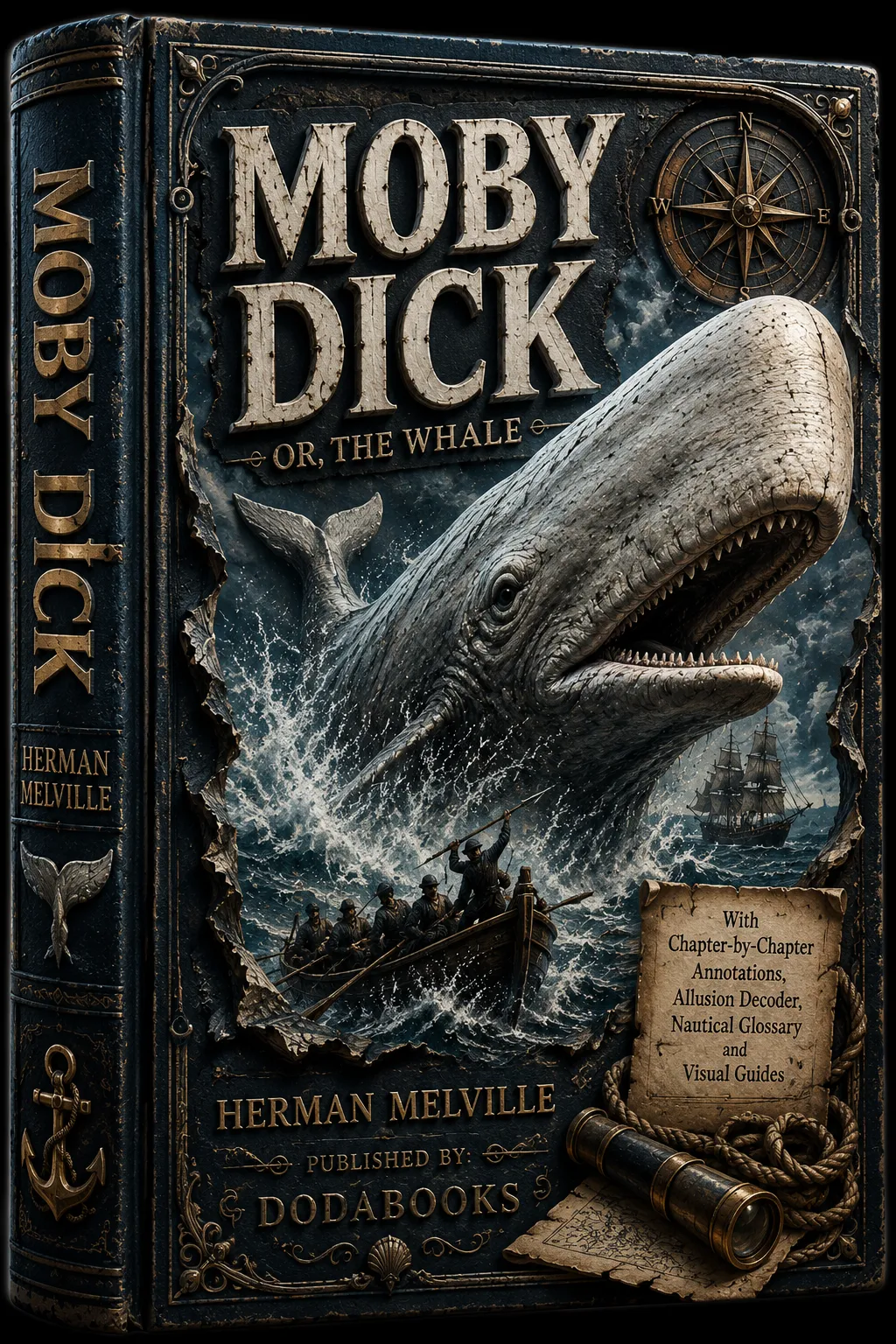
🐋
Moby-Dick Annotated Edition Review
Is the Annotated Edition of Moby-Dick worth it? We review the literary value of Melville's masterpiece and evaluate the annotated edition as a reading experience.
| ⭐ Rating | 4.5 / 5 — ★★★★½ |
| 📖 Book | Moby-Dick by Herman Melville (1851) |
| 📦 Edition | Annotated Edition by Annotated EBooks |
| 📄 Pages | 720 |
| 🏢 Publisher | Annotated EBooks |
| 📋 Format | Paperback, eBook |
| 💰 Price | $14.99 (paperback) |
| ⏱️ Reading Time | ~28 hours (with annotations) |
| 🎯 Best for | First-time readers, students, re-readers who want deeper understanding |
📊 Moby-Dick Scorecard
👥 Editorial Perspectives
"The annotations saved me. Without the footnotes explaining whaling terms and 19th-century slang, I would have given up in Chapter 3. By Chapter 135, I felt like I'd actually understood the novel — not just survived it."
"The chapter-by-chapter commentary is excellent for essay writing. Every symbol, allusion, and theme is traced through the text. Saved me hours of research for my term paper on Ahab as a tragic hero."
"The historical context on Nantucket whaling and the Essex disaster is worth the price alone. Melville's world comes alive when you understand the real history behind the fiction."
"I've read Moby-Dick three times over twenty years. This edition showed me things I'd missed every time. The annotations on Biblical symbolism alone transformed how I understand the novel."
💬 Critics Say
The Verdict at a Glance
Before we dive into the details, here’s the short version: if you want to finally understand Moby-Dick without spending hours Googling references and vocabulary, this is the edition to buy. The annotations strike the perfect balance between scholarly depth and readability, and the edition is gorgeous to hold.
Is it perfect? No. But it’s the best edition for the vast majority of readers.
What Makes Moby-Dick Worth Reading?
Moby-Dick isn’t just a novel — it’s a complete immersion into the world of 19th-century whaling, American philosophy, Shakespearean tragedy, and the limits of human obsession. Published in 1851, Herman Melville’s masterpiece was initially a commercial failure, only to be rediscovered in the 20th century as one of the greatest works of world literature.
Why Moby-Dick matters: It’s a novel that reinvents itself every hundred pages. One moment you’re reading a thrilling adventure story about a mad captain chasing a white whale; the next, you’re immersed in a dissertation on whale anatomy or a Shakespearean soliloquy about the nature of evil. This chameleon-like quality is why literary critics consistently rank it alongside Hamlet and The Odyssey as a cornerstone of Western literature.
But Moby-Dick presents real challenges for modern readers:
- Obsolete vocabulary — whaling terminology, 19th-century slang, nautical jargon
- Dense prose — Melville’s sentences can run half a page
- Countless allusions — Biblical, Shakespearean, classical, and philosophical references on every page
- Digressive structure — chapters on whale anatomy interrupt the narrative flow
- Unreliable narrator — Ishmael’s perspective is layered and ambiguous
This is where the Annotated Edition shines.
The problem it solves: The Annotated Edition removes the friction. Instead of reaching for your phone every three pages to look up a word or reference, the explanation is right there — at the bottom of the page, unobtrusive but immediate. This transforms the reading experience from a struggle into a flow state.
✍️ About the Author
Herman Melville (1819–1891) drew on his own experience as a sailor on the whaler Acushnet when writing Moby-Dick. The real-life story of the Essex — a Nantucket whaler sunk by a sperm whale in 1820 — provided the novel’s central disaster. Melville was close friends with Nathaniel Hawthorne, to whom he dedicated Moby-Dick, and the two writers deeply influenced each other. Published in 1851 to lukewarm reviews and poor sales, the novel was largely forgotten by Melville’s death in 1891. It wasn’t until the 1920s that literary critics rediscovered it, elevating it to its current status as one of the greatest novels ever written. Melville died believing his masterpiece had failed.
Pros and Cons
✅ What Works Well
- Comprehensive annotations — hundreds of footnotes covering vocabulary, historical context, literary references, and thematic analysis
- Readable format — clear typesetting, well-structured footnotes that don’t overwhelm the page
- Beautiful design — quality cover, sturdy binding, cream-colored paper that’s easy on the eyes
- Chapter-by-chapter commentary — each section opens with context that helps orient the reader
- Victorian vocabulary decoded — every obsolete or obscure word defined inline
- Biblical & literary references traced — each allusion is sourced and explained
- Historical context — the Essex disaster, Nantucket whaling, Melville’s life and influences
- Great price-to-value ratio — $14.99 for 720 pages of carefully curated scholarship
❌ What Could Improve
- No illustrations — the original edition included whaling illustrations; none are reproduced here
- Font size — some readers may find the font slightly small for comfortable extended reading
- No audiobook — the annotations are text-only; no companion audio edition
- No online component — no supplementary website or digital resources
- Only paperback/eBook — no hardcover or special edition available
- Thick book — 720 pages makes it a hefty volume to carry around
🔍 Sample Annotations from This Edition
Here is how the Annotated Edition breaks down the famous opening of Moby-Dick — three annotations from Chapter 1 alone:
⚓ Allusion Decoder — Biblical Reference
“Call me Ishmael.”
Genesis 16:12. In the Bible, Ishmael was the son of Abraham and the servant Hagar. He was cast out into the wilderness to wander forever. By naming the narrator “Ishmael,” Melville signals that this character is an outcast, a drifter, and an observer on the edge of society.
📝 Definition — The Spleen
“It is a way I have of driving off the spleen and regulating the circulation.”
In 19th-century medicine, the spleen was thought to be the seat of melancholy and bad temper. To “drive off the spleen” means to cure depression or boredom.
📝 Definition — Hypos
“Whenever my hypos get such an upper hand of me…”
Short for “hypochondriasis.” In Melville’s time, this referred to a deep, morbid depression or melancholy, not just a worry about sickness. Going to sea is Ishmael’s way of avoiding self-destruction — “my substitute for pistol and ball.”
The annotations run like this on virtually every page — decoding vocabulary, tracing allusions, and providing historical context exactly where you need it.
How It Compares to Other Editions
Moby-Dick Editions Compared
| Edition | Price | Annotations | Extras | Best For |
|---|---|---|---|---|
| Annotated EBooks ⭐ | $14.99 | Extensive (vocab, history, lit references) | Chapter commentary | First-time & returning readers |
| Penguin Classics | $10.00 | Minimal (mostly historical) | Introduction only | Budget readers |
| Norton Critical | $25.00 | Academic (critical essays) | Scholarly essays | Students & academics |
| Modern Library | $16.00 | None | Introduction only | Casual readers |
| Oxford World’s Classics | $9.95 | Moderate (notes at back) | Chronology | Value seekers |
The Annotated Edition strikes the best balance for the general reader who wants to understand the novel deeply without wading through academic scholarship. Norton is better for university courses; Penguin is cheaper but offers far less help.
Who Is This Edition For?
🎯 First-time readers who found Moby-Dick intimidating
If you've started Moby-Dick before and gave up around the cetology chapters (the whale anatomy sections), this edition will keep you on track. The annotations explain why those chapters matter and what Melville was trying to achieve, turning frustration into fascination.
📚 Students who need to write essays on Moby-Dick
Each chapter's commentary highlights key themes, symbols, and literary devices. The footnotes trace every Biblical and Shakespearean allusion — saving you hours of research when writing papers.
🔄 Re-readers who want to go deeper
If you've read Moby-Dick before and want to catch what you missed, this edition is perfect. The annotations reveal layers of meaning that are invisible on a first reading.
🎁 Gift buyers looking for a quality edition
The attractive cover, sturdy binding, and thoughtful design make this a great gift for the literature lover in your life. At $14.99, it's an affordable but impressive present.
🧭 How to Approach This Book
Don’t skip the cetology chapters. Chapters 31–32 (the whale anatomy sections) are where most readers give up. But here’s the secret: these chapters are the philosophical heart of the novel. Melville uses whale anatomy as a metaphor for humanity’s attempt to categorize and understand the infinite. When Ishmael says “the whale is a spouting fish with a horizontal tail,” he’s satirizing the whole enterprise of taxonomy — and by extension, our futile attempts to comprehend God, fate, or the white whale itself. The annotations in this edition will guide you through these sections, showing you exactly why they matter.
Read the chapter commentaries first. Each chapter opens with a brief introduction that frames what you’re about to read. Read it before the chapter — it will orient you without spoiling anything.
Take it slow. Moby-Dick wasn’t written to be binge-read. One to two chapters per sitting (about 20–30 minutes) is the ideal pace. Let Melville’s language wash over you; the meaning will settle.
Use the annotations, don’t fight them. Some readers feel footnotes interrupt the flow. Treat them like a friend tapping your shoulder — they’re pointing out things you’d otherwise miss. You can always skip a note and come back. The book rewards both approaches.
Frequently Asked Questions
Is this the complete, unabridged text?
Yes. The Annotated Edition contains every word of Melville's original 1851 text, including all 135 chapters, the epilogue, and the original front matter. Nothing has been cut, abridged, or modernized.
Are the annotations intrusive?
No. Footnotes are placed at the bottom of each page, marked by superscript numbers in the text. They're easy to consult when needed but don't interrupt the reading flow. You can read straight through without looking at them, or dive into every footnote — the choice is yours.
How does the eBook version work?
The eBook version includes the same annotations as the paperback, reformatted for digital screens. Footnotes are linked so you can tap to read and tap to return. Works on Kindle, Kobo, and all major e-readers.
Can I buy this as a gift?
Absolutely. The edition ships in protective packaging and the cover design makes it a handsome addition to any bookshelf. Gift options are available at checkout.
📝 Memorable Quotes
Related Reviews
Final Verdict
★★★★½ — 4.5 / 5
🎯 The Best Edition for Most Readers
The Moby-Dick Annotated Edition earns our highest recommendation. It transforms a famously difficult novel into an accessible, enjoyable, and profoundly rewarding reading experience. The annotations are scholarly yet approachable, the design is beautiful, and the price is more than fair.
Who should buy it: Anyone who wants to read Moby-Dick and actually understand it — whether it’s your first time or your fifth.
Who should skip it: Academic researchers who need the Norton Critical Edition’s scholarly apparatus, or budget readers who just want the cheapest possible text.