Why do critics call Moby-Dick the Great American Novel? A complete defense of Melville’s masterpiece — its ambition, its themes, its language, and its enduring relevance.
This article is part of our annotated Moby-Dick guide, designed to help readers unlock the full depth of Melville’s masterpiece through comprehensive notes and analysis.
🐋
Why Moby-Dick Is the Great American Novel: A Complete Defense
Why do critics call Moby-Dick the Great American Novel? A complete defense of Melville's masterpiece — its ambition, its...
The Title Itself
Critics have been calling Moby-Dick the Great American Novel since the 1940s, when the literary scholar F.O. Matthiessen placed it at the center of the American canon. But what does the phrase mean, and does Moby-Dick deserve it?
The Great American Novel is not a prize or a contest. It is a cultural aspiration — the idea that a single novel can capture the American experience, in all its complexity and contradiction. Many novels have been nominated. Moby-Dick is the most enduring candidate.
Unparalleled Ambition
📖 Want the complete annotated experience?
👉 Get the Annotated EditionThe first reason Moby-Dick deserves the title is its sheer ambition. Melville was not content to write a good novel. He wanted to write a book that contained everything: adventure, science, philosophy, drama, poetry. He wanted to create a total work of art that would encompass the whole of human experience.
No American novel before Moby-Dick had attempted anything like this. The novel traditionally focused on individual characters and their relationships. Melville expanded the form to include the natural world, the industrial world, and the spiritual world. He made the novel a vehicle for everything he knew and everything he felt.
The Language
The second reason is the language. Moby-Dick contains some of the most powerful prose ever written in English. “Call me Ishmael.” “From hell’s heart I stab at thee.” “It is not down on any map; true places never are.” These lines are not just quotable — they are perfect.
Melville’s prose ranges from the simplest directness to the most complex philosophical argument. He shifts registers effortlessly. He can write a chapter that reads like a dramatic soliloquy and then a chapter that reads like a scientific textbook. The range is astonishing, and the quality is consistently high.
The Characters
Third, the characters. Captain Ahab is one of the most unforgettable characters in all of literature. He is not a hero or a villain — he is something more interesting: a tragic figure whose greatness and flaw are the same thing. Ishmael is the perfect narrator: curious, empathetic, philosophical. Queequeg is a portrait of nobility that defied the racial stereotypes of Melville’s time.
Even the minor characters are vivid: Starbuck, the voice of reason; Stubb, the fatalistic joker; Flask, the aggressive little man; Pip, the cabin boy whose madness gives him vision.
The Themes
Fourth, the themes. Moby-Dick addresses the biggest questions: What is the nature of evil? Do we have free will? Can we know the universe? What is our place in nature? The novel does not answer these questions — great novels do not — but it asks them with more power and urgency than any other American novel.
The themes are also deeply American. The novel is about enterprise, ambition, diversity, obsession, and failure. It is about the American desire to dominate nature and the American tendency to overreach. It captures both the promise and the peril of the national character.
The Historical Moment
Fifth, the novel’s relationship to its time. Moby-Dick was published in 1851, on the eve of the Civil War. America was deeply divided over slavery. The whaling industry was at its peak. The nation was expanding westward, displacing indigenous peoples and exploiting natural resources.
Moby-Dick engages with all of these issues. Through the Pequod’s multinational crew, Melville imagines a diverse America. Through Ahab’s tyranny, he warns against authoritarian leadership. Through the whale hunt, he questions the human project of dominating nature.
🐋 Whaling as the American Frontier
One of the most original claims for Moby-Dick as the Great American Novel is that it relocates the American frontier from the land to the sea. In the standard telling, the frontier is the West — the wagon trains, the plains, the mountain passes. But Melville saw that the deepest American frontier at mid-century was the ocean, and the whaling grounds were its wilderness. The Pequod is not merely a ship; it is a moving frontier, a tiny republic of enterprise carried into a vast, unconquered space.
This reframing matters because it makes Moby-Dick a genuinely national epic rather than a regional one. The crew is drawn from every corner of the earth, a working model of American diversity: Ishmael the New Englander, Queequeg the Pacific islander, Tashtego the Native American, Daggoo the African harpooneer. In the closed world of the ship, these men must cooperate or die — an image of the American experiment itself. When Ahab drives this diverse crew toward destruction, Melville is staging a confrontation between the American ideals of freedom and democracy and the American temptation toward tyranny.
⚖️ Fate, Freedom, and Democracy
At its philosophical heart, Moby-Dick is a book about whether human beings can control their destinies. Ahab is convinced the white whale has singled him out, that he is locked in a duel with something that hates him specifically. Yet Melville refuses to answer the question of whether the whale is evil, a god, or merely a dumb brute — and that refusal is the point. Ahab’s certainty that he understands the meaning of his hunt is presented as both heroic and insane, and the novel leaves us unable to decide.
This ambiguity is deeply American. The nation that produced Moby-Dick was simultaneously devoted to the self-made individual and haunted by the forces — slavery, expansion, industrial capitalism — that were remaking it. Ahab is the ultimate self-made man, the individual will raised to cosmic proportions, and the Pequod is the democracy he would bend to his purpose. Starbuck, the first mate who sees the folly and cannot stop it, represents every ordinary good citizen who quietly enables a tyrant. In that sense, Moby-Dick is an American tragedy not because it is set in America but because it dramatizes American contradictions with terrifying clarity.
🎭 Mythic Characters
The Great American Novel needs characters who feel mythic, and Moby-Dick delivers them. Ahab towers over the book as an almost elemental force — part man, part sea-god, part Old Testament prophet, raging against a white whale he believes embodies all the malice of the universe. He is unforgettable because he is not simply evil or simply good, but a figure of colossal, self-destructive will. Ishmael, the survivor and narrator, is the warm, curious conscience of the book, the man who goes to sea to keep from shooting himself and finds instead a way of facing the universe. And Queequeg — a harpooneer of noble bearing and deep loyalty who teaches Ishmael about friendship across every boundary — remains one of the most sympathetic and quietly radical figures in nineteenth-century American fiction, defying the racial stereotypes of his era.
📜 Critical Reception: Then and Now
Understanding the novel’s reputation clarifies its claim to greatness. When Moby-Dick appeared in 1851, it was not the unqualified success Melville hoped for. Early readers found it strange and digressive; many preferred the adventure and suspense of his earlier novels. It sold modestly and went out of print, and Melville’s career as a best-selling author never truly recovered. For decades, the book was kept alive by a small minority of devoted readers.
The recovery began in earnest in the early twentieth century, when modernist critics rediscovered the book’s ambition, symbol, and psychological depth. In 1941 the literary scholar F.O. Matthiessen placed Moby-Dick at the heart of the American Renaissance, and from the 1940s onward it became a fixture of the American canon and the standard answer to “what is the Great American Novel?” The reversal is itself part of the story: a book that failed with its first readers became the novel that defined American literature. That arc — from commercial failure to national cornerstone — is why our account of Moby-Dick’s reception treats its afterlife as a phenomenon worth studying in its own right.
The Flaw That Proves the Rule
Some critics argue that Moby-Dick cannot be the Great American Novel because it is too strange, too difficult, too digressive. But this is precisely why it deserves the title. America is strange, difficult, and digressive. A novel that reflects the complexity of the nation is more truthful than a novel that simplifies it.
The cetology chapters — those long, strange chapters about whale anatomy — are part of what makes the novel great. They represent the American impulse to know everything, to classify everything, to master everything. They are a monument to curiosity. If you appreciate the depth of Melville’s language and ideas here, our decoded analysis of Moby-Dick as the Great American Novel takes apart the symbolism and structure chapter by chapter.
The Annotated Difference
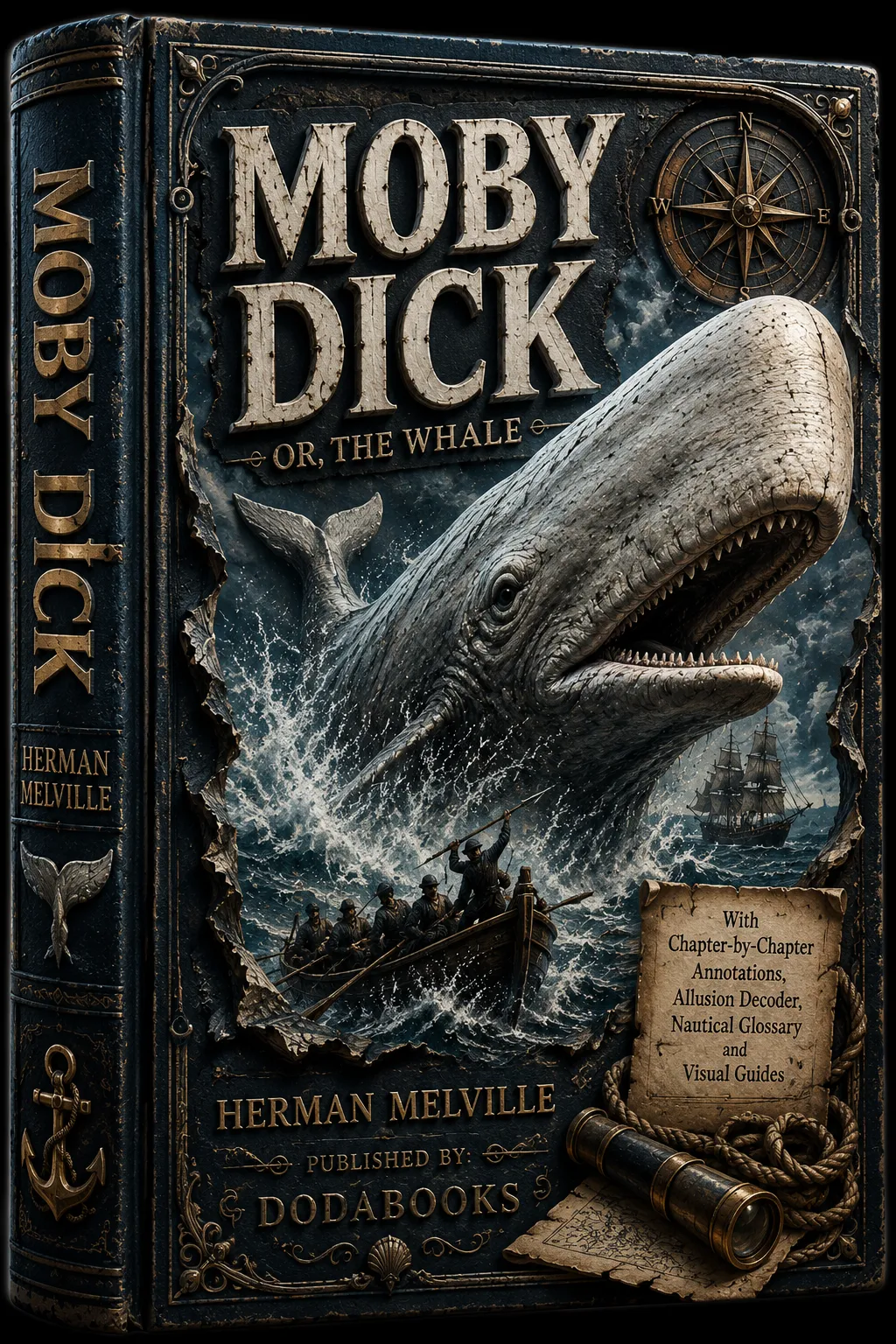
Many readers have heard of Moby-Dick’s greatness but have never experienced it because the novel’s difficulty stands in the way. The annotated edition at DodaBooks removes this barrier, providing the context and guidance that make the novel accessible without diluting its power.
If you have never read Moby-Dick, or if you tried and gave up, the annotated edition offers a second chance. Experience the Great American Novel →
Experience Moby-Dick Like Never Before
Don’t struggle through Melville’s masterpiece alone. Our annotated edition of Moby-Dick includes:
- Complete, unabridged text of the novel
- Hundreds of explanatory footnotes clarifying obscure references
- Historical context on 19th-century whaling and Nantucket culture
- Literary analysis of key chapters and passages
- Victorian vocabulary definitions and nautical terminology
- Biblical and literary allusion guides
Get the annotated edition at DodaBooks →
❓ Frequently Asked Questions
What does "the Great American Novel" actually mean?
It is not a prize but a cultural aspiration — the idea that a single novel might capture the American experience in all its complexity and contradiction. Many books have been nominated, but Moby-Dick is the most enduring and most frequently cited candidate.
Why did Moby-Dick fail when it was first published?
Early readers found it strange and digressive, and it sold modestly compared to Melville’s earlier adventure novels. It went out of print and was only rediscovered and elevated to the canon in the early twentieth century.
Is the cetology (whale anatomy) material really necessary?
It is not padding — it is the point. Those encyclopedic chapters embody Melville’s ambition to make the novel a total work, and they represent the American drive to know and classify everything. Most readers come to appreciate them on a second reading.
Is Ahab the hero or the villain?
Neither, exactly. Ahab is a tragic figure whose greatness and fatal flaw are the same quality — his absolute, self-destructive will. Melville refuses to judge him cleanly, which is precisely why he is so memorable.
Is Moby-Dick hard to read?
It can be, especially for new readers, because of its encyclopedic scope and dense language. But it rewards persistence enormously, and an annotated edition with historical and literary notes removes most of the barriers without diluting the power.
📚 Related Articles
🎯 Stop Struggling. Start Understanding.
The annotated edition of Moby-Dick gives you everything you need to finally get Melville’s masterpiece:
- ✅ Complete, unabridged text — every word of the original 1851 edition
- ✅ Hundreds of explanatory footnotes — no more Googling every other page
- ✅ Historical context — the Essex disaster, Nantucket whaling, Melville’s life
- ✅ Literary analysis — chapter-by-chapter commentary on themes and symbols
- ✅ Victorian vocabulary — obsolete words and nautical terms defined inline
- ✅ Biblical & literary references — every allusion traced to its source