Moby-Dick is notoriously difficult. But the difficulty is the point. Here is why this challenging novel is worth the effort.
🐋
Why Moby-Dick Is Hard to Read (And Why You Should Try)
Moby-Dick is notoriously difficult. But the difficulty is the point. Here is why this challenging novel is worth the eff...
The Difficulty Is Real
Moby-Dick is objectively difficult: 135 chapters, 200,000 words, pages of digression. The prose is dense and allusive. Chapters shift without warning from narrative to essay to drama.
But the difficulty is not a flaw. It is a feature.
Melville set out to write a novel that would contain everything — the physical reality of whaling, the metaphysical terror of existence, the comedy and tragedy of human life at sea. He wanted a book as vast and unpredictable as the ocean itself. The difficulty is the price of that ambition. You cannot have a novel that encompasses the world without making the reader work to keep up.
The difficulty manifests in several distinct ways. The length is the most obvious: at roughly 200,000 words, Moby-Dick is nearly twice as long as most modern novels. The structure is disorienting: chapters shift without warning from narrative to essay to drama to philosophical meditation. The language is dense, mixing theatrical rhetoric, Biblical cadence, and nautical slang in ways that can feel impenetrable. And the pacing defies modern expectations: the novel slows to a crawl in its middle sections, dwelling for dozens of chapters on whale anatomy and whaling technique before accelerating into the final chase.
Each of these difficulties serves a purpose. The length immerses the reader in the experience of a long sea voyage. The shifting structure mirrors the unpredictability of life at sea. The dense language demands the kind of attention that Ahab himself brings to his quest. And the pacing replicates the rhythms of whaling itself: long stretches of patient labor punctuated by moments of intense, terrifying action.
Why Melville Made It Hard
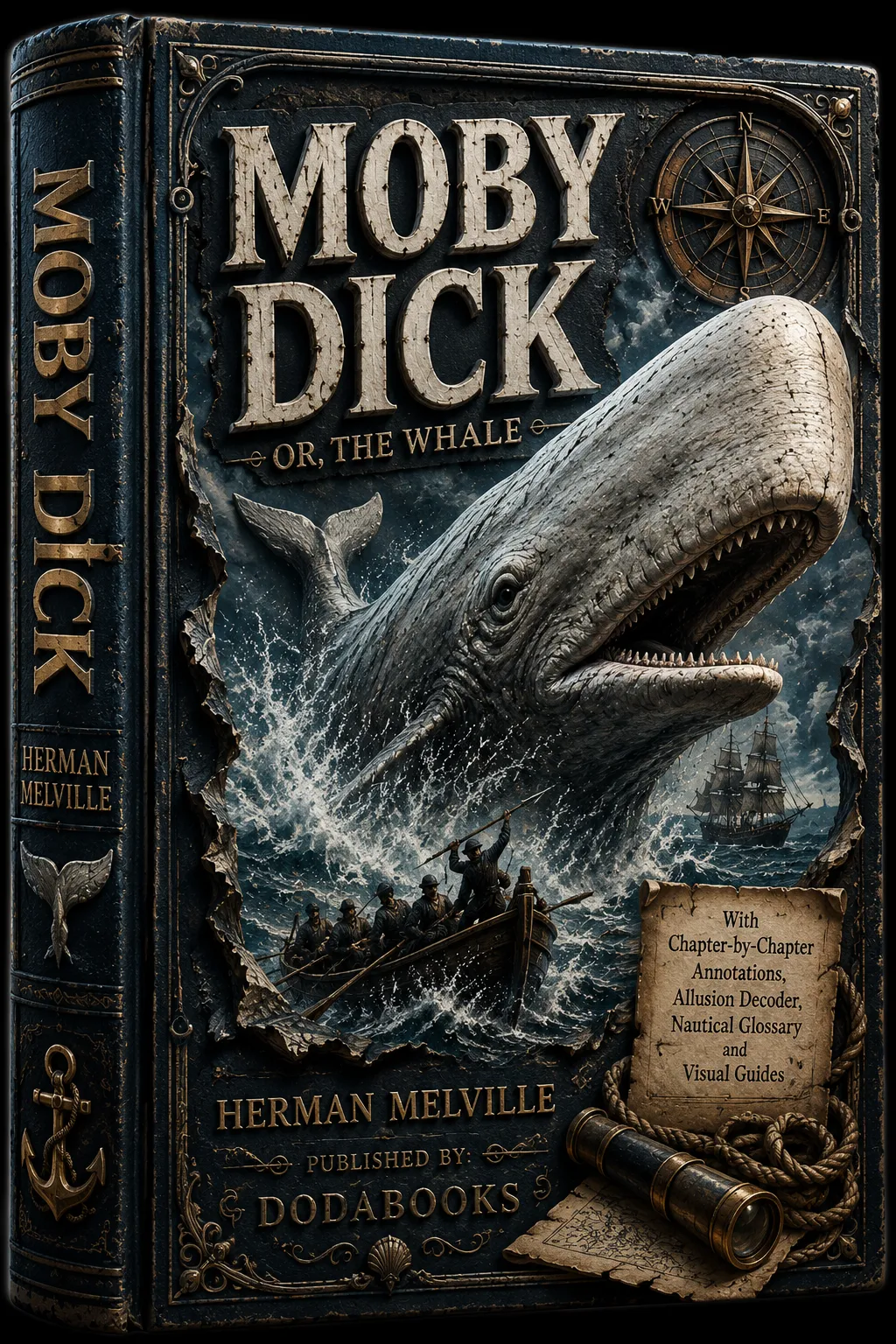
📖 Want the complete annotated experience?
👉 Get the Annotated EditionMelville could have written a simple adventure story. He chose not to. He was trying to create a book that contained the entire world of whaling. The cetology chapters are the novel’s claim to completeness. The dramatic language is his attempt to achieve the highest possible register.
Melville was also fighting against the limitations of his own reputation. His first two novels, Typee and Omoo, were popular adventure stories set in the South Seas. Readers and publishers expected more of the same. Moby-Dick was Melville’s attempt to transcend the genre that had made him famous — to prove that a novel about whaling could be as serious, as complex, and as artistically ambitious as anything being written in Europe.
The theatrical influence is particularly important to understand. Melville had been reading dramatic literature voraciously, absorbing the tragedies and histories. He decided that he wanted his novel to achieve the same emotional intensity as the great stage dramas — the same mixture of high rhetoric and physical action, the same compression of language, the same willingness to let characters speak in verse when ordinary speech was inadequate.
This ambition is visible throughout Moby-Dick. Ahab’s speeches are written in a deliberately elevated register that echoes Lear and Macbeth. The stage directions in “The Quarter-Deck” give the scene a dramatic intensity that conventional narration could not achieve. Even the cetology chapters are infused with a kind of visionary energy that elevates them above mere science. Melville wanted to create a novel that operated at the highest level of literary art, and the difficulty of the prose is a direct consequence of that ambition.
The Difficulty as Metaphor
Reading Moby-Dick is itself a voyage. It is long. It requires endurance. There are boring stretches and terrifying peaks. The experience mirrors being on the Pequod.
This is not an accident. Melville designed the novel to function as a metaphor for the human condition. The experience of reading it — the boredom, the confusion, the moments of transcendent beauty — mirrors the experience of living. We do not choose the difficulties we encounter. We endure them. We push through. And sometimes, in the middle of the struggle, we discover something that makes the struggle worthwhile.
The cetology chapters, for example, are the novel’s equivalent of the long, monotonous days at sea — the days when nothing happens, when the horizon is empty, when the only task is to wait and watch. These chapters test the reader’s patience in the same way that whaling tests the crew’s patience. And just as the crew’s patience is rewarded by the sudden appearance of a whale, the reader’s patience is rewarded by the sudden eruption of narrative power in chapters like “The Quarter-Deck” or “The Chase.”
The shifting narrative structure mirrors the unpredictability of the sea. You never know what is coming next. A chapter about whale anatomy may give way to a philosophical meditation, which may give way to a scene of high comedy, which may give way to a moment of existential terror. The experience is disorienting — and that disorientation is the point. Melville wants you to feel what it is like to be on a ship in the middle of the ocean, where the only certainty is uncertainty itself.
How to Survive
Adopt a flexible approach — read at your own pace, skip what bores you, return to what puzzles you. There is no single correct way to read Moby-Dick.
Use an annotated edition for help. The best annotated editions provide historical context, explain allusions, and clarify difficult passages without spoiling the experience. Think of annotations as a guide through unfamiliar territory — they do not replace the journey, but they make it easier to navigate.
Discuss the novel with others. Moby-Dick is a book that comes alive in conversation. Join a book club, find an online discussion group, or simply talk about the novel with a friend. The perspectives of other readers will reveal dimensions of the text you might otherwise miss.
Trust Melville — the chapters that seem irrelevant often connect later. The cetology chapters build toward “The Whiteness of the Whale.” The seemingly random anecdotes in the middle sections illuminate the novel’s themes in unexpected ways. Melville always has a purpose, even when that purpose is not immediately apparent.
Listen to it. An audiobook version of Moby-Dick, read by a skilled narrator, can transform the experience. Hearing the prose aloud reveals rhythms and patterns that are invisible on the page. The dramatic speeches, in particular, gain power when spoken.
Read it in sections. You do not have to read Moby-Dick in one sitting. Break it into manageable chunks — a chapter a day, or a section a week. The novel rewards slow, attentive reading more than any other method.
What You Gain
The reward is the sense of having navigated something vast and strange. You have been on a voyage, survived, and have the story to prove it.
But the rewards go deeper than mere accomplishment. Reading Moby-Dick changes the way you think about language, about storytelling, about the possibilities of the novel form. You emerge from the experience with a richer vocabulary, a sharper ear for prose, and a deeper appreciation for what literature can achieve.
There is also the community of readers. Moby-Dick has been read, studied, argued over, and loved for more than 170 years. When you read it, you join a conversation that spans generations — a conversation about obsession, about knowledge, about the limits of human understanding. You become part of the novel’s living history, adding your own perspective to the long tradition of readers who have wrestled with Melville’s masterpiece.
And there is the simple, visceral pleasure of the story itself. Strip away the philosophy, the cetology, the theatrical rhetoric, and you have a thrilling tale of a man, a whale, and the sea. The chase is one of the great set pieces in all of literature. Ahab is one of the great characters. The final pages are as gripping as anything you have ever read. The difficulty is real — but so is the reward.
The Final Word
Ahab’s final speech is worth the entire journey. To fully understand “from hell’s heart I stab at thee,” you must have accompanied him. That is why you should read the book: to earn those final pages.
The speech is not just words on a page. It is the culmination of a journey that you have taken alongside Ahab — through the long middle chapters, through the cetology digressions, through the philosophical meditations, through the growing sense of dread that builds chapter by chapter until it becomes unbearable. Without that journey, the speech is merely powerful. With it, the speech is devastating.
This is what Moby-Dick offers: not a story to be consumed, but an experience to be endured and ultimately transformed by. The difficulty is not an obstacle to the reward. The difficulty is the reward. You earn the final pages by reading the middle ones. You earn Ahab’s speech by walking in his shadow. You earn the ending by surviving the voyage.
And that is why you should try. Not because the novel is famous. Not because your teacher told you to. Not because it is on a list of great books. You should try because the experience of reading Moby-Dick — the full, difficult, exhausting, exhilarating experience — is unlike anything else in literature. There is no other novel that demands so much and gives so much in return. The whale is waiting. The sea is vast. The voyage is yours to take.
Discover the depth of Melville’s masterpiece with our annotated edition of Moby-Dick. Complete text with explanatory notes, historical context, and literary analysis.
📚 Related Articles
Frequently Asked Questions
Why do many readers struggle to finish Moby-Dick?
Readers often get bogged down by the lengthy non-narrative chapters on whale anatomy, blubber boiling, and obsolete 19th-century nautical mechanics.
Do you have to read every single chapter about cetology?
While some casual readers skim them, these chapters are where Melville embeds his deepest philosophical jokes, allegories, and meditations on human knowledge.
What makes finishing Moby-Dick so rewarding?
Conquering the novel rewards you with one of the most sublime climaxes in world literature and a profound perspective on human nature, hubris, and the cosmos.
What tips help beginners successfully read Moby-Dick?
Read at a steady pace of 2–3 chapters per day, embrace Melville's humor and poetic digressions, and use a reliable annotated edition for unfamiliar terms.
How does the DodaBooks annotated edition make reading Moby-Dick easier?
By providing immediate definitions of nautical jargon, historical context, and thematic signposts, DodaBooks removes reading friction completely.
🎯 Stop Struggling. Start Understanding.
The annotated edition of Moby-Dick gives you everything you need to finally get Melville’s masterpiece:
- ✅ Complete, unabridged text — every word of the original 1851 edition
- ✅ Hundreds of explanatory footnotes — no more Googling every other page
- ✅ Historical context — the Essex disaster, Nantucket whaling, Melville’s life
- ✅ Literary analysis — chapter-by-chapter commentary on themes and symbols
- ✅ Victorian vocabulary — obsolete words and nautical terms defined inline
- ✅ Biblical & literary references — every allusion traced to its source