What does the white whale symbolize in Moby-Dick? Herman Melville’s albino sperm whale is one of the most enigmatic figures in world literature—representing indifferent nature, biblical majesty, the unknowable universe, and human obsession. Inspired by the real-life 19th-century white whale Mocha Dick, Melville transforms a marine creature into an enduring cosmic mystery.
This article is part of our annotated Moby-Dick guide, designed to help readers unlock the full depth of Melville’s masterpiece through comprehensive notes and analysis.
🐋
The White Whale Symbolism in Moby-Dick: What Does Moby-Dick Really Mean?
What does the white whale symbolize in Moby-Dick? Discover the multiple interpretations — nature, fate, evil, God, and t...
The Question at the Center
What does the white whale mean? This is the question every reader of Moby-Dick asks, and the novel resists giving a simple answer. Melville was not interested in creating an allegory with a single key. He wanted to create a symbol that could hold multiple meanings — a white whale that would mean different things to different readers and different things to the same reader at different moments.
The white whale is the novel’s central mystery. It is the object of Ahab’s obsession, the engine of the plot, and the book’s most famous image. But what is it, really?
The Whale as a Real Animal
📖 Want the complete annotated experience?
👉 Get the Annotated EditionAt the simplest level, Moby-Dick is a sperm whale — a physical animal with a scientific classification (Physeter macrocephalus), a known size (up to 60 feet long), and a known habitat (deep oceans worldwide). Melville devotes entire chapters to whale anatomy: the skeleton, the skin, the blubber, the spermaceti organ in the whale’s head.
This literal reality is crucial. The whale is not merely a symbol — it is a living creature. It eats, swims, breathes, and fights. This is what makes Ahab’s quest both heroic and absurd. He is trying to kill an animal, but he has transformed it into something cosmic.
The Whale as Fate
To the superstitious members of the Pequod’s crew, the white whale is a supernatural being — an embodiment of fate. It appears at precisely the moments it is prophesied to appear. It seems to know where the Pequod will be. It kills with a deliberateness that suggests intelligence, even malevolence.
Fedallah, the Parsee harpooneer, delivers prophecies about Ahab’s death that hinge on the whale’s behavior. The whale follows these prophecies with uncanny precision. Is the whale guided by fate? Or is Melville using the prophecies to create a sense of inevitability?
The novel never answers this question. That is the point: fate in Moby-Dick is something you feel, not something you can prove.
The Whale as Evil
To Ahab, the white whale is the embodiment of evil. “He tasks me; he heaps me; I see in him outrageous strength, with an inscrutable malice sinewing it.” Ahab’s interpretation of the whale is personal and psychological. He needs the whale to be evil because that justifies his revenge. If the whale is just an animal doing what animals do, then Ahab’s quest is meaningless.
Melville complicates this interpretation by giving the whale no point of view. We never enter the whale’s mind. It remains inscrutable — a blank screen onto which characters project their own fears and obsessions.
The Whale as God
Some critics read the whale as a symbol of God — or at least, of the divine. The whale’s whiteness suggests purity and transcendence. Its power over the Pequod suggests divine sovereignty. Ahab’s quest to kill it is explicitly blasphemous — he tells Starbuck, “I’d strike the sun if it insulted me.”
But this reading is complicated by the fact that the whale kills indiscriminately. If the whale is God, it is a God who destroys both the guilty (Ahab) and the innocent (the crew).
The Whale as Nature
Perhaps the most straightforward reading: the whale is nature itself. It is vast, powerful, and utterly indifferent to human concerns. It does not hate Ahab. It does not love the crew. It simply exists, and in its existence, it demonstrates that humanity is not the center of the universe.
This reading connects Moby-Dick to the ecological concerns of our own time. The novel anticipates the idea that nature is not a resource to be exploited but a force to be respected. Ahab’s attempt to dominate the whale is humanity’s attempt to dominate nature — and nature always wins.
⚪ The Whiteness of the Whale
No discussion of the white whale’s meaning is complete without Chapter 42, “The Whiteness of the Whale,” where Ishmael tries to explain why the whale’s colour is so powerful. The chapter is central because Melville explicitly refuses to let the whale stand for any one thing. Ishmael catalogues the many faces of whiteness — the innocence of snow, the purity of brides, the beauty of marble — and then turns to its terrors: the polar bear, the white shark, the albatross, ghosts, and corpses. The same colour that suggests divine purity also intensifies horror.
Melville’s point is that whiteness is the “visible absence of colour” — the blank, featureless quality that can hold any meaning the mind projects onto it. That is precisely why the whale can mean so many things at once. White is not a fixed symbol in the novel; it is a screen. It blesses and appalls in the same gesture because it is empty enough to receive whatever terror or wonder the observer brings to it. If you want to go deeper into this turning-point chapter, our dedicated study of the whiteness chapter untangles the whole passage line by line.
💭 Ahab’s Projection
Understanding the whiteness chapter makes Ahab’s behaviour clearer — and more disturbing. Ahab does not read the whale as an animal; he reads it as a mask hiding some inscrutable, hostile force. He tells the crew that the whale is but an agent of something far vaster that he hates: the dumb brute that has tormented him stands for the entire indifferent universe. In Ahab’s hands, the whale becomes the projection of his own unresolved rage, a container for every wound and grievance he cannot strike directly.
The tragedy is that Ahab is half aware of what he is doing. He knows his mind is at war with itself, yet he cannot turn back. The whale, being blank and unknowable, allows him to pour his whole self into the pursuit — and that is the trap. Because the whale “really” is nothing more than a whale, Ahab fights a phantom and drags everyone down with him. The projection is complete, the reality never touched. Our guide to the other interpretations of the whale, from the chapter that first reveals Moby-Dick properly, shows how the crew’s awe and Ahab’s hatred diverge from the start.
🔎 Why the Meaning Never Stays Still
The genius of Melville’s symbolism is that it is deliberately unstable. Valid readings of the whale multiply: nature’s indifference, the mystery of fate, the unknowable, the divine, the projection of obsession — and the novel supports each of them with real textual evidence while refusing to crown any single one. That instability is not a flaw; it is the design. A symbol that could be exhaustively decoded would shrink the novel to a puzzle, and Melville wanted the opposite — a book that reads differently each time because the central image holds more than any one meaning can contain.
It is also why the whale has outlived the novel’s own gloomy first reception. Moby-Dick failed commercially in 1851 and only found its audience decades later, once readers were ready for a symbol that refused to resolve. The whale means so much because it cannot mean only one thing, and that open-endedness is what has made it one of the most analysed images in all of literature. If you are curious how this ambiguity plays out across the whole reading, our account of the final chase shows the whale’s meaning at the moment of the novel’s climax.
❓ Frequently Asked Questions
What does the white whale symbolize in Moby-Dick?
There is no single answer — and that is the point. The whale is read as nature, fate, evil, the divine, the unknowable, and Ahab’s own projection. Melville deliberately allows all of these readings while refusing to choose one, making the whale a symbol that holds multiple meanings at once.
Why does Melville make the whale white?
Because whiteness, as Ishmael argues in Chapter 42, is the “visible absence of colour” — a blankness that can hold almost any meaning. The same white that suggests purity and innocence also intensifies terror, which makes it the perfect colour for a symbol that resists being pinned down.
Is the whale a symbol of evil?
Only in Ahab’s mind. To Ahab, the whale embodies an inscrutable malice he must destroy. But Melville gives the whale no point of view; it behaves as a whale. The “evil” Ahab sees is largely a projection of his own anger onto a blank, unknowable surface.
Does Melville believe the whale represents God?
Some readers have argued the whale is divine, given its whiteness and its power over the Pequod. But the novel complicates this — if the whale is God, it is a God who destroys the innocent along with the guilty. Melville keeps the question open rather than endorsing any one religious reading.
Why is the whale's meaning still debated?
Because Melville designed the symbol to stay open. Every major interpretation has textual support, yet none exhausts the whale. That deliberate ambiguity is exactly why Moby-Dick continues to invite new readings more than a century and a half after it was written.
Multiple Meanings
The great achievement of Moby-Dick is that the whale contains all of these meanings simultaneously. It is an animal, a symbol of fate, an embodiment of evil, a figure of God, and a representation of nature. No single reading exhausts it.
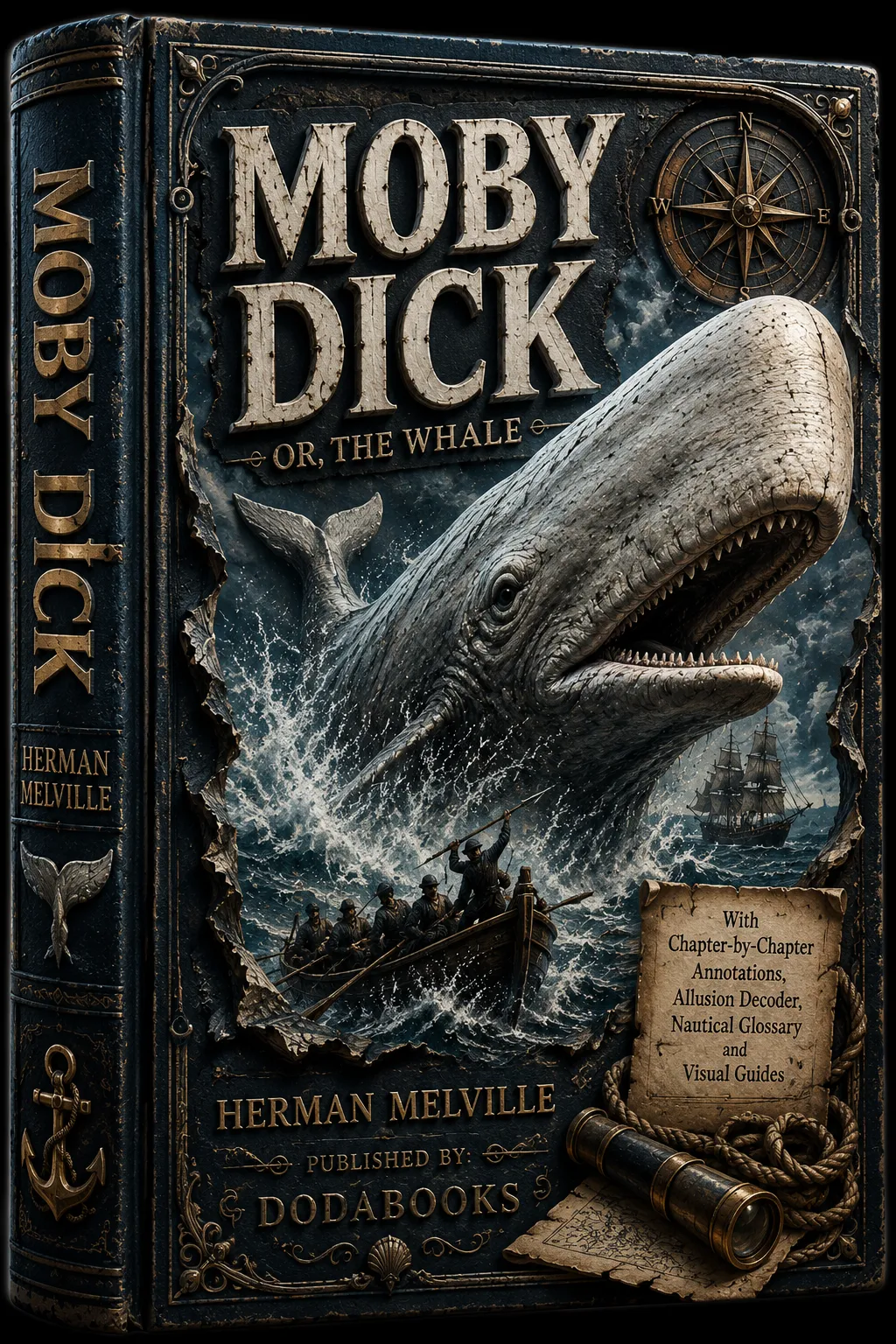
The DodaBooks annotated edition includes a comprehensive guide to the novel’s symbolism, tracing each interpretation through the text and showing how Melville layers meaning upon meaning. For readers who want to fully appreciate Melville’s achievement, this guide is indispensable. Explore the annotated edition →
Experience Moby-Dick Like Never Before
Don’t struggle through Melville’s masterpiece alone. Our annotated edition of Moby-Dick includes:
- Complete, unabridged text of the novel
- Hundreds of explanatory footnotes clarifying obscure references
- Historical context on 19th-century whaling and Nantucket culture
- Literary analysis of key chapters and passages
- Victorian vocabulary definitions and nautical terminology
- Biblical and literary allusion guides
Get the annotated edition at DodaBooks →
📚 Related Articles
🎯 Stop Struggling. Start Understanding.
The annotated edition of Moby-Dick gives you everything you need to finally get Melville’s masterpiece:
- ✅ Complete, unabridged text — every word of the original 1851 edition
- ✅ Hundreds of explanatory footnotes — no more Googling every other page
- ✅ Historical context — the Essex disaster, Nantucket whaling, Melville’s life
- ✅ Literary analysis — chapter-by-chapter commentary on themes and symbols
- ✅ Victorian vocabulary — obsolete words and nautical terms defined inline
- ✅ Biblical & literary references — every allusion traced to its source