The major themes in Robert Burns poems explained simply — love, nature, social justice, Scottish identity, and the human condition behind 539 works.
Themes in Robert Burns Poems Explained
The themes in Robert Burns poems are surprisingly consistent for a writer who produced 539 works. Burns returned to the same big ideas throughout his life. Once you recognise them, every poem fits into a larger picture.
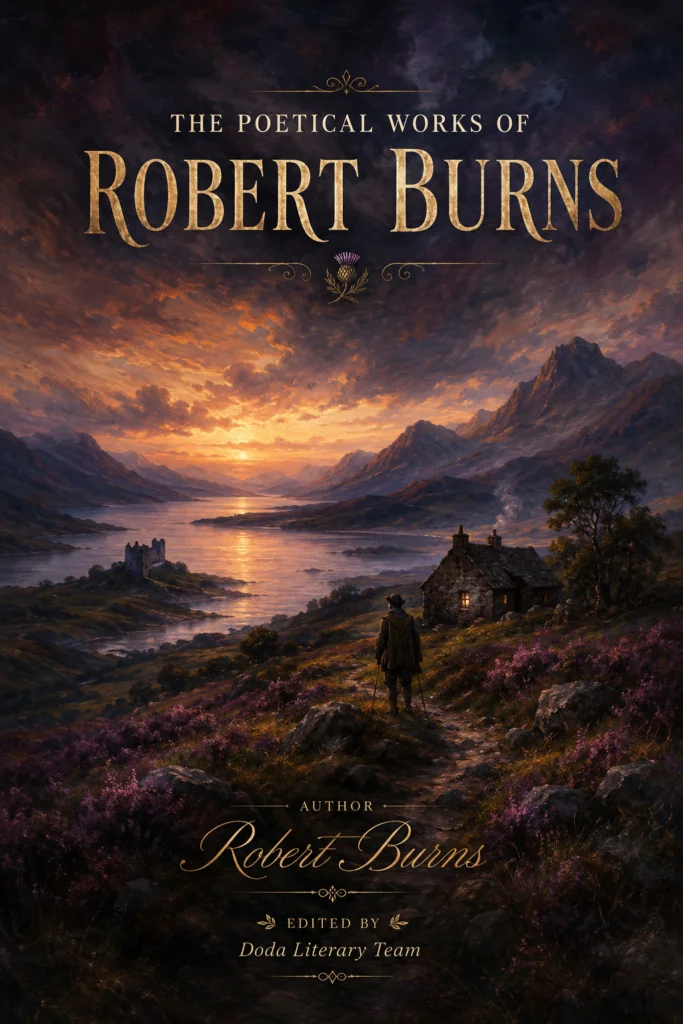
| Theme 1 | Love and Human Connection |
| Theme 2 | Nature and the Natural World |
| Theme 3 | Social Justice and Equality |
| Theme 4 | Scottish Identity |
| Theme 5 | The Human Condition |
| Key Insight | Themes recur across all 539 poems |
🔭 The Big Picture: Why Themes Matter
When you read a single Burns poem in isolation, it can feel like catching one sentence of a long conversation. You register the image or the emotion, but you miss the deeper argument humming underneath. Reading Burns thematically changes that. Once you see how he returns again and again to the same core concerns — love, nature, equality, identity, mortality, and the living Scottish voice — each individual poem snaps into focus as one thread of a much larger pattern.
This is where the annotated edition earns its keep. Because it walks through all 539 poems, it lets you watch a theme develop across dozens of works instead of studying one isolated text. You begin to notice, for example, that Burns almost never describes a landscape for its own sake. A field, a hillside, or a winter sky is always doing emotional work. The same is true of his animals: they are never just animals. Once you train yourself to spot these patterns, you stop reading Burns as a set of separate poems and start reading him as a single, remarkably coherent body of work.
The five themes in the glance box above are the ones that carry the most weight. But they are not separate boxes. Burns’s love poems lean on nature imagery. His political poems are inseparable from his Scottish identity. His reflections on the human condition — the third, and subtlest, through-line — surface in almost everything he wrote. The result is a poetry where every concern feeds the others.
❤️ Love and Human Connection
Burns wrote about love in every form: romantic, familial, friendly, and lost. His love poems range from joyful (“A Red, Red Rose”) to grief-stricken (“Ae Fond Kiss”) to tender and quiet (“John Anderson My Jo”). What unites them is honesty. Burns never pretends love is easy or perfect.
Key poems: “A Red, Red Rose,” “Ae Fond Kiss,” “John Anderson My Jo,” “Mary in Heaven”
Much of this love poetry began as song — Burns wrote to folk tunes he had collected, which is why the lines feel effortless when you say them aloud. Take “A Red, Red Rose” and its vow to love “till a’ the seas gang dry”: the hyperbole is enormous, yet the tone stays private and intimate. Burns is not showing off; he is being honest about how total love can feel. Set beside it, “Ae Fond Kiss” shows the same devotion at the moment of parting, and the two poems together trace the whole arc of romance — from first joy to final goodbye. Both reward a line-by-line reading, which is exactly what our guide to “A Red, Red Rose” and our guide to “Ae Fond Kiss” provide in plain English.
🌿 Nature and the Natural World
Burns grew up poor on a farm. He knew nature as work, not just scenery. His nature poems use animals and landscapes to reflect human experience. The mouse’s ruined nest mirrors human failure. The winter cold reflects depression. Nature is never just beautiful — it is also harsh, unpredictable, and indifferent. It is worth remembering that Burns literally worked the land; he was a ploughman before he was a poet, and that labour runs through his nature writing. When he describes a stony field or a blighted crop, he is not offering tourist scenery but describing the conditions of an actual life.
Two poems sit at the heart of this theme. “To a Mouse” takes the destruction of a field mouse’s nest and turns it into a meditation on how quickly careful plans collapse — a full close reading of that poem lives in our easy-language guide to “To a Mouse”. “To a Louse” flips the same instinct toward humour: Burns spots a louse crawling on a fine lady’s bonnet in church and uses the tiny creature to puncture social vanity. In both poems, the animal is the doorway to a larger truth about human beings.
This sets Burns apart from the Romantic poets who came after him. A poet like Wordsworth often presented nature as a refuge or a teacher. Burns is too honest for that. His nature is alive with sympathy, but it never sugar-coats the fact that it can destroy you. The mountain daisy crushed by his plough and the bare frost that “blaws” through the fields are not comfortable images — they are reminders that human beings are exposed, fragile, and at the mercy of forces larger than themselves.
Key poems: “To a Mouse,” “To a Louse,” “The Mountain Daisy,” “Winter: A Dirge”
⚖️ Social Justice and Equality
Burns was a radical. He believed all people were equal regardless of birth, wealth, or status. His social poems attack hypocrisy in the church, the arrogance of the rich, and the cruelty of a system that kept poor people down. “A Man’s a Man for A’ That” is his most direct statement of this belief — its famous refrain argues that a man’s worth comes from “the honest heart” and “the independent mind,” not from title or fortune. This egalitarian conviction is the moral engine of much of his work and explains why he has remained popular with working people, not just literature students.
Burns’s social poems are rarely abstract lectures. They work through vivid situations. “Holy Willie’s Prayer” is a devastating satire in which a hypocritical elder of the kirk prays smugly to God even as his prayer reveals his nastiness — a poem that fires directly at religious hypocrisy. “The Twa Dogs” stages a conversation between a wealthy lapdog and a poor farmer’s dog, letting their exchange expose the gulf between rich and poor with gentle humour. Even in lighter verse, Burns keeps returning to the same conviction: that rank and money are accidents of birth, and that human worth should be measured by character alone. If you want to understand the ethical core of his whole body of work, his poetry overview and themes summary is the best place to see it collected.
Key poems: “A Man’s a Man for A’ That,” “Holy Willie’s Prayer,” “The Twa Dogs”
📚 Explore every theme with line-by-line annotations
👉 Get the Annotated Edition🏴 Scottish Identity
Burns wrote in Scots deliberately. At a time when English culture dominated British life, he chose to write in his native dialect and celebrate Scottish traditions. Poems like “Address to a Haggis” and “Scots Wha Hae” are explicitly patriotic, but even his love poems assert Scottish identity through language. “Address to a Haggis,” famously recited at Burns Suppers, turns a humble dish of sheep’s offal into a symbol of honest Scottish character. “Scots Wha Hae” imagines Robert the Bruce rallying his troops before the Battle of Bannockburn, and it remains one of the most stirring patriotic poems in the language.
Choosing Scots was itself a political statement. In the eighteenth century, educated Britons — including many Scots — were learning to write in standard English as a route to respectability. Burns deliberately did the opposite. By writing in the language he actually heard and spoke, he dignified a dialect that polite society treated as inferior. The result is that his poems preserve a living Scottish voice and helped keep the Scots tongue alive at a moment when it was under real pressure. This is why a great deal of his work can only fully sing in its original language — a point explored further in our simple-English translation guide and our plain-English versions of his poems.
Key poems: “Scots Wha Hae,” “Address to a Haggis,” “My Heart’s in the Highlands”
🌍 The Human Condition
Underneath everything, Burns wrote about what it means to be human — flawed, hopeful, struggling, loving, failing, and trying again. This is why he has lasted. The surface details are 18th-century Scottish, but the emotions are universal. He does not give his readers polished heroes or edifying moral lessons. Instead he gives them people who drink too much, make the wrong choices, feel shame, and keep going. In poems like “To a Mouse” the failure is not something to hide but something to think about honestly. This refusal to tidy up the mess of living is a large part of his enduring appeal.
💀 Death and Mortality
Death haunts Burns’s poetry more than is often acknowledged. The “Auld Lang Syne” we sing at New Year is, at its heart, a poem about the passage of time and the friends we have lost along the way. His “Elegy on Captain Matthew Henderson” mourns a friend directly, and “A Bard’s Epitaph” has him writing — with typical irony — the words for his own gravestone. Even some of his love poems carry a deathly undertone: “Mary in Heaven” imagines the lost beloved looking down from beyond the grave.
What is striking about Burns’s treatment of death is that it is neither morbid nor cold. He treats mortality as a fact of life, sometimes with sadness, sometimes with a shrug, and occasionally with a joke that lets his readers face it more easily. The result is that his poems about death feel honest rather than frightening — they acknowledge that life is short without pretending otherwise. This gives his celebration of love, friendship, and song an edge of urgency that makes it feel more precious, not less.
🎵 Song and the Living Voice
One of the most distinctive threads in Burns’s work — and easiest to overlook when you only read poetry on the page — is his relationship to song. Burns was a passionate collector and arranger of Scottish folk music, and large numbers of his poems were written to be sung. He revived old tunes, wrote new words for traditional melodies, and helped preserve hundreds of Scottish folk songs that might otherwise have been lost. This is why so much of his verse has such a strong, singable rhythm: it was built for the ear before the eye.
Understanding this changes how you read him. The repetition in the choruses, the simplicity of the imagery, and the way lines repeat and resolve all make sense when you remember these poems were meant to be heard. It also explains his enormous popularity — long before his poems were studied in classrooms, they were being sung in homes and taverns across Scotland. A list of his most iconic songs and their meanings is gathered in our guide to the top Burns poems, while his writing style — the cadence, dialect, and lyric flow — gets a closer look of its own.
🏛️ Historical and Cultural Context
Burns wrote between the mid-1780s and his death in 1796, a period of extraordinary change. The French Revolution raised hopes of liberty and equality across Europe, and Burns, an admirer of its early ideals, poured that optimism into poems like “A Man’s a Man for A’ That.” At the same time, Scotland’s distinct identity was being squeezed by political union with England and the cultural prestige of English. Burns’s decision to write in Scots was therefore far more than a stylistic quirk — it was a quiet act of resistance.
His life was also framed by poverty. Born in 1759 to a struggling tenant farmer, Burns knew hardship firsthand, and that experience shapes his sympathy for the poor, his distrust of rank, and his respect for honest labour. When he died in 1796, still only thirty-seven, he left behind a body of work that had already made him famous. Historical background of this kind fills in the gaps a bare text leaves open — the context notes in the annotated edition are built to do exactly that.
🌟 Why It Still Matters Today
Two hundred years later, Burns’s themes have not gone away. People still fall in love, still lose the people they love, still feel the sting of injustice, still watch their careful plans collapse, and still wonder who they are and where they belong. Burns gives voice to all of these experiences with unusual directness and warmth. That is why “Auld Lang Syne” is still sung across the world every New Year, and why his poems and songs remain a living part of Scottish — and global — culture.
Reading Burns thematically is also a genuinely practical way in for a new reader. Instead of wrestling with a single difficult poem in isolation, you can approach him by following a thread you already understand — love, say, or the fear of losing things we count on — and let that thread carry you through the dialect. Once the big ideas are clear, the hard words become far less intimidating, and a few dozen common Scots terms open up the whole collection. Our guide to Burns’s Scots vocabulary can help with exactly that.
🎯 What the Annotated Edition Unlocks
539 Poems Annotated
Every poem with line-by-line explanations that connect to Burns's major themes.
Scots Glossary
500+ words defined and indexed — no more guessing unfamiliar vocabulary.
Teacher's Insights
Stanza-level commentary revealing how each poem develops its themes.
Poem Summaries
Overview, context, themes, and devices for every poem — perfect for thematic study.
Historical Context
Understand why Burns wrote what he wrote and how his context shaped his themes.
Beautiful EPUB Format
Works on Kindle, Apple Books, Kobo, and all major e-readers.
❓ Frequently Asked Questions
What is the most common theme in Burns's poetry?
Love is the most common theme across Burns’s 539 poems. He wrote about romantic love, family love, friendship, and the pain of lost love. His love poems range from joyful celebration to heartbreaking farewell.
Did Burns write about politics?
Yes. Burns was politically radical for his time. He supported the French Revolution, believed in human equality, and satirised the church and aristocracy. “A Man’s a Man for A’ That” is his most famous political poem.
How does Burns use nature in his poetry?
Burns uses nature as a mirror for human experience. Animals, weather, and landscapes reflect human emotions and situations. Unlike other Romantic poets, Burns presents nature as harsh and unpredictable — not idealised or beautiful.
Why is Scottish identity such a big theme?
Burns wrote during a period when English culture dominated Britain. Writing in Scots and celebrating Scottish traditions was a political act of resistance. His work helped preserve the Scots language and assert Scottish cultural pride.
Are there religious themes in Burns's work?
Yes, but Burns was sceptical of organised religion. He wrote satires of religious hypocrisy (“Holy Willie’s Prayer”) while also writing hymns and religious poems. His faith was in human goodness rather than institutional religion.
How do the themes connect to each other?
Burns’s themes are deeply interconnected. His love poems often use nature imagery. His political poems assert Scottish identity. His nature poems reflect on the human condition. Once you recognise one theme, you will see how it connects to the others.
Which poem best combines all of Burns's major themes?
“To a Mouse” is the clearest example. It uses nature imagery (the field mouse and its ruined nest), meditates on the human condition (the fragility of all plans), and asserts an egalitarian sympathy that treats the mouse as worthy of respect. It is often the first poem people use to understand Burns because it packs so much into a small space.
Do I need to know Scottish history to understand Burns's themes?
No, but it helps. The core themes — love, loss, equality, mortality — are universal and speak for themselves. Knowing the historical context (the French Revolution, the pressure on Scots culture, Burns’s own poverty) adds depth, but you can grasp the big ideas on a first reading without it.