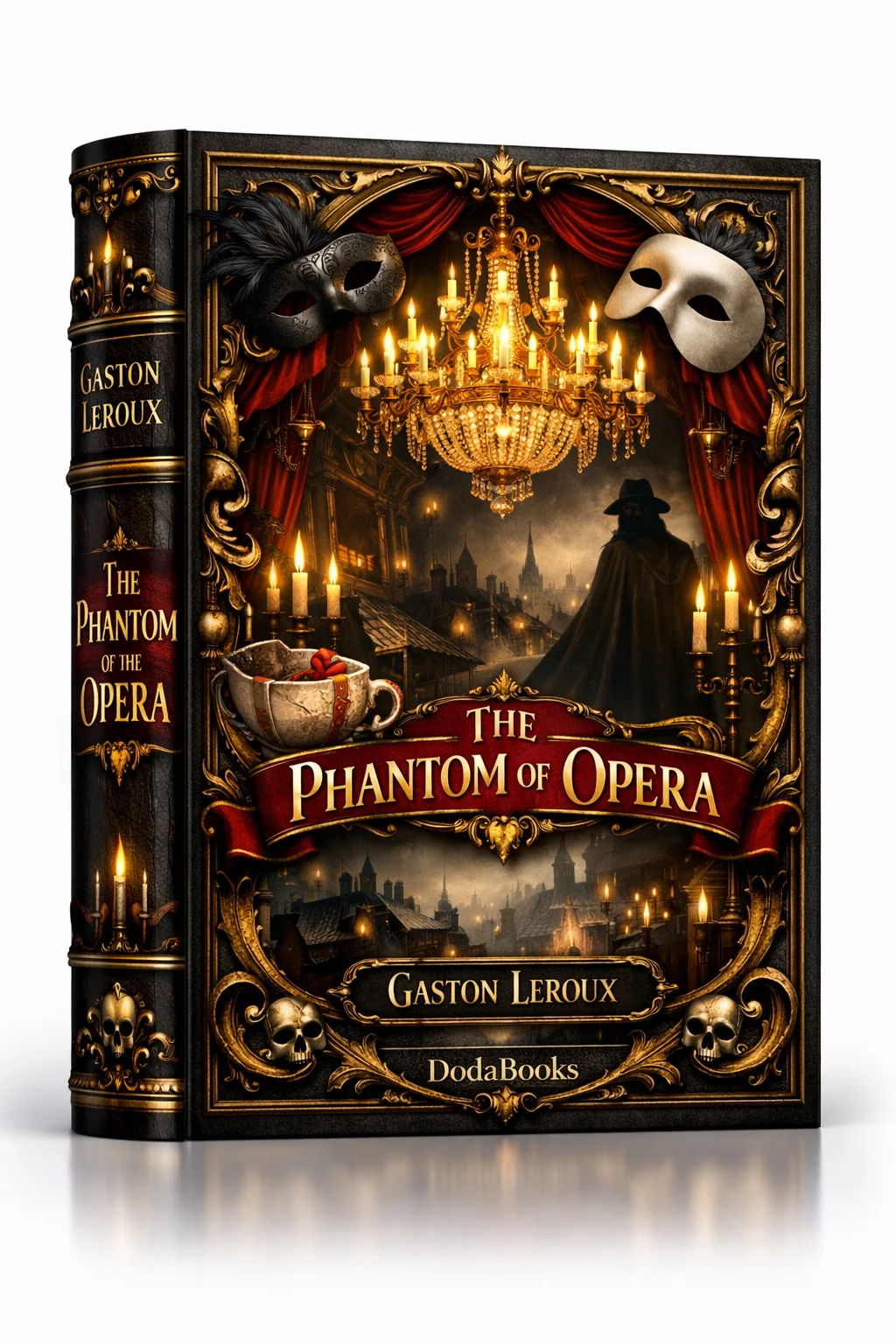
Gaston Leroux’s The Phantom of the Opera weaves romance, mystery, and horror into a tale of a disfigured musical genius who haunts the Paris Opera House. Published in 1910, this French Gothic masterpiece has captivated readers for over a century and inspired Andrew Lloyd Webber’s iconic musical, one of the longest-running in Broadway history.
🎭
The Phantom of the Opera
A Gothic masterpiece of obsession and music set in the labyrinthine depths of the Paris Opera House.
| Author | Gaston Leroux |
| Published | 1910 |
| Genre | Gothic fiction, romance, mystery |
| Chapters | 28 |
| Setting | Palais Garnier, Paris — stages, passageways, and the underground lake |
| Legacy | Inspired Andrew Lloyd Webber’s iconic musical |
📖 The Music of the Night
The story opens at the Palais Garnier, the grand opera house of Paris, where strange events have been plaguing the management. A mysterious “Opera Ghost” has been demanding a private box, a salary, and the attention of the new soprano, Christine Daaé. The managers dismiss the demands as a hoax — until the consequences of ignoring them prove fatal.
Christine Daaé, a young Swedish soprano, has been visited by a figure she calls the Angel of Music — her father’s promise sent from heaven to guide her singing. In truth, this angel is Erik, a brilliantly talented but hideously deformed man who lives in the labyrinthine passages beneath the opera house. Born with a face so grotesque that it terrifies all who see it, Erik has fashioned a hidden world beneath the stages — complete with a underground lake, a candlelit chamber, and a dwelling place where he can pursue his musical genius in secret.
Erik becomes obsessed with Christine, coaching her voice to extraordinary heights while keeping her isolated from the world. When she falls in love with her childhood sweetheart, Raoul de Chagny, Erik’s jealousy erupts into a campaign of terror. He abducts Christine to his underground lair, murders those who stand in his way, and threatens to destroy the entire opera house unless Christine agrees to be his.
The climax takes place during a lavish masquerade ball and a performance of Faust, as Raoul and the mysterious Persian attempt to rescue Christine from Erik’s clutches. The final confrontation reveals the depth of Erik’s suffering and the transformative power of Christine’s compassion, leading to a resolution that is both heartbreaking and unexpectedly tender.
🎭 Key Characters
Erik (The Phantom)
A musical genius of extraordinary talent, cursed with a face so deformed it inspires horror in all who see it. Erik is both villain and victim — a man driven to crime and cruelty by a lifetime of rejection, yet capable of profound love and artistry. His complexity makes him one of Gothic literature’s most compelling figures.
Christine Daaé
A young Swedish soprano whose angelic voice captivates both Erik and Raoul. Christine is torn between her gratitude and fascination with the Phantom and her genuine love for Raoul. Her compassion for Erik — seeing beyond his monstrous exterior to the suffering man within — gives the story its emotional depth.
Raoul de Chagny
Christine’s childhood sweetheart and devoted lover. Raoul is brave and noble, willing to risk everything to rescue Christine from the Phantom’s clutches. He represents the conventional romantic hero, though Leroux gives him enough vulnerability to feel human rather than archetypal.
The Persian
A mysterious figure from Erik’s past who understands the Phantom’s true nature. The Persian provides crucial exposition about Erik’s history and serves as an unlikely ally during the final rescue attempt. His knowledge of the opera house’s secret passages proves essential to the climax.
📖 Literary Significance
The Phantom of the Opera stands as one of the defining works of French Gothic fiction. Leroux created a story that operates on multiple levels simultaneously — as a thrilling mystery, a poignant love story, a horror tale, and a meditation on art, beauty, and human compassion. The Palais Garnier itself becomes a character, its grandeur concealing darkness and its architecture hiding secrets that mirror the story’s themes.
The novel’s influence on popular culture is immeasurable. While Andrew Lloyd Webber’s 1986 musical brought the story to a global audience, Leroux’s original text offers a darker, more complex vision. The novel Erik is more terrifying and more sympathetic than his musical counterpart, and the plot includes elements — including the Persian’s backstory and the opera house’s catastrophic fire — that the musical largely omits.
Leroux blended fact and fiction with masterful skill. The Palais Garnier is real, and some of the novel’s details — including the underground lake and the idea of a haunted opera house — were drawn from actual rumors about the building. This blending of the real and fantastical gives the story an air of authenticity that enhances its power. The novel remains essential reading for anyone interested in Gothic literature, romance, or the darker side of artistic obsession.
✨ What Makes the DodaBooks Edition Special
This is the original 1910 text, carefully prepared for modern readers without distractions or clutter.
Zero Distractions
No ads, no license pages, no project boilerplate — just the original novel, clean and uninterrupted.
Smart Typography
Curly quotes, em-dashes, proper ellipsis — typeset with care for a premium reading experience.
Chapter Navigation
Full table of contents with back-to-chapter links in every section — jump between all 28 chapters effortlessly.
Cleaned & Polished
All Gutenberg boilerplate stripped, consistent formatting throughout the text.
No DRM
You own your copy — read on any device, anytime, forever.
Instant Download
EPUB + PDF + AZW3 formats included, delivered instantly after purchase.
🏛️ Historical Context: The Real Paris Opera House
The Palais Garnier is real, and so — astonishingly — is much of what Leroux describes. The opera house, completed in 1875, still sits over an underground reservoir that helps balance the weight of its foundation, and that genuine lake became the seed of Erik’s secret kingdom. The grand staircase, the private boxes, the miles of dim cellars beneath the stage — all are drawn with accuracy. Leroux even reworks a genuine disaster: in 1896 a counterweight crashed a chandelier into the auditorium and killed a woman. He also borrows the building’s real reputation for being haunted, and he had the perfect training to exploit it. By 1910 he was a veteran Parisian crime reporter, and much of the novel’s power comes from that investigative voice.
🎭 Themes: Obsession, Beauty, and the Mask
Erik is the engine of the book, and Leroux takes care to show where his obsession comes from. He was never allowed to be anything but a monster; the world recoiled from his face before he committed a single crime, and cruelty followed rejection. Christine wants the opposite — to be loved for what she is, not what she looks like — yet the two men who pursue her both want to possess her. Raoul wants her saved; Erik wants her wholly; between them the novel asks a startlingly modern question about what it means to be truly seen. The mask carries that question. Everyone wears one — Erik’s dead-white covering, the public faces of managers and divas, and the secret cellars the Opera House hides beneath its grandeur. Art is the one place the mask slips, which is why Erik, the greatest unmasked failure of them all, composes music underground that no one will ever hear. For another Gothic tale of a man at war with his own reflection, see Dr Jekyll and Mr Hyde.
📖 Why the Novel Still Matters
The story has lasted over a century because it rests on fears that do not age: the terror of not being loved, of being judged by the surface and misunderstood within. Lloyd Webber’s musical made the Phantom famous, but the novel offers what no stage show can — Erik’s interior world, the Persian’s account of his past, and an ending that is genuinely heartbreaking rather than merely romantic. If you know only the musical, expect to be surprised by how much more Leroux gives you.
✍️ How to Read It
The chapters are short and the plot moves fast, so the practical route is a quick first read to follow the chase, then a slower second pass for the machinery. Keep a mental map of the building — the stage above, the lake below — and remember that the final chapters rewrite everything you thought the abduction meant. Readers who enjoy Leroux’s blend of detective structure and Gothic dread should continue with Dracula or Frankenstein, where horror is once again powered less by monsters than by human longing.
❓ Frequently Asked Questions
How does the novel compare to the musical?
Leroux’s novel is darker and more complex. The Phantom is more terrifying, the plot includes political intrigue and a catastrophic fire, and the ending differs significantly. The musical focuses on the love triangle; the novel is also a murder mystery and a story about artistic obsession.
Is Erik based on a real person?
Leroux claimed inspiration from rumors about a mysterious figure at the Palais Garnier, though there is no confirmed historical basis for Erik. The character draws on Gothic archetypes — the disfigured genius, the beast beneath the mask — while feeling startlingly modern in his psychological depth.
How long does it take to read?
At roughly 284 pages across 28 chapters, most readers finish in 6–8 hours. The chapters are short and the plot moves quickly, making it an accessible read despite its age.
Is the book scary?
The novel contains genuine horror elements — murder, abduction, and scenes of terror in the opera house’s underground passages. However, it is primarily a romance and mystery rather than a pure horror story. The atmosphere is more Gothic dread than graphic violence.
Is the story based on true events?
While the Palais Garnier is a real building and rumors of a haunted opera house existed, the story is fiction. Leroux blended real locations and historical details with invented characters and plot to create a convincing sense of authenticity.
Is the Phantom a hero or a villain?
He is both. Leroux never lets you forget that Erik’s crimes grow out of a lifetime of rejection — the world made him a monster before he behaved like one. That ambiguity is what separates the novel from the musical’s simpler romance, and it is why the final chapters feel so unsettling.
What is really underneath the Palais Garnier?
A genuine underground reservoir of water sits below the opera house, and it still exists today. Leroux took that real feature and turned it into Erik’s domain of lakes, tunnels, and secret rooms — one of the finest examples in Gothic fiction of building horror on a foundation of accurate detail.
📚 Related Articles
Readers captivated by tragic Parisian romance and societal scandal should also read Alexandre Dumas fils’ Camille (La Dame aux Camélias) Guide.
📖 Read the Original Classic
The Phantom of the Opera is one of the most beloved Gothic novels ever written. The DodaBooks edition preserves the complete original text in a clean, distraction-free format:
- ✅ Complete 28-chapter novel — every word of the 1910 edition
- ✒️ Smart typography — curly quotes, em-dashes, proper ellipsis
- 📜 Full table of contents with chapter navigation
- 🔒 DRM-free — read on any device, anytime
- 📥 Instant download — EPUB + PDF + AZW3 formats