G. K. Chesterton’s The Man Who Was Thursday: A Nightmare is a metaphysical thriller unlike any other — part detective story, part philosophical allegory, and part surreal fever dream. Gabriel Syme, a poet recruited as a detective, infiltrates a secret council of seven anarchists. But nothing is as it seems. Each of the seven councillors is hiding a secret, and the rabbit hole goes far deeper than Syme could have imagined.
🌙
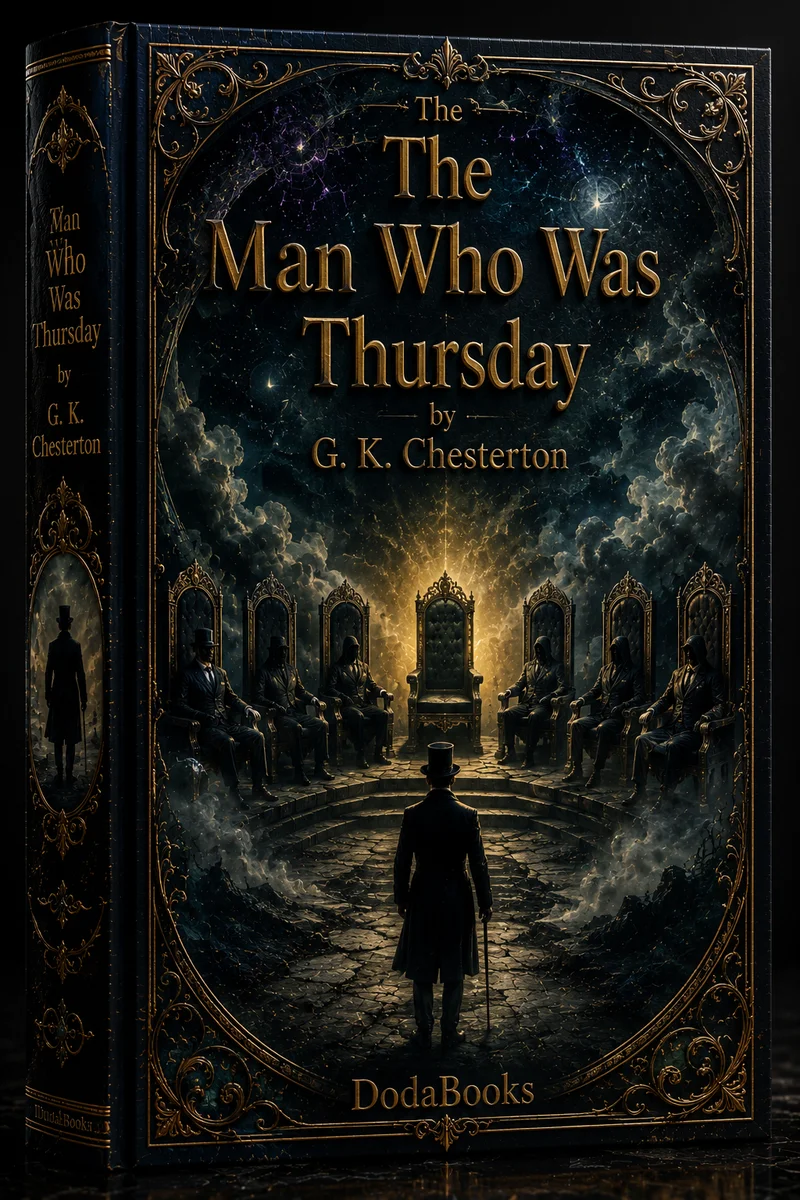
The Man Who Was Thursday
A poet infiltrates a council of anarchists only to discover each member is a disguised police detective — a surreal nightmare that questions order, chaos, and the nature of God.
| Author | G. K. Chesterton |
| Published | 1908 |
| Genre | Philosophical thriller, allegory, surrealist fiction |
| Chapters | 15 |
| Setting | Edwardian London and a surreal countryside — Saffron Park, Scotland Yard, and a dreamlike chase across England |
| Legacy | Widely considered Chesterton’s masterpiece; a cult classic that defies genre classification |
🌙 The Story
Gabriel Syme is a poet who lives in Saffron Park, a bohemian suburb where artists and anarchists debate the nature of the universe. After a heated argument, Syme is recruited into Scotland Yard’s elite secret anti-anarchist police force. His mission: infiltrate the Central Council of Anarchists, whose seven members are code-named after the days of the week.
Syme gains entry as Thursday. At the council’s first meeting, he meets the terrifying Sunday, the enormous, inscrutable president. But when Monday is accused of being a traitor and his mask is torn off, Syme discovers the first of many shocks: Monday is also a police detective.
So begins a story that grows progressively stranger. One by one, each member of the council is revealed to be a disguised policeman — Tuesday, Wednesday, Thursday (Syme himself), Friday, Saturday — all are detectives. All except the mysterious Sunday, who presides over them with an inscrutable calm.
The second half of the novel becomes a surreal chase across the English countryside. The six detectives pursue Sunday, who seems to be everywhere and nowhere, leaving behind a trail of philosophical riddles. Each detective represents a different philosophical position — order, chaos, science, skepticism — and their conversation as they chase is a running debate on the meaning of existence.
The final confrontation with Sunday is one of the most extraordinary scenes in English literature. In a vast, dreamlike courtroom, Sunday reveals himself as something far beyond what any of them expected — a figure who transcends their categories of order and chaos, good and evil.
🎭 Key Characters
Gabriel Syme
Syme is a poet turned detective, a passionate believer in order and civilization who volunteers to fight the forces of chaos. He is brave, idealistic, and increasingly bewildered as the layers of reality peel away. His journey from confident crusader to humble questioner is the heart of the novel.
Sunday
The president of the council, Sunday is enormous, silent, and utterly mysterious. He laughs at inappropriate moments, seems to know everything, and moves through the world with an incomprehensible purpose. He is the novel’s central symbol — representing God, nature, fate, or something beyond all categories.
The Other Days
Each member of the council represents a different philosophical stance: Monday (Gogol) is a nihilist, Tuesday (the Marquis de Saint-Eustache) is a dandy, Wednesday (Professor de Worms) is a skeptic, Friday (Dr. Bull) is a scientist, and Saturday (the Secretary) is a quiet everyman. Their disguises as anarchists conceal not just their identities as detectives but their deeper roles as representatives of order within chaos.
📖 Literary Significance
The Man Who Was Thursday defies easy categorization. It is a detective story, a philosophical dialogue, a religious allegory, and a surrealist novel written a decade before surrealism existed. Chesterton called it a “nightmare,” and the book has the logic of a dream — events follow a pattern that makes sense while you are experiencing it, even if they defy rational explanation afterward.
The novel is a profound exploration of Chesterton’s central themes: the paradox of order and chaos, the problem of evil, and the mysterious nature of existence. Why does God permit suffering? Why does the world seem both beautiful and terrible? The book’s answer — hinted at in Sunday’s final words — is that the apparent chaos of the world conceals a deeper order that we cannot fully comprehend.
H. G. Wells called it “the most amazing, the most original book of our time,” and it has influenced everyone from Jorge Luis Borges to Stephen Colbert. Its dream logic anticipates Kafka, and its philosophical depth rewards repeated readings.
✨ What Makes the DodaBooks Edition Special
This is the original 1908 text, carefully prepared for modern readers without distractions or clutter.
Zero Distractions
No ads, no license pages, no project boilerplate — just the original novel, clean and uninterrupted.
Smart Typography
Curly quotes, em-dashes, proper ellipsis — typeset with care for a premium reading experience.
Chapter Navigation
Full table of contents with back-to-chapter links in every section — jump between all 15 chapters effortlessly.
Cleaned & Polished
All Gutenberg boilerplate stripped, consistent formatting throughout the text.
No DRM
You own your copy — read on any device, anytime, forever.
Instant Download
EPUB format included, delivered instantly after purchase.
🏛️ Historical Context: The Anarchist Panic of 1908
The Man Who Was Thursday appeared in 1908, at the peak of a genuine moral panic. European anarchists had assassinated a Russian tsar, a French president, an Italian king, and an American president within living memory, and London’s newspapers were full of plots, bombs, and exiled conspirators from Russia and Italy. Chesterton — a natural believer in order, home, and faith — watched the hysteria with rising amusement: the more frantic the papers grew, the more absurd the whole spectacle seemed. Rather than write a pamphlet, he wrote a chase. Where contemporaries like Conrad treated the anarchist as a brooding, unknowable threat, Chesterton flipped the genre on its head: every sinister revolutionary turns out to be a policeman in disguise. He was mocking the age’s terror of the unknown and quietly puncturing his own side’s complacency in a single gesture.
🔮 Masks, Days, and the Size of Things: Symbolism
The book is written in code, and Chesterton happily leaves the key half-visible. The seven days of the week are more than nicknames; they suggest that time itself stands under authority, that the calendar is a silent conspiracy of order. Masks fall off at the most theatrical moments, and every unmasking only reveals another mask — until the six detectives are left staring at Sunday, the single face that never explains itself. Sunday’s size is the oldest trick of all: Chesterton’s God is not a small supervision but a huge, laughing, uncontrollable presence. Critics have read Sunday as God, as nature, as fate, or as a mere joke, and Chesterton kept every reading open on purpose. The chase itself is the argument, because the six pursuers stand for order, science, scepticism, mystery, and plain decency, and the quarrelling among them is the human condition.
🎓 Why It Still Matters
The novel has survived every shift in literary fashion because its questions never date. Can you trust your own senses? Are the powers that be secretly in league with the powers that seem to oppose them? What would it change if the respectable and the anarchist turned out to be the same people wearing different masks? In an age of conspiracy theories, surveillance, and identity as performance, The Man Who Was Thursday reads not like a Victorian curiosity but like a freshly written prophecy. Its dream logic, which unnerved readers in 1908, now looks suspiciously like the most accurate realism we have.
✍️ Reading Tips for the Nightmare
Do not try to solve it — that is the trap. The book is a nightmare with the logic of a nightmare, and forcing it into the shape of a conventional plot is the one sure way to spoil it. Read fast, enjoy the bravura set pieces — the pursuit over the rooftops, the balloon journey, the impossible final banquet — and let the philosophy arrive through the action rather than in front of it. Chesterton’s Father Brown stories show the same mind thinking in miniature, and The Innocence of Father Brown is the gentlest companion. For the period’s darker treatment of the same material, The Secret Agent is Conrad’s brooding counterpoint. If you want the logic of nightmare pushed further, The Call of Cthulhu and Dr. Jekyll and Mr. Hyde explore adjacent rooms of the same strange palace.
❓ Frequently Asked Questions
Is this a detective story or a philosophical book?
Both. It begins as a detective thriller — a poet infiltrates an anarchist council — and gradually transforms into a philosophical allegory about order, chaos, and the nature of God. Chesterton called it a “nightmare,” and it operates by dream logic, where the thriller and the philosophy are inseparable.
What does the title mean?
The “Thursday” of the title refers to the main character’s code name on the Central Council of Anarchists, where each member is named after a day of the week. Gabriel Syme is “Thursday.” The “Man Who Was Thursday” refers both to Syme’s role in the council and to the deeper question of identity that runs through the novel.
Do I need to understand philosophy to enjoy it?
No — the philosophy is woven into an exciting adventure story. You can enjoy it purely as a surreal thriller on a first reading. The philosophical depth adds richness for those who want it, but the story works perfectly well as a wild chase narrative.
How long does it take to read?
At 204 pages in the DodaBooks edition, most readers finish in 4-6 hours. The short chapters and propulsive plot make it a fast read, though the ideas may linger much longer.
Is the ending satisfying?
The ending is one of the most debated and celebrated in English literature. It does not provide tidy answers — instead, it opens up into a vast, mysterious resolution that some find transcendent and others find baffling. Most readers need to read the final chapter at least twice.
Is The Man Who Was Thursday suitable for younger readers?
Yes — it is an adventure story first and a philosophical debate second. The chase scenes, disguises, and theatrical unmaskings delight younger readers, while the ideas reward older ones. It appears regularly on school and college reading lists for exactly that reason.
What should I read next after finishing it?
Chesterton’s Father Brown stories are the same mind working in miniature and make a perfect next step. For a darker spin on the same themes, try Joseph Conrad’s The Secret Agent, which treats the anarchist panic as tragedy rather than comedy — a stark contrast to Chesterton’s farce.
Is Sunday meant to be God?
The book encourages the reading without ever locking it in. Sunday is enormous, generous, inscrutable, and laughs at the smallness of his pursuers — Chesterton clearly shaped him with a divine model in mind. But he refuses to name the meaning, and the novel closes on a question rather than an answer, which was exactly the effect he wanted.
📚 Related Articles
🌙 Read the Original Surreal Masterpiece
The Man Who Was Thursday is one of the most original novels ever written — a detective story, a philosophical allegory, and a dream. The DodaBooks edition preserves the complete original text in a clean, distraction-free format:
- ✅ Complete 15-chapter novel — every word of the 1908 edition
- ✒️ Smart typography — curly quotes, em-dashes, proper ellipsis
- 📜 Full table of contents with chapter navigation
- 🔒 DRM-free — read on any device, anytime
- 📥 Instant download — EPUB format