A practical chapter-by-chapter guide to teaching Moby-Dick in high school ELA, with annotations, allusions decoded, and classroom strategies for every stage of the Pequod’s voyage. Perfect for teachers planning their next American literature unit.
🐋
Teaching Moby-Dick: Complete Chapter-by-Chapter Guide for Teachers
A practical chapter-by-chapter guide to teaching Moby-Dick in high school ELA, with annotations, allusions decoded, and classroom strategies for every stage of the Pequod’s voyage...
| Novel length | 135 chapters + epilogue |
| Teaching focus | Themes, allusions, symbolism, character analysis |
| Key sections | The Setting Forth (Ch. 1–22), The Hunt (Ch. 23–126), The Chase (Ch. 127–Epilogue) |
| Best for | Grades 10–12 American Literature, AP English |
| Estimated time | 6–8 weeks for full novel study |
| Essential chapters | 1, 28, 36, 41, 42, 110, 135 |
🎓 Why Teach Moby-Dick?
Moby-Dick is often taught only in excerpts — the famous opening lines, the “whiteness of the whale” chapter, the final chase scene. But students who read the full novel (or a thorough guided version) encounter one of the most ambitious works in American literature: part adventure story, part philosophical meditation, part encyclopedia of whaling.
The novel rewards close reading on every page. Melville layers biblical allusions (Ishmael, Jonah, Ahab), Shakespearean drama (the soliloquies, the stage directions, the five-act structure), and philosophical questions about fate, free will, obsession, and the nature of evil.
The challenge is that the novel is long, digressive, and filled with archaic whaling terminology. Students can get lost in the “cetology” chapters and lose sight of the narrative thread.
📋 Structure of the Novel
Melville organized Moby-Dick in 135 chapters plus an epilogue, divided into three broad movements:
The Setting Forth (Chapters 1–22): Ishmael arrives in New Bedford, meets Queequeg, and they ship aboard the Pequod. Captain Ahab is revealed and the crew learns the true purpose of the voyage.
The Hunt (Chapters 23–126): The Pequod sails across the Atlantic and Indian Oceans, encountering other whalers and chasing whales. Interspersed with cetology chapters that classify whales and explain whaling practices.
The Chase (Chapters 127–Epilogue): Ahab’s pursuit of the White Whale intensifies. The Pequod encounters the Rachel, the Delight, and finally Moby-Dick himself. The novel ends with the Pequod’s destruction.
How do I handle the cetology chapters in class? The cetology chapters can be treated as interludes rather than required reading. Use them to discuss Melville’s encyclopedic ambition and the 19th-century fascination with scientific classification. The annotated edition distinguishes story chapters from essay chapters so you can assign accordingly.
📖 Save hours of lesson planning time
👉 Get the Annotated Edition🔥 Key Themes to Track
Obsession and Monomania: Ahab isn’t just angry — he’s clinically obsessed. His monomania consumes everything and everyone around him. The novel asks: where is the line between determination and self-destruction?
Fate vs. Free Will: Is Ahab in control of his choices, or is he driven by forces beyond his understanding? The “quarterdeck” chapter (Chapter 36) stages this debate through Ahab’s ritual with the crew.
The White Whale as Symbol: Is the whale evil? Is it nature? Is it God? Is it meaningless? Melville deliberately keeps Moby-Dick’s meaning ambiguous. Students should recognize that multiple interpretations are valid.
Friendship and the Other: The relationship between Ishmael and Queequeg subverts 19th-century racial hierarchies. Queequeg is portrayed with dignity, intelligence, and spiritual depth — a remarkable choice for 1851.
The Limits of Knowledge: Ahab wants to “strike through the mask” and understand the ultimate nature of reality. The novel suggests some things can’t be known — and the attempt to know them can destroy you.
📜 The Allusions That Matter Most
Moby-Dick draws heavily on the Bible and Shakespeare. Here are the allusions that appear most frequently and are most worth teaching:
Ishmael (Genesis): The narrator names himself after Abraham’s outcast son. The reference signals that Ishmael is an orphan, a wanderer, and a survivor.
Ahab (1 Kings): An evil king who worshipped false gods and met a violent death. Melville’s Ahab follows the same pattern.
Jonah (Book of Jonah): The prophet swallowed by a whale. Ishmael’s survival in Queequeg’s coffin-parody echoes Jonah’s story.
King Lear and Macbeth: Ahab’s soliloquies and his descent into madness borrow directly from Shakespeare. Students who know Lear and Macbeth will recognize the patterns.
Job (Book of Job): The righteous man who questions God’s justice. Ahab’s defiance of the “pasteboard masks” of reality echoes Job’s demands.
Where can I find these allusions explained in context? The annotated edition of Moby-Dick includes an Allusion Decoder for every chapter that explains biblical, Shakespearean, and classical references as they appear.
👥 Crew Manifest: Who’s Who on the Pequod
Students often lose track of the large cast. Here are the essential characters:
Captain Ahab: The monomaniacal captain. Missing a leg from his first encounter with Moby-Dick. Driven by vengeance.
Ishmael: The narrator. The only survivor. His voice is philosophical, witty, and reflective.
Queequeg: A harpooneer from the South Pacific. Ishmael’s closest friend. Brave, loyal, and wise.
Starbuck: The first mate. Rational, cautious, and religious. He senses Ahab’s madness but cannot stop him.
Stubb: The second mate. Easygoing and fatalistic. Laughs at everything, including danger.
Flask: The third mate. Practical and unimaginative. Sees whaling purely as a business.
Fedallah: A mysterious Parsee (Persian) who serves as Ahab’s harpooneer and dark advisor.
Pequod: The ship itself — named after the Pequod tribe of New England, who were nearly exterminated. The name is a warning.
🐋 Annotated Chapter Highlights
Not every chapter needs equal attention. Here are the essential chapters for classroom focus:
Chapter 1 — Loomings: The famous opening. “Call me Ishmael.” Establishes the narrator’s voice, the theme of water as freedom, and the compulsion to go to sea.
Chapter 28 — Ahab: Ahab’s first appearance on deck. The scar, the ivory leg, the “crucifixion in his face.” This is where students understand they’re reading a tragedy.
Chapter 36 — The Quarterdeck: Ahab nails the gold doubloon to the mast and rallies the crew. The chapter reads like a stage scene — use it for dramatic reading.
Chapter 41 — Moby-Dick: Ishmael’s direct meditation on the White Whale. Melville lays out the interpretation of the whale as symbolic without reducing it to any single meaning.
Chapter 42 — The Whiteness of the Whale: The most famous essay chapter. Why is whiteness terrifying? A masterclass in symbolic reading.
Chapter 110 — Queequeg in His Coffin: Queequeg’s illness and his construction of a coffin that becomes a life buoy. Foreshadowing and friendship converge.
Chapter 135 — The Chase — Third Day: The final confrontation. The Pequod sinks, the whale is victorious, and Ishmael survives on Queequeg’s coffin.
💬 Anticipating Student Questions
“Why is there so much about whales?” Melville was writing a “whale book” — part adventure, part natural history, part epic poem. The cetology chapters reflect his belief that understanding the whale was essential to understanding the story.
“Is the whale evil?” No — but Ahab believes it is. Melville leaves the question open. The whale is a force of nature, not a moral agent. The evil is in Ahab’s obsession, not in the whale.
“Why does everyone die except Ishmael?” Ishmael is the narrator — he has to survive to tell the story. But Melville also suggests that Ishmael survives because he is the one character who questions, reflects, and learns.
🧩 What the Annotated Edition Unlocks
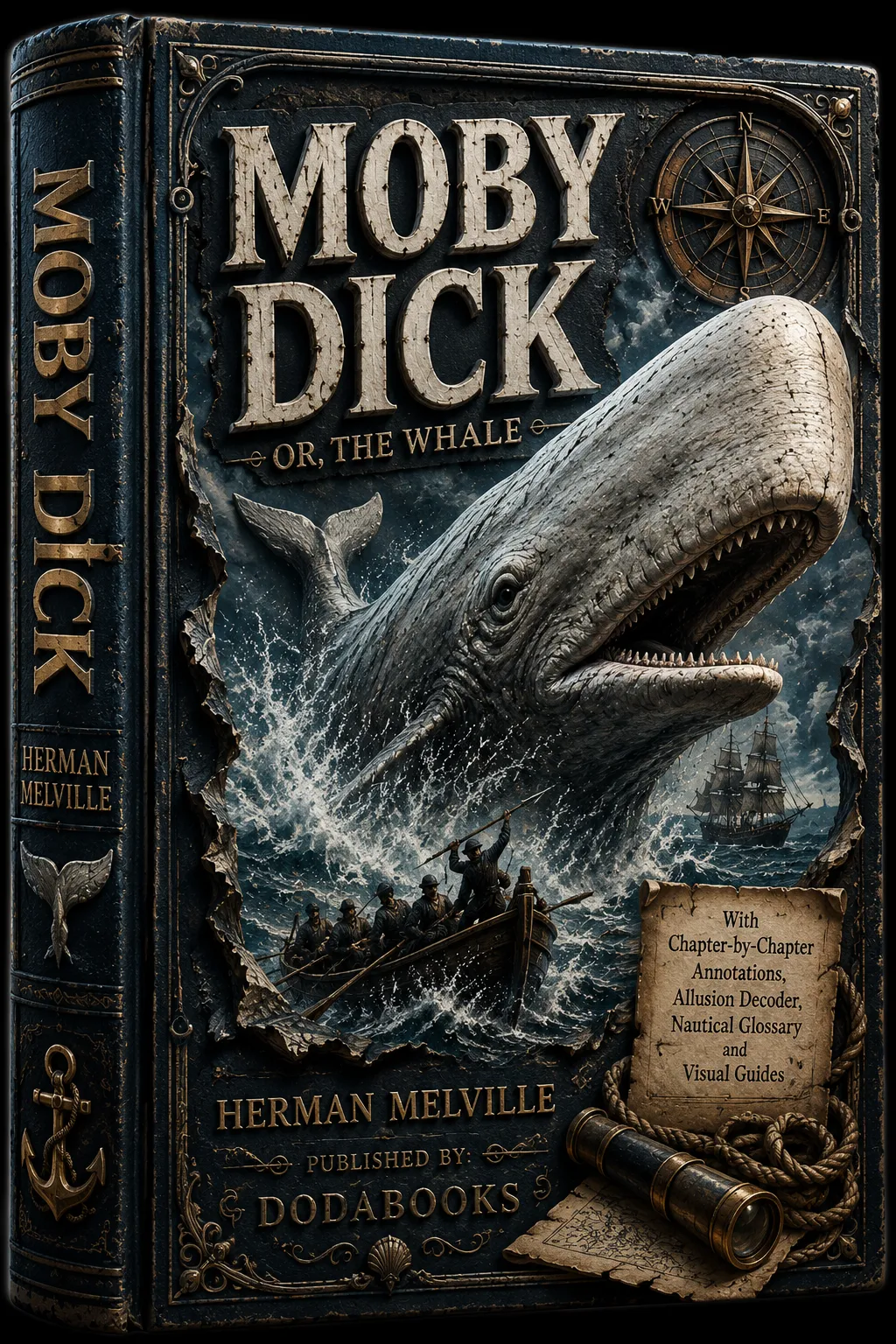
81 Annotated Chapters
Every major chapter includes detailed explanatory notes covering historical context, symbolism, and literary techniques — perfect for lesson planning and classroom discussion.
Allusion Decoder
Hundreds of biblical, Shakespearean, and classical references identified and explained in context. Never miss a reference to Jonah, King Lear, or the Book of Job again.
Nautical Glossary
Over 200 whaling and maritime terms defined in plain English. From “blubber” to “try-works” — every piece of 19th-century sailing vocabulary at your fingertips.
Complete Crew Manifest
Detailed profiles of every character from Ahab to the cabin boy Pip. Relationship maps show how the crew connects and why each person matters to the story.
Symbolism Guide
Chapter-by-chapter breakdown of the novel’s major symbols: the white whale, the doubloon, the coffin, the sea, and the Pequod itself — with multiple interpretive angles.
Historical Context
The real story of the Essex shipwreck, the Nantucket whaling industry, Melville’s own sea voyages, and the 19th-century world that shaped the novel.
❓ Frequently Asked Questions
How long should I spend teaching Moby-Dick?
Plan for 6–8 weeks for a full novel study. Focus on the essential chapters (1, 28, 36, 41, 42, 110, 135) if time is limited, and treat cetology chapters as optional interludes. The annotated edition marks story chapters vs. essay chapters so you can prioritize effectively.
What grade level is appropriate for Moby-Dick?
Most teachers place Moby-Dick in grades 10–12. The vocabulary and sentence structure are challenging even for advanced readers. The annotated edition helps by providing inline explanations for difficult passages, making the novel accessible to a wider range of students.
How do I assess student understanding?
Use the discussion questions in the annotated edition for formative assessment. For summative assessment, assign analytical essays on themes (obsession, fate, friendship) or have students trace a single symbol (the whale, the doubloon, the coffin) through the novel.
What should I do about the cetology chapters?
Assign them selectively. Chapter 32 (“Cetology”) introduces Melville’s classification system and is worth discussing as a structural choice. Other cetology chapters can be summarized or skipped. Use them to discuss what Melville was trying to achieve with his encyclopedic approach.
Which film adaptation should I show?
The 1956 John Huston adaptation starring Gregory Peck is the most widely available. It captures the novel’s epic scope but simplifies the philosophical content. Show clips after reading key chapters (36, 135) rather than the full film, which takes significant liberties with the plot.
How can I help struggling readers access the text?
Pair struggling readers with the annotated edition, which provides paragraph-by-paragraph explanations alongside the original text. Use dramatic readings for key chapters (36 works especially well as a classroom performance). Assign audio versions for at-home reading.
What are the most important themes to teach?
Focus on four: obsession and monomania (Ahab’s arc), fate vs. free will (the quarterdeck scene), the meaning of the white whale (Chapter 42), and friendship across difference (Ishmael and Queequeg). These four themes give students a framework for understanding the entire novel.