A quick revision summary of major Robert Burns poems — key themes, famous lines, and what each poem is about. Perfect for exam prep or a fast overview of Scotland’s national poet.
Summary of Major Robert Burns Poems (Quick Revision Guide)
A fast, focused summary of the major Robert Burns poems — subject, key theme, famous lines, and the single most important thing to know about each one.
👉 Get the Annotated Edition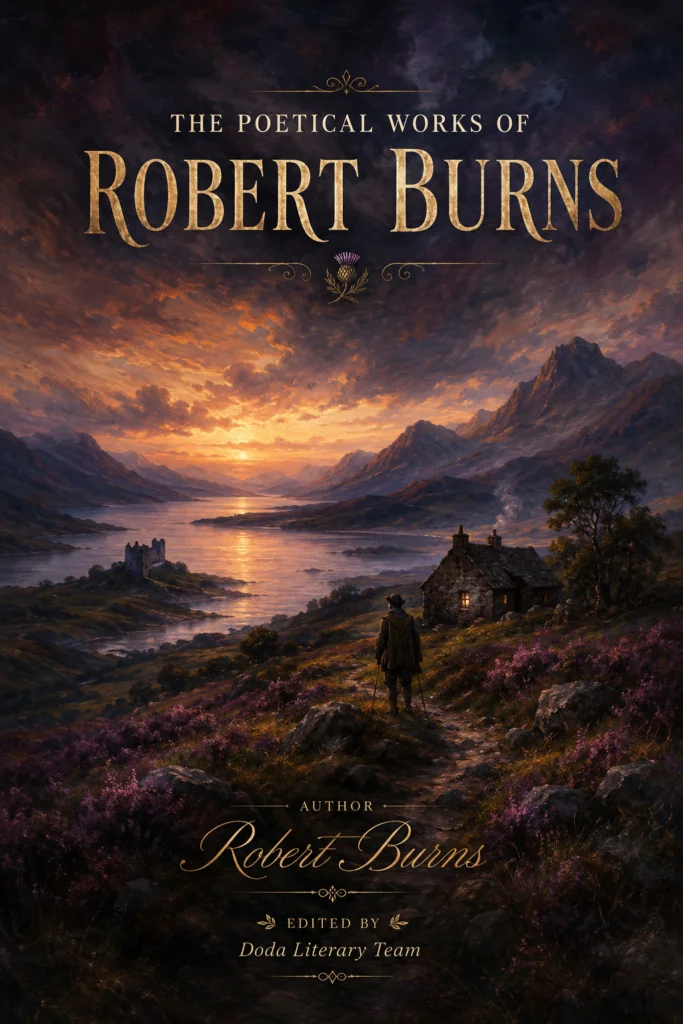
| Poet | Robert Burns (1759–1796) |
| Poems Covered | 7 major works |
| Key Themes | Love, equality, nature, Scottish identity |
| Best For | Exam revision, quick reference |
| Annotated Edition | All 539 poems with line-by-line help |
✍️ “A Red, Red Rose” (1794)
Subject: A man promises eternal love to his beloved. Key theme: Unconditional, everlasting love. Famous line: “O my Luve is like a red, red rose” Key point: Burns uses deliberate exaggeration (hyperbole) — love that lasts until seas dry and rocks melt.
🐭 “To a Mouse” (1785)
Subject: Burns apologises to a mouse whose nest he destroyed while ploughing. Key theme: The fragility of all plans — human and animal. Famous line: “The best-laid schemes o’ mice an’ men gang aft agley” Key point: John Steinbeck borrowed the title Of Mice and Men from this poem.
🍺 “Tam o’ Shanter” (1790)
Subject: A drunk farmer stumbles into a witches’ coven and barely escapes. Key theme: The consequences of excessive drinking and risky behaviour. Famous line: “Wi’ tippenny, we fear nae evil” Key point: Burns’s only narrative poem and his most entertaining work.
💋 “Ae Fond Kiss” (1791)
Subject: A final kiss goodbye to a woman Burns loved but could not keep. Key theme: The pain of necessary separation. Famous line: “Never met or never parted — We had ne’er been broken-hearted” Key point: Written for Agnes McLehose, a love that could not be.
👑 “A Man’s a Man for A’ That” (1795)
Subject: True worth comes from character, not wealth or birth. Key theme: Human equality and social justice. Famous line: “The honest man, though e’er sae poor, is king o’ men for a’ that” Key point: Burns’s most direct political statement, often sung at Burns Suppers.
👁️ “To a Louse” (1786)
Subject: A louse crawling on a woman’s hat in church becomes a lesson in humility. Key theme: Self-awareness and not judging others. Famous line: “O wad some Pow’r the giftie gie us To see oursels as ithers see us” Key point: Burns uses a disgusting insect to teach a universal truth.
🥘 “Address to a Haggis” (1786)
Subject: A hilarious, proud tribute to Scotland’s national dish. Key theme: Scottish identity and cultural pride. Famous line: “Great chieftain o’ the pudding-race!” Key point: Recited at Burns Suppers worldwide.
🥂 “Auld Lang Syne” (1788)
Subject: A song remembering old friends and times past, and toasting the friendship that endures across the years. Key theme: Nostalgia, friendship, and shared memory. Famous line: “Should auld acquaintance be forgot, / and never brought to mind?” Key point: Burns adapted an older Scots folk phrase, and his version became the New Year’s anthem sung worldwide — at Hogmanay, Burns Suppers, and every parting worth marking.
⚔️ “Scots Wha Hae” (1793)
Subject: A patriotic war song put into the mouth of Robert the Bruce before the Battle of Bannockburn, calling the Scots to fight for freedom. Key theme: National pride, liberty, and sacrifice. Famous line: “Scots, wha hae wi’ Wallace bled, / Scots, wham Bruce has aften led” Key point: Burns wrote it to the tune of an old song and gave it a stirring, martial urgency that still makes it Scotland’s unofficial anthem of independence and courage.
🏛️ The Man Behind the Poems
Reading Burns’s major poems together reveals a single, consistent sensibility rather than a scatter of unrelated works. Born in 1759 in Ayrshire, the son of a struggling tenant farmer, Burns knew poverty, manual labour, and the rhythms of rural Scotland from the inside — which is why his poems about field mice, fairground drinkers, and proud labourers feel so personal. He was also fiercely literate, widely read in English poetry, and politically radical for his time, sympathetic to the French Revolution and to ideals of human equality.
That mix of farmyard realism and Enlightenment idealism is the key to his most famous work. “To a Mouse” takes a tiny ploughing accident and turns it into a meditation on whether anyone can truly plan their life. “To a Louse” finds wisdom in a crawling insect. “A Man’s a Man for A’ That” argues that human worth has nothing to do with rank or riches. Burns kept one foot in the stubble field and one in the poetry of ideas, and it is precisely that tension that makes him feel modern nearly 250 years later. To see how the same themes run across more of his work, our overview of the major themes in Burns’s poetry draws the threads together.
📖 How to Read Burns Without Getting Lost
The single biggest barrier for new readers of Burns is the Scots language, and the good news is that it is not as foreign as it first looks. Words like gang (go), ken (know), wha (who), and o’ (of) are spelling conventions more than separate vocabulary, and they settle quickly once you read a few lines aloud. If you get stuck, a Scots glossary is the fastest unlock — and it is worth keeping one at hand, because a stanza you frustratingly misread in English often turns out to be witty, tender, or bawdy in the original.
A useful approach for exam prep is to read each poem twice: once for the gist, once for the details. On the second pass, note the emotional shift — where a poem turns from comedy to seriousness (“To a Mouse” and “Tam o’ Shanter” both pivot sharply), and what the famous closing lines are actually saying. That turning point is almost always where the essay-marking ideas live. For a closer walk through single poems in plain English, our line-by-line explanation of “To a Mouse” and our guide to “A Red, Red Rose” are good places to start.
📚 Want every poem explained line by line?
👉 Get the Annotated Edition🎓 What the Annotated Edition Unlocks
Line-by-Line Explanations
Every difficult line in all 539 poems is paraphrased in plain English — no more guessing what Burns meant.
500+ Scots Glossary
A complete Scots-to-English glossary cross-referenced to poem locations. Look up any word in seconds.
Poem Summaries
Every poem includes Overview, Historical Context, Key Themes, and Literary Devices — perfect for essays.
Teacher's Insights
Thematic analysis and literary commentary for every stanza — ready-made analysis for classroom discussion.
Exam-Ready Analysis
Colour-coded formatting helps you quickly find key quotes, themes, and literary devices for timed essays.
E-Reader Compatible
Works on Kindle, Apple Books, Google Play Books, Kobo, and Foliate. Study anywhere on any device.
❓ Frequently Asked Questions
How many poems did Robert Burns write?
Burns wrote 539 poems and songs. The annotated edition collects them all, including his most famous works like “A Red, Red Rose,” “To a Mouse,” “Tam o’ Shanter,” and “Auld Lang Syne.”
What is Burns's most famous poem?
“Auld Lang Syne” is his most widely known work worldwide, sung every New Year’s Eve. “To a Mouse” and “A Red, Red Rose” are his most studied poems in schools.
Which Burns poem should I start with?
Start with “A Red, Red Rose” — it’s short, uses mostly modern English, and shows Burns at his most beautiful. Then try “To a Mouse” for its famous line and universal theme.
Why is Burns hard to read in the original Scots?
Burns wrote in 18th-century Scots, a distinct language with different vocabulary and grammar. Words like gang (go), ken (know), and bonnie (beautiful) look like English but mean something else.
What is the best edition for exam revision?
The annotated edition is ideal for exams — it includes line-by-line explanations, a full Scots glossary, and Teacher’s Insights with ready-made analysis for essays and timed questions.
Can I understand Burns without knowing Scots?
Yes, with an annotated edition. The glossary explains every Scots word, and the line-by-line paraphrases show you exactly what each stanza means in plain English.
What are the main themes in Burns's poetry?
Love (romantic and platonic), social justice and equality, Scottish identity and national pride, the fragility of life and plans, satire of hypocrisy, and celebration of ordinary people.
Why is "Auld Lang Syne" sung everywhere on New Year's Eve?
It is the world’s most widely sung Burns poem — a song about remembering old friends and not letting time erase them. Its universality (“should old acquaintance be forgot”) is why it crosses borders and languages every New Year.
What makes "Tam o' Shanter" so special?
It is Burns’s only real narrative poem — a fast, funny ghost story about a farmer who stumbles into a witches’ dance and barely escapes. It shows off his storytelling gift and his command of pace, humour, and dread all at once.
📚 Related Articles
Ready to master Robert Burns with confidence?
Poems and Songs of Robert Burns — The Annotated Edition
All 539 poems with line-by-line explanations, 500+ Scots glossary entries, and Teacher’s Insights for every stanza.
👉 Get the Annotated Edition{ .cta-button }