Is an annotated edition of Moby-Dick worth it? In this guide, we compare reading with and without annotations, show exactly what the notes unlock, and set you up to finally finish the voyage.
🐋
Should You Read Moby-Dick with an Annotated Edition?
Is an annotated edition of Moby-Dick worth it? We compare reading with and without annotations.
The Case Against
Reading Moby-Dick without notes is a purer experience. The difficulty is part of the experience. You encounter Melville’s voice directly, without interruption.
There is something to be said for this position. When you read Moby-Dick without annotations, you are forced to rely on your own knowledge, your own instincts, your own ability to puzzle out meaning from context. The experience is more demanding, and the demand is part of the reward. You engage with the text on its own terms, without a guide holding your hand. You discover things for yourself — or you don’t, and the mystery remains your own.
The purist’s argument also rests on a deeper principle: that literature should speak for itself. Annotations, however helpful, are an intrusion. They break the spell. When you stop to read a footnote about 19th-century whaling terminology, you are pulled out of the narrative world and into the world of scholarship. The spell is broken. The story becomes an object of study rather than an experience of immersion.
And there is a romance to the unannotated reading — a sense of confronting the text alone, without assistance, the way Melville’s first readers did. Those readers did not have footnotes. They had their own knowledge, their own curiosity, and their own willingness to be confused. Reading without annotations connects you to that tradition of solitary, challenging, sometimes frustrating engagement with the text.
The Case For
📖 Want the complete annotated experience?
👉 Get the Annotated EditionMoby-Dick was written in 1851 for an audience that shared its references. Modern readers do not know the Bible as Melville’s readers did. We do not know 19th-century whaling terms. We have never heard of the Essex.
This is not a minor issue. Melville’s readers in 1851 would have recognized hundreds of biblical allusions that fly past modern readers entirely. They would have known the story of Jonah and the whale, the Book of Job, the Psalms, the Book of Revelation. They would have understood the significance of names like Ishmael and Ahab without being told. They would have been familiar with the whaling industry — one of the most important industries in mid-19th-century America — and would have understood the cetology chapters not as digressions but as authoritative accounts of a trade they knew well.
An annotated edition bridges this gap with:
- Historical context — explanations of the whaling industry, the maritime world, and the cultural moment in which the novel was written
- Biblical and literary allusions — identification of the hundreds of references to the Bible, Milton, and other writers that Melville weaves into his prose
- Vocabulary explanations — definitions of archaic words, nautical terms, and scientific language that are no longer in common use
- Interpretive notes — analysis of key passages that illuminates themes, symbols, and structural patterns without dictating a single “correct” reading
The annotator’s task is not to explain the novel away. It is to provide the knowledge that Melville’s original readers brought to the text naturally. A good annotation does not tell you what to think. It gives you the tools to think more deeply. It fills in the gaps that time and cultural change have created, allowing the novel to speak as clearly to a modern reader as it did to its first audience.
What to Look For
A good annotated edition of Moby-Dick should include:
- Explanatory footnotes that clarify difficult passages without overwhelming the text
- An introduction discussing themes, history, and the novel’s place in American literature
- Maps or illustrations that help visualize the voyage and the whaling industry
- Further reading suggestions for readers who want to go deeper
Not all annotated editions are created equal. The best ones strike a delicate balance: they provide enough information to make the novel accessible, but not so much that they overwhelm it. They illuminate the text without replacing it. They answer questions you did not know you had, and they raise questions you had not thought to ask.
The worst annotated editions are those that turn the novel into a textbook — that reduce Melville’s living prose to a series of problems to be solved, meanings to be extracted, symbols to be decoded. A good annotated edition should feel like a conversation with a knowledgeable friend, not a lecture from a professor. It should enhance your reading, not replace it.
Look for editions that provide context without condescension. Melville was writing for an intelligent, well-read audience. A good annotated edition treats you the same way — as a reader capable of engaging with the text on its own terms, who simply needs help with the specific knowledge that time has eroded.
Our Recommendation
For a first-time reader, an annotated edition is the better choice. You can ignore notes if you prefer. But having them available makes the difference between giving up and pushing through to the final chase.
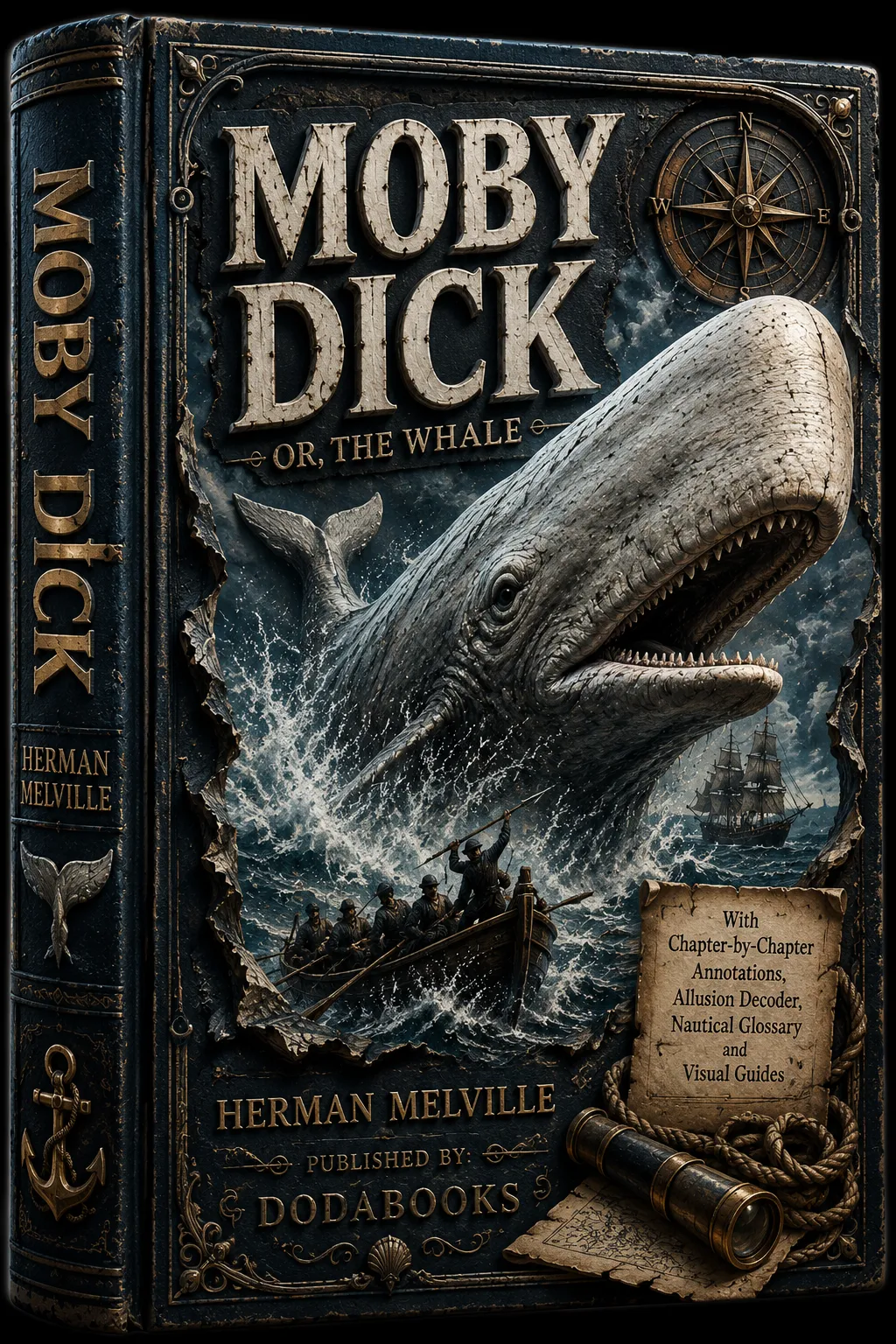
Our annotated edition of Moby-Dick includes comprehensive notes designed to make the novel accessible without diluting its power.
The practical reality is this: most people who attempt Moby-Dick without annotations do not finish it. They get lost in the cetology chapters. They stumble over the allusions. They lose the thread of the narrative in the middle sections. The difficulty, which is meant to be productive, becomes instead a barrier — and the barrier defeats them.
An annotated edition does not remove the difficulty. It transforms it. The cetology chapters, which seem like impenetrable walls of technical language, become fascinating accounts of a vanished world — once you understand what Melville is describing. The biblical allusions, which seem like arbitrary intrusions, become the key to the novel’s deepest themes — once you recognize their source. The dramatic language, which seems pretentious and overwrought, becomes genuinely powerful — once you understand what Melville is trying to achieve.
The annotated reading is not a lesser reading. It is a fuller reading. You see more, understand more, and ultimately feel more. The novel’s emotional power depends on understanding its references — and the annotations provide that understanding without requiring years of independent study. They are not a shortcut. They are a bridge.
🐋 The Story in Under a Minute
“Call me Ishmael.” — Ishmael, Chapter 1
The narrator of Moby-Dick is a young schoolmaster-turned-sailor who signs onto a whaling voyage aboard the Pequod under Captain Ahab, a man bent on revenge against the white whale that took his leg. The voyage runs from the Atlantic, around the Horn, and into the Pacific — and only one man survives the final chase. For a tour of the whole voyage, our complete plot summary covers the major events, and the chapter-by-chapter guide explains what each section is doing.
🏛️ The World of 1851
In 1851 whaling was one of America’s biggest industries, so Melville’s audience knew the technical language firsthand and knew their Bibles well enough that Ahab and Ishmael arrived as loaded names. Modern readers share almost none of that knowledge, which is why the cetology chapters stall so many first attempts. An annotated edition restores it. To understand the industry behind the fiction, our article on the whaling history behind Moby-Dick covers the Essex disaster and the economics of the chase.
🔥 What the Annotations Unlock
One moment of recognition can turn an opaque page vivid, and that is what the notes are for: biblical layers (Ishmael, Jonah, Job) reveal the novel’s argument about fate and pride; symbolic readings deepen the whale; and inline vocabulary definitions keep you inside the story. Our guide to the biblical allusions and our guide to what the white whale means preview the ground those notes cover.
🧭 Tips for Actually Finishing the Voyage
Read a chapter a day — about six weeks — and treat the cetology chapters as documents of a vanished world rather than digressions. Don’t force yourself to love every page, and slow down for the final chase: our explanation of the ending shows how it gathers every thread of the voyage. For a full beginner road map, the guide to reading Moby-Dick walks the whole process.
An annotated edition makes this approach natural. Read the notes when you are curious, skip them when you are not. Both habits work — and having the choice is precisely what makes an annotated reading fuller rather than easier.
❓ Frequently Asked Questions
What is an annotated edition?
An annotated edition is the complete, unabridged text with added editorial layers — footnotes that define archaic and nautical vocabulary, historical context, biblical and literary cross-references, and interpretive notes that illuminate themes and structure.
Will the notes spoil the story?
No. Annotations clarify the passage they sit beside; they do not reveal what happens next. Thematic notes preview ideas, not plot, and they are easy to skip if you want an unmediated first read.
Is the annotated text really complete?
Yes — the complete text of the original 1851 edition, with annotations added on top. Nothing is cut, abridged, or rewritten.
How long does it take to read Moby-Dick?
Budget 18–20 hours for the text alone, and closer to 25–35 if you linger over every note. With the chapter navigation, the novel works well as a daily 30–40 minute reading habit.
Annotated or plain — which should I choose?
For a first attempt, choose the annotated edition. You can ignore the notes if you prefer, but they are there when the cetology chapters or the biblical allusions threaten to stall you. Skipping notes is easy; conjuring 1851 context from nothing is not.
📚 Related Articles
🎯 Stop Struggling. Start Understanding.
The annotated edition of Moby-Dick gives you everything you need to finally get Melville’s masterpiece:
- ✅ Complete, unabridged text — every word of the original 1851 edition
- ✅ Hundreds of explanatory footnotes — no more Googling every other page
- ✅ Historical context — the Essex disaster, Nantucket whaling, Melville’s life
- ✅ Literary analysis — chapter-by-chapter commentary on themes and symbols
- ✅ Victorian vocabulary — obsolete words and nautical terms defined inline
- ✅ Biblical & literary references — every allusion traced to its source