How Shakespeare influenced Moby-Dick. From King Lear to Macbeth, discover how the Bard’s tragedies shaped Melville’s novel.
🐋
Shakespeare's Influence on Moby-Dick: How the Bard Shaped the Masterpiece
How Shakespeare influenced Moby-Dick. From King Lear to Macbeth, discover how the Bard's tragedies shaped Melville's nov...
Melville’s Shakespeare Revelation
In 1849, Herman Melville acquired a handsome seven-volume edition of Shakespeare’s works, and what followed was one of the most transformative reading experiences in literary history. Melville devoured the plays with a feverish intensity, reading and rereading them so obsessively that his wife Elizabeth reportedly feared for his sanity. The encounter happened at a pivotal moment — Melville had already published Typee and Omoo, successful travel narratives based on his own seafaring adventures, but he hungered for something deeper, more ambitious, more permanent. Shakespeare showed him the way.
The timing was crucial. Melville was simultaneously befriending Nathaniel Hawthorne, whose dark vision of American life challenged Melville to push beyond mere adventure writing. In a letter to Hawthorne, Melville confessed: “I feel that the Godhead is broken up like the bread at the Supper, and that we are the pieces. Hence this infinite fraternity of feeling.” This sense of cosmic fragmentation — of a universe that refuses to cohere — is Shakespearean to its core. Melville absorbed Shakespeare’s vision of tragic grandeur and transplanted it aboard a Nantucket whaler. The result was Moby-Dick, a novel that would not exist without King Lear, Hamlet, and Macbeth. Every chapter bears the marks of this encounter, from the soliloquies that structure Ahab’s monologues to the dramatic stage directions Melville uses to organize his most theatrical scenes.
The Structure of Tragedy
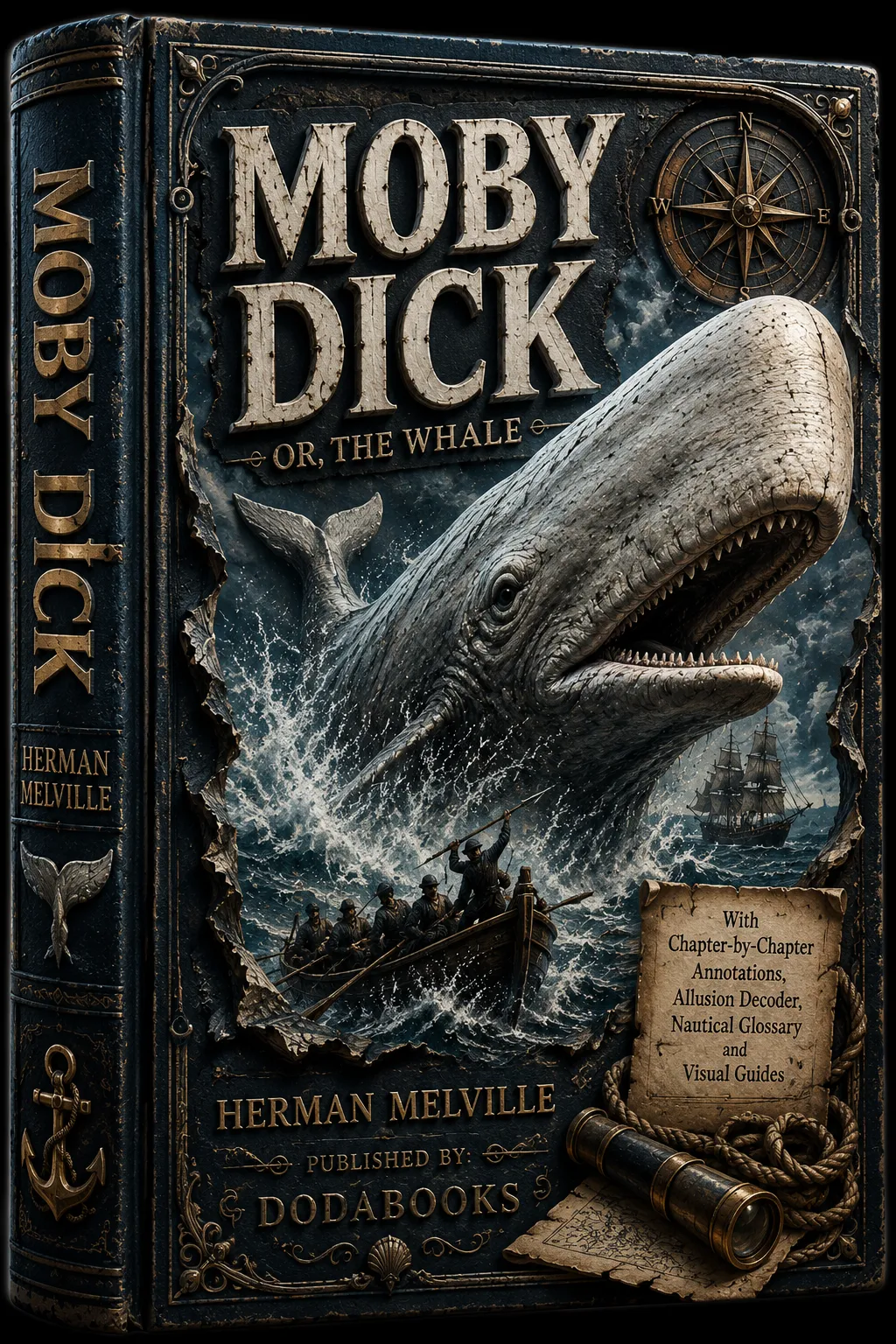
📖 Want the complete annotated experience?
👉 Get the Annotated EditionMoby-Dick follows the architecture of Shakespearean tragedy with remarkable precision. There is a noble protagonist of elevated status — Ahab is the captain, the sovereign of his floating kingdom — whose fatal flaw (hubris, obsession, the refusal to accept limitation) sets in motion a rising action of escalating wrong choices and mounting dread. The turning point arrives when Ahab nails the gold doubloon to the mast and declares his single-minded purpose in full view of his crew. From that moment, catastrophe becomes inevitable. Like King Lear raging on the heath, Ahab brings destruction upon himself and everyone around him, yet we cannot look away because his passion, however destructive, is undeniably magnificent. The Shakespearean structure gives Moby-Dick its emotional spine — without it, the novel might collapse under the weight of its cetological digressions and philosophical tangents.
Ahab as Lear
The parallels between Ahab and King Lear run deeper than surface resemblance. Lear, like Ahab, is a ruler who refuses to accept the limits of his authority. Lear demands unconditional love from his daughters; Ahab demands that the universe submit to his vendetta against the whale. Both men rage against forces they cannot control, and both are accompanied by a retinue of loyal followers who are dragged into catastrophe through no fault of their own. Consider the scene in Chapter 36, “The Quarter-Deck,” when Ahab addresses his crew with the thundering declaration: “He tasks me; he heaps me; I see in him outrageous strength, with an inscrutable malice sinewing it.” This echoes Lear’s howling on the heath — the sense that the natural order has been violated, that the gods themselves are capricious and cruel. Both characters lose everything through stubbornness — Lear loses his kingdom and his daughters, Ahab loses his ship and his crew. And both die with a terrible, defiant dignity that elevates their destruction into something approaching grandeur. The difference is that Lear achieves recognition and reconciliation before death; Ahab dies still cursing, still refusing to yield. Melville takes the Shakespearean tragic structure and pushes it further into ambiguity — we are left wondering whether Ahab’s defiance is magnificent or simply insane.
Ahab as Macbeth
“I’d strike the sun if it insulted me” — this single line from Chapter 36 captures the essence of Ahab’s Macbeth-like ambition. Macbeth, who would “jump the life to come” for a crown, has sold his soul for temporal power. Ahab has sold his soul for something even more abstract: vengeance against a creature that represents the indifference of the universe. Both characters are driven by a monomania that distorts their perception of reality. Macbeth sees daggers that are not there; Ahab sees malice where there is only nature. Both are surrounded by complicit followers — Macbeth by Lady Macbeth and the murderers, Ahab by Starbuck, Stubb, and the crew who sign his mad oath. And both meet their ends in a final, futile confrontation that they cannot win but refuse to avoid. The key difference is that Macbeth recognizes too late that his ambition was hollow — “a tale told by an idiot, full of sound and fury, signifying nothing.” Ahab never reaches that recognition. He dies still believing his cause is just, still cursing the whale with his final breath. Melville understood Shakespeare’s tragic villains not as simple monsters but as figures whose terrible clarity makes them persuasive, even sympathetic. We follow Ahab to his doom because we understand, at some level, his refusal to accept a meaningless universe.
The Soliloquies
Several chapters of Moby-Dick function as soliloquies, those dramatic monologues where a character speaks their inner thoughts aloud, and Melville uses them to devastating effect. “The Quarter-Deck” (Chapter 36) is structured precisely like a Shakespearean dramatic scene — Ahab takes the quarter-deck as his stage, addressing his crew as both audience and chorus, building to a crescendo of collective oath-taking that seals everyone’s doom. The scene’s rhythm is unmistakably theatrical: the pauses, the rhetorical questions, the escalating emotional stakes. “The Symphony” (Chapter 132) is perhaps the most poignant soliloquy in the novel — Ahab stands at the rail on a beautiful day, watching the sea, and for one brief, luminous moment considers abandoning his quest. He tells Starbuck, “What a forty years’ fool — old fool has this been!” It is the closest Ahab comes to reconciliation, to recognizing the beauty and love he has sacrificed. But the moment passes, and he turns back to the hunt. Melville understood that Shakespeare’s power lay not just in the great set pieces but in those quiet, interior moments where a character stands on the edge of transformation — and steps back.
Stage Directions
One of the most striking evidence of Shakespeare’s influence is Melville’s use of actual stage directions within the prose narrative. Phrases like “Enter Ahab” and “Exit Starbuck” appear in the text, treating the deck of the Pequod as if it were a theater stage and the crew as performers in a drama that has been scripted by fate. This is not mere stylistic flourish — it reveals Melville’s fundamental understanding of Moby-Dick as a literary hybrid, a novel that aspires to the condition of drama while exploiting the resources available only to prose fiction. The stage directions serve a structural function: they organize the narrative into scenes, signal shifts in perspective, and create a sense of dramatic inevitability. They also establish a meta-theatrical awareness — the reader is reminded that they are watching a performance, that the characters are playing roles assigned to them by their captain and by the narrative itself. Shakespeare’s plays, after all, are full of moments where characters become aware of their own dramatic function: Hamlet knows he is performing madness, Richard III knows he is playing the villain. Melville’s stage directions achieve something similar — they elevate the whaling voyage from documentary realism to symbolic drama.
The Ship as Stage
The Pequod functions as a theatrical stage in the most complete sense — a confined, elevated space where characters appear, speak, and exit while the audience (the reader) watches from an omniscient perspective. The crew serves as a Greek chorus, commenting on the action, expressing collective fear and hope, and bearing witness to Ahab’s tragic trajectory. In Shakespeare’s tragedies, the chorus provides context, foreshadows events, and offers moral judgment; Melville’s crew does the same, though their commentary is often more subtle, conveyed through whispered conversations and collective reactions. The final chase across three days is staged with all the climactic intensity of a Shakespearean fifth act — the action builds relentlessly toward catastrophe, with each day raising the stakes and narrowing the possibilities until only destruction remains. Moby-Dick is the first novel to fully integrate dramatic techniques into prose narrative on this scale — dialogue, monologue, stage directions, theatrical structure — and it remains one of the most successful experiments in literary hybridity. Melville proved that the novel could absorb drama’s strengths without surrendering its own distinctive powers of interiority, description, and philosophical meditation. The Pequod’s claustrophobic quarters, its hierarchical decks, its relationship to the vast and indifferent ocean surrounding it — all of these create a dramatic space of extraordinary intensity, a world where every gesture, every word, every silence carries weight and consequence. Melville understood that Shakespeare’s greatest plays work not because of their spectacular set pieces but because of the pressure of confined space — the sense that characters are trapped together with no escape, forced to confront each other and themselves in a crucible of escalating tension. The Pequod replicates this pressure perfectly, and the result is a novel that feels, in its most powerful passages, less like prose fiction and more like a living drama unfolding before our eyes.
Discover the depth of Melville’s masterpiece with our annotated edition of Moby-Dick. Complete text with explanatory notes, historical context, and literary analysis.
📚 Related Articles
Frequently Asked Questions
How did Shakespeare influence Herman Melville's writing of Moby-Dick?
Melville re-read Shakespeare in 1849, which transformed Moby-Dick from a simple whaling adventure into a towering, tragic drama infused with Elizabethan language.
Which Shakespearean plays influenced Moby-Dick most heavily?
King Lear, Macbeth, Hamlet, and The Tempest heavily inspired Ahab's soliloquies, the presence of the mad boy Pip, and the novel's metaphysical doom.
Are parts of Moby-Dick written in iambic pentameter?
Yes, several of Ahab's impassioned monologues naturally scan as unrhymed iambic pentameter (blank verse), reflecting Shakespearean cadence.
How does the relationship between Ahab and Pip parallel King Lear and the Fool?
Like Lear and his Fool on the stormy heath, the mad Ahab finds strange spiritual kinship and emotional tenderness with the traumatized boy Pip.
Where can I learn more about Shakespearean parallels in Moby-Dick?
The DodaBooks annotated edition specifically highlights Shakespearean echoes, meter, and dramatic structures across all key chapters.
🎯 Stop Struggling. Start Understanding.
The annotated edition of Moby-Dick gives you everything you need to finally get Melville’s masterpiece:
- ✅ Complete, unabridged text — every word of the original 1851 edition
- ✅ Hundreds of explanatory footnotes — no more Googling every other page
- ✅ Historical context — the Essex disaster, Nantucket whaling, Melville’s life
- ✅ Literary analysis — chapter-by-chapter commentary on themes and symbols
- ✅ Victorian vocabulary — obsolete words and nautical terms defined inline
- ✅ Biblical & literary references — every allusion traced to its source