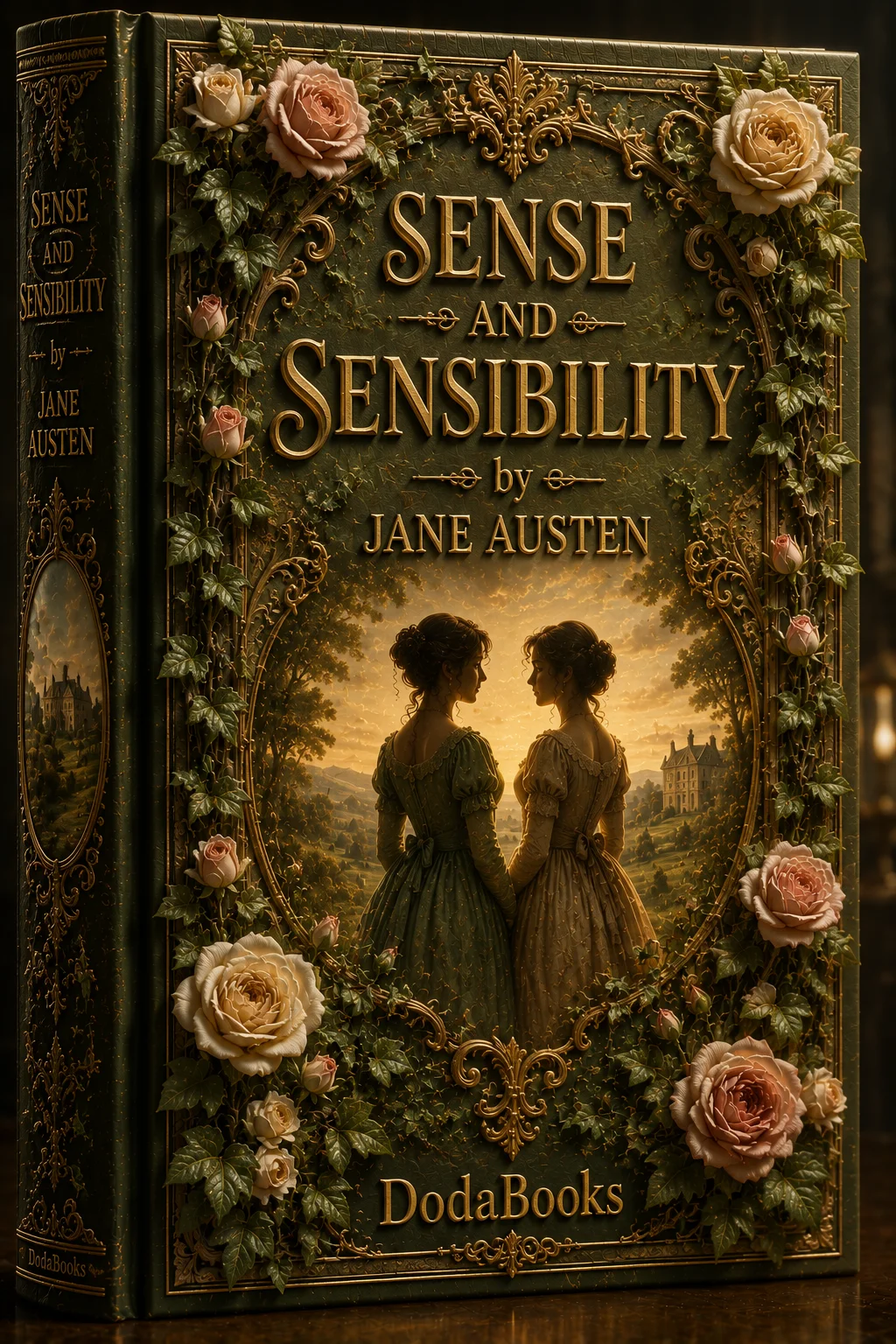
Jane Austen’s Sense and Sensibility (1811) is a masterful tale of love, heartbreak, and the triumph of sisterhood. When the Dashwood sisters are left destitute after their father’s death, they must navigate a world where fortune dictates fate and marriage is the only currency that matters. Austen’s debut novel remains one of the most beloved works of English literature.
💕
Sense and Sensibility
Elinor guards her heart in silence. Marianne throws herself headlong into romance. Together they discover that true happiness lies not in wealth, but in knowing one's own heart.
| Author | Jane Austen |
| Published | 1811 |
| Genre | Romance, comedy of manners, domestic fiction |
| Chapters | 50 |
| Setting | Regency England — Norland Park, Barton Cottage in Devonshire, London |
| Legacy | Austen’s first published novel; one of the most beloved works of English literature |
💕 The Story
The Dashwood family lives at Norland Park in Sussex. Upon the death of Mr. Dashwood, his son John inherits the estate — but John’s selfish wife Fanny persuades him to leave his stepmother and half-sisters with next to nothing. The Dashwood women — Mrs. Dashwood and her three daughters Elinor, Marianne, and Margaret — are forced to take up residence in a modest cottage in Devonshire.
Elinor, the eldest, is practical and reserved. She forms an attachment to Edward Ferrars, Fanny’s brother, but keeps her feelings hidden out of honor and uncertainty. Marianne, passionate and romantic, falls devastatingly for the dashing John Willoughby, who rescues her after a fall in the rain. Their connection seems fated — they share the same tastes in poetry, music, and landscape — and Marianne throws herself into the relationship with abandon.
But both sisters are heading toward heartbreak. Edward, it emerges, has been secretly engaged for years to Lucy Steele, a scheming young woman who delights in revealing the engagement to Elinor. And Willoughby abruptly departs for London, leaving Marianne distraught. When the sisters travel to London, they discover Willoughby engaged to a wealthy heiress — he had never been serious about Marianne at all.
The novel follows both sisters through their trials: Elinor suffering in dignified silence, Marianne succumbing to a near-fatal illness brought on by grief. Through it all, they are supported by Colonel Brandon, a quiet, honorable man who has loved Marianne from afar. In the end, both sisters find their way to happiness — Elinor with Edward (once his engagement to Lucy is dissolved) and Marianne with Colonel Brandon, having learned that sensibility without sense is a dangerous guide.
🎭 Key Characters
Elinor Dashwood
Elinor represents “sense” — prudence, discretion, and emotional restraint. She is the emotional anchor of her family, managing their reduced circumstances with quiet competence. Her struggle to conceal her own heartbreak while supporting her sister makes her one of Austen’s most sympathetic heroines.
Marianne Dashwood
Marianne embodies “sensibility” — passion, spontaneity, and romantic idealism. She believes in love at first sight, judges people by their taste in poetry, and wears her heart on her sleeve. Her journey is one of painful growth: she must learn that feeling must be balanced with judgment.
Edward Ferrars
Edward is a gentle, honorable man trapped by a youthful promise. He loves Elinor but cannot declare himself because of his secret engagement to Lucy Steele. His quiet integrity makes him worthy of Elinor, even if he lacks the dash of a romantic hero.
John Willoughby
Willoughby is charming, handsome, and reckless. He genuinely loves Marianne but is too selfish and financially desperate to marry her. He represents the danger of sensibility without principle — all feeling, no honor.
Colonel Brandon
Brandon is the quiet hero of the novel — older, wounded by a past romance, and unfailingly honorable. He loves Marianne with a steady devotion that contrasts sharply with Willoughby’s flashy passion. He represents the wisdom of sense tempered by deep feeling.
📖 Literary Significance
Sense and Sensibility was Austen’s first published novel, and it announced a major new voice in English literature. The book is a brilliant comedy of manners that skewers the economic realities of Regency marriage — where women’s financial dependence made love a luxury few could afford.
The novel’s central contrast — sense vs. sensibility, reason vs. emotion, restraint vs. passion — was a live debate in Austen’s time. The cult of sensibility valued intense emotional experience as a sign of moral refinement. Austen gently mocks this view through Marianne’s suffering while ultimately affirming that both sense and sensibility have their place. The sisters learn from each other: Elinor must learn to feel more openly, Marianne to judge more wisely.
Austen’s prose is already fully formed in this debut: sharp, ironic, and devastatingly precise. Her ability to reveal character through dialogue — to let her characters condemn themselves with their own words — is on full display. The novel has never been out of print and has inspired numerous film and television adaptations.
✨ What Makes the DodaBooks Edition Special
This is the original 1811 text, carefully prepared for modern readers without distractions or clutter.
Zero Distractions
No ads, no license pages, no project boilerplate — just the original novel, clean and uninterrupted.
Smart Typography
Curly quotes, em-dashes, proper ellipsis — typeset with care for a premium reading experience.
Chapter Navigation
Full table of contents with back-to-chapter links in every section — jump between all 50 chapters effortlessly.
Cleaned & Polished
All Gutenberg boilerplate stripped, consistent formatting throughout the text.
No DRM
You own your copy — read on any device, anytime, forever.
Instant Download
EPUB format included, delivered instantly after purchase.
🏛️ Historical Context: England in 1811
To understand Sense and Sensibility, you have to understand the world Austen wrote into. In Regency England, a woman’s social standing was almost entirely bound to marriage. With no real profession open to a gentlewoman, matrimony for Elinor and Marianne was not merely romance but economics.
The legal details matter too. Under primogeniture, estates passed to the eldest son, which is why John Dashwood inherits Norland Park while his mother and sisters are left with almost nothing. Entailed property and the limited rights of widows and daughters were the machinery that makes the plot inevitable. For a deeper look at the same pressures, see our guide to Pride and Prejudice.
📖 Major Themes
The title is the thesis. Throughout, Austen pits sense — prudence, restraint, clear judgement — against sensibility — passion, feeling, spontaneous emotion. The genius is that neither side wins outright: Marianne’s unchecked feeling nearly destroys her, while Elinor’s stoic restraint costs her years of silent suffering. A full life requires both.
Money and marriage are inseparable, and Austen never lets you forget it. Willoughby genuinely loves Marianne yet abandons her for a wealthy heiress; Lucy Steele manipulates her engagement to Edward. Sisterhood is the quiet third theme — the bond between Elinor and Marianne carries them through the book.
💡 Why It Still Matters
Sense and Sensibility still speaks to modern readers because its question is timeless: how do you balance what you feel with what is wise? The book is also a masterclass in irony — Austen lets her characters condemn themselves in their own words.
Austen’s influence is everywhere in the books and films that followed. To see how much of this craft carried into her second novel, the character breakdown in Pride and Prejudice shows the same ironic voice on a new cast.
🎬 Adaptations and Legacy
The most celebrated adaptation is the 1995 film starring Emma Thompson as Elinor and Kate Winslet as Marianne, with a screenplay that won Thompson an Oscar. Ang Lee directed it with a restraint that mirrors its heroine, and the novel has also reached television, stage, and Bollywood.
🧭 How to Read It
Because Austen’s wit is dry, much of the humour lives in what characters say rather than what they mean, so slow down for dialogue scenes — especially the conversations with the scheming Lucy Steele. On a first read, let the plot carry you. On a second, track how the sisters misjudge each other until sense and sensibility meet in the middle.
❓ Frequently Asked Questions
Which sister is sense and which is sensibility?
Elinor represents “sense” (reason, prudence, emotional restraint) and Marianne represents “sensibility” (passion, spontaneity, romantic idealism). The novel shows that both qualities are necessary — and dangerous in isolation.
Do I need to read this before other Austen novels?
It’s a perfect starting point. It was Austen’s first published novel and introduces her signature themes: the economics of marriage, the constraints on women, and the comedy of social manners. If you enjoy it, Pride and Prejudice and Emma are natural next steps.
How long does it take to read?
At 404 pages in the DodaBooks edition, most readers finish in 8-12 hours. The novel is longer than Pride and Prejudice but shorter than Emma, with a pace that rewards patient reading.
Is this the same as the movie with Kate Winslet?
Yes — the 1995 film adaptation starring Emma Thompson and Kate Winslet is one of the most acclaimed Austen adaptations. It follows the novel closely, though it compresses some minor characters and subplots. Emma Thompson won an Oscar for her screenplay.
Why is the book called Sense and Sensibility?
The title announces the novel’s central theme: the contrast between two ways of approaching life. “Sense” (reason, prudence) and “sensibility” (emotion, sensitivity) were key concepts in 18th-century moral philosophy. Austen’s genius is to show that neither is sufficient alone — true wisdom is a balance of both.
What is the main message of Sense and Sensibility?
That neither pure reason nor unchecked emotion is enough on its own. Elinor’s sense and Marianne’s sensibility each prove dangerous in isolation, and the novel argues that wisdom lies in balancing head and heart. Their complementary journeys — Elinor learning to feel, Marianne learning to judge — embody this ideal.
Is Sense and Sensibility a good first Jane Austen novel?
Yes. It was Austen’s first published novel and shows all her strengths: sharp irony, vivid dialogue, and a deep understanding of money, class, and marriage. It is a wonderful introduction before you move on to the even more famous Pride and Prejudice.
Why did Willoughby leave Marianne?
He genuinely cares for her, but he is financially dependent and unwilling to give up the comfortable life they would lose by marrying without fortune. He abandons her for a wealthy heiress, Miss Grey, because money matters more than the feeling he claims. He is the novel’s cautionary example of sensibility without principle.
📚 Related Articles
💕 Read the Original Regency Romance
Sense and Sensibility is Jane Austen’s brilliant debut novel — a tale of love, heartbreak, and sisterhood. The DodaBooks edition preserves the complete 1811 text in a clean, distraction-free format:
- ✅ Complete 50-chapter novel — every word of the 1811 edition
- ✒️ Smart typography — curly quotes, em-dashes, proper ellipsis
- 📜 Full table of contents with chapter navigation
- 🔒 DRM-free — read on any device, anytime
- 📥 Instant download — EPUB format