The biggest barrier to reading Robert Burns is the Scots vocabulary. Here are 50 essential Scots words from the full 500+ word glossary included in the annotated edition.
The Robert Burns Scots Glossary: 500+ Words Decoded
50 of the most common Scots words in Burns's poetry with meanings and examples — a sample from the complete 500+ word glossary in the annotated edition.
👉 Get the Annotated Edition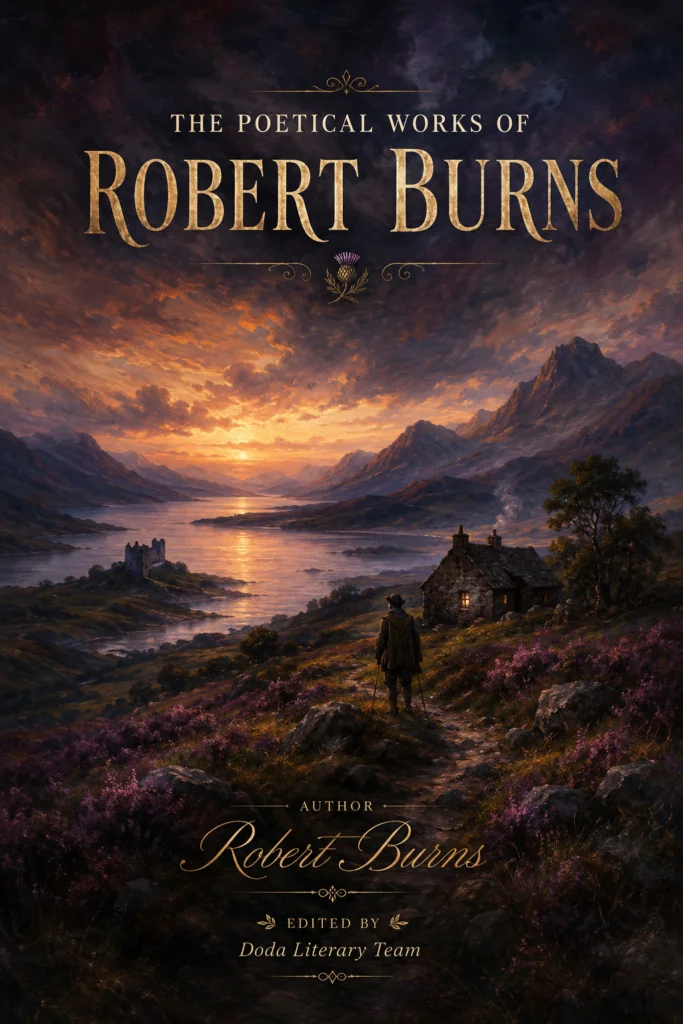
| Poet | Robert Burns (1759–1796) |
| Glossary Size | 500+ entries |
| Sample Here | 50 essential words |
| Includes | Definitions, examples, poem references |
| Best For | Reading Burns without frustration |
📋 The 50 Most Common Scots Words in Burns
| Scots | Meaning | Example in Burns |
|---|---|---|
| a' | all | “A Man’s a Man for A’ That” |
| aboon | above | “The moon glints aboon” |
| ae | one, only | “Ae Fond Kiss” (title) |
| aft | often | “Gang aft agley” (go often wrong) |
| aften | often | “Wham Bruce has aften led” |
| agley | wrong, askew | “Gang aft agley” |
| aiblins | perhaps | “Aiblins you may think” |
| aith | oath | “I swear by aith” |
| ane | one | “Ane may think” |
| auld | old | “Auld Lang Syne” (title) |
| auld-farran | old-fashioned | “Auld-farran frien’s” |
| ava | at all | “Nae cause ava” |
| baith | both | “Baith night and day” |
| bannet | hat, cap | “His bannet saucily” |
| baudrons | cat | “The baudrons crew” |
| birkie | lively fellow | “A birkie callant” |
| bide | stay, remain | “Bide wi’ me” |
| bien | comfortable | “A bien fireside” |
| biggin | building, house | “His mither’s biggin” |
| birk | birch tree | “The birks o’ Aberfeldy” |
| blastie | little blast, gust | “Thou poor blastie” (To a Mouse) |
| blawn | blown | “The wind has blawn” |
| blellum | babbler, talker | “A blellum and a fool” |
| blithe | happy, cheerful | “Blithe and bonie” |
| bonie, bonnie | beautiful, pretty | “Bonie lassie” |
| brae | hillside, slope | “Down the brae” |
| braw | handsome, fine | “Braw, braw lads” |
| brawly | finely, very well | “That suits ye brawly” |
| breist | breast, chest | “My breist is sair” |
| brigs | bridges | “The brigs o’ Ayr” |
| brither | brother | “My brither John” |
| broo | brow, forehead | “His angry broo” |
| buik | book | “The holy buik” |
| burn | stream, brook | “By the burn side” |
| buskit | dressed, adorned | “Buskit in silk” |
| byous | extraordinary | “Byous rich” |
| callant | young fellow | “A bonie callant” |
| canty | cheerful, lively | “Canty and gay” |
| carlin | old woman, witch | “The carlin’s curse” |
| cauld | cold | “The cauld winter” |
| chancy | lucky, fortunate | “A chancy business” |
| chiel | child, young person | “A chiel’s amang ye” |
| claith | cloth, clothing | “In claith of gold” |
| clanjamphry | crowd, rabble | “The clanjamphry” |
| claut | claw, scratch | “The cat’s claut” |
| cleed | clothe | “To cleed the naked” |
| cloot | hoof, cloven foot | “Auld Clootie” (the Devil) |
| cock-up | proud, strutting | “Cock-up and proud” |
| cour, cowr | cower, bend | “Cowran, tim’rous beastie” |
| crambo | rhyme, nonsense | “Your crambo, crambo” |
📚 Get the complete 500+ word glossary with cross-references
👉 Get the Annotated Edition🔍 How the Glossary Works in the Annotated Edition
The complete glossary in the annotated edition includes over 500 entries, each with:
- The Scots word or phrase
- Part of speech
- Modern English definition
- Example line from a Burns poem
- Poem reference number (cross-referenced to the full text)
The glossary is cumulative — it covers every Scots word used across all 539 poems. If a word appears in multiple poems, the entry lists all locations.
💡 How to Use the Glossary
Look up every unfamiliar word. Do not guess. Burns often uses words that look like English but mean something different. Wabbit looks like it might mean “rabbit-like” — it means exhausted. Sonsie looks like it might mean “son-like” — it means plump, cheerful, good-natured.
Use it for active vocabulary building. Pick 10 words from a poem you are about to read, learn them first, then read the poem. You will recognise the words in context, which reinforces learning.
Cross-reference with the line-by-line annotations. The glossary gives you definitions in isolation. The line-by-line annotations show you how the words work together in a sentence.
🎓 What the Annotated Edition Unlocks
500+ Glossary Entries
Every Scots word defined with part of speech, modern English meaning, and poem reference numbers.
Line-by-Line Explanations
See how Scots words work together in context with complete paraphrases of every difficult line.
Cross-Referenced
Every glossary entry links back to the poem where it appears — learn words in their natural context.
Teacher's Insights
Analysis of Burns's use of Scots — why he chose specific words and what effects they create.
Study Tool Ready
Use the glossary for flashcards, vocabulary tests, and active language learning as you read.
Searchable Format
Digital format means you can search for any word instantly — no flipping through pages.
⚠️ False Friends: Words That Look English but Aren’t
The biggest trap in reading Burns is not the obviously foreign words but the ones that look familiar and mean something else entirely. These “false friends” quietly derail your reading until you learn to see them for what they are.
| Scots | Looks Like | Actually Means |
|---|---|---|
| kent | “Kent” (place) | knew |
| wanton | “wanton” (lewd) | playful, merry |
| forward | “forward” (ahead) | presumptuous, bold |
| gar | “gar” (fish) | make, compel |
| herd | “herd” (animals) | shepherd, cowherd |
| speir | “spear” (weapon) | ask, enquire |
| leal | “leal” (?) | loyal, faithful |
| douce | “douce” (?) | gentle, sober, respectable |
| braw | “bra” (underwear) | handsome, fine |
| girn | “grin” (smile) | snarl, complain |
Learn these ten and you have removed the most common confusion for new readers. When you meet one in a poem, try the glossary before your intuition — our guide to understanding poetry like Robert Burns explains the same principle with worked examples.
🎶 Pronouncing Burns: A Quick Guide to Scots Sounds
Half the pleasure of Burns is hearing him aloud, and the pronunciation is friendlier than the spelling suggests. A few simple rules get you most of the way:
- a’ is pronounced “all” — the apostrophe simply drops the double l.
- ui or u in words like guid is a short “u” — “good.”
- Final -ie as in bonie is “ee” — “bon-nee.”
- ch in loch is the guttural Scottish “kh,” as in “Bach.”
- Final -ed is often dropped: blawn (blown), ta’en (taken).
The best teacher is hearing the line: read aloud slowly, forget the spelling, and let the rhyme guide you — Burns wrote in the rhythms of speech, not the printed page. Our line-by-line walkthrough of Tam o’ Shanter shows how the sounds and the sense work together, and the To a Mouse guide does the same for the poem’s most famous address.
🧠 Why the Full Glossary Pays for Itself
Fifty words get you through most of Burns; the complete glossary gets you through all 539 poems. That coverage matters: Burns’s Scots vocabulary is stubbornly varied, and the difference between loving a poem and merely surviving it is usually a handful of words you did not expect to need.
Because the edition is a searchable digital file, the glossary becomes a dictionary you can consult mid-line without losing your place. For students preparing for exams or recitals, our complete guide to Burns in simple English pairs the same vocabulary with clear modern paraphrases, and the beginner’s guide to Burns poems suggests the best poems to start with once your word list is growing.
❓ Frequently Asked Questions
Is Scots a real language or just a dialect?
Scots is a distinct language with its own vocabulary, grammar, and pronunciation. It is recognised as a regional language under the European Charter for Regional or Minority Languages.
How many Scots words do I need to know to read Burns?
The 50 most common words cover about 80% of the Scots vocabulary you’ll encounter. The full 500+ glossary covers everything.
Are Burns's Scots words used in Scotland today?
Many are. Words like wee (small), bonnie (beautiful), auld (old), and ken (know) are still common in Scottish English today.
How is the glossary organised in the annotated edition?
Alphabetically, with each entry including the word, part of speech, definition, example line, and poem reference number.
Can I use the glossary for other Scots literature?
Much of it applies to other Scots writers. The core vocabulary (a’, ae, auld, bonnie, braw, ken, etc.) appears across Scottish literature.
Does the glossary include phrases or just single words?
Both. The glossary covers individual words and common phrases, with full explanations of idioms that don’t translate literally.
Is Burns's Scots the same as Gaelic?
No. Scots is a Germanic language closely related to English, descended from the language of the Anglo-Saxons who settled northern Britain. Gaelic is a Celtic language from a completely different family. Burns wrote in Scots; the two are often confused but share almost nothing beyond geography.
What is the fastest way to memorise the essential words?
Learn words in context, not in isolation. Pick a short poem — To a Mouse and A Red, Red Rose are ideal — look up its ten or twelve unfamiliar words, then read the poem aloud several times. Reciting lines fixes both meaning and pronunciation in a way flashcards never do.
Does the glossary cover Tam o' Shanter?
Yes. The complete 500+ entry glossary covers every poem in the collection, and Tam o’ Shanter is among the most fully annotated, because its dialect is unusually dense and its story — a drunken farmer riding home from market and glimpsing a witches’ revel — rewards knowing exactly what each line says. Our line-by-line guide to Tam o’ Shanter explores the poem scene by scene.
📚 Related Articles
Master Burns’s Scots vocabulary with the complete glossary
Poems and Songs of Robert Burns — The Annotated Edition
Complete 500+ Scots glossary with all 539 poems, line-by-line explanations, and Teacher’s Insights.
👉 Get the Annotated Edition{ .cta-button }