How religion and fate shape Moby-Dick. Explore the biblical names, spiritual themes, and Melville’s complex relationship with faith.
🐋
Religion and Fate in Moby-Dick: Biblical Allusions and Spiritual Themes
How religion and fate shape Moby-Dick. Explore the biblical names, spiritual themes, and Melville's complex relationship...
Biblical Names
Moby-Dick is saturated with biblical references. Ahab (the wicked king of Israel), Ishmael (the outcast son of Abraham), Elijah (the prophet), Bildad (one of Job’s comforters). These names cue readers to see the characters as archetypes in a cosmic drama.
The biblical naming is not accidental but structural. Melville chose these names deliberately, creating a web of allusions that deepens every scene and every character. The biblical Ahab was a king of Israel who worshipped false gods and was destroyed by divine wrath. Melville’s Ahab is a king of his ship who worships his own will and is destroyed by the consequences of that worship. The parallel is precise: both Ahabs are destroyed by the very power they seek to control.
Ishmael’s name carries its own biblical weight. In Genesis, Ishmael is the son of Abraham and Hagar — a child born outside the covenant, destined to wander in the wilderness. God tells Hagar that Ishmael “will be a wild donkey of a man; his hand will be against everyone and everyone’s hand against him.” This description fits Melville’s narrator perfectly: a wanderer, an outsider, a man who exists on the margins of society and finds his truest self in the wild spaces of the earth. Ishmael’s survival at the novel’s end — he alone escapes the Pequod’s destruction — is itself a biblical echo: the outcast survives, while the righteous perish.
Elijah, the prophet who warns Ishmael and Queequeg not to board the Pequod, is another crucial allusion. In the Bible, Elijah is taken up to heaven in a whirlwind, leaving behind his successor Elisha. Melville’s Elijah is a prophet of doom — a man who sees the future and tries (and fails) to prevent it. His warnings about Ahab are ignored, just as biblical prophets were ignored by the people they tried to save. Elijah’s failure foreshadows the novel’s larger tragedy: the inability of reason, warning, or moral argument to overcome the force of obsession.
Bildad, the first mate, takes his name from one of Job’s comforters — men who try to explain Job’s suffering by blaming him for sins he did not commit. Bildad’s namesake is a defender of orthodox theology: he insists that God rewards the righteous and punishes the wicked, that suffering is always a consequence of sin. Melville’s Bildad applies this logic to whaling: he quotes Scripture to justify the hunt, using religion as a tool of commerce rather than a path to understanding. The irony is sharp: the man named after Job’s comforter serves a captain who is himself a kind of Job — a man who has lost everything and refuses to accept the mystery of his suffering.
Ahab’s Blasphemy
Ahab’s quest is blasphemous. He tells Starbuck: “I’d strike the sun if it insulted me.” This is Promethean defiance — a mortal challenging the gods. Is Ahab’s rebellion heroic or sinful? Melville refuses to answer.
Ahab’s blasphemy is the novel’s moral center — the question around which everything else orbits. His defiance of the gods is not simply pride; it is a philosophical position. Ahab believes that the universe is governed by malice — that the white whale is the visible agent of an invisible evil. His quest to destroy Moby Dick is therefore not revenge but justice: an attempt to punish the power that wounded him and, in doing so, to demonstrate that mortals can resist divine cruelty.
This position is both heroic and insane. It is heroic because it refuses to accept the universe as it is presented — as a place where suffering is random and meaning is absent. Ahab insists on finding meaning in his pain, even if that meaning is the certainty of evil. It is insane because it requires him to deny everything that ordinary humans accept: the limits of mortal power, the mystery of fate, the possibility that some questions have no answers. Ahab’s blasphemy is thus a form of faith — faith in the power of human will to challenge cosmic injustice.
Starbuck’s opposition to Ahab is equally theological. He argues that the whale is God’s creature, not God’s agent — that to hunt it is to challenge the Creator himself. “It were impious to hunt this creature,” he says, invoking a theology of stewardship and submission. Ahab’s response is devastating: “All my rage and hate felt maddeningly personified in the whale.” For Ahab, the whale is not a creature but a symbol — the visible form of an invisible power that must be destroyed. The conflict between Ahab and Starbuck is thus a theological debate: between those who accept God’s mystery and those who declare war on it.
Melville does not resolve this debate. He presents both positions with equal force and intelligence, leaving the reader to judge. This refusal to judge is the novel’s greatest moral strength: it trusts the reader to engage with the question rather than accept an answer. The question itself — whether humans have the right to challenge the power that made them — is one of the oldest and most profound in Western literature, and Melville treats it with the seriousness it deserves.
The Prophecies
Fedallah delivers prophecies about Ahab’s death: he will die only after seeing two hearses and by hemp. These prophecies give the novel a sense of inescapable fate — the plot unfolds according to a script written before the voyage.
The prophecies are the novel’s most complex narrative device. On one level, they create dramatic irony: the reader knows what Ahab does not — that the prophecies will be fulfilled, that Ahab’s death is inevitable, that every step he takes brings him closer to the end. On another level, they raise profound questions about free will and determinism. If Ahab’s death is foretold, is he free to choose a different path? Does the prophecy cause the outcome, or merely describe it? These questions have no easy answers, and Melville wants it that way.
Ahab himself treats the prophecies as a challenge rather than a warning. When Fedallah delivers them, Ahab hears not a death sentence but a puzzle to be solved. He believes he can interpret the prophecies, find loopholes, escape his fate through cleverness. “Hemp is a soundless death,” he says, dismissing the prophecy as a riddle rather than a prophecy. This interpretation is a form of hubris — the belief that human reason can outwit divine will. Ahab’s confidence in his ability to interpret the prophecies mirrors his confidence in his ability to defeat the whale: both are acts of faith in the power of human intellect to master cosmic forces.
The fulfillment of the prophecies is one of the novel’s most devastating moments. When Ahab sees the two hearses — one made from a whale’s jaw, the other invisible but implied — he realizes that the prophecies were not riddles but literal truths. The hemp that kills him is the line attached to the harpoon that drags him into the sea. Every loophole he imagined was an illusion; every interpretation was a self-deception. The prophecies were fulfilled exactly as predicted, and Ahab’s death is both inevitable and meaningless — a death that achieves nothing, changes nothing, redeems nothing. This is Melville’s darkest vision: the universe keeps its promises, even when those promises are death.
The Rachel
The ship Rachel has lost a boat containing the captain’s son. Ahab refuses to help. The name comes from “Rachel weeping for her children” (Jeremiah 31:15). The Rachel seeks to save a child; Ahab is indifferent to all life but his obsession.
The Rachel encounter is one of the novel’s most morally charged scenes. Captain Gardiner of the Rachel begs Ahab to help search for his missing son — a boy lost at sea when his whale boat capsized. Ahab refuses, arguing that his own quest takes priority. The refusal is both practical and philosophical: practically, Ahab believes that delay will cost him his chance at the whale; philosophically, he has decided that his mission matters more than any individual life, even a child’s.
The biblical allusion to Jeremiah 31:15 is devastating. In the original passage, Rachel weeps for her children who are no more — a prophecy of national destruction and exile. Melville inverts the image: here, a mother is not weeping but searching, desperate to find a child who may still be alive. Ahab’s refusal to help is therefore not just a failure of compassion but a violation of the most basic human duty: the duty to protect the innocent. By refusing to help Gardiner, Ahab crosses a moral line that makes his eventual destruction not just inevitable but justified.
The Rachel also serves as a mirror for the Pequod. Both ships are at sea for the same reason: to find something lost. But the Rachel seeks a living child; the Pequod seeks a dead whale. The Rachel’s quest is selfless and loving; Ahab’s is selfish and destructive. The contrast is meant to be uncomfortable: Melville forces the reader to ask why we sympathize with Ahab when his cause is so clearly less noble than Gardiner’s. The answer, perhaps, is that we are drawn to obsession even when we recognize its cost — and that Moby-Dick’s power lies in its ability to make us complicit in Ahab’s madness.
Melville’s Faith
Melville grew up in a Calvinist tradition emphasizing predestination. Moby-Dick wrestles with these ideas — asking whether the Pequod’s destruction is fated and whether the crew is responsible for their own deaths.
Melville’s religious background was the theological soil from which Moby-Dick grew. Calvinism — the dominant Protestant tradition in nineteenth-century New England — taught that God had already determined who would be saved and who would be damned, that human free will was an illusion, and that the elect were chosen by divine decree rather than human merit. These ideas are everywhere in Moby-Dick: Ahab’s fate seems predetermined, the crew seems trapped in a story they did not write, and the novel’s ending offers no redemption, no rescue, no divine mercy.
But Melville was not a Calvinist; he was a skeptic. Moby-Dick does not endorse predestination; it interrogates it. The novel asks: if the Pequod’s destruction is fated, why does Ahab fight so hard to avoid it? If the crew is innocent, why do they perish? If God exists, why does He allow such suffering? These questions have no answers in the novel — and that is Melville’s point. He does not want to confirm or deny God’s existence; he wants to show what happens to human beings when they are forced to confront the absence of answers.
Melville’s personal faith was a mixture of belief and doubt. He read widely in theology, philosophy, and comparative religion. He was drawn to the grandeur of religious language but repelled by the cruelty of religious institutions. He admired Christ but doubted the Church. He believed in some kind of spiritual reality but could not identify it. Moby-Dick is the product of this uncertainty: a novel that simultaneously invokes and denies the possibility of divine meaning, that uses the language of faith to express the experience of doubt.
The novel’s final vision is one of radical ambiguity. The Pequod is destroyed; Ahab is killed; the crew is lost. Only Ishmael survives, floating on Queequeg’s coffin, rescued by the Rachel — the very ship Ahab refused to help. This ending can be read as divine justice: the sinful captain is punished, the innocent narrator is saved. But it can also be read as pure chance: a coincidence without moral meaning, a survival without purpose. Melville leaves both readings open, and the reader must choose. This choice — between meaning and meaninglessness, between faith and doubt — is the novel’s final and most enduring challenge.
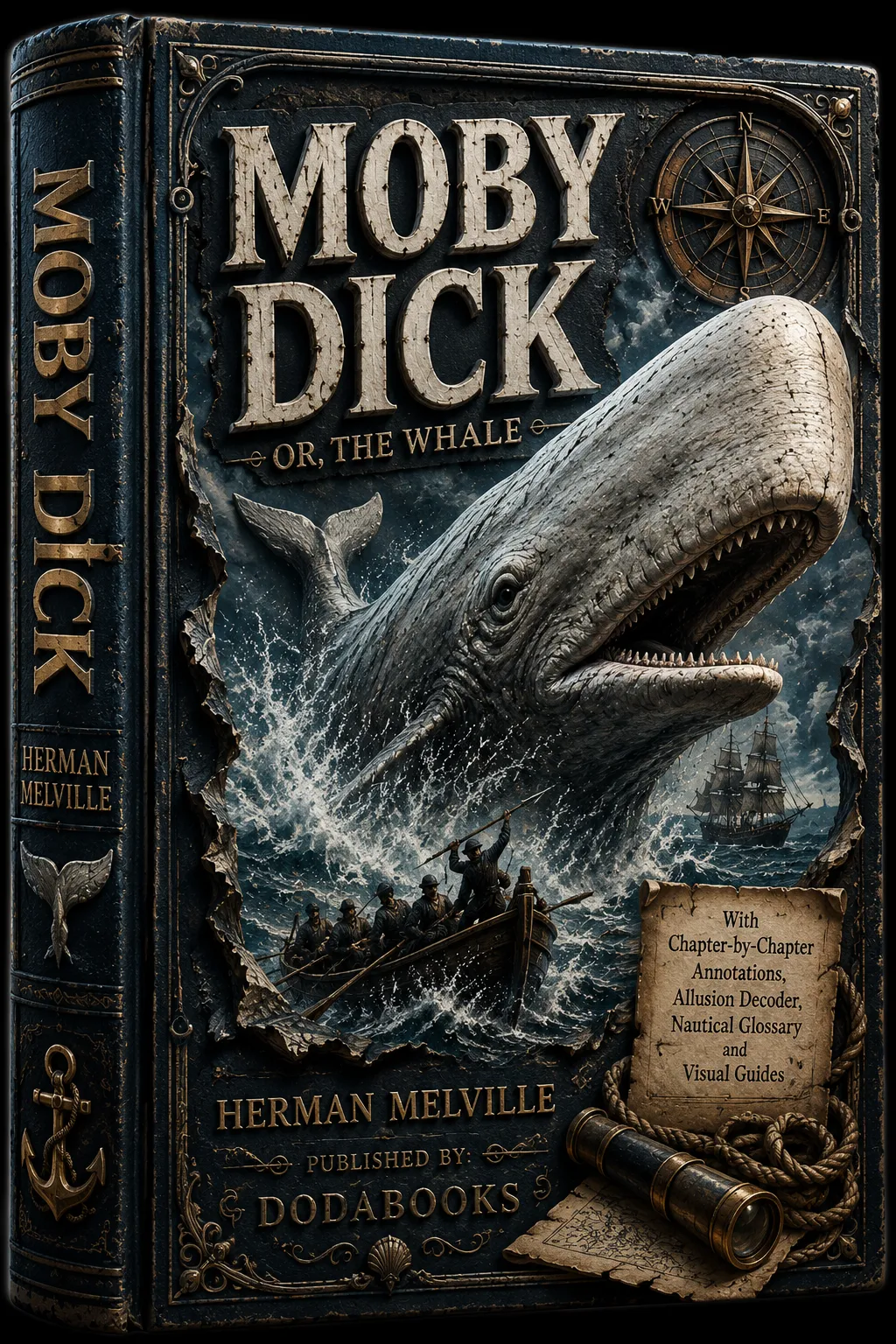
Discover the depth of Melville’s masterpiece with our annotated edition of Moby-Dick. Complete text with explanatory notes, historical context, and literary analysis.
📚 Related Articles
Frequently Asked Questions
What are the major religious themes in Moby-Dick?
The novel explores Calvinist predestination, Christian orthodoxy versus pagan spirituality, divine silence, and humanity's rebellion against God.
What is the significance of Father Mapple's sermon in Chapter 9?
Father Mapple preaches the story of Jonah, arguing that true faith requires obeying God by preaching unwelcome truth in the face of a sinful world.
Does Herman Melville believe in fate or free will in Moby-Dick?
Melville portrays fate and free will as inextricably woven together, famously depicted in the 'Mat-Maker' chapter as warp, weft, and sword.
Why is Ahab's quest viewed as blasphemous?
Ahab attempts to impose human vengeance on divine providence, viewing God or nature as a cruel tyrant that must be struck down.
How do the annotations in DodaBooks clarify Melville's theological allusions?
DodaBooks provides detailed notes on Calvinism, Gnosticism, Zoroastrianism, and biblical typography that illuminate Melville's spiritual themes.
🎯 Stop Struggling. Start Understanding.
The annotated edition of Moby-Dick gives you everything you need to finally get Melville’s masterpiece:
- ✅ Complete, unabridged text — every word of the original 1851 edition
- ✅ Hundreds of explanatory footnotes — no more Googling every other page
- ✅ Historical context — the Essex disaster, Nantucket whaling, Melville’s life
- ✅ Literary analysis — chapter-by-chapter commentary on themes and symbols
- ✅ Victorian vocabulary — obsolete words and nautical terms defined inline
- ✅ Biblical & literary references — every allusion traced to its source