Pride and Prejudice has been in print for over 200 years, never gone out of fashion, and is adapted every few years. Here is what makes it a timeless classic — and why it will still be read in another two centuries.
Why Pride and Prejudice Is a Timeless Classic
Explore why this 200-year-old novel endures — from its fresh prose and real characters to its sharp social commentary and universally resonant themes.
| Published | 1813 |
| Author | Jane Austen (1775–1817) |
| Chapters | 61 |
| Adaptations | Dozens of film, TV, and stage versions |
| Copies sold | Millions, never out of print |
| Original title | First Impressions |
✍️ The Writing Is Still Fresh
Austen’s prose style is deceptively modern. She uses free indirect discourse — a technique where the narration slips into a character’s thoughts without announcing it. You experience Elizabeth’s perspective directly, as if you are inside her head.
Compare Austen to her contemporaries. Most novels from 1813 are almost unreadable today — heavy, moralising, and slow. Austen reads like a contemporary literary novel. The sentences are structured differently from modern writing, but the intelligence behind them feels current.
👤 The Characters Are Real
Austen does not write heroes and villains. She writes people:
- Elizabeth is clever but biased. She is right about some things and wrong about others. She grows.
- Darcy is arrogant but honourable. He is the villain of the first half and the hero of the second.
- Charlotte Lucas marries a fool for financial security. Austen neither condemns nor praises her — she simply shows why the choice makes sense.
- Wickham is charming and evil. Even knowing what he is, you understand why Elizabeth trusted him.
No character is purely good or purely bad. This psychological realism was unusual for Austen’s time and is still uncommon today.
🎯 The Social Commentary Is Sharp
Under the romance, Austen is writing about economics. She shows how marriage in her society was a financial transaction disguised as a romantic choice. The women who understand this (Charlotte) make practical decisions. The women who do not (Lydia) pay for their ignorance.
This critique is subtle enough that you can enjoy the novel as a pure romance. But it is there for readers who want to dig deeper. The novel rewards both surface reading and deep analysis.
📚 Discover the depth beneath the romance
👉 Get the Annotated Edition🌍 The Themes Are Universal
Specific situations change across centuries. Human nature does not.
| Theme | Then | Now |
|---|---|---|
| Pride | Social class arrogance | Online certainty, refusal to admit error |
| Prejudice | Judging by first impression | Same — we all do it |
| Marriage as economics | Women needed husbands | Financial pressure in relationships still exists |
| Personal growth | Learning from mistakes | Still the hardest thing to do |
🏆 The Ending Is Earned
The reason the novel’s happy ending works is that both characters change before they get together. Darcy does not win Elizabeth by being rich. Elizabeth does not win Darcy by being pretty. They both become better people and then earn each other.
Most love stories end when the couple gets together. Austen ends when they are ready for each other.
🧩 What the Annotated Edition Unlocks
242 Literary Annotations
Historical context, critical analysis, and literary allusions for every chapter — understand why Austen chose certain words and what Regency-era social rules mean for the plot.
139 Modern Simplifications
Complex passages rewritten in clear modern English. When Austen's sentences get dense, you will find a plain-English breakdown right there on the page.
Chapter Summaries
Every chapter begins with a concise 150–250 word recap of key events — perfect for quick orientation before you read or for revision after.
76 Discussion Questions
With original answers. Perfect for teachers planning classroom activities, book clubs preparing for meetings, or students writing essays.
Character Relationship Maps
Detailed profiles of every major character with relationship diagrams showing how Elizabeth, Darcy, Bingley, Jane, Wickham, and the rest connect.
Bonus Resources
Story timeline, chapter length bar chart, 10-question quiz with answers, comprehensive glossary of 143 archaic terms, and further reading recommendations.
📜 A Novel of Its Moment
Part of what makes Pride and Prejudice timeless is how precisely it is rooted in its own time. Austen finished an early version of the story (then called First Impressions) in the late 1790s, revised it over the next fifteen years, and finally published it in January 1813, near the end of the Napoleonic Wars. England was a society at war, uneasy about revolution across the Channel, and gripped by parables about heredity, money, and class — exactly the pressure points the novel explores.
Every character is placed in a specific economic and social slot that a Regency reader would understand instantly. Mr. Collins depends on Lady Catherine de Bourgh for his living. Darcy’s wealth is hereditary and landed, which outranks the “new money” of trade. Wickham’s charm is a dangerous asset precisely because, as a penniless officer, he has nothing but his looks and his word. Austen does not need to lecture about any of this because she trusts her readers’ world — which is the central reason an annotated edition is so valuable. For a fuller look at exactly what Regency context the annotations restore, our guide to reading the annotated edition spells out what the notes add to every chapter.
💡 Why the Characters Still Win
The deepest reason the novel endures is not its plot but its people. Austen refuses to make anyone a cardboard villain or a flawless hero. Elizabeth Bennet is clever, warm, and right — and also prejudiced, impulsive, and initially blind to Wickham’s true character. Fitzwilliam Darcy is proud, socially awkward, and condescending at the start, yet quietly honourable and capable of enormous change. Because they are flawed, their growth means something. Because they are both wrong and both right about each other, their eventual union feels hard-won rather than foreordained.
This is a realism that was startling in 1813 and still stands out today. Contrast the walking-instrument moral exemplars of many other Georgian and Regency novels, and Austen’s achievement becomes clear: she lets her characters be complex enough to be mistaken, and she lets them learn. It is why readers argue about them as though they were real people — and why the story of Elizabeth and Darcy has been retold, adapted, and reimagined dozens of times. Our explanations of the major characters traces exactly how each one’s arc works.
🎭 Wit as a Way of Seeing
People often describe Austen as witty, but her wit is not mere decoration — it is a mode of moral perception. The narrator’s irony lets us see what the characters cannot. When Mrs. Bennet announces that the “business of her life was to get her daughters married,” the narrator’s deadpan framing both invites our laughter and quietly indicts a society that makes that a woman’s only real ambition. When Charlotte Lucas marries Mr. Collins for security, Austen neither mocks nor praises her; she simply shows us an intelligent woman making the only sensible choice she has.
That irony is why the novel rewards rereading. The first time through, you are swept along by the romance and the comedy. The second time, you notice how Austen has been winking at you all along — how every early judgment is seeded with the truth that will overtake it. The 1995 BBC adaptation with Colin Firth and Jennifer Ehle captures much of this, but the wit is subtlest on the page, where you have to catch it for yourself. If you want to read it more skillfully, our guide to common reading mistakes shows where most first-timers go astray.
✨ About This Annotated Edition
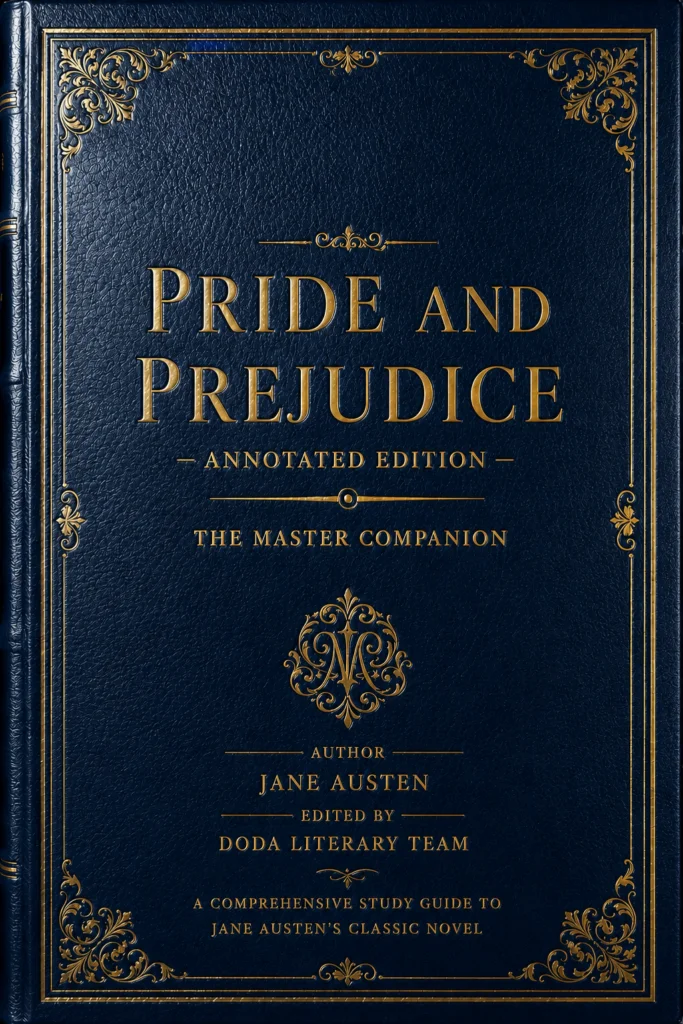
One reason the DodaBooks annotated edition pairs so well with the argument of this article is that it makes visible the machinery of Austen’s timelessness. The 242 notes explain the Regency social rules and the irony that are so easy to miss, while the 139 simplifications open up Austen’s denser sentences without replacing them. The character relationship maps keep the web of connections clear, and the glossary of 143 archaic terms removes the last barrier between you and the text. Together, these tools do what the novel always did for its first readers — hand you the world so the wit can land on the first try.
That is the honest case for the infinite rereadability of Pride and Prejudice: it never runs out of depth. You can read it at fifteen for the romance, at thirty for the social critique, and at fifty for the quiet comedy of human self-deception. Each layer is there because Austen built them all. If you are still deciding whether to make the investment, our honest look at whether it’s worth reading today lays out the case from both sides.
❓ Frequently Asked Questions
What makes Pride and Prejudice different from other 19th-century novels?
Austen’s use of free indirect discourse, her ironic tone, and her focus on ordinary people’s inner lives were revolutionary. Most novels of her era were moralistic and told from a distance. Austen’s feel intimate and modern.
Why is the novel still so popular?
The combination of sharp wit, psychological depth, romantic payoff, and social critique creates a novel that works on multiple levels. You can enjoy it as a love story, a comedy, or a social commentary — or all three at once.
Is Pride and Prejudice a feminist novel?
It is complicated. Elizabeth is an independent, intelligent heroine who refuses to marry for convenience. But she does marry at the end. Most scholars read it as a proto-feminist work that critiques the limited options available to women.
How has the novel influenced modern literature?
It established the “enemies to lovers” trope, popularised the strong-willed heroine archetype, and set the standard for witty romantic fiction. Nearly every romantic comedy written since owes something to Austen.
Which adaptation is closest to the novel?
The 1995 BBC miniseries with Colin Firth and Jennifer Ehle is widely considered the most faithful adaptation. The 2005 film with Keira Knightley is more condensed but captures the spirit well.
What deeper meaning is often missed by first-time readers?
Many readers miss the economic critique. Beneath the romance, Austen is arguing that marriage in her society was a financial transaction that forced women to trade their freedom for security.