Every year thousands of students are assigned Pride and Prejudice, and a significant number of them hate it. Here is why students struggle — and what actually helps them connect with Austen.
Why Students Struggle with Pride and Prejudice
The real reasons students bounce off Austen — language barriers, invisible social rules, slow pacing, and wrong expectations — with proven strategies to help them connect.
| Reason #1 | Language gap — 19th-century vocabulary and 80-word sentences |
| Reason #2 | Invisible social context — entailment, courtship, class rules |
| Reason #3 | Nothing happens on the surface — all drama is internal |
| Reason #4 | Wrong expectations — it is a social satire, not a romance |
| Reason #5 | Reading alone without support |
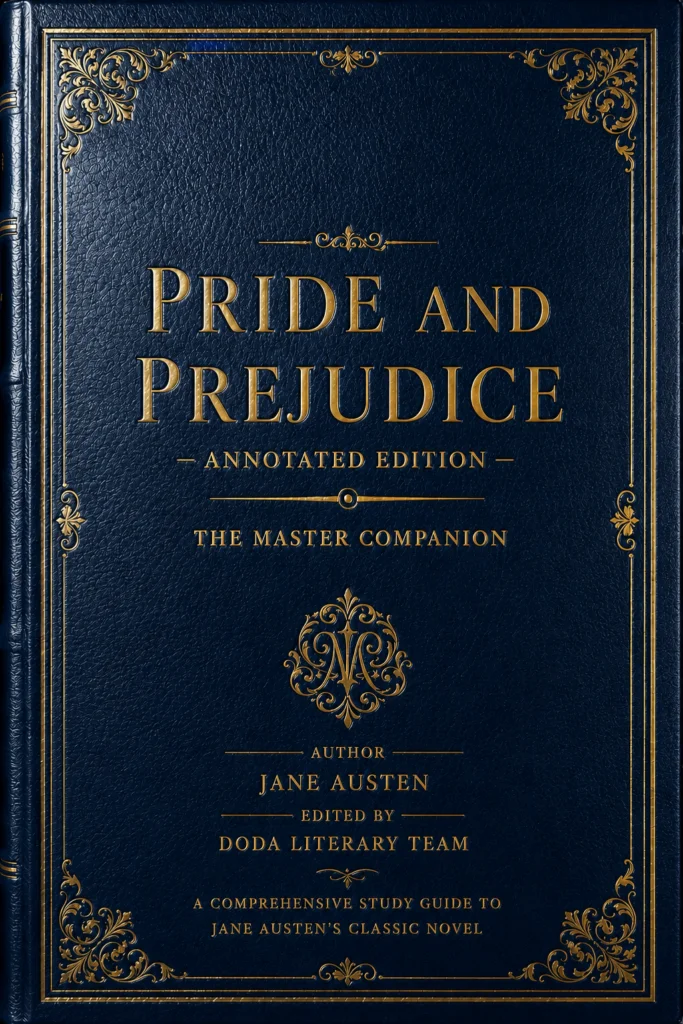
| Best solution | Annotated edition with integrated context |
🗣️ Reason 1: The Language Gap
Austen wrote 200 years ago. Her vocabulary, sentence structure, and grammar are different from modern English. Students who are strong readers can usually manage. Students who are average or struggling readers face a wall.
The problem: A single sentence can run 80 words with multiple clauses. By the time a student reaches the period, they have forgotten the beginning.
Example from Chapter 1:
“However little known the feelings or views of such a man may be on his first entering a neighbourhood, this truth is so well fixed in the minds of the surrounding families, that he is considered as the rightful property of some one or other of their daughters.”
That is 42 words. A modern sentence would break this into 3–4 sentences. Students read it once, get lost, and give up.
🏛️ Reason 2: The Social Context Is Invisible
The entire plot depends on social rules that modern students do not know exist:
- Entailment — why the Bennet daughters will be homeless
- Courtship conventions — why certain behaviours are scandalous
- Class hierarchy — why Darcy and Bingley are treated differently
- Property and income — why marriage is a financial decision
Without this context, the stakes feel artificial. Students wonder: “Why is Lydia running away such a big deal? Why does everyone care about Bingley’s income?”
🐌 Reason 3: Nothing Happens (On the Surface)
Pride and Prejudice has no car chases, no murders, no explosions, and no explicit scenes. For students raised on action-driven plots, the novel feels slow. The drama is internal — arguments, realisations, social snubs — and students who are not trained to read for subtext miss it entirely.
📚 Give students the context they need to succeed
👉 Get the Annotated Edition🎭 Reason 4: Wrong Expectations
Many students expect a romance novel. They get a social satire. The romantic scenes are few and brief. The bulk of the novel is about family dynamics, social pressure, and bad decisions. Students who wanted Darcy to be a romantic hero from page one are confused when he is rude and unlikeable.
🤷 Reason 5: Reading Alone Without Support
Reading Austen in isolation is hardest. Without discussion, annotation, or guidance, students can spend hours on a chapter and come away with nothing. They understand the words but not the meaning.
💡 What Helps
| Strategy | Impact |
|---|---|
| Annotated edition | Very high — explains context inline |
| Chapter summaries first | High — creates a map before the journey |
| Watch a film version first | Medium — helps with character visualisation |
| Group discussion | High — different readers catch different things |
| Simplified version for pre-reading | High — build familiarity with the plot first |
👨🏫 For Teachers
The most effective strategy: have students read the simplified version first (one weekend), watch the 1995 BBC adaptation (one week), then read the original (two weeks). By the time they hit Austen’s language, they already know the story and characters — they can focus on the prose.
🧩 What the Annotated Edition Unlocks
242 Literary Annotations
Historical context, critical analysis, and literary allusions for every chapter — understand why Austen chose certain words and what Regency-era social rules mean for the plot.
139 Modern Simplifications
Complex passages rewritten in clear modern English. When Austen's sentences get dense, you will find a plain-English breakdown right there on the page.
Chapter Summaries
Every chapter begins with a concise 150–250 word recap of key events — perfect for quick orientation before you read or for revision after.
76 Discussion Questions
With original answers. Perfect for teachers planning classroom activities, book clubs preparing for meetings, or students writing essays.
Character Relationship Maps
Detailed profiles of every major character with relationship diagrams showing how Elizabeth, Darcy, Bingley, Jane, Wickham, and the rest connect.
Bonus Resources
Story timeline, chapter length bar chart, 10-question quiz with answers, comprehensive glossary of 143 archaic terms, and further reading recommendations.
🧠 Reading the Novel Like a Modern Detective
The biggest single unlock for students is reframing what kind of book they are reading. Pride and Prejudice is less like a dramatic romance and more like a puzzle box of misinterpretations — nearly every chapter is built on someone misreading someone else. Elizabeth misreads Wickham, Darcy, and her own family; Darcy misreads Elizabeth’s motives and Jane’s feelings; Mrs. Bennet misreads everyone. Once students read for misunderstandings, the slow sections fill with tension.
Treat each chapter like a detective case: who believes what at the start, what new information arrives, and how does the belief shift by the end? You can chart the whole novel this way. Our chapter-by-chapter summary and quotes explained guide both map these perception shifts, giving students a scaffold for reading intelligently on their own.
🏛️ The Social Stakes, Explained Simply
Much student frustration comes down to missing information. The entail means the Bennet daughters lose the house when Mr. Bennet dies — so every marriage is a financial lifeboat, not just a romance. A woman who behaved as Lydia does would be socially ruined, and her sisters’ prospects along with her. A man of Darcy’s income was an independent power; nobody could tell him whom to marry. These are not side details — they are the plot.
The fastest fix is to spend one lesson front-loading these rules before Chapter 1. Explain entail, primogeniture, the economics of marriage, and the social code that governs every dance and conversation. Our themes explained guide organises exactly this context, and teachers who front-load it report students engaging with the novel’s stakes almost immediately — because suddenly the stakes are visible.
👥 Working in Pairs and Groups
Reading Austen alone is the hardest way to read her; reading her with a partner halves the difficulty. Pair students and give each pair a character to track across the novel — their lines, their decisions, their blind spots — and meet once a week to compare notes. The conversations this generates are remarkable: students notice that Elizabeth misjudges as fervently as her mother, or that Darcy’s rudeness is rooted in social terror.
When pairs present, the novel’s pattern of mutual misjudgment clicks into place. For classroom-ready discussion material, try our free discussion questions in week one — the simple, non-spoiler prompts build confidence before the plot thickens.
📋 A Realistic Two-Week Plan
If students only read in class, one semester is not enough; if they read alone, they drift. A workable middle ground: assign two chapters per night, and set aside ten minutes each lesson for a “story so far” recap plus one focus question for that night’s reading. By week two, students have momentum, and the final lessons can move to analysis — the romantic subplots, the comedy of the Bennets, and the famous ending explained as the novel’s payoff to its own misunderstandings.
Pairs, chapter recaps, and focus questions sound humble, but they are what stop strong readers from quitting in boredom and weak readers from quitting in confusion. Add the annotated edition with its chapter summaries and simplifications, and the same plan also works for independent study — which is why it is the default recommendation for students at all levels.
❓ Frequently Asked Questions
Why is Pride and Prejudice assigned in schools?
It is considered one of the finest examples of English literature, demonstrating masterful use of irony, free indirect discourse, and social commentary. It also introduces students to a key historical period through an engaging narrative.
What grade level is Pride and Prejudice appropriate for?
The original text is typically taught in grades 9–12 (ages 14–18). The simplified English version is appropriate for grades 5–8 or ESL students.
How can teachers make the novel more accessible?
Use a layered approach: simplified version for pre-reading, film adaptation for visual context, annotated edition for deep study. Front-load historical context before reading begins.
Is there a version with built-in teaching resources?
Yes, the annotated edition includes 76 discussion questions with answers, character relationship maps, and chapter summaries — all designed for classroom use.
Why do students who love reading still struggle with this novel?
Even strong readers struggle with Austen because the difficulty is not vocabulary level but sentence structure and cultural context. The sentences are syntactically complex, and the social dynamics require background knowledge most modern readers lack.
What is the single most helpful resource for struggling students?
An annotated edition that explains social context, breaks down complex sentences, and provides chapter summaries. It is like having a tutor alongside as they read.
Is it true that the novel gets easier after the first few chapters?
Yes — and this surprises most students. Chapter 1 is dense because it introduces the whole Bennet household and the narrator’s ironic voice at once. Once you know the characters and the “person who believes what” pattern, Chapters 5-20 flow much faster. Many readers report the second half flying past. Powering through the opening is the single highest-value habit for a first-time reader.
What does the title Pride and Prejudice actually mean?
It names the two failings the plot is built on: Darcy’s proud assumption that he is above the Bennets’ world, and Elizabeth’s prejudiced judgment of him based on first impressions and Wickham’s lies. Austen deliberately pairs them — each character exhibits both flaws at different moments, and the ending works only when each learns to correct both.
Which chapters should a struggling student focus on first?
Chapters 1-6 establish the whole mechanism: the Bennet family, Darcy’s first insult, and the arrival of Wickham’s rival version of events. If a student can grasp the dynamic of those six chapters, the rest of the novel becomes a matter of watching misunderstandings compound. Teachers should steer struggling readers here before anything else.