Fifteen iconic Pride and Prejudice quotes explained with context and meaning — from Darcy’s insult to Elizabeth’s laugh, with analysis of each famous line.
Pride and Prejudice Quotes Explained: 15 Most Famous Lines
Famous lines from Pride and Prejudice explained in plain English — what each quote actually means, why it matters, and how it reveals character, theme, and Austen's legendary irony.
👉 Get the Annotated Edition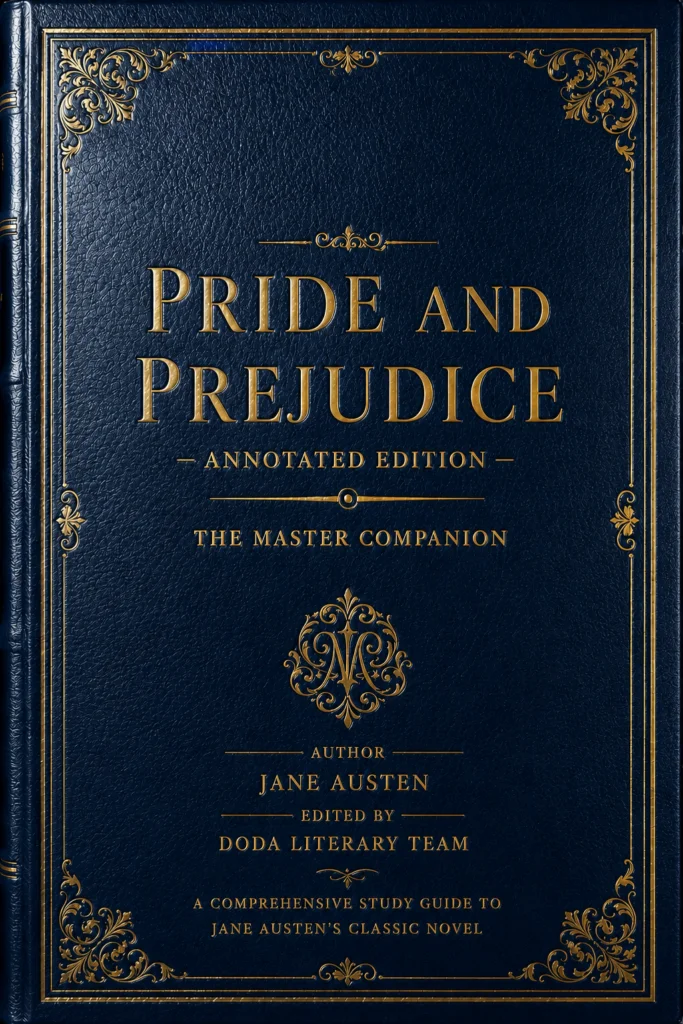
| Novel | Pride and Prejudice |
| Author | Jane Austen (1775–1817) |
| Published | 1813 |
| Famous Lines Count | 15 (featured here) |
| Book Length | 61 chapters, ~120,000 words |
💕 “It is a truth universally acknowledged, that a single man in possession of a good fortune, must be in want of a wife.”
Narrator, Chapter 1
Austen opens her novel with the most famous first line in English literature — but it’s pure irony. The “truth” she describes isn’t a truth at all; it’s a social assumption that everyone treats as fact. A wealthy man might want a wife, or he might not. The joke is that the novel’s mothers (especially Mrs. Bennet) believe it so completely that they treat every eligible bachelor as a potential son-in-law before he’s even been introduced. This one sentence establishes the ironic tone, introduces marriage as the central subject, and warns readers to question everything they’re told.
😤 “She is tolerable, but not handsome enough to tempt me.”
Mr. Darcy, Chapter 3
Darcy says this at the Meryton ball when Bingley suggests he dance with Elizabeth. On the surface, it’s a cruel dismissal. But look closer: why say anything at all? Darcy could have simply declined to dance. His defensiveness suggests he’s already attracted to Elizabeth and is trying to convince himself — and Bingley — that he isn’t. Elizabeth overhears him, and this single line poisons her opinion of Darcy for the next half of the novel. Everything she sees, she filters through this insult. One careless remark creates the entire central conflict.
🎯 “I could easily forgive his pride, if he had not mortified mine.”
Elizabeth Bennet, Chapter 5
Elizabeth says this to Charlotte Lucas, and it’s the most honest thing she says in the early novel. She admits that her dislike of Darcy isn’t a principled stand against arrogance — it’s personal revenge. She can tolerate Darcy’s pride as long as it doesn’t insult her. This is the novel’s central dynamic in one sentence: both Darcy and Elizabeth are proud, and both are wounded when the other’s pride clashes with their own. Elizabeth’s self-awareness here is ironically blind to her own prejudice.
❤️ “You must allow me to tell you how ardently I admire and love you.”
Mr. Darcy, Chapter 34
This line comes in the middle of Darcy’s first proposal — but it’s surrounded by insults about Elizabeth’s family and social position. Darcy genuinely believes he’s being romantic by declaring his love “despite” her inferior connections. Elizabeth, understandably, hears: “I love you even though you’re embarrassing.” The proposal is a disaster, and this line shows exactly why: Darcy can’t separate his love from his class prejudice. He means well, but his delivery is catastrophic — and it forces both of them into an open confrontation that changes everything.
💡 “Till this moment, I never knew myself.”
Elizabeth Bennet, Chapter 36
After reading Darcy’s letter explaining his treatment of Wickham and Bingley, Elizabeth is forced to confront the truth: she has been completely, utterly wrong. She misjudged Darcy, she was fooled by Wickham, and her cherished self-image as a sharp judge of character is shattered. This line is her moment of genuine self-awareness, and it’s painful. Character growth doesn’t begin without this kind of honest reckoning. Elizabeth emerges from this scene a different person — humbler, more careful, ready to see the truth instead of what she expects.
💔 “You are the last man in the world whom I could ever be prevailed on to marry.”
Elizabeth Bennet, Chapter 34
Elizabeth fires this at Darcy during his first proposal, and she means every word of it. She believes he ruined Jane’s happiness, destroyed Wickham’s prospects, and acted with unforgivable pride. The dramatic irony is exquisite: by the end of the novel, Darcy will become the only man she would marry. The gap between what Elizabeth says here and what she feels at the end is the entire novel condensed into a single sentence. This is Austen proving that first impressions — and firm declarations — can be dangerously wrong.
😅 “In vain have I struggled. It will not do. My feelings will not be repressed.”
Mr. Darcy, Chapter 34
This is how Darcy begins his first proposal — and it’s genuinely revealing. He admits he’s been fighting his feelings for Elizabeth and losing. For a man as controlled and prideful as Darcy, this confession is extraordinary. But then he immediately ruins it by explaining why he’s struggled: her family, her social position, her connections. He’s confessing love and snobbery in the same breath. The line shows that Darcy’s feelings are real and powerful — but he still has a long way to go before he understands what love actually requires.
🏠 “Think only of the past as its remembrance gives you pleasure.”
Elizabeth Bennet, Chapter 58
Elizabeth says this to Darcy after their reconciliation, and it’s one of the most mature lines in the novel. She’s not pretending the past didn’t happen. She’s choosing, deliberately, not to dwell on mistakes that have been acknowledged and learned from. This is forgiveness in action — not forgetting, but deciding that the future matters more than the past. It’s the line that finally proves both characters have grown enough to deserve each other.
😏 “For what do we live, but to make sport for our neighbors, and laugh at them in our turn?”
Mr. Bennet, Chapter 57
Mr. Bennet delivers this line with his characteristic dry wit, and it captures his entire philosophy of life. He sees society as a comedy, and he’s content to observe and chuckle from his library. It’s funny, yes — but it’s also a confession of detachment. While Mr. Bennet is laughing at his neighbours, his daughters’ futures are at risk. Austen uses this line to make us enjoy Mr. Bennet’s wit while also recognising its cost.
🗣️ “Your defect is a propensity to hate everybody.”
Mr. Darcy, Chapter 11
Darcy says this to Elizabeth during a conversation at Netherfield, and she fires back immediately. It’s one of their earliest extended exchanges, and the chemistry is electric. Darcy is, of course, projecting: he’s the one who hates everybody. But Elizabeth’s reply is even sharper — and it reveals that both of them are more alike than they’d care to admit. They’re both proud, both quick to judge, and both unwilling to back down. The attraction is already there; they’re just expressing it as combat.
🙃 “And yours is to wilfully misunderstand everybody.”
Elizabeth Bennet, Chapter 11
Elizabeth’s immediate retort to Darcy’s accusation, and it’s the more perceptive of the two lines. Darcy’s defect (hating everybody) is obvious. Elizabeth’s defect (wilfully misunderstanding people who challenge her assumptions) is subtler — and more dangerous. She doesn’t just misunderstand Darcy; she chooses to misunderstand him because the truth would force her to revise her self-image. This line contains a warning that Elizabeth herself can’t yet see.
😱 “An unhappy alternative is before you, Elizabeth. From this day you must be a stranger to one of your parents.”
Mr. Bennet, Chapter 20
Mr. Bennet says this when Elizabeth refuses to marry Mr. Collins and her mother threatens to never speak to her again. It’s classic Mr. Bennet: a serious situation wrapped in irony. But there’s real pain underneath. He’s proud of Elizabeth’s refusal, but he also knows the consequences are serious. The line captures the tragicomic bind of women in Regency England: defy your mother and lose her support, or marry a fool and lose yourself.
🌍 “The more I see of the world, the more am I dissatisfied with it.”
Elizabeth Bennet, Chapter 24
Elizabeth writes this in a letter to her aunt after learning of Wickham’s true character. It’s a young woman’s disillusionment, and it’s heartbreaking. The world she thought she understood — charming men are good, rude men are bad — has turned out to be far more complicated. This line marks the beginning of Elizabeth’s maturity. Disillusionment is painful, but it’s also necessary. You can’t grow until you admit you were wrong.
🏃 “A lady’s imagination is very rapid; it jumps from admiration to love, from love to matrimony in a moment.”
Mr. Darcy, Chapter 6
Darcy says this to Miss Bingley, but he’s really talking about Elizabeth — and himself. He’s already jumping from admiration to something deeper, and he’s terrified by how fast it’s happening. The irony is delicious: Darcy accuses ladies of romantic haste while falling in love far faster than he’d ever admit. This is Austen showing that Darcy’s feelings are real and urgent long before he’s ready to acknowledge them.
😂 “I am happier even than Jane; she only smiles, I laugh.”
Elizabeth Bennet, Chapter 60
Elizabeth says this after her engagement to Darcy, and it’s the perfect ending to her arc. The woman who swore she’d never marry Darcy is now happier than her perpetually serene sister. The woman who was all sharp edges and defensive pride now laughs openly. This line proves that Elizabeth’s happiness with Darcy isn’t just social or financial — it’s genuinely joyful. She’s not settling. She’s delighted.
📚 All 61 chapters annotated line by line — get the annotated edition with every quote explained in context
👉 Buy the Annotated Edition📦 What the Annotated Edition Unlocks
242 Literary Annotations
Historical context, critical analysis, and literary allusions for every chapter — understand why Austen chose certain words and what Regency-era social rules mean for the plot.
139 Modern Simplifications
Complex passages rewritten in clear modern English. When Austen's sentences get dense, you'll find a plain-English breakdown right there on the page.
Chapter Summaries
Every chapter begins with a concise 150–250 word recap of key events — perfect for quick orientation before you read or for revision after.
76 Discussion Questions
With original answers. Perfect for teachers planning classroom activities, book clubs preparing for meetings, or students writing essays.
Character Relationship Maps
Detailed profiles of every major character with relationship diagrams showing how Elizabeth, Darcy, Bingley, Jane, Wickham, and the rest connect.
Bonus Resources
Story timeline, chapter length bar chart, 10-question quiz with answers, comprehensive glossary of 143 archaic terms, and further reading recommendations.
❓ Frequently Asked Questions
What is the most famous line in Pride and Prejudice?
The most famous line is the novel’s opening: “It is a truth universally acknowledged, that a single man in possession of a good fortune, must be in want of a wife.” It’s widely considered one of the greatest opening lines in English literature for its ironic tone, social commentary, and immediate establishment of the novel’s central concerns — marriage, money, and the gap between public assumption and private truth.
Why does Darcy say Elizabeth is "not handsome enough to tempt me"?
Darcy says this at the Meryton ball in Chapter 3 when Bingley suggests he dance with Elizabeth. On the surface, it’s a cruel dismissal. But most scholars interpret it as defensiveness: Darcy is already attracted to Elizabeth and tries to convince himself (and Bingley) that he isn’t. His behaviour for the rest of the novel — seeking out her company, admiring her eyes, falling in love — completely contradicts his words.
What does Elizabeth mean when she says "till this moment, I never knew myself"?
She means she has just realised her judgment is flawed. After reading Darcy’s letter, she understands that she was completely wrong about both Darcy and Wickham. Her confidence in her own perceptions was misplaced. This line marks the moment Elizabeth’s pride is humbled and her genuine growth begins.
How many proposals does Darcy make to Elizabeth?
Two. The first (Chapter 34) is a disaster — Darcy confesses his love while insulting her family and social position. Elizabeth rejects him furiously. The second (Chapter 58) is humble and respectful. Darcy has changed. Elizabeth accepts, and their reconciliation is one of the most satisfying moments in English literature.
What is the meaning of the title Pride and Prejudice?
The title refers to the two central character flaws of the protagonists. Darcy’s pride (in his social status and judgment) must be humbled. Elizabeth’s prejudice (judging Darcy based on a first impression and biased information) must be overcome. Together, the title encapsulates the novel’s argument: both pride and prejudice must give way to self-awareness for genuine love to flourish.
Why does Elizabeth reject Darcy's first proposal?
Elizabeth rejects Darcy for three reasons: he insulted her at the Meryton ball (wounding her pride), she believes he separated Bingley and Jane (based on her prejudice), and she trusts Wickham’s lies over Darcy’s character. She’s also furious at the way Darcy proposes — he lists all the reasons he shouldn’t marry her while asking her to accept him. It’s not a proposal of love; it’s a proposal of condescension.
What is the last line of Pride and Prejudice and why does it matter?
The last line describes the relationship between Lady Catherine and the Darcys: “Lady Catherine was extremely indignant on the marriage of her nephew; and as she gave way to all the genuine frankness of her character, in her reply to the letter which announced its arrangement, she sent him language so very abusive, especially of Elizabeth, that for some time all intercourse was at an end.” It matters because it shows that Elizabeth and Darcy’s happiness doesn’t require everyone’s approval. Lady Catherine’s fury is the final proof that they chose each other over social convention.
📚 Related Articles
Get the Annotated Edition
242 annotations, 139 simplifications, 76 discussion questions, and complete character analysis — all in one beautifully formatted EPUB.
- ✅ All 61 chapters annotated line by line
- ✅ 139 modern simplifications for difficult passages
- ✅ 76 discussion questions with answers
- ✅ Character maps, glossary, quiz, and more