The full Pride and Prejudice ending explained step by step — Darcy’s second proposal, Lydia’s elopement, Lady Catherine’s intervention, and the double wedding.
📖
Pride and Prejudice Ending Explained: What Happens and Why
From Darcy's rejected proposal to the double wedding — every twist in Austen's iconic finale, explained step by step.
| Novel | Pride and Prejudice |
| Author | Jane Austen (1775–1817) |
| Final Arc | Chapters 46–61 |
| Key Events | Lydia’s elopement, Darcy’s second proposal, double wedding |
| Ending Tone | Comic resolution with earned happiness |
| Reading Time | ~3 hours for final arc |
🔥 The Setup: Everything Falls Apart (Chapters 46–50)
By the final ten chapters, everything has gone wrong:
- Lydia has eloped with Wickham. This is a catastrophe for the Bennet family. If Wickham does not marry her, Lydia is ruined forever, and her sisters will never find respectable husbands.
- Darcy has been rejected. Elizabeth turned down his first proposal and accused him of ruining Wickham’s life and separating Jane from Bingley.
- Elizabeth believes Darcy is the villain. She trusts Wickham’s story completely and has no reason to doubt it.
🔄 The Turning Point (Chapters 46–47)
Elizabeth receives a frantic letter from Jane describing Lydia’s elopement. Darcy arrives at Longbourn while Elizabeth is distraught. She tells him everything.
Darcy leaves. Elizabeth assumes he is washing his hands of the Bennet family’s disaster — and why would he not? She already rejected him.
What actually happens: Darcy goes to London, finds Lydia and Wickham, and forces Wickham to marry Lydia by paying off all his debts and giving him additional money. He does all of this in secret. Elizabeth only finds out the truth months later.
✉️ The Letter (Chapter 48)
Elizabeth reads a letter from Mrs. Gardiner revealing that Darcy was responsible for arranging Lydia’s marriage. This is the second time Elizabeth has received a letter that completely changes her understanding of Darcy.
Her reaction: “She respected, she esteemed, she was grateful to him.” She is not consciously in love yet — but she can no longer maintain her prejudice. The foundation for her feelings has been laid.
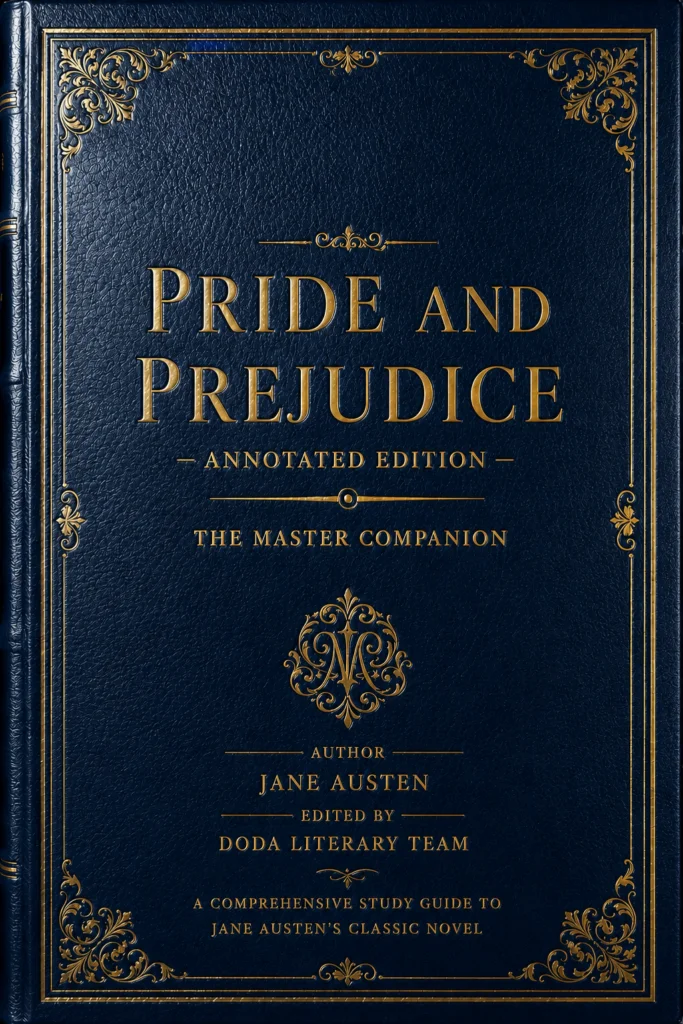
📚 Follow every chapter with expert annotations
👉 Get the Annotated Edition👑 Lady Catherine’s Intervention (Chapter 56)
This is the comic climax of the novel. Lady Catherine de Bourgh arrives at Longbourn and demands that Elizabeth promise never to accept a marriage proposal from Darcy.
Lady Catherine’s logic: Darcy is engaged to her daughter. Elizabeth is beneath him socially. She must withdraw for the sake of propriety.
Elizabeth’s response: She refuses to make any such promise. She does not confirm she loves Darcy — she simply says she will not be intimidated into a vow she does not choose to make.
This scene is the most important moment for Elizabeth’s character development. She is offered an easy way out (promise not to marry Darcy, end the conflict) and refuses — not because she wants Darcy, but because she refuses to be controlled by anyone.
💍 Darcy’s Second Proposal (Chapter 58)
Darcy arrives at Longbourn with Lady Catherine’s letter in his pocket. Lady Catherine has told him about Elizabeth’s refusal to promise anything — and Darcy correctly interprets this as hope.
Darcy proposes again. The contrast between his two proposals reveals everything about how both characters have grown:
| Aspect | First Proposal | Second Proposal |
|---|---|---|
| Tone | Insults Elizabeth’s family | Respects Elizabeth |
| Certainty | Assumes she will accept | Unsure of her answer |
| Focus | His own feelings | Her feelings |
| Pride | Arrogant, entitled | Humble, sincere |
| Outcome | Rejected | Accepted |
Elizabeth accepts. They talk through everything — the misunderstandings, the mistakes, the growth. Darcy apologises for his first proposal. Elizabeth admits she was wrong about Wickham. For the first time, they meet as equals.
🎀 The Wedding and Aftermath (Chapters 59–61)
Darcy and Elizabeth marry. Jane and Bingley also finally marry. The novel ends with each character receiving their fitting conclusion:
- Lydia and Wickham — still irresponsible, still spending beyond their means, but tolerated at a distance by the family
- Lady Catherine — furious, but eventually reconciling after Darcy’s continued happiness with Elizabeth
- Mrs. Bennet — overjoyed that her daughter married rich
- Mr. Bennet — genuinely missing Elizabeth but proud of her choice, admitting he “never knew you were so handsome”
- The Gardiners — recognised by both Darcy and Elizabeth as their true parents in spirit
✨ Why the Ending Works
The ending satisfies because Elizabeth and Darcy earned it. Neither character changes to please the other. They both change independently:
- Darcy changes because Elizabeth’s rejection forced him to confront his arrogance and entitlement
- Elizabeth changes because Darcy’s letter forced her to confront her bias and blind trust in Wickham
By the time they come together, they are both ready. Austen earns her happy ending by making sure her characters have become people capable of sustaining it.
📦 What You Get with the Annotated Edition
Chapter Annotations
Over 240 expert annotations explaining historical context, literary allusions, and Regency-era social rules.
Historical Context
Regency England brought to life — class structures, marriage laws, inheritance customs, and daily life in 1813.
Character Analysis
Detailed profiles of every major character with relationship maps showing how they all connect.
Modern Translations
Over 130 complex passages rewritten in clear, modern English — no more struggling with dense prose.
Discussion Questions
76 discussion questions with answers for teachers, book clubs, and students writing essays.
Bonus Resources
Character diagrams, timeline visualizations, chapter length charts, glossary of 143 archaic terms, and a quiz.
❓ Frequently Asked Questions
Why does Darcy propose twice?
Darcy proposes the first time while still prideful, assuming Elizabeth will accept despite his insults to her family. After her rejection forces him to reflect, he changes his behaviour — helping Lydia in secret, treating Elizabeth with respect — and proposes again as a genuinely changed man.
Does Elizabeth really love Darcy at the end?
Yes, but it is a slow-burn realisation. She begins to respect and esteem him after learning the truth about Wickham. Love follows respect. By the time she accepts his second proposal, she is genuinely in love — not marrying for convenience or money.
Why does Lady Catherine visit Elizabeth?
Lady Catherine is threatened by rumours that Darcy intends to marry Elizabeth. She visits Longbourn to intimidate Elizabeth into promising never to accept Darcy. Her plan backfires spectacularly — Elizabeth’s refusal to be bullied convinces Darcy that Elizabeth might accept him.
What happens to Lydia and Wickham after the wedding?
Lydia and Wickham remain irresponsible. They visit occasionally but their relationship is loveless and financially unstable. Wickham’s debts continue, and Darcy quietly manages the situation to protect the family’s reputation. Austen uses them as a cautionary counterpoint to Elizabeth and Darcy’s genuine partnership.
Does Mr. Bennet approve of Darcy?
Mr. Bennet initially dislikes Darcy — finding him proud and cold. But when he learns how Darcy managed Lydia’s elopement (paying Wickham, saving the Bennet family’s honour), he gives his blessing. His final words to Elizabeth — “I never knew you were so handsome” — show his deep affection and approval.
Do Jane and Bingley marry at the same time as Elizabeth and Darcy?
Almost. Jane and Bingley become engaged first, with Elizabeth’s encouragement. Darcy and Elizabeth follow shortly after. Both couples marry in a double wedding ceremony, though Austen handles this quietly — the focus remains firmly on Elizabeth and Darcy.
Is the Pride and Prejudice ending truly happy?
Yes, but with Austen’s characteristic realism. The ending is happy because Elizabeth and Darcy have grown into people who deserve each other. But Lydia still struggles, Lady Catherine remains furious, and social constraints still exist. The happiness is earned, not perfect — which makes it feel more real.
📚 Related Articles
🎯 Never Struggle with Austen Again
The Pride and Prejudice Annotated Edition gives you everything you need to fully understand Austen’s masterpiece:
- ✅ Complete, unabridged text — every word of the 1813 original
- ✅ Over 240 expert annotations — historical context, literary analysis, and Regency social rules explained inline
- ✅ 130+ modern translations — complex passages rewritten in plain English
- ✅ Chapter summaries — concise recaps for quick orientation
- ✅ Character profiles — relationship maps and detailed analysis of every major figure
- ✅ 76 discussion questions — perfect for teachers, book clubs, and essay writing