Should you read the original Pride and Prejudice or an annotated version? Here is a direct comparison of what each offers, what each lacks, and which one suits different readers.
⚖️
Pride and Prejudice Annotated vs Original: What's the Difference?
The right choice depends on what you want from the book. Here is a direct comparison of readability, understanding, and time commitment.
| Original | Pure Austen — no notes, no explanations, just the 1813 text |
| Annotated | Full original text + 242 annotations, 139 simplifications, bonus materials |
| Original Cost | Free (public domain) |
| Annotated Cost | $9.99 |
| Original Reading Time | ~10-12 hours |
| Annotated Reading Time | ~14-16 hours |
📖 What the Original Gives You
The original text is what Austen wrote. No notes, no explanations, no modern context — just the novel as it was published in 1813.
Pros. You experience the book exactly as its first readers did. The humour lands harder when you catch it yourself. The sentences flow without interruption. There is no voice telling you what to think.
Cons. You will miss things. The social rules, the class dynamics, the archaic word meanings — if you do not already know them, whole layers of the novel are invisible. And Austen’s long sentences genuinely are difficult for many modern readers.
📚 What the Annotated Version Adds
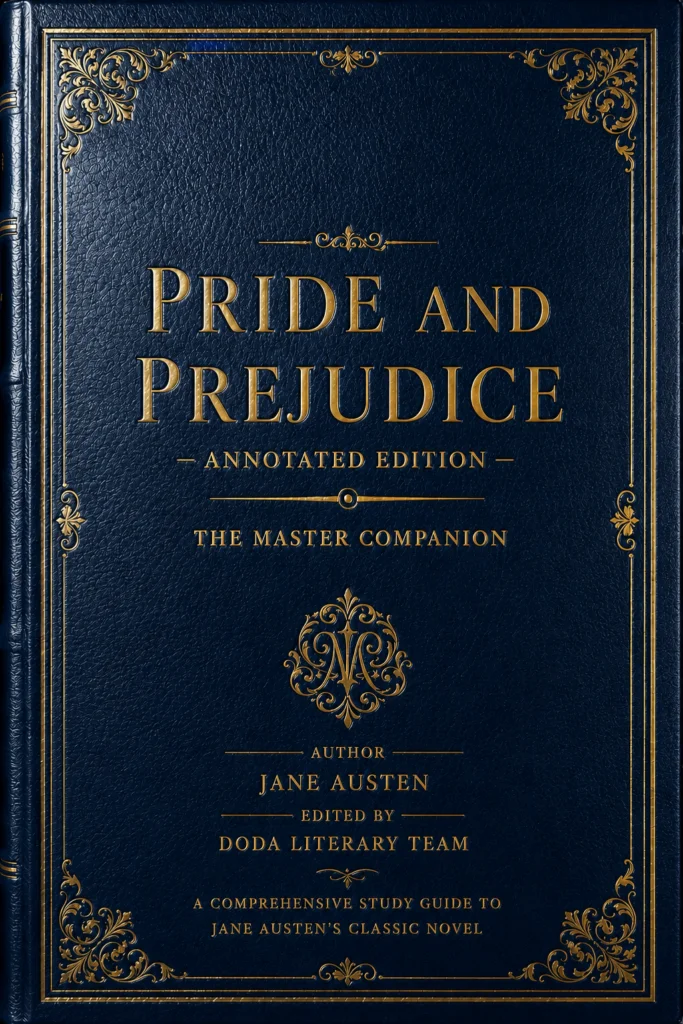
An annotated edition keeps the full original text and adds explanations around it — word definitions, historical context, character notes, thematic analysis.
Pros. Nothing is mysterious. Every reference is explained. The social rules that drive the plot (why can’t women inherit? what is wrong with running away with a soldier?) are clarified as you read. You understand more with less effort.
Cons. The annotations can interrupt your reading flow. Some readers find the constant notes distracting. And if you are already familiar with the period, much of the annotation will feel redundant.
📖 Get the best of both worlds — the original text with all the context
👉 Get the Annotated Edition📊 Side-by-Side Comparison
| Factor | Original | Annotated |
|---|---|---|
| Reading time | ~10-12 hours | ~14-16 hours (more content to read) |
| Understanding | Depends on prior knowledge | Consistent for all readers |
| Flow | Uninterrupted | Notes break the rhythm |
| Cost | Free (public domain) | $9.99 |
| Depth | Surface level | Historical + literary context |
| Best for | Experienced readers | Students and first-timers |
👤 Who Should Read Which
Read the original if: You are comfortable with 19th-century English, you have read other Austen novels, or you want the pure experience without commentary.
Read the annotated version if: This is your first Austen novel, you are studying it for a course, or you have tried the original before and gave up.
🤝 The Middle Ground
You can also read the original first and use an annotated version as a companion — check the notes after each chapter. This preserves the reading flow while still giving you access to the explanations when you want them.
Some readers find this is the best of both worlds. Others find they never actually go back to check the notes. Your mileage will vary.
📚 What the Annotated Edition Unlocks
242 Annotations
Historical context, literary analysis, and word definitions for every chapter
139 Simplifications
Dense Austen sentences rewritten in clear modern English alongside the original
Character Profiles
Detailed relationship maps for Elizabeth, Darcy, and every major character
76 Discussion Questions
Ready-made prompts with original answers for essays and classroom activities
143-Term Glossary
Every archaic word and social term from Regency England defined clearly
Visual Guides
Character diagram, story timeline, and chapter length bar chart
🧠 What the Annotations Actually Cover
It helps to be specific about what an annotation is doing on the page, because that determines how much it slows you down. In the DodaBooks annotated edition, the 242 annotations break down into four broad kinds.
The first kind is vocabulary and usage. Austen writes in a register that has drifted in over two centuries: words like “condescension,” “censure,” and “felicity” carried different weight in 1813, and terms of address (“my dear Mr. Bennet”) encode a whole social hierarchy. A note that shows you a Regency reader would have understood a phrase differently does more than clarify a sentence — it restores the joke or the sting you would otherwise walk straight past.
The second kind is Regency social codes. The rules of courtship, visiting, card-playing, and property were enormously elaborate, and they drive the plot. Why is Mr. Collins so confident he should propose? Why must Lydia’s elopement be hushed up at all costs? Why does everyone assume Elizabeth wants to marry Darcy precisely because he is rich? Each of these is a social question before it is a romance question, and the annotations answer them in place, the moment the issue arises.
The third kind is literary technique. Austen is a master of irony and free indirect discourse — she slips into a character’s thoughts mid-sentence and lets you overhear their self-deceptions. Notes that flag “this is Elizabeth’s opinion, not Austen’s” rescue readers from misreading the narrator’s irony for straightforward statement. This is the single biggest pay-off for first-time readers, and exactly where the annotated edition earns its keep.
The fourth kind is context and allusion. Politics, the military, the church, and the law cast light on small details — what a militia officer was, what entailment and settlements meant, why Pemberley’s scale signals power. None of it is essential to the love story, but all of it changes how fully you understand it.
🏛️ Why the Regency Context Matters So Much
You can finish Pride and Prejudice without knowing a single Regency rule and still enjoy the romance. But the novel’s richest comedy and its sharpest social critique live in details that a modern reader simply does not catch unaided. Consider the entail that threatens to disinherit the Bennet daughters: without understanding what it is, Mrs. Bennet’s obsession with marrying off her girls looks like comic fussiness rather than the survival panic it actually is. The annotations turn those moments of confusion into delight.
There is also the question of what Austen takes for granted. She wrote for readers who shared her world — who knew what a “living” was, what “being in the militia” implied, why a gentleman would never write directly to an unmarried woman. A plain edition leaves all of it implicit. An annotated edition makes the implicit explicit, which is why it is so often recommended to students; the difference is not that annotations add facts, but that they restore the understanding the original audience brought to the page for free.
⚖️ The Real Trade-Off: Page Density vs. Notes
The honest comparison comes down to a single trade-off: coherence of understanding versus unbroken reading flow. An annotated edition physically spaces its pages the same way, but the presence of a note after every paragraph or two changes the rhythm. Some readers love this — they read a passage, glance at the note, and feel a click of understanding. Others find it breaks the spell and prefer to read the story clean and then return to the notes afterwards.
Neither approach is wrong. What matters is knowing which reader you are. If you are the kind of person who stops to look words up anyway, an annotated edition saves you dozens of separate searches and keeps that access one glance away. If you lose immersion the moment a footnote appears, you may prefer to read the plain text first and use the annotated edition as a companion, jumping to its notes chapter by chapter. There is no universal winner — only the right fit for how you actually read. For more on starting out, our beginner’s guide to Pride and Prejudice walks through both paths in detail, and our comparison of which edition to buy weighs the same trade-offs against your goals.
✨ About This Edition — Keeping the Numbers Honest
To be fair to both sides of the comparison, the annotated edition’s value is concentrated in its 242 notes, 139 simplifications, and glossary of 143 archaic terms — not in changing the text, which is preserved word for word. If you need to know precisely what Austen wrote, this is not a substitution; it is the original plus support. If you mainly want to understand what you are reading without reaching for a dictionary or a history book every minute, the annotations exist exactly for you.
One honest caveat: if you already know Regency England well and read Austen comfortably, much of the apparatus will feel redundant, and the extra costs in both money and time may not be worth it. That is the entire argument — the annotated edition is aimed at readers for whom the plain text is a barrier, not a pleasure. For those readers, it is hard to overstate how much difference it makes to have the social context and the irony explained in the moment.
❓ Frequently Asked Questions
Does the annotated edition change Austen's original words?
No. The complete, unabridged original text is preserved. The annotations and simplifications are added alongside — nothing is removed, rewritten, or abridged. You get the full 1813 text plus explanations.
Is it worth paying for the annotated edition when the original is free?
If you are confident in your ability to parse 19th-century English and understand Regency social rules, the free original is fine. If you want consistent understanding without stopping to look things up, the annotated edition saves significant time and frustration.
How much longer does it take to read the annotated edition?
The annotations add approximately 2-4 hours to the total reading time, depending on how thoroughly you read the notes. The original takes 10-12 hours; the annotated version takes 14-16 hours.
Can I switch between original and annotated while reading?
Yes. The annotated edition presents the original text with annotations appearing inline as bold words with explanations. You can read the original text continuously and check annotations only when you need them.
Which version do teachers recommend for students?
Most teachers recommend the annotated edition for students. The explanations of social context, archaic vocabulary, and literary techniques save class time and help students engage with the novel independently. The discussion questions are also useful for assignments.
Does the annotated edition include the same bonus materials as the bundle?
The annotated edition includes chapter summaries, annotations, simplifications, character profiles, discussion questions, a quiz, and a glossary. The bundle adds the simple English retelling and the 15-minute study guide as separate volumes.
Will I understand the irony better with annotations?
Almost certainly. Austen's irony and free indirect discourse are the hardest parts of the novel for modern readers, because the narration often slips into a character's thoughts without flagging it. Annotations mark these shifts, showing you when a sentence is Elizabeth's opinion or Mr. Darcy's assumption rather than Austen's judgement — which transforms how the comedy lands.
Do the simplifications take away the beauty of Austen's prose?
No. The simplifications appear alongside the original text, not instead of it. The full, unabridged Austen sentences remain on the page word for word. The plain-English versions are an extra layer for moments when the original is dense — you always have the choice of which to read.
If I'm an experienced Austen reader, is the original better?
Possibly. If you already understand Regency social codes and find Austen's sentences easy to follow, the plain public-domain text gives you the exact purity of the reading experience with no interruption — and it costs nothing. The annotated edition is designed for readers for whom the plain text is a barrier, and it shines precisely there.
📚 Related Articles
🎯 Get the Full Original with Expert Guidance
The annotated edition of Pride and Prejudice preserves every word of Austen’s original while adding everything you need to understand it:
- ✅ Complete, unabridged text — the full 1813 original, word for word
- ✅ 242 chapter-by-chapter annotations — historical context and literary analysis
- ✅ 139 modern simplifications — dense passages explained in plain English
- ✅ Character profiles and relationship maps — never lose track of who is who
- ✅ 76 discussion questions with answers — perfect for essays and book clubs
- ✅ Glossary of 143 archaic terms — every unfamiliar word defined