The Pequod is more than a whaling ship in Moby-Dick. Discover its rich symbolism as a microcosm of society, a stage for tragedy, and a vessel of doomed ambition.
This article is part of our annotated Moby-Dick guide, designed to help readers unlock the full depth of Melville’s masterpiece through comprehensive notes and analysis.
🐋
The Pequod: Ship Symbolism in Moby-Dick
The Pequod is more than a whaling ship in Moby-Dick. Discover its rich symbolism as a microcosm of society, a stage for ...
Why the Ship Matters First
Ask most readers what Moby-Dick is about and they will answer “a captain hunting a whale.” But the novel is not one long chase: it is the daily life, labour, and talk of a floating community, almost all of it set aboard one vessel. The Pequod is where the book truly happens — the stage for nearly every theme, the society that Ahab bends toward destruction, and the engine that carries the story to its end.
Reading the ship, then, is the master key to the whole novel. Understand what the Pequod represents and the rest of the symbolism falls into place: the white whale gains a world to destroy, the crew’s faiths become a debate about fate, and the sinking becomes a judgment rather than an accident. This article walks through those layers, and the complete plot summary refreshes the voyage from Nantucket to the final chase.
More Than a Ship
The Pequod is one of the most famous ships in literature — and one of the most richly symbolic. It is not merely the setting of Moby-Dick. It is a character, a symbol, and a stage for the novel’s tragic drama.
Melville names the ship after the Pequot people, a Native American tribe that was nearly exterminated by English colonists in 1637. The name is a death sentence: from the first page, we know this ship is doomed. Like the Pequot people, the Pequod and its crew are destined for destruction.
The Pequod as Microcosm
📖 Want the complete annotated experience?
👉 Get the Annotated EditionThe crew of the Pequod represents a cross-section of humanity. Ishmael catalogs them in detail: Queequeg from the Pacific, Tashtego from Martha’s Vineyard, Daggoo from Africa, Fedallah from India. The mates are Americans, the crew is multinational. Christians, Muslims, pagans — all are represented.
This diversity is not decorative. Melville is making a point: Ahab’s fate involves all of humanity. The Pequod is a ship, but it is also a world. When it sinks, a world sinks with it.
The ship’s hierarchy mirrors social structures on land. The captain has absolute authority. The mates exercise delegated power. The crew works and obeys. This is a society in miniature, and the novel explores how such a society can be led to destruction by a single obsessed individual.
Queequeg, Starbuck, and the Two Faiths Aboard
The deepest contrast aboard the Pequod is between two of the crew. Starbuck is the ship’s reluctant conscience — a Christian, a married man with a family awaiting him, and the only officer who dares to name Ahab’s quest blasphemous. Queequeg is a “pagan” whom Melville treats with steady dignity, faithful to his own gods and to his friendship with Ishmael. Melville uses the pairing to ask whether genuine devotion stands closer to God than Starbuck’s timid prayerfulness, and their powerlessness to stop Ahab is one of the book’s quietly devastating turns. Our crew comparison works through every member of both watches.
The Ship as Stage
Throughout Moby-Dick, Melville describes the ship in theatrical terms. The quarter-deck is a “stage.” Ahab’s appearances are “entrances.” The crew serves as a “chorus.” Melville even writes several chapters in the form of a play, with stage directions and character lists.
The Pequod becomes a stage on which a tragedy unfolds, with Ahab as the tragic hero, the crew as the chorus, and the ocean as the audience.
The Ship as Symbol
The Pequod also functions as a symbol of several things simultaneously:
American enterprise. The ship represents the American spirit of adventure, industry, and risk-taking. But it also represents the darker side of that spirit: exploitation, domination, and destruction.
The human body. The ship’s parts correspond to parts of the body: the keel (spine), the masts (bones), the sails (lungs). Melville describes the ship as a living thing throughout the novel.
The vessel of fate. The Pequod is not just a ship — it is a vehicle carrying its crew toward their destiny. They cannot escape. They cannot turn back. They are passengers on a journey they did not choose.
Isolation on the Empty Sea
Melville dwells on how alone the Pequod is. Whaling ships occasionally met on the water — a “gam” — but the Pequod’s meetings serve a darker purpose: each ship carries news of Moby-Dick and robs the crew of a little more hope. This is symbolic as well as physical: cut off from homes and the society that would have stopped Ahab, the ship becomes a closed system, and inside a closed system a single will can command everything.
Omens, Doom, and the Ship of the Damned
Melville stocks the Pequod with signs that its end is fixed. Ahab nails a gold doubloon to the mast as a reward for the first man to raise the white whale, and the crew reads the coin as a confession of the hunt’s cost. Fedallah and his Parsee stowaways shadow the captain with a prophecy that hangs over the voyage: Ahab will see two hearses and die by hemp — a doom fulfilled when the whale-line itself garrotes him.
None of this is decoration. Melville was fascinated by the problem of fate, and the ship is the laboratory where he tests it: Ahab chooses his course yet seems trapped by prophecy, while the crew never chooses anything yet dies beside him. That tension between belief and inescapable destiny is one of the novel’s richest threads, and the analysis of religion and fate in Moby-Dick unpacks it across the whole book.
The Sinking
The sinking of the Pequod is one of the most famous scenes in American literature. The white whale rams the ship, and it goes down with its flags flying. Ahab’s final act is to nail a sea hawk to the mast — a defiant gesture that echoes the novel’s opening image of the sea as “the universal cannibalism of the ocean.”
The sinking is not just a disaster — it is a judgment. The ship that was built for destruction is destroyed. The crew that followed Ahab to their deaths pays the ultimate price.
The Coffin-Buoy
The ship that sinks is replaced by a smaller vessel: Queequeg’s coffin, which becomes Ishmael’s life buoy. The transformation of an instrument of death into a means of survival is one of the novel’s most beautiful paradoxes. The ship sinks, but the coffin floats. Death leads to life. The story survives.
What the Pequod Teaches Us
The Pequod is a warning. It reminds us that societies, like ships, can be steered toward destruction by charismatic leaders. It reminds us that we are all on a voyage together, and that the choices of the captain affect everyone aboard.
The DodaBooks annotated edition includes a detailed diagram of the Pequod, with annotations explaining the function of each part of the ship and how Melville uses it symbolically. For readers who want to visualize the novel’s setting, this is an invaluable resource. Get the annotated edition →
❓ Frequently Asked Questions
Why did Melville name the ship the Pequod?
He named it for the Pequot people, the Native American tribe destroyed by English colonists and their allies in 1637. The name is deliberate foreshadowing: a ship named for a destroyed people cannot expect a better fate than its namesake.
What does the Pequod symbolize?
Several things at once: a microcosm of human society, a portrait of American enterprise, a human body in nautical dress, and a vessel of fate. Its multinational crew and rigid hierarchy make it a world in miniature that Ahab steers toward destruction.
Is the sinking of the Pequod symbolic?
Yes. The sinking is the novel’s judgment on Ahab’s quest — the ship built toward destruction is destroyed, and the crew that followed its captain pays the price. Only Ishmael survives, riding Queequeg’s coffin, which turns an instrument of death into a means of life.
What happens to the crew of the Pequod?
Almost everyone drowns when the white whale rams the ship. Ishmael alone survives, kept afloat by Queequeg’s coffin, which becomes his life buoy — and he later writes the story of the voyage and its loss.
How was the real Moby-Dick story different from the Pequod's sinking?
Melville drew on the real whaleship Essex, a Nantucket vessel sunk by a sperm whale in the Pacific in 1820. Unlike the fictional Pequod, the Essex was hit on open water, and its stranded crew endured months of ordeal in small boats — real men survived the encounter the Pequod did not.
Is the Pequod a symbol of America?
Many readers take it that way. The ship combines American enterprise, industry, and risk-taking with their darker twin — exploitation and domination — and its end reads as a warning about a nation led to ruin by a single obsessed will.
Experience Moby-Dick Like Never Before
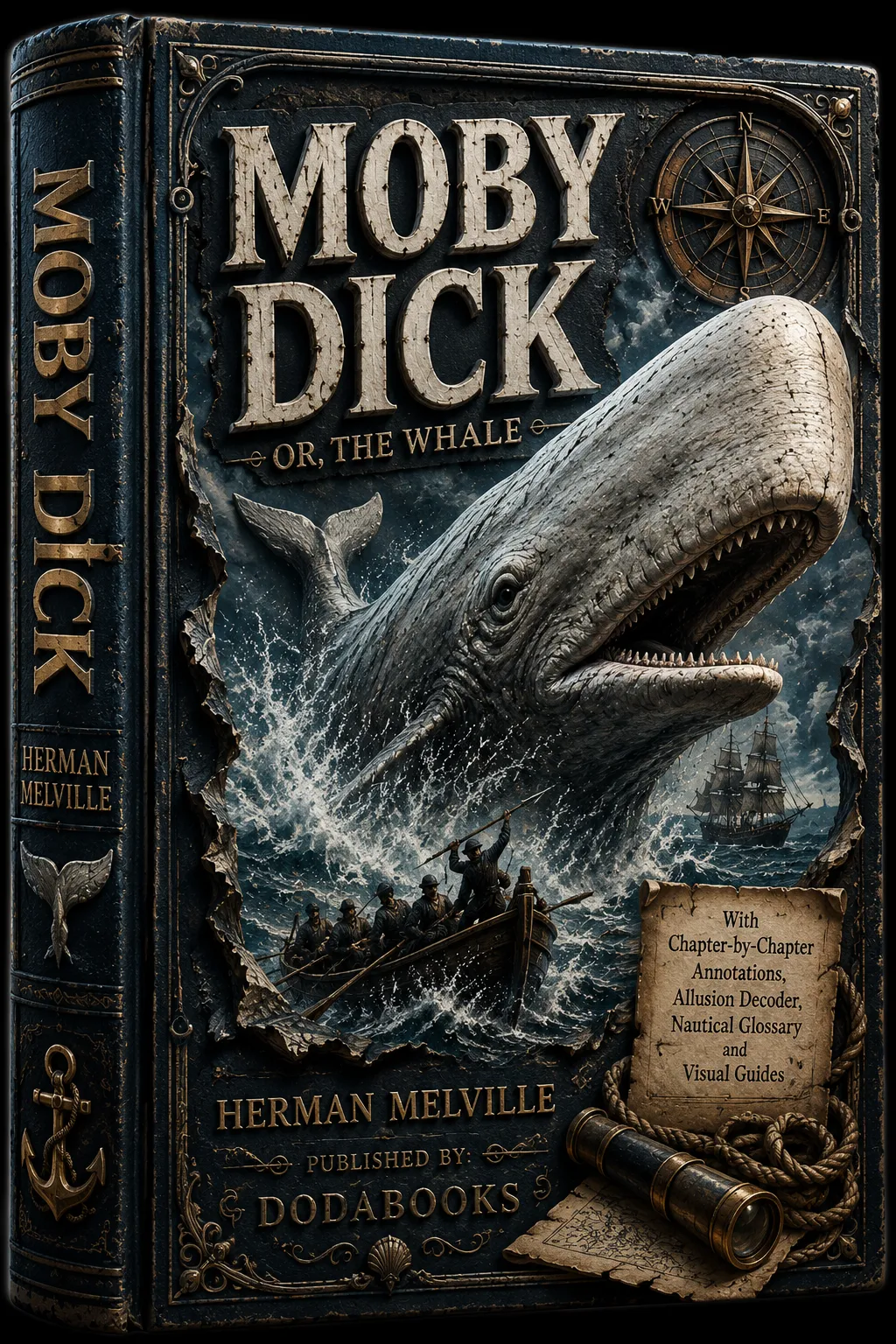
Don’t struggle through Melville’s masterpiece alone. Our annotated edition of Moby-Dick includes:
- Complete, unabridged text of the novel
- Hundreds of explanatory footnotes clarifying obscure references
- Historical context on 19th-century whaling and Nantucket culture
- Literary analysis of key chapters and passages
- Victorian vocabulary definitions and nautical terminology
- Biblical and literary allusion guides
Get the annotated edition at DodaBooks →
How to Read the Ship Chapters
A ship-focused reading repays watching for three things: the hierarchy (how authority moves from captain to mates to harpooneers to the anonymous crew, and how each rung reacts when that chain is bent toward a mad purpose), the ship itself (Melville treats the Pequod’s beams and planks almost as a body, and the nautical terms are exactly the vocabulary the annotated edition defines inline), and the omens (every sign, from the doubloon to the coffin, is placed deliberately). Knowing what a try-works was for, or who the Pequot were, sharpens these chapters further — the real history behind Moby-Dick covers the whaling world the Pequod belongs to.
About This Edition
The symbolism of the Pequod only deepens when you can see it. The annotated edition of Moby-Dick includes the detailed ship diagram, with annotations explaining each part’s function and how Melville uses it symbolically. Around it sit hundreds of explanatory footnotes, historical context on nineteenth-century whaling and Nantucket, chapter-level literary analysis, Victorian vocabulary and nautical terms defined inline, and biblical allusion guides that trace references like Fedallah’s prophecies to their sources.
That combination matters most in the ship chapters: dense with period seamanship and faith, the passages that stall unprepared readers become the clearest in the book.
📚 Related Articles
🎯 Stop Struggling. Start Understanding.
The annotated edition of Moby-Dick gives you everything you need to finally get Melville’s masterpiece:
- ✅ Complete, unabridged text — every word of the original 1851 edition
- ✅ Hundreds of explanatory footnotes — no more Googling every other page
- ✅ Historical context — the Essex disaster, Nantucket whaling, Melville’s life
- ✅ Literary analysis — chapter-by-chapter commentary on themes and symbols
- ✅ Victorian vocabulary — obsolete words and nautical terms defined inline
- ✅ Biblical & literary references — every allusion traced to its source