Analysis of Moby-Dick’s innovative narrative style. Why did Melville shift between first-person, essay, drama, and poetry?
🐋
The Narrative Style of Moby-Dick: Why Melville Used Multiple Voices
Analysis of Moby-Dick's innovative narrative style. Why did Melville shift between first-person, essay, drama, and poetr...
A Novel of Many Voices
Moby-Dick shifts fluidly between first-person recollection, third-person omniscience, stage drama, scientific essay, philosophical meditation, and epic poetry. This was unprecedented in 1851. The novel’s contemporaries — Hawthorne, Stowe, Dickens — wrote in relatively stable narrative voices. Their narrators might comment on events, but they didn’t suddenly become plays, or shift into encyclopedic taxonomy, or erupt into dramatic verse. Melville did all of these things, sometimes within a single chapter.
The result is a book that feels less like a conventional novel and more like a literary universe — a text that contains multiple genres, multiple registers, and multiple ways of knowing the world. Some readers find this exhilarating; others find it disorienting. But no one can deny its ambition, and no one has ever successfully imitated it. Moby-Dick remains unique because Melville’s shifts between voices aren’t decorative — they’re structural. Each voice corresponds to a different way of understanding the whale, the sea, and the human condition. The novel’s form enacts its argument: reality is too complex for any single mode of expression.
The Ishmael Voice
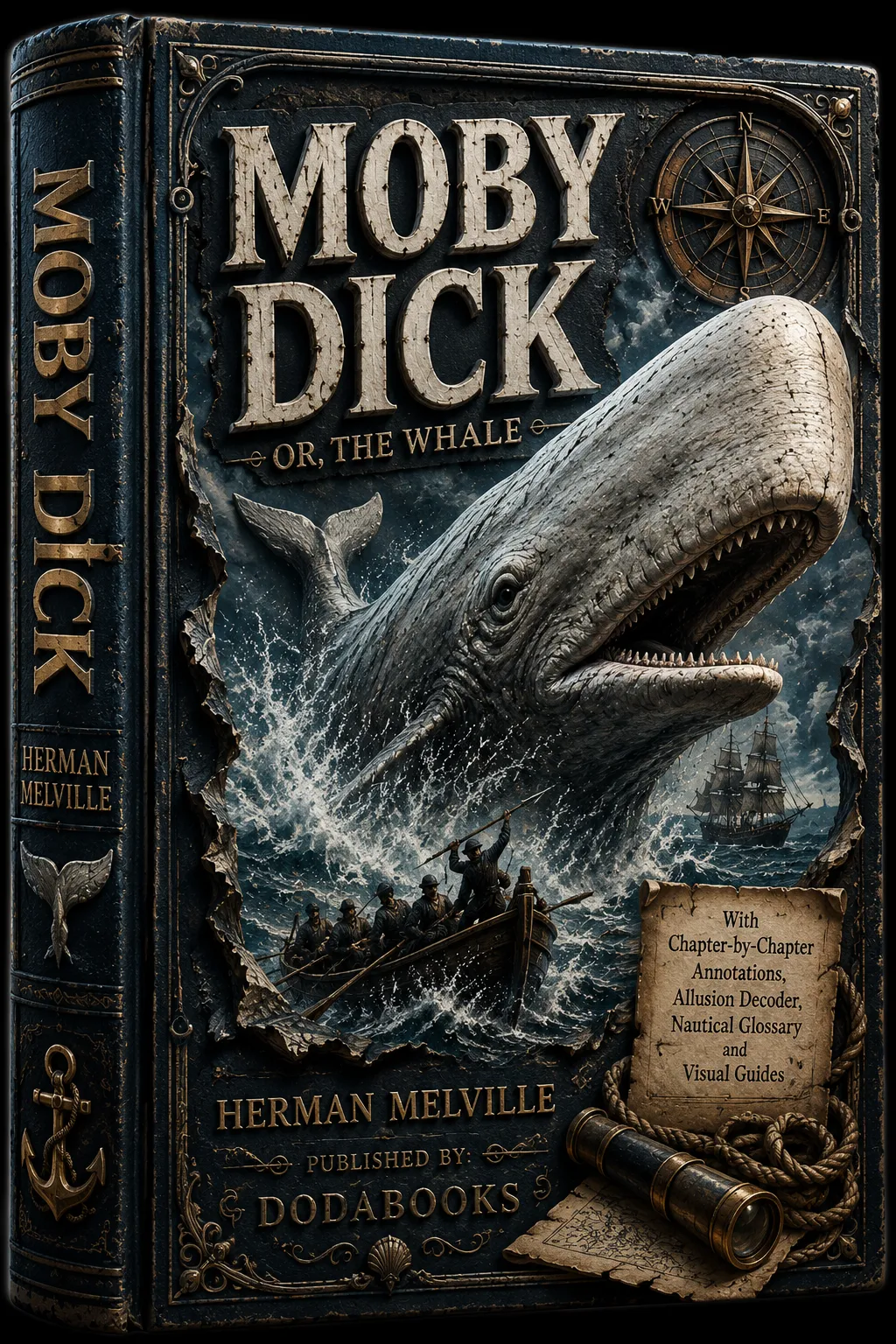
📖 Want the complete annotated experience?
👉 Get the Annotated EditionMost of the novel is Ishmael’s first-person narration — intimate, philosophical, slightly informal. This is the voice of “Call me Ishmael” and the meditations on whiteness, friendship, and the meaning of the sea. Ishmael is not a typical narrator: he’s both participant and observer, inside the action and commenting on it from a distance. His voice shifts between the concrete and the abstract, between the sensory detail of whale-hunting and the metaphysical question of what the whale means.
What makes Ishmael’s voice distinctive is its tolerance for ambiguity. Unlike Ahab, who insists on certainty, Ishmael is comfortable not knowing. He explores ideas without committing to them, considers multiple perspectives, and frequently admits his own confusion. This makes him an ideal guide through a novel that resists definitive interpretation. His narration is the thread that holds the disparate elements of the book together, even when those elements seem to pull in different directions.
Ishmael also functions as a collector of other voices. He reports the speeches of Ahab, Starbuck, Stubb, Flask, and dozens of minor characters, each with their own distinctive speech patterns. Ahab speaks in dramatic verse; Starbuck speaks in the measured tones of a Quaker; Stubb speaks in dry, sardonic humor; the harpooneers speak in clipped, practical sentences. Ishmael absorbs all of these voices without losing his own, creating a polyphonic narrative that anticipates the technique later novelists would call “free indirect discourse.”
This technique of multiple voices within a single narrator was revolutionary. Later novelists — Virginia Woolf, James Joyce, William Faulkner — would develop stream-of-consciousness and multiple-perspective narration in different ways, but Melville was the first to combine so many registers within a single coherent narrative. The result is a novel that feels less like one person telling a story and more like a community speaking through one person — a chorus of voices that together approximate the full range of human response to the mystery of existence.
The Dramatic Voice
Chapters like “The Quarter-Deck” are plays with stage directions. Melville had been reading dramatic literature obsessively during the writing of Moby-Dick, and the dramatic chapters translate that influence directly into form. Characters speak in verse, the stage directions describe action and mood, and the scene unfolds without Ishmael’s narration mediating between the reader and the event.
This is a radical technique. By stepping outside the first-person frame, Melville allows the reader to witness scenes without the distortion of memory or interpretation. We see Ahab’s madness directly, rather than through Ishmael’s recollection of it. The effect is more immediate, more theatrical, and more unsettling — we’re no longer safe in the narrator’s retrospective understanding. We’re in the scene, experiencing it as it happens, with no guarantee that anyone will survive to tell the story.
The Scientific Voice
The cetology chapters adopt the language of natural history — objective, methodical, dry. Melville describes whale anatomy, whale species, whale behavior, and the mechanics of whaling with the precision of a textbook. The prose becomes technical, even pedantic: “Take a business-like round view of the world, and what do you see?”
But Melville is doing something more complex than simply providing information. The cetology chapters satirize scientific pretension while demonstrating Melville’s own mastery of the material. He shows that even the most detailed taxonomy cannot capture the whale as it actually exists — the more you classify, the more the creature escapes your categories. The scientific voice is presented as one way of knowing, necessary but insufficient. It provides the facts; it cannot provide the meaning.
This is why the cetology chapters frustrate some readers and enchant others. On the surface, they appear to interrupt the narrative — we’re following Ahab’s quest, and suddenly we’re reading about the comparative anatomy of whale bones. But the interruptions are the point. Melville is demonstrating that no single discourse can contain the whale. Science can describe the whale’s body; it cannot explain the whale’s meaning. Philosophy can speculate about the whale’s significance; it cannot account for the whale’s physical reality. Only by combining multiple modes of discourse — scientific, philosophical, dramatic, lyrical — can the novel approach the full complexity of its subject.
The Prophetic Voice
Some passages rise to biblical prophecy. Ahab’s soliloquies echo the cadences of the King James Bible: “He tasks me; he heaps me; I see in him outrageous strength, with an inscrutable malice sinewing it.” The language is heightened, incantatory, almost liturgical. “The Whiteness of the Whale” employs the same register, meditating on the theological implications of whiteness with the gravity of a sermon.
This prophetic voice serves a specific purpose: it elevates Ahab’s quest from a personal vendetta to a cosmic drama. When Ahab speaks in biblical language, he’s not just a man hunting a whale — he’s humanity challenging the universe, demanding answers from a silence that will not respond. The prophetic register makes the stakes feel absolute, even as the novel questions whether those stakes are real or imagined.
Why Melville Did This
Moby-Dick is about the impossibility of containing reality in a single framework. Just as the whale cannot be reduced to one symbol, the novel cannot be contained in one style. The form reflects the content.
Melville understood that different subjects require different languages. You can’t describe a whale hunt the way you describe a philosophy lecture. You can’t capture Ahab’s madness in the same register you use to classify whale species. By shifting between voices, Melville creates a novel that matches its style to its subject at every moment — and in doing so, he acknowledges that no single style can encompass the full complexity of experience.
This is why Moby-Dick feels so modern, even though it was published in 1851. The multiple voices, the generic instability, the refusal to settle into a single mode — these are techniques that modernist and postmodernist writers would spend the next century developing. Melville invented them first, and he used them not as experiments in form but as the natural expression of a novel that is, finally, about the limits of language itself.
For readers, the multiple voices create a unique experience: the novel shifts so frequently between registers that no single reading strategy works for the whole book. You must be willing to shift with it — to enjoy the drama when the drama appears, to tolerate the science when the science arrives, to surrender to the poetry when the poetry rises. This is demanding, but it is also deeply rewarding: a novel that refuses to be read in only one way teaches its readers to be flexible, curious, and comfortable with complexity.
Consider what Melville accomplishes: in a single novel, he writes first-person memoir, third-person omniscience, stage drama, scientific taxonomy, philosophical essay, biblical prophecy, comic burlesque, and lyrical poetry. No other novel in English — before or since — contains this range of styles. The effect is not杂乱 but orchestrated: each voice enters at the moment when it’s most needed, and each contributes something that no other voice could provide. The dramatic chapters give us immediacy. The cetology chapters give us knowledge. The prophetic chapters give us transcendence. And Ishmael’s narration gives us the reflective consciousness that holds it all together.
Discover the depth of Melville’s masterpiece with our annotated edition of Moby-Dick. Complete text with explanatory notes, historical context, and literary analysis.
📚 Related Articles
Frequently Asked Questions
Why does the narrative style of Moby-Dick change so frequently?
Melville blends multiple literary genres—first-person memoir, stage drama with stage directions, scientific textbook, and biblical sermon—to mirror the chaos of life.
Does Ishmael remain the sole narrator throughout Moby-Dick?
No, Ishmael mysteriously vanishes as a visible character in the middle sections, replaced by an omniscient narrator privy to Ahab's private soliloquies.
Why does Melville include stage directions in certain chapters?
Chapters like 'Midnight, Forecastle' are written as theatrical playscripts, highlighting Shakespeare's dramatic influence on Melville's storytelling.
What is the purpose of the factual 'cetology' chapters?
They ground the cosmic romance in physical reality, forcing the reader to confront the real, bloody labor and scientific classification of the whaling industry.
How does the DodaBooks annotated edition guide readers through these stylistic shifts?
DodaBooks provides structural overviews and stylistic commentary that orient readers as Melville transitions between prose, drama, and scientific discourse.
🎯 Stop Struggling. Start Understanding.
The annotated edition of Moby-Dick gives you everything you need to finally get Melville’s masterpiece:
- ✅ Complete, unabridged text — every word of the original 1851 edition
- ✅ Hundreds of explanatory footnotes — no more Googling every other page
- ✅ Historical context — the Essex disaster, Nantucket whaling, Melville’s life
- ✅ Literary analysis — chapter-by-chapter commentary on themes and symbols
- ✅ Victorian vocabulary — obsolete words and nautical terms defined inline
- ✅ Biblical & literary references — every allusion traced to its source