Analysis of ‘The Whiteness of the Whale’ from Moby-Dick. Why does Melville argue that white is the most terrifying color?
🐋
Moby-Dick and the Meaning of Whiteness: The Most Important Chapter Explained
Analysis of 'The Whiteness of the Whale' from Moby-Dick. Why does Melville argue that white is the most terrifying color...
The Chapter That Changes Everything
Chapter 42 of Moby-Dick, titled “The Whiteness of the Whale,” is the philosophical center of the novel and one of the most extraordinary essays in American literature. Ishmael meditates at length on why white — the color most Western cultures associate with purity, innocence, and divinity — is capable of inspiring profound terror. This is not a minor digression; it is the intellectual heart of Melville’s project. Everything in the novel — Ahab’s obsession, the whale’s inscrutability, the crew’s dread — converges on this single question: why does whiteness frighten us? Ishmael begins by cataloging instances of white in nature: the white bear of the Arctic, the white shark of the tropics, the ghostly white albatross that follows ships across vast oceans. He notes that white is the color of wedding gowns and angel wings, but also of shrouds and bones. It is the color of blank pages — and of nothingness itself. The chapter builds its argument with the rigor of a philosophical treatise and the imagery of a poem, creating a meditation on color, meaning, and terror that anticipates the existentialist philosophy of the twentieth century by nearly a hundred years.
The Paradox
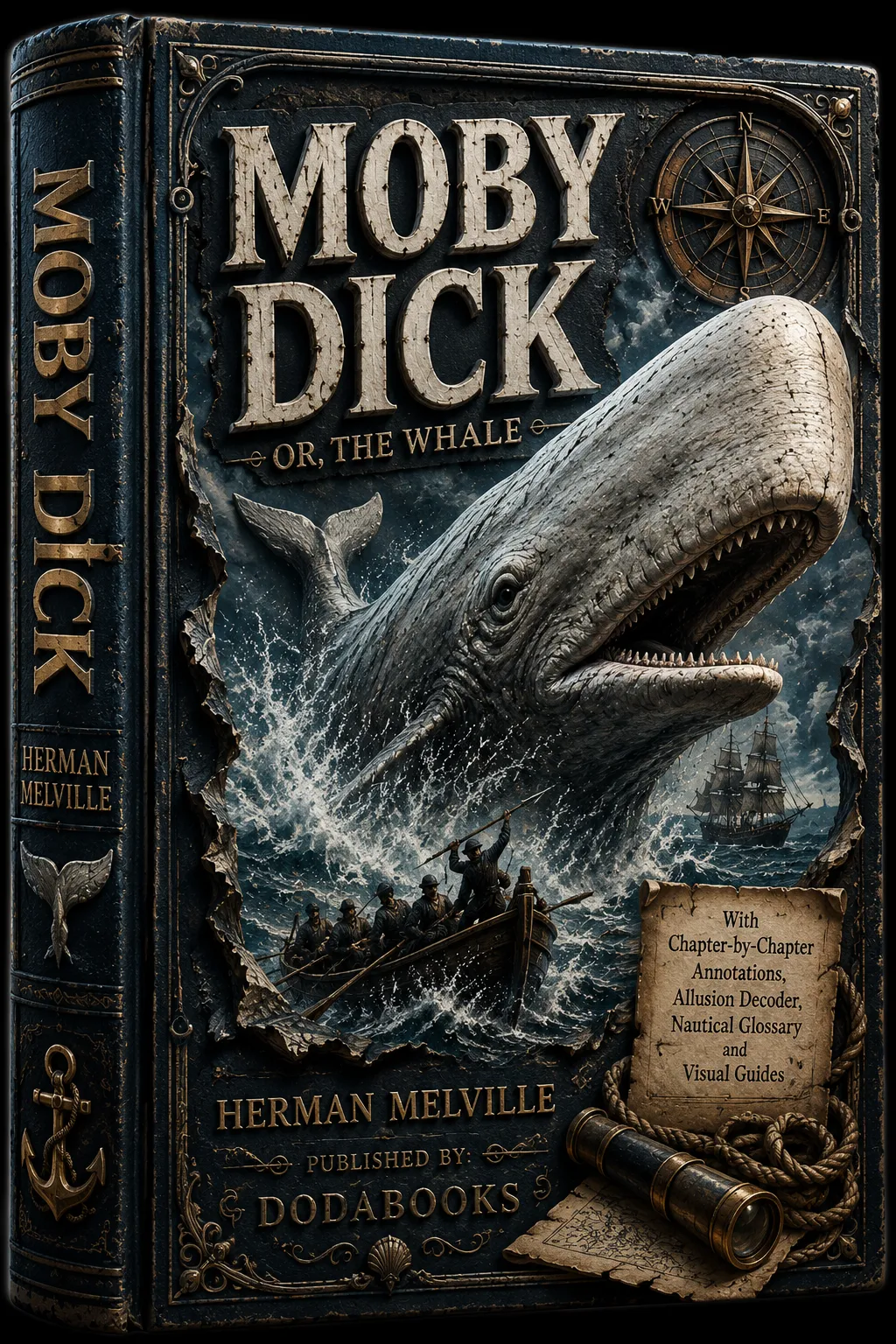
📖 Want the complete annotated experience?
👉 Get the Annotated EditionWhite is the color of bridal gowns and angel wings, of snow and pearls and the pages of holy books. So why do we also find it terrifying? Ishmael catalogs a dizzying array of examples: the white bear of the Arctic, prowling through blinding blizzards; the white shark of the tropics, gliding through clear water with its mouth open; the white albatross that follows sailing ships for thousands of miles, its ghostly form appearing and disappearing in fog. Melville’s argument builds through accumulation — each example adds another layer to the paradox, another reason to fear what we have been taught to worship. White is the color of the blank page, the empty canvas, the silence before speech. It is the color of absence, of potential without fulfillment, of space without content. In a world where humans are desperate to assign meaning to everything they see, white represents the terrifying possibility that meaning may not exist — that the universe is not hostile or benevolent but simply empty, a white expanse stretching endlessly in all directions without purpose or design. The whale’s whiteness is not a symbol of evil; it is a symbol of something far more frightening: the absence of symbol itself.
Ishmael’s examples are not chosen at random — they represent a systematic dismantling of the comforting associations that Western culture has built around the color white. The bridal gown suggests purity and new beginnings; the shroud suggests death and finality. The snow suggests beauty and tranquility; the blizzard suggests annihilation and the erasure of all landmarks. The pearl suggests rarity and value; the bone suggests decay and the persistence of death. By juxtaposing these contradictory associations, Ishmael reveals that white is not inherently meaningful — it is a screen onto which we project our deepest fears and desires, a blank surface that reflects whatever we bring to it. The terror of the white whale lies precisely in this blankness: Moby-Dick is not a symbol of anything specific because he is too real, too physical, too present to be reduced to a single meaning. He is the thing itself, not a representation of something else — and in a world where we depend on symbols to make sense of experience, a thing that refuses to be symbolic is the most terrifying thing of all.
The Argument
The philosophical argument Melville constructs in this chapter is startlingly modern. Whiteness terrifies because it represents the absence of meaning. Evil can be fought; it has qualities, intentions, desires that can be understood and opposed. Good can be embraced; it provides comfort, direction, purpose. But blankness — a universe without inherent meaning, without moral structure, without design — is the most frightening possibility of all. The white whale is terrifying not because it is evil but because it is indifferent. Moby-Dick does not hate Ahab; he does not love him either. He does not care. He is a whale doing what whales do — eating, swimming, defending himself — and Ahab’s vendetta against him is, from the whale’s perspective, utterly irrelevant. This is the horror that Melville identifies: not malice but meaninglessness, not a hostile god but no god at all, just a white expanse of nature that reflects back our own need for significance without providing any. Ishmael reaches this conclusion reluctantly, circling the idea from multiple angles, testing it against examples from nature and culture, building a case that is not quite airtight but is emotionally devastating. The chapter reads like a thought experiment conducted by a man who desperately wants to be proven wrong — and is not.
The Conclusion
The chapter reaches its devastating conclusion through a process of elimination: if the whale is not a symbol of evil, not a symbol of God, not a symbol of nature’s indifference, then what is it? Ishmael’s answer is that the whale’s whiteness is a metaphysical statement: the universe does not care about you. Your categories of good and evil, your moral frameworks, your desperate need to assign meaning to suffering — none of these apply here. The whale simply is. It exists, it survives, it destroys what opposes it, and it continues. There is no malice in its actions, no justice, no lesson. It is blankness made flesh, and the terror it inspires is the terror of confronting a reality that refuses to conform to human expectations. This is why Ahab’s quest is both magnificent and futile — he is trying to impose meaning on a creature that is, by its very nature, meaningless. The whale cannot be a symbol because it is too real, too physical, too present in its whiteness to serve as a vehicle for human interpretation. Melville understood, decades before the existentialists, that the most terrifying thing in the universe is not cruelty but indifference — not a devil who opposes you but an ocean that doesn’t notice you’re there. The chapter’s final paragraphs carry a weight that few passages in all of literature can match: Ishmael has followed his argument to its logical conclusion, and the conclusion is devastating. He has stripped away every comforting illusion — every framework that allows human beings to believe the universe is fundamentally on their side — and what remains is a vast, white, silent emptiness that offers no answers, no guidance, no redemption. The whale’s whiteness is the color of a question mark that can never be answered.
Why This Matters
This chapter matters because it is a precursor to existentialist philosophy, decades before Nietzsche declared God dead, before Heidegger analyzed Being-toward-death, before Sartre argued that existence precedes essence. Melville grappled with the possibility of a meaningless universe in 1851, when the dominant cultural frameworks — Protestant Christianity, Enlightenment rationalism, Transcendentalist optimism — still assumed that the universe was fundamentally intelligible and morally ordered. Melville dared to suggest otherwise. His answer to the problem of meaninglessness is not despair but creation: meaning is something we make, not something we find. We create meaning through storytelling — Ishmael survives to tell the tale, and the tale itself is the victory over blankness. We create meaning through friendship — Queequeg’s coffin-buoy saves Ishmael, a love that transcends death. We create meaning through the act of bearing witness — refusing to let catastrophe pass unnoticed, insisting that suffering deserves to be recorded and remembered. The chapter “The Whiteness of the Whale” is not just a brilliant literary essay; it is a philosophical argument that has lost none of its urgency. In an age of information overload and existential anxiety, Melville’s meditation on the terror of blankness, and his insistence that human consciousness can create meaning even in the face of cosmic indifference, speaks more powerfully than ever. The chapter’s influence extends far beyond literary studies — it has shaped how philosophers, psychologists, and theologians think about the relationship between perception, meaning, and terror. When contemporary thinkers discuss existential dread, when artists explore the horror of the void, when ordinary people confront the possibility that their lives may not matter in the cosmic scheme, they are walking a path that Melville mapped out with extraordinary precision in Chapter 42 of Moby-Dick. The whiteness of the whale is not just a literary symbol; it is a permanent feature of the human condition.
Discover the depth of Melville’s masterpiece with our annotated edition of Moby-Dick. Complete text with explanatory notes, historical context, and literary analysis.
📚 Related Articles
Frequently Asked Questions
What is the core argument of Chapter 42 'The Whiteness of the Whale'?
Ishmael argues that whiteness terrifies the human soul not because it represents purity, but because it represents cosmic void, blankness, and divine absence.
Why does Melville consider whiteness more terrifying than darkness?
Darkness conceals what might be there, whereas absolute whiteness reveals the terrifying, cold indifference and blank canvas of the universe.
How does 'The Whiteness of the Whale' relate to Ahab's quest?
Ahab projects all the malice and existential dread of the universe onto Moby Dick's blank white hide, making the whale a visible symbol of his rage.
What optical science did Melville incorporate into Chapter 42?
Melville referenced Newton's color theory, noting that white is the absence of all distinct color yet the synthesis of all light, symbolizing divine mystery.
How does DodaBooks help readers interpret Chapter 42?
The DodaBooks annotated edition provides comprehensive philosophical analysis of Melville's aesthetics, Transcendentalist context, and ontological arguments.
🎯 Stop Struggling. Start Understanding.
The annotated edition of Moby-Dick gives you everything you need to finally get Melville’s masterpiece:
- ✅ Complete, unabridged text — every word of the original 1851 edition
- ✅ Hundreds of explanatory footnotes — no more Googling every other page
- ✅ Historical context — the Essex disaster, Nantucket whaling, Melville’s life
- ✅ Literary analysis — chapter-by-chapter commentary on themes and symbols
- ✅ Victorian vocabulary — obsolete words and nautical terms defined inline
- ✅ Biblical & literary references — every allusion traced to its source