Moby-Dick and Treasure Island are both sea adventures, but they could not be more different. Compare Melville’s epic with Stevenson’s pirate tale.
🐋
Moby-Dick vs Treasure Island: Two Visions of Adventure at Sea
Moby-Dick and Treasure Island are both sea adventures, but they could not be more different. Compare Melville's epic wit...
Two Sea Novels, Two Worlds
Moby-Dick (1851) and Treasure Island (1883) are 19th-century sea novels from opposite poles: one a philosophical epic, the other a pure adventure story.
The comparison is instructive because both novels share the same setting — the open ocean, the wooden ship, the crew of men bound together by wind and water — yet produce utterly different reading experiences. Melville and Stevenson both understood that the sea is a space where civilization’s rules dissolve: there are no courts, no police, no social safety nets. What remains is raw human nature, tested by isolation, danger, and the relentless demands of the natural world. But where Melville uses this testing ground to explore metaphysical questions about God, fate, and meaning, Stevenson uses it to tell a rollicking tale of treasure, mutiny, and adventure.
The key difference lies in audience and intent. Stevenson wrote for boys — young readers hungry for excitement and moral clarity. Melville wrote for adults — readers willing to sit with ambiguity, digression, and philosophical complexity. Neither approach is superior; they serve different purposes. But understanding this difference helps explain why Treasure Island remains a beloved adventure classic while Moby-Dick stands as one of the most challenging and rewarding works in the English language.
Both novels also reflect their historical moments. Moby-Dick emerged from the height of American whaling — an industry that was simultaneously heroic and brutal, a source of national pride and moral compromise. Treasure Island, written three decades later, looks back on the Age of Sail with romantic nostalgia, transforming the brutal reality of piracy into a children’s game. The ocean in both books is real, but the stakes could not be more different: Melville’s sea is indifferent to human ambition; Stevenson’s sea is a playground.
The Plot
Moby-Dick: a man signs onto a whaling ship and gets caught in a captain’s obsessive hunt for a white whale. Treasure Island: a boy finds a treasure map and joins a voyage for buried gold. Pirates and mutiny ensue.
The plot structures reveal fundamentally different approaches to storytelling. Moby-Dick is open-ended and digressive: Ishmael wanders through New Bedford, shares a bed with Queequeg, signs onto the Pequod, and then drifts through cetology chapters, philosophical meditations, and character studies before the white whale even appears. The novel is deliberately unhurried, trusting that the reader will find meaning in the journey rather than the destination.
Treasure Island, by contrast, is lean and propulsive. Jim Hawkins finds the map, joins the voyage, and the action never lets up. Stevenson’s genius lies in his ability to maintain suspense through pacing: every chapter moves the plot forward, every scene raises the stakes, every chapter ends with a hook. There are no digressions, no philosophical meditations, no chapters on the classification of coins or the anatomy of pirate ships. The story races from beginning to end, and the reader races with it.
This structural difference reflects a deeper philosophical divide. Melville believed that the process of discovery is as important as the discovery itself — that understanding comes not from answers but from the willingness to sit with questions. Stevenson believed that a good story should deliver what it promises: adventure, excitement, a clear moral framework. Both approaches are valid; they simply serve different readers and different needs. The reader who wants to be challenged will prefer Moby-Dick. The reader who wants to be entertained will prefer Treasure Island. The wisest reader will want both.
The Narrator
Ishmael is philosophical, reflective, an adult looking back. Jim Hawkins is a boy telling the story as it happens — direct and suspenseful.
The narrators embody the novels’ different temperaments. Ishmael is a thinker who happens to go to sea; Jim Hawkins is a doer who happens to tell the story. Ishmael’s narration is expansive, digressive, and self-conscious — he pauses the action to meditate on the color white, to quote scripture, to classify whales. Jim’s narration is urgent, physical, and immediate: he tells us what he sees, what he does, and what he fears, with little time for reflection.
This difference reflects the narrators’ ages and positions. Ishmael is an adult, educated and world-weary, looking back on events with the perspective of time. Jim is a boy — fourteen or fifteen, depending on the reading — experiencing everything for the first time. His narration captures the intensity of youth: every danger is unprecedented, every discovery is miraculous, every betrayal is devastating. The reader experiences the story through Jim’s eyes, sharing his fear, his excitement, and his growing understanding of the adult world’s capacity for cruelty.
Ishmael, by contrast, provides an adult’s perspective on the same themes: the danger of obsession, the limits of knowledge, the indifference of the natural world. His narration is not just a story but a philosophical commentary on the story he is telling. This double consciousness — narrator as both participant and observer — gives Moby-Dick its extraordinary depth. Ishmael is not just telling us what happened; he is telling us what it means — and he admits, often, that he does not know.
The Tone
Moby-Dick is tragic, philosophical, and bleak. Treasure Island is thrilling, fun, and optimistic — the good guys win, the treasure is found.
The tonal difference is the most immediately apparent contrast between the two books. Treasure Island operates in bright primary colors: the danger is real but manageable, the villains are clearly villainous, the heroes are clearly heroic, and the ending delivers exactly what the reader expects — treasure found, justice served, adventure concluded. The novel’s tone is exhilarating without being overwhelming, exciting without being terrifying.
Moby-Dick, by contrast, operates in shades of gray. The danger is not just physical but metaphysical — the crew is not just at risk of drowning but of spiritual annihilation. The villain (the white whale) is not evil but indifferent, and the hero (Ahab) is not heroic but obsessive. The ending delivers not satisfaction but devastation: the ship destroyed, the crew killed, the captain dragged into the deep. There is no treasure, no justice, no moral lesson — only the terrible silence of the ocean after the storm has passed.
This tonal difference reflects the novels’ different relationships to reality. Stevenson wrote a fantasy — a story of adventure that could never actually happen, set in a world where good and evil are clearly defined and moral outcomes are guaranteed. Melville wrote a tragedy — a story rooted in the real world, where consequences are uncertain, justice is elusive, and the universe does not care about human ambition. Treasure Island reassures us; Moby-Dick challenges us. We need both.
The Sea
In Moby-Dick, the sea is a character — vast, dangerous, indifferent. In Treasure Island, the sea is a backdrop for adventure.
The sea in Moby-Dick is a philosophical entity — a symbol of everything that lies beyond human understanding. Ishmael meditates on the ocean’s depth, its color, its silence, its refusal to reveal what lies beneath. The sea in this novel is not a setting but a subject: it is the thing the characters are trying to understand, the thing Ahab is trying to conquer, the thing that ultimately destroys them. Melville’s ocean is ancient, vast, and fundamentally unknowable — a mirror of the universe itself.
The sea in Treasure Island is a means to an end: it carries the characters to the island, it provides the setting for pirate attacks, and it serves as the final obstacle between the heroes and the treasure. Stevenson’s ocean is realistic and functional — it has tides, winds, and currents, and it behaves exactly as a reader expects. There are no philosophical meditations on its meaning, no digressions into its color or depth. The sea is a stage, and the characters are the actors.
This difference in treatment reflects the novels’ different ambitions. Melville wanted to write a total novel — a book that encompassed everything: adventure, philosophy, science, history, religion. The sea was the perfect vehicle for this ambition because it is the last great wilderness on Earth, a space where human knowledge fails and imagination takes over. Stevenson wanted to write a perfect novel of its kind — a flawless adventure story that delivered exactly what it promised. The sea was the perfect setting for this ambition because it is inherently dramatic: wind, waves, ships, islands, and the ever-present possibility of death.
Which Should You Read?
Both. Moby-Dick is the greater work of art but demands more. Treasure Island is perfect of its kind — a masterful adventure story. They are not competitors but companions, showing the range of sea literature.
The choice between them depends on what you want from a book. If you want to be thrilled, to race through pages with your heart pounding, to cheer for heroes and boo at villains, Treasure Island delivers. It is one of the most perfectly constructed adventure novels ever written — every scene serves the plot, every character fulfills a function, every chapter builds to the next. Stevenson’s craft is invisible, which is the highest praise for a storyteller.
If you want to be challenged, to encounter ideas that rearrange your thinking, to sit with ambiguity and complexity that refuses easy answers, Moby-Dick delivers. It is one of the most ambitious novels ever attempted — a book that tries to contain everything and, against all odds, mostly succeeds. Melville’s craft is deliberately visible: you can feel him thinking on every page, wrestling with questions that have no answers and writing sentences that sound like they were carved in stone.
But there is a deeper reason to read both. Together, they demonstrate the extraordinary range of what literature can do. One novel shows us the sea as adventure; the other shows us the sea as metaphor. One tells us a story; the other asks us to think. The reader who knows both books understands something about the possibilities of fiction that the reader who knows only one does not. That understanding is worth the effort of reading both — and it is a reminder that great literature is not a competition but a conversation.
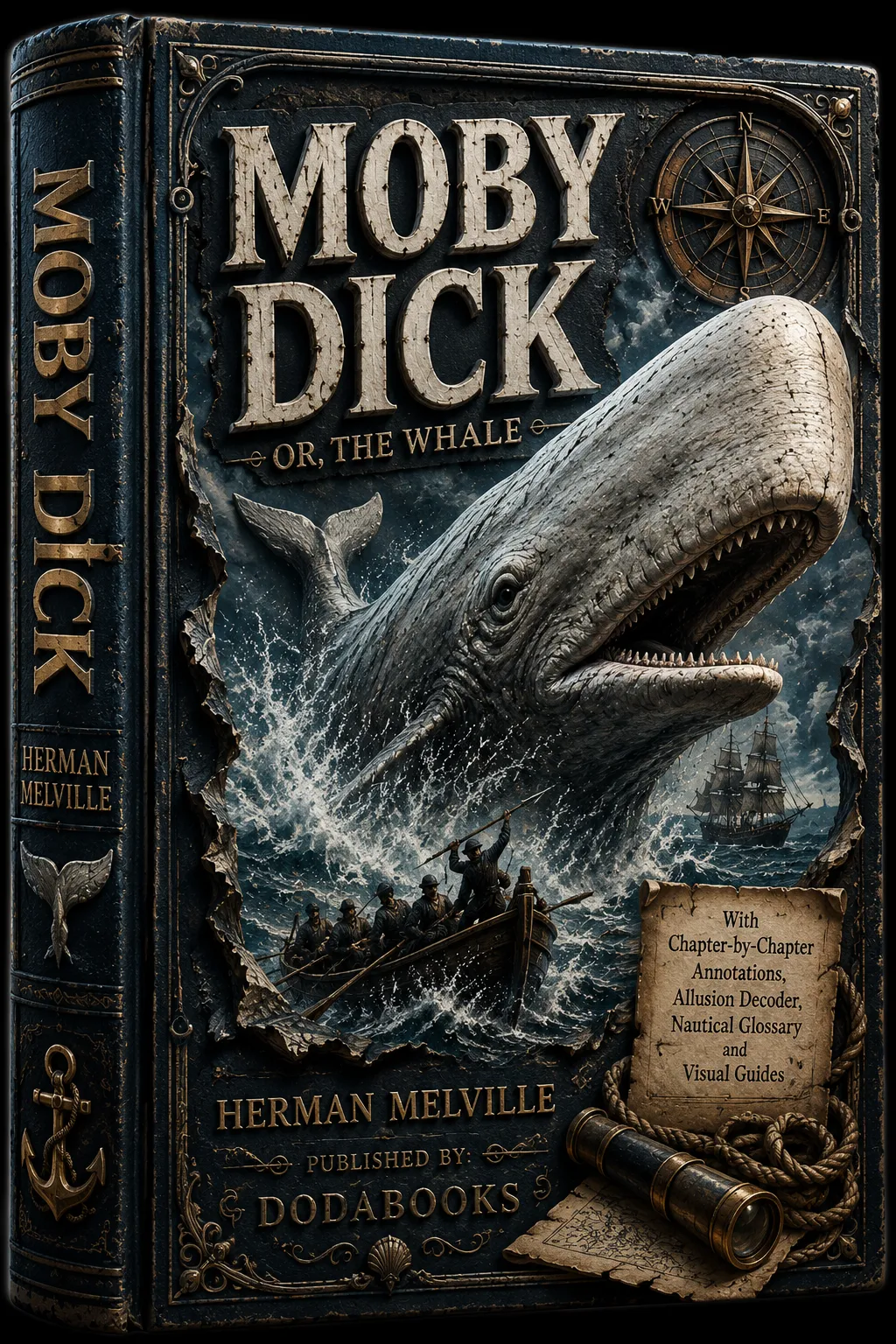
Discover the depth of Melville’s masterpiece with our annotated edition of Moby-Dick. Complete text with explanatory notes, historical context, and literary analysis.
📚 Related Articles
Frequently Asked Questions
How do Moby-Dick and Treasure Island differ as sea novels?
Treasure Island is a tightly plotted, romantic adventure focused on youthful courage and pirate treasure, whereas Moby-Dick is an encyclopedic, existential tragedy.
Which book is harder to read: Moby-Dick or Treasure Island?
Moby-Dick is significantly more demanding due to its philosophical digressions, dense vocabulary, and irregular narrative pacing.
How do Captain Ahab and Long John Silver compare?
Ahab is a tragic, monomaniacal fanatic driven by cosmic vengeance, while Silver is a charming, pragmatic, and morally flexible opportunist.
Which sea story is better suited for younger readers?
Treasure Island is ideal for middle-grade and young adult readers, while Moby-Dick is best suited for mature readers seeking deep literary and philosophical inquiry.
Where can I find well-crafted editions of both maritime classics?
DodaBooks curates premier digital editions of both classic masterpieces, featuring custom styling, contextual notes, and complete reading convenience.
🎯 Stop Struggling. Start Understanding.
The annotated edition of Moby-Dick gives you everything you need to finally get Melville’s masterpiece:
- ✅ Complete, unabridged text — every word of the original 1851 edition
- ✅ Hundreds of explanatory footnotes — no more Googling every other page
- ✅ Historical context — the Essex disaster, Nantucket whaling, Melville’s life
- ✅ Literary analysis — chapter-by-chapter commentary on themes and symbols
- ✅ Victorian vocabulary — obsolete words and nautical terms defined inline
- ✅ Biblical & literary references — every allusion traced to its source