Moby-Dick vs The Old Man and the Sea: A deep-dive comparison of Herman Melville and Ernest Hemingway on human obsession, pride, nature, and the struggle against the sea.
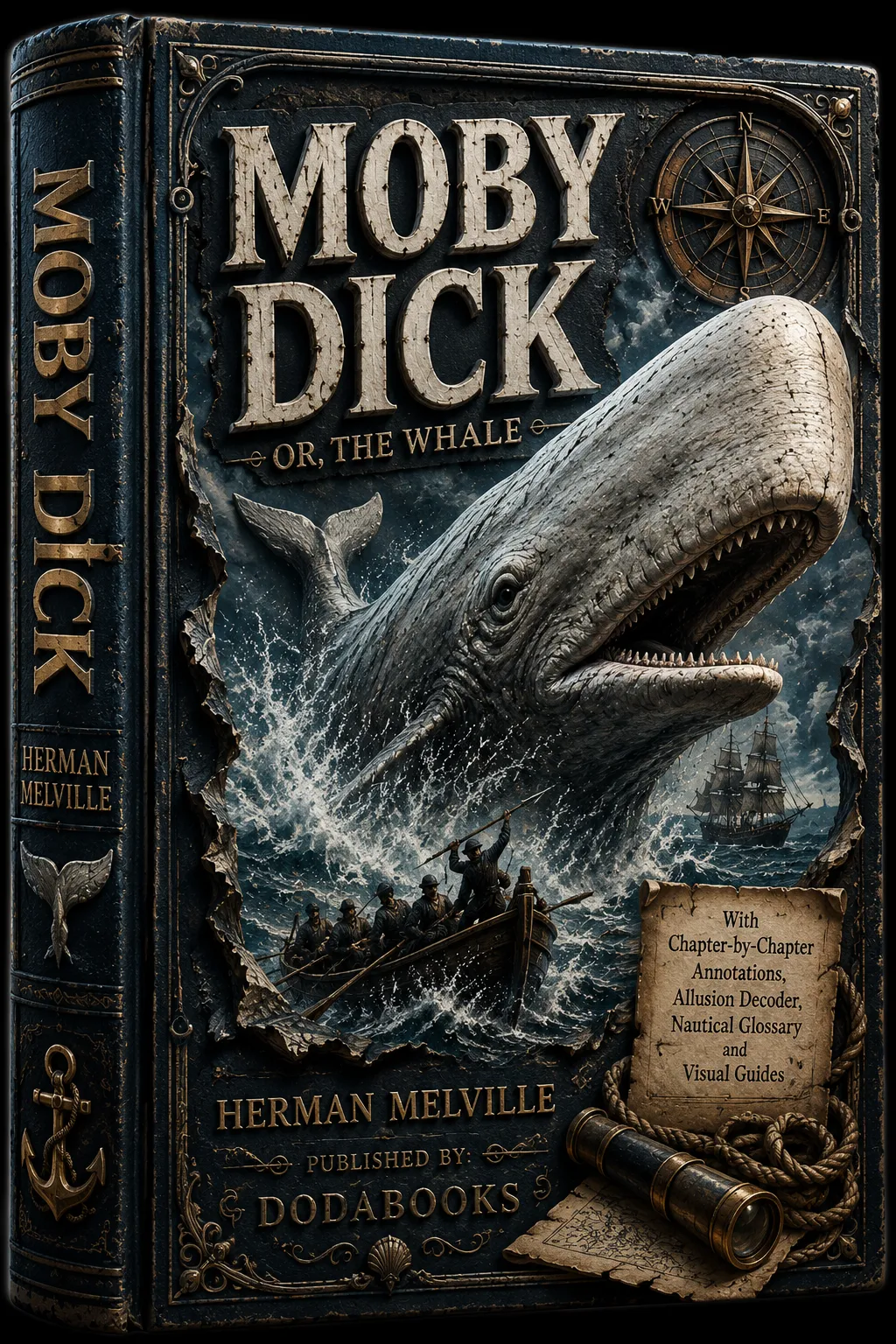
This article is part of our annotated Moby-Dick guide, designed to help readers unlock the full depth of Melville’s masterpiece through comprehensive notes and analysis.
🐋
Moby-Dick vs The Old Man and the Sea: Two American Sea Classics Compared
Compare Moby-Dick and The Old Man and the Sea — two masterpieces of American sea literature. How do Melville and Hemingw...
Two Novels, One Ocean
Moby-Dick (1851) and The Old Man and the Sea (1952) are the two most famous American novels set at sea. Separated by a century, they share a deep DNA: both are about older men obsessed with catching a single creature of the deep. But the differences between them are as revealing as the similarities.
Scale
📖 Want the complete annotated experience?
👉 Get the Annotated EditionMoby-Dick is vast — 135 chapters, 200,000 words, an encyclopedia of whaling knowledge inserted into the middle of a novel. The Old Man and the Sea is tiny — 27,000 words, a single story that can be read in an afternoon.
Hemingway achieves in miniature what Melville attempted at epic scale. The difference reflects their historical moments: Melville was writing for a Victorian audience that valued completeness and abundance. Hemingway was writing for a modern audience that valued compression and economy.
The Protagonist
Ahab is a captain, a leader of men, a figure of immense charisma and destructiveness. He destroys everyone around him. Santiago is a poor, solitary fisherman, a man whose only companion is a boy who is forbidden to fish with him. He harms no one but himself.
Ahab’s obsession is metaphysical — he is fighting against the universe. Santiago’s struggle is practical — he is trying to catch a fish to feed himself and his village.
The Creature
The white whale in Moby-Dick is a symbol — of nature, of fate, of evil, of the unknowable. It can bear all these meanings because it is never fully explained. We never enter the whale’s mind.
The marlin in The Old Man and the Sea is a fish — a magnificent, noble, edible fish. Santiago loves the marlin even as he kills it. He calls it “brother.” This relationship — simultaneously loving and destructive — is Hemingway’s great insight.
The Style
Melville’s prose is baroque, allusive, richly layered. His sentences are long, complex, layered with meaning. Hemingway’s is stripped-down, declarative, famously spare. “He was an old man who fished alone in a skiff in the Gulf Stream and he had gone eighty-four days now without taking a fish.”
Reading them side by side is like comparing a cathedral to a Zen garden. Both are beautiful. Both require different kinds of attention.
The Ending
In Moby-Dick, everyone dies except Ishmael. The ship sinks. The whale wins. In The Old Man and the Sea, Santiago returns to harbor with the skeletal remains of the marlin — proof of his triumph even though the sharks ate the meat. He sleeps and dreams of lions.
Ahab dies in a state of defiance, refusing to repent. Santiago is exhausted but at peace. He has done what he set out to do, even if the evidence of his victory has been consumed.
What Each Teaches Us
Moby-Dick teaches us about the destructive power of obsession and the indifference of nature. The Old Man and the Sea teaches us about endurance, dignity, and the quiet heroism of doing one’s best against impossible odds.
Both are essential. They are not competitors but companions. Together, they represent the full range of what American literature can achieve.
Deeper Analysis
The connections between these two novels run deeper than a brief comparison can capture. The DodaBooks annotated edition of Moby-Dick includes an essay comparing the two novels in detail, tracing their shared themes and their different approaches to the same fundamental questions. Get the annotated edition →
🏛️ Historical & Cultural Context
Melville published Moby-Dick in 1851, at the industrial peak of American whaling, when the young republic’s fleets chased the whale oil that lit its cities and greased its machines. He drew on his own years at sea aboard whaling ships, and on the chilling real story of the whaleship Essex, which was sunk by a sperm whale in 1820. The novel failed commercially in its own day; Melville retreated from fiction and was only rediscovered by 20th-century readers. Hemingway published The Old Man and the Sea in 1952, from a Cuba he had been fishing for decades out of Havana. The novella won the Pulitzer Prize in 1953 and contributed directly to his Nobel Prize in Literature in 1954. Where Melville wrote at the top of an industry, Hemingway wrote at the close of a career, casting old Santiago as a double for the aging artist reflecting on his own endurance and reputation. Context matters here: when Moby-Dick was published it bombed, and its long road to classic status is one of the strangest stories in American literature.
🌊 The World Around the Two Old Men
Ahab and Santiago are both defined by the people around them. The Pequod is a floating commonwealth — a New England Quaker captain commanding pagan harpooners from the farthest islands, a mixed crew of every background, and a Black cabin boy named Pip whose ocean madness becomes a haunting refrain. The world of The Old Man and the Sea is much smaller: a boy named Manolin who loves the old man, a village that has begun to doubt him, and the fishermen who mock his streak of bad luck. Where Melville builds his hero against the backdrop of an entire industry, Hemingway builds his against a tiny community. The difference is worth examining: the full cast of Moby-Dick is a study in how obsession infects an entire ship, while Santiago’s solitude is precisely what lets his dignity survive.
✍️ Two Kinds of Victory
The endings of the two novels are the clearest statement of how differently these writers think. Ahab’s last words are pure defiance:
“From hell’s heart I stab at thee; for hate’s sake I spit my last breath at thee.” — Captain Ahab
Santiago’s equivalent — his code — is quieter and, strangely, more stubborn:
“But man is not made for defeat,” he said. “A man can be destroyed but not defeated.” — Santiago
Ahab would rather burn the world than surrender to it. Santiago accepts destruction — his marlin is eaten to the bone before he reaches harbor — but refuses defeat. Both men lose their prize; only one of them has found a version of winning inside the loss. That distinction is the heart of the comparison, and it is why the theme of obsession and fate in Moby-Dick reads so differently from Hemingway’s quieter version of endurance.
📖 Why Both Still Matter
These two books bookend a century of American thinking about the individual against nature. Moby-Dick says the universe does not care, and asks whether defiance is noble or insane when it cannot win. The Old Man and the Sea says that dignity is available even when nature wins, and asks what “winning” means when the evidence of your success is eaten by sharks. Each is a lens the other sharpens. If you are daunted by the prospect of Melville’s 200,000-word whale encyclopedia, you can build up to it with the far shorter Hemingway — and our explanation of why Moby-Dick is hard to read and worth trying will tell you honestly what you are in for. And if you finish both hungry for more of this deeper literary kinship, our comparison of Moby-Dick and Heart of Darkness traces the same obsessive DNA through Conrad’s jungle.
❓ Frequently Asked Questions
Which book should I read first?
If you are new to sea literature, start with The Old Man and the Sea — it is short, famously clear, and can be finished in an afternoon, and it gives you the thematic vocabulary to appreciate Moby-Dick’s ambition. If you are committed and don’t mind a challenge, Moby-Dick rewards patience enormously. Many readers do Hemingway first and use him as a warm-up.
Is The Old Man and the Sea a response to Moby-Dick?
Not directly — Hemingway never set out to “answer” Melville. But both novels belong to the same American conversation about individuals struggling against nature, and Hemingway knew and admired Melville. Read together, they make each other clearer: nearly every choice in one illuminates the opposite choice in the other.
Which book has the more optimistic ending?
The Old Man and the Sea, clearly. Santiago returns to harbor exhausted but at peace and dreams of lions. Moby-Dick ends with the Pequod sunk and every man drowned except Ishmael. Yet Melville’s pessimism is not the whole story — Ishmael survives to tell the tale, and the modern reader ultimately decides what the book “means.”
Do I need to know about whaling to enjoy Moby-Dick?
No — but you’ll enjoy it a lot more if you understand even the basics, because Melville fills the book with 19th-century whaling craft and vocabulary. The annotated edition explains those terms inline so you never have to pause and search, which is the single biggest difference between struggling through it and sailing through it.
Are these books really about fishing and whaling?
Barely. The whale and the marlin are the bait. Moby-Dick is about obsession, fate, and the limits of human knowledge, and The Old Man and the Sea is about endurance, pride, and dignity. Both are really about how a person should face the parts of life they cannot control — which is why they’ve never stopped finding new readers.
Experience Moby-Dick Like Never Before
Don’t struggle through Melville’s masterpiece alone. Our annotated edition of Moby-Dick includes:
- Complete, unabridged text of the novel
- Hundreds of explanatory footnotes clarifying obscure references
- Historical context on 19th-century whaling and Nantucket culture
- Literary analysis of key chapters and passages
- Victorian vocabulary definitions and nautical terminology
- Biblical and literary allusion guides
Get the annotated edition at DodaBooks →
📚 Related Articles
🎯 Stop Struggling. Start Understanding.
The annotated edition of Moby-Dick gives you everything you need to finally get Melville’s masterpiece:
- ✅ Complete, unabridged text — every word of the original 1851 edition
- ✅ Hundreds of explanatory footnotes — no more Googling every other page
- ✅ Historical context — the Essex disaster, Nantucket whaling, Melville’s life
- ✅ Literary analysis — chapter-by-chapter commentary on themes and symbols
- ✅ Victorian vocabulary — obsolete words and nautical terms defined inline
- ✅ Biblical & literary references — every allusion traced to its source