Compare Moby-Dick and Jaws — two stories about men hunting a sea monster. How does Melville’s whale compare to Spielberg’s shark?
🐋
Moby-Dick vs Jaws: The Whale vs the Shark Compared
Compare Moby-Dick and Jaws — two stories about men hunting a sea monster. How does Melville's whale compare to Spielberg...
The Primal Story
A monster in the water. Men who hunt it. An obsessive captain risking everything. This is the story of both Moby-Dick and Jaws — a narrative template so ancient it appears in myths from every seafaring culture. The difference is in the telling. Melville takes 600 pages to explore every philosophical implication of the hunt. Spielberg compresses the terror into two hours of summer blockbuster. Yet both stories tap into the same primal fear: the ocean is not ours, and something in it wants us dead.
What makes this comparison so interesting is how it reveals the relationship between literature and cinema. Moby-Dick is a novel that could never be filmed in its entirety — its digressions, its philosophical depth, its encyclopedic scope defeat the visual medium. Jaws is a film that could never be a novel in the traditional sense — its power depends on what you see and don’t see, on the shark’s absence for most of the runtime. Yet they tell fundamentally the same story, which means they illuminate each other in surprising ways.
The Monster
📖 Want the complete annotated experience?
👉 Get the Annotated EditionThe white whale is a sperm whale of uncommon magnitude — white, scarred, intelligent. It is a symbol of everything Ahab hates: the indifference of the universe, the cruelty of fate, the power that took his leg. Moby Dick is not just an animal in Moby-Dick — it is a metaphysical antagonist, a creature onto which Ahab projects all his rage and existential despair.
The shark in Jaws is a great white predator — not symbolic, just hungry. But to Chief Brody, it represents the threat to his family, the vulnerability of his community, the failure of his own courage. Where Ahab sees the whale as an embodiment of cosmic evil, Brody sees the shark as a practical problem that must be solved. The difference reflects the difference between the two works: Moby-Dick is philosophical, Jaws is visceral. Melville asks what the whale means. Spielberg asks what the shark does.
Yet the shark in Jaws is not entirely devoid of symbolism. It attacks during summer, when the beach is full of tourists, when the town is most vulnerable. It strikes without warning, without pattern, without mercy. Its attacks are random but devastating, and they expose the fragility of human civilization. In this sense, the shark functions much like the whale — as a force that reveals the limits of human control. The difference is one of emphasis: Melville makes the symbolism explicit, Spielberg leaves it implicit.
The Captain
Ahab is a tragic hero — immense will, destroyed by obsession. He is a figure of epic grandeur, a man who dares to challenge the forces of the universe and pays the price. His famous speech on the quarter-deck — “I’d strike the sun if it insulted me” — reveals both his magnificence and his madness. Ahab is not a villain. He is a hero whose greatness is inseparable from his flaw.
Quint is a working-class Ahab — scars, the Indianapolis speech, the same refusal to back down. Robert Shaw’s performance in Jaws is one of cinema’s great characterizations, capturing a man who has been marked by trauma (the sinking of the Indianapolis, where he survived among sharks for days) and who responds to that trauma by hunting the thing that terrifies him. Quint does not philosophize about the shark the way Ahab philosophizes about the whale. He simply wants to kill it. But the underlying psychology is the same: the need to master the thing that almost destroyed you.
The third captain figure in Jaws, Chief Brody, is the anti-Ahab. He is afraid of the water. He is not a hunter by nature. He is an ordinary man thrust into extraordinary circumstances, and his survival depends on adapting rather than obsessing. Brody is what Ahab might have been if he had accepted his limitations — a man who fights when he must but does not seek out destruction.
The Ending
Ahab dies tangled in his harpoon line. Quint is eaten. Both hunters are destroyed by the hunted. But Brody survives by blowing up the shark. The endings reveal the fundamental difference between the two stories: Moby-Dick is a tragedy, Jaws is a thriller. Tragedy demands death. Thriller demands survival.
Ahab’s death is magnificent. He makes his final stand against the whale, cries “From hell’s heart I stab at thee,” and is dragged into the deep by his own harpoon line. There is no redemption, no recognition, no moment of wisdom. Ahab dies as he lived — in rage, in defiance, in the grip of an obsession he could not and would not release. It is one of the most powerful endings in literature.
Quint’s death is shocking. After fighting the shark for the entire film, after surviving the Indianapolis, after proving himself the most capable hunter on the boat, he is killed in a single moment — dragged under by the shark’s terrible jaws. It is sudden, brutal, and deeply unfair. Quint deserves a better death, and the unfairness is the point. The ocean does not care about human heroism.
Brody’s survival, by contrast, is deeply satisfying. He overcomes his fear, he adapts to the situation, he finds a way to destroy the shark with intelligence rather than brute force. It is a triumph of human resourcefulness over natural power. But it is also, in a sense, a denial of the deeper truth that both stories share: nature is indifferent to human courage.
What They Share
Both are about the terrifying knowledge that we are not at the top of the food chain. The ocean is vast, and something is out there that does not care about us. That fear never gets old. It is the fear that drives Ahab to hunt the whale, that drives Quint to fight the shark, that drives Brody to overcome his terror. It is the fear that makes both stories resonate across generations and media.
What Moby-Dick and Jaws ultimately share is an understanding that the sea is the last wild place on earth — a space where human civilization has no authority, where the rules of society dissolve, where the only law is survival. On land, we are masters. At sea, we are prey. Both Melville and Spielberg understand this, and both use it to create stories that are simultaneously entertaining and profound. The comparison also reveals something about the nature of storytelling itself. Moby-Dick works because of its depth — its philosophical richness, its linguistic brilliance, its encyclopedic scope. Jaws works because of its economy — its tight plotting, its masterful suspense, its unforgettable imagery. Both are perfect examples of their respective art forms, and both tell a story that will never stop haunting us.
🏛️ Monsters with a True Story
Both works have roots in real events, and that grounding is a large part of why they still unsettle us. Moby-Dick grew directly out of the fate of the whaleship Essex, a Nantucket vessel rammed and sunk by a sperm whale in the Pacific in 1820. Melville read the survivors’ published account years later, and it supplied the bones of his ending — a ship crushed, a crew scattered, and a whale that simply keeps swimming. The industry around the Pequod was just as real: by mid-century, New England’s whale fishery drove a vast global trade in oil, and the true story of the Essex disaster shows how closely Melville stuck to the facts where it mattered.
Jaws draws on a documented panic of its own — the spate of shark attacks along the New Jersey shore in the summer of 1916, which closed beaches and made national headlines for weeks. Spielberg’s sunlit Amity Island is a dramatized version of a coastal community that really did learn that terror can arrive with the tourists. In both cases the monster is enlarged but not invented; the fear is borrowed straight from history.
📺 Why Both Became Cultural Phenomena
The two works travelled very different roads. Moby-Dick (1851) was a commercial failure, out of print and largely unread for decades, before the twentieth century crowned it the Great American Novel. Jaws (1975) invented the summer blockbuster, broke box-office records, and haunted a generation of swimmers. One took a century to be recognized; the other was an overnight sensation. Yet today the two are in constant dialogue, and every “man versus nature” story owes something to both.
That crossover is why the comparison keeps being made. Viewers who meet Ahab after watching Quint’s quest for the great white often discover the film again through a literary lens, while readers who watch Jaws return to the whale chapters with fresh eyes. For the full picture, our guide to the best Moby-Dick film and TV adaptations covers how directors have wrestled with the book, and our roundup of Moby-Dick in pop culture shows how deeply the whale has embedded itself in modern storytelling.
🎓 How to Read Moby-Dick After Watching Jaws
If the film grabbed you, the number one rule is: do not read for the plot. You already know how the chase ends. Read for the whale — let the cetology chapters wash over you, because they are not detours but the book’s real subject, a full account of what the sea contains. Pay close attention to Ahab’s quarter-deck speeches in the chapters before the Pequod sails: they are the clearest statement of the novel’s argument about obsession. Take each chapter as its own essay, read slowly, and use an annotated edition so the nineteenth-century maritime vocabulary and biblical allusions do not break your stride. When you finish, re-watching Jaws will deepen rather than diminish it.
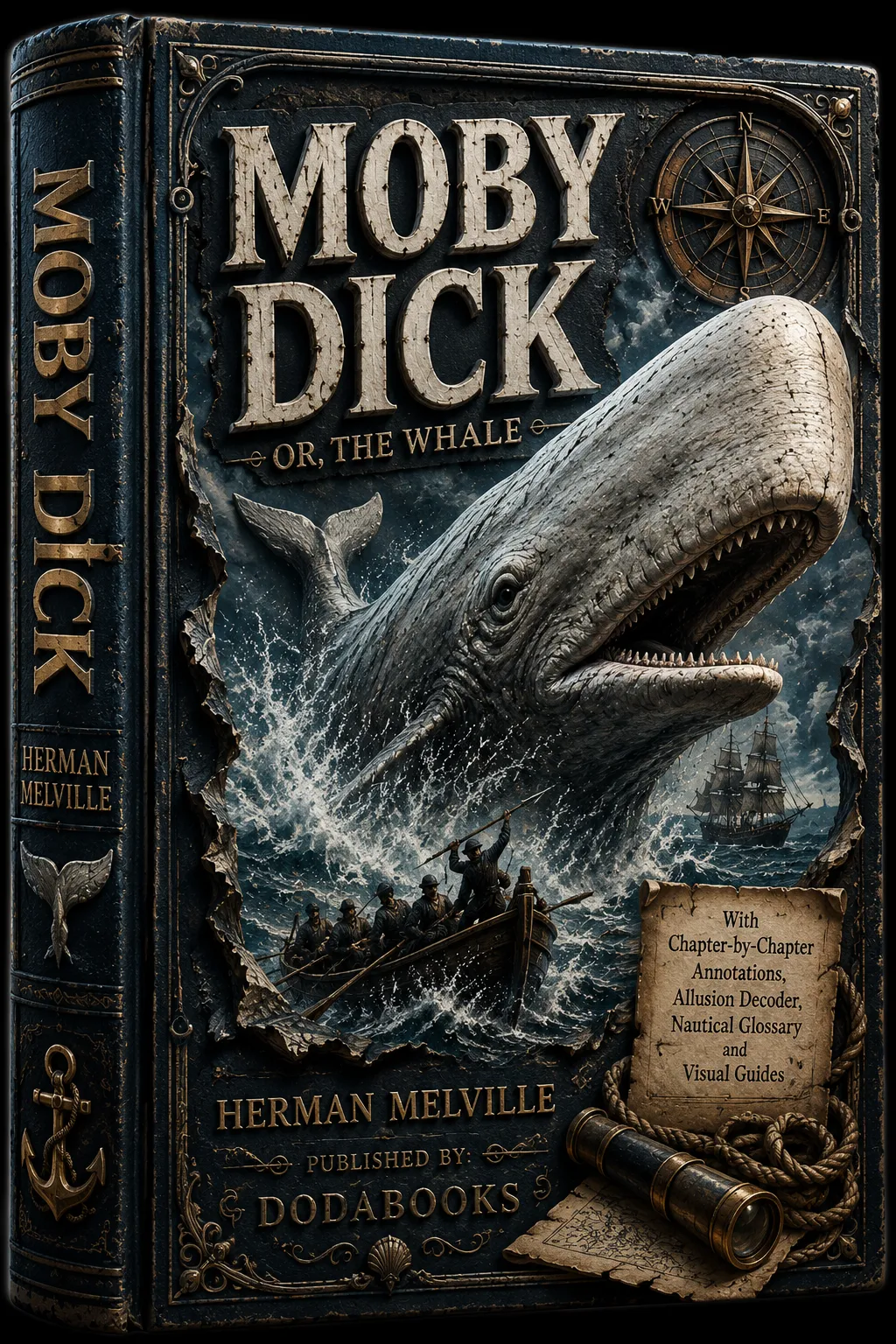
Discover the depth of Melville’s masterpiece with our annotated edition of Moby-Dick. Complete text with explanatory notes, historical context, and literary analysis.
❓ Frequently Asked Questions
Is Moby-Dick based on a true story?
Inspired by one, yes. Melville drew directly on the 1820 sinking of the whaleship Essex, which was rammed and destroyed by a sperm whale in the Pacific. He read the survivors’ published account and used it as the foundation for the novel’s ending.
Was Jaws inspired by Moby-Dick?
Not directly — Peter Benchley developed the novel from his own interests. But Jaws works the same mythic vein: an obsessed hunter, a monster of the deep, and a battle that ends badly. The comparison is invited by the story itself.
Is Quint really like Captain Ahab?
Structurally, yes. Both are scarred hunters driven by a wound — Ahab’s severed leg, Quint’s survival of the Indianapolis disaster. Both channel their trauma into a determination to kill the creature that represents it. The difference is scale: Ahab turns the hunt into a cosmic battle, Quint keeps it personal.
Which should I read or watch first?
Watch Jaws first if you want the quick, visceral version — it runs two hours and needs no preparation. Then read Moby-Dick for the depth the screen cannot touch. If the structure intimidates you, our complete plot summary breaks the entire novel down.
Why do Moby-Dick and Jaws still feel modern?
Because the fear at their center has not aged. The ocean remains the one place where humans are genuinely not in control, and both stories dramatize what happens when we refuse to accept that. The annotated Moby-Dick edition opens up that whole tradition.
📚 Related Articles
🎯 Stop Struggling. Start Understanding.
The annotated edition of Moby-Dick gives you everything you need to finally get Melville’s masterpiece:
- ✅ Complete, unabridged text — every word of the original 1851 edition
- ✅ Hundreds of explanatory footnotes — no more Googling every other page
- ✅ Historical context — the Essex disaster, Nantucket whaling, Melville’s life
- ✅ Literary analysis — chapter-by-chapter commentary on themes and symbols
- ✅ Victorian vocabulary — obsolete words and nautical terms defined inline
- ✅ Biblical & literary references — every allusion traced to its source