Expand your vocabulary with words from Moby-Dick — from ‘ambergris’ to ’try-works,’ the language of Melville’s masterpiece.
🐋
Moby-Dick Vocabulary: 20 Words and Phrases Melville Used
Expand your vocabulary with words from Moby-Dick — from 'ambergris' to 'try-works,' the language of Melville's masterpie...
Melville’s Rich Vocabulary
One of the pleasures of Moby-Dick is its language. Melville uses vocabulary that is simultaneously archaic, technical, and poetic.
Melville’s language is one of the novel’s greatest pleasures and one of its greatest challenges. He draws from an extraordinary range of sources: the Bible, nautical manuals, scientific treatises, slang dictionaries, and his own coinages. The result is a vocabulary that feels simultaneously ancient and immediate — as if the words were carved in stone and spoken yesterday. This linguistic richness is not decoration; it is essential to the novel’s meaning. Melville believed that the right word could unlock the right thought, and he spent years choosing his words with the precision of a jeweler selecting gems.
The novel’s language also reflects the diversity of the Pequod’s crew. Sailors from thirty different nations bring their own idioms, their own rhythms, their own ways of speaking. Melville captures this polyglot world in his prose, mixing high literary language with low sailor’s slang, scientific terminology with street argot. The effect is a linguistic democracy — a text where every voice, from the captain’s dramatic soliloquies to the crew’s pidgin English, has its place and its dignity.
Understanding Melville’s vocabulary is part of the reading experience. These words are not obstacles to be overcome but doors to be opened. Each term carries history, context, and meaning. Learning them transforms the reader from a passive consumer into an active participant — someone who shares the crew’s language and, therefore, their world.
Whaling Terms
- Try-works — furnace for rendering blubber into oil
- Gam — a social meeting between whaling ships
- Lance — long spear for killing a whale
- Harpoon — barbed spear for fastening to a whale
- Sound — when a whale dives deep
These terms are the vocabulary of a vanished industry. Whaling in the nineteenth century was one of America’s most important trades — whale oil lit the lamps that made cities safe after dark, lubricated the machines that drove the Industrial Revolution, and powered the spermaceti candles that burned in parlors from Boston to San Francisco. Understanding the language of whaling is understanding the economic engine that built modern America.
The try-works deserve special attention because they are one of Moby-Dick’s most powerful symbols. Located on the deck of the Pequod, the try-works are a furnace where whale blubber is rendered into oil — a process that involves fire, boiling fat, and the transformation of a living creature into a commodity. Melville uses the try-works as a metaphor for the human mind: just as the try-works transforms blubber into oil, the human mind transforms experience into meaning. But the process is dangerous — stare into the try-works too long and you will go mad, just as Ahab goes mad staring into the depths of his obsession.
The gam is another term that reveals the social world of whaling. Whaling ships spent months at sea, and encounters with other ships were rare and precious. A gam was a social event: ships would tie up alongside each other, exchange news, trade supplies, and share stories. The gam was the only social outlet available to men who spent years away from land, and Melville describes these meetings with warmth and nostalgia. They represent the human need for connection in even the most isolated circumstances.
Lancing and harpooning are distinct processes that Melville describes with documentary precision. The harpoon is thrown first — it fastens the whale to the boat, preventing escape. The lance is used later, when the whale is exhausted, to deliver the killing blow. This two-stage process is a metaphor for Ahab’s pursuit: the harpoon is his initial obsession, the lance is his final destruction. The distinction also reflects Melville’s commitment to technical accuracy — he wanted readers to understand exactly how whaling worked, not just as a romantic adventure but as a skilled trade with its own procedures, dangers, and expertise.
Nautical Terms
- Fo’c’sle — forecastle, crew quarters
- Binnacle — housing for the compass
- Quarter-deck — aft part of the upper deck (officers)
- Capstan — machine for hauling anchors
- Taffrail — rail around the ship’s stern
These nautical terms are the language of hierarchy and space aboard a whaling ship. Every location on the Pequod has its name, and every name carries social meaning. The fo’c’sle is where common sailors sleep — cramped, hot, shared among dozens of men. The quarter-deck is where officers stand — elevated, spacious, overlooking the entire ship. The spatial vocabulary of the ship mirrors the social structure of the crew: officers above, sailors below, with the captain at the very top.
The binnacle is worth lingering on because it is where Ahab stands in his most iconic scenes. The binnacle houses the compass — the instrument that tells the ship where it is and where it is going. Ahab’s position at the binnacle is therefore symbolically charged: he is the man who claims to know the ship’s direction, who insists on controlling its destination. But Ahab’s compass is broken — not literally, but metaphorically. He has replaced the objective guidance of the compass with the subjective guidance of his own obsession, steering the Pequod not toward profit or safety but toward Moby Dick.
The capstan appears in some of the novel’s most dramatic moments. The crew walks around the capstan to raise anchor — a circular, rhythmic motion that Melville compares to the turning of the earth itself. The capstan is where the crew becomes a single organism, moving in unison, their individual wills subsumed into the collective effort. This image of unity is one of the novel’s most powerful: the ship as body, the crew as cells, the captain as brain. But Ahab’s brain is diseased, and the body of the Pequod will ultimately be destroyed by the sickness of its leader.
The taffrail marks the ship’s stern — its rear, its past, the direction from which it came. When Ishmael stands at the taffrail, he looks back toward home, toward Nantucket, toward the life he has left behind. The taffrail is the novel’s anchor to the past — a reminder that the Pequod was once a normal ship, that Ahab was once a normal captain, that the crew was once a group of men earning a living. The taffrail is where the reader can see how far the ship has traveled from its original purpose — and how far Ahab has traveled from sanity.
Rare Words
- Cetology — the study of whales
- Leviathan — biblical sea monster
- Monomaniac — obsessed with a single idea (Ahab)
- Inscrutable — impossible to understand
- Spermaceti — waxy oil from a sperm whale’s head
These rare words are the novel’s intellectual architecture. They are not everyday language; they are the vocabulary of specialists, scholars, and men who have spent years studying the whale and the sea. Melville uses them to create a sense of authority — to convince the reader that Ishmael knows what he is talking about, that the Pequod’s crew operates in a world of genuine expertise.
Cetology is the novel’s most ambitious project: Ishmael’s attempt to classify every species of whale, to impose scientific order on creatures that resist classification. The project is deliberately absurd — whales are too large, too varied, too mysterious to fit into any system. But the absurdity is the point. Melville uses cetology to suggest that human knowledge has limits, that the natural world will always exceed our attempts to understand it. The whale remains, as Ishmael repeatedly says, “inscrutable” — a word that appears more than any other in the novel.
Leviathan carries enormous biblical weight. In the Book of Job, Leviathan is the creature that God displays to Job as evidence of His power — a monster so vast and so terrible that no human can hope to control it. Ahab sees himself as a second Job, battling not God but God’s creature. The whale is his Leviathan, and his quest is a parody of Job’s submission: where Job accepts God’s mystery, Ahab declares war on it. The word Leviathan thus frames the entire novel as a theological conflict — a battle between human will and divine power.
Monomaniac is a medical term from Melville’s era, used to describe someone obsessed with a single idea. Ahab is the novel’s quintessential monomaniac: he thinks of nothing but the whale, cares for nothing but revenge, sees every event as connected to his quest. The term carries both clinical and moral weight: Ahab is sick, but his sickness is also a choice. He could stop; he could turn back; he could accept his loss. Instead, he pursues his obsession to the end. The word monomaniac thus raises the novel’s central question: is Ahab a victim of his madness or its author?
Spermaceti is the waxy oil found in a sperm whale’s head — the most valuable substance in the nineteenth-century whaling trade. It burns cleaner and brighter than any other oil, making it the fuel of choice for lighthouses, lamps, and candles. Melville describes spermaceti with almost fetishistic attention: its color, its texture, its smell, its way of congealing in cold water. This attention reflects the industry’s obsession with the substance — and the novel’s larger meditation on the relationship between beauty and utility, between the whale as living creature and the whale as commodity.
Melville’s Usage
- Whaleman — whaler (Melville’s preferred term)
- Ambergris — waxy substance from sperm whales, used in perfume
- Spouter — whaling ship (slang)
Melville’s choice of terms reveals his own relationship to the whaling industry. He uses “whaleman” rather than “whaler” — a distinction that may seem trivial but reflects his desire to humanize the men who worked the ships. A “whaler” sounds like a machine; a “whaleman” sounds like a person. This linguistic choice reflects Melville’s broader project: to transform the whaling trade from an abstract industry into a human story.
Ambergris is one of the novel’s most fascinating substances. Found in the digestive system of sperm whales, it was worth more than gold by weight in the nineteenth century. It was used to make perfumes last longer, and its scarcity made it the ultimate prize for whalers. Melville describes ambergris with the same attention he gives to spermaceti, exploring its origins, its properties, and its value. The substance becomes a metaphor for the novel itself: something valuable that comes from inside a mysterious creature, something that requires patience and skill to extract, something that is simultaneously beautiful and repulsive.
Spouter is sailor’s slang for a whaling ship — a term that captures the informal, irreverent culture of the crew. Sailors did not speak in formal English; they invented their own language, their own jokes, their own ways of describing the world. “Spouter” is a term of both affection and mockery: the ship spouts water (and oil), it spouts orders, it spouts the dreams of its owners. The term reminds us that the Pequod is not a military vessel but a working ship — a place where men joke, complain, and survive through humor and solidarity.
These three terms — whaleman, ambergris, spouter — represent different levels of the novel’s language: the formal, the technical, and the informal. Melville uses all three to create a richly textured linguistic world where every word carries history, context, and meaning. The reader who learns these words does not just learn vocabulary; they learn the culture of the nineteenth-century whaling ship — its hierarchy, its dangers, its dark humor, and its strange beauty.
Why It Matters
The vocabulary is not decoration. Precise terms establish authenticity. Moby-Dick immerses you in the language of whaling — learning these words is part of the experience.
The language of Moby-Dick is not an obstacle to the story but the story itself. Every term Melville uses carries meaning, context, and history. When Ishmael describes the try-works, he is not just explaining a process; he is building a metaphor for the human mind. When he uses the word “inscrutable,” he is not just describing the whale; he is describing the limits of human knowledge. The vocabulary of whaling becomes the vocabulary of philosophy, and the reader who learns it gains access to the novel’s deepest meanings.
Learning these words also transforms the reader’s relationship to the text. Instead of skimming past unfamiliar terms, the reader engages with them, asking what they mean, where they come from, why Melville chose them. This engagement is the opposite of passive reading — it is an active, collaborative process in which the reader and the writer work together to create meaning. Melville rewards this collaboration with a reading experience unlike any other: a novel that reveals new layers with every rereading, a novel that teaches you its own language as you go.
The vocabulary of Moby-Dick is also a historical artifact — a record of a vanished industry, a lost way of life, a world that no longer exists except in these pages. The words Melville uses are time capsules: they preserve the sounds, the rhythms, and the meanings of nineteenth-century whaling. When you read them, you are not just reading a novel; you are hearing the voices of men who worked the ships, who faced the whale, who survived (or did not) the dangers of the sea. That is a privilege that no amount of modern technology can replicate — and it is the ultimate reason to learn Melville’s language.
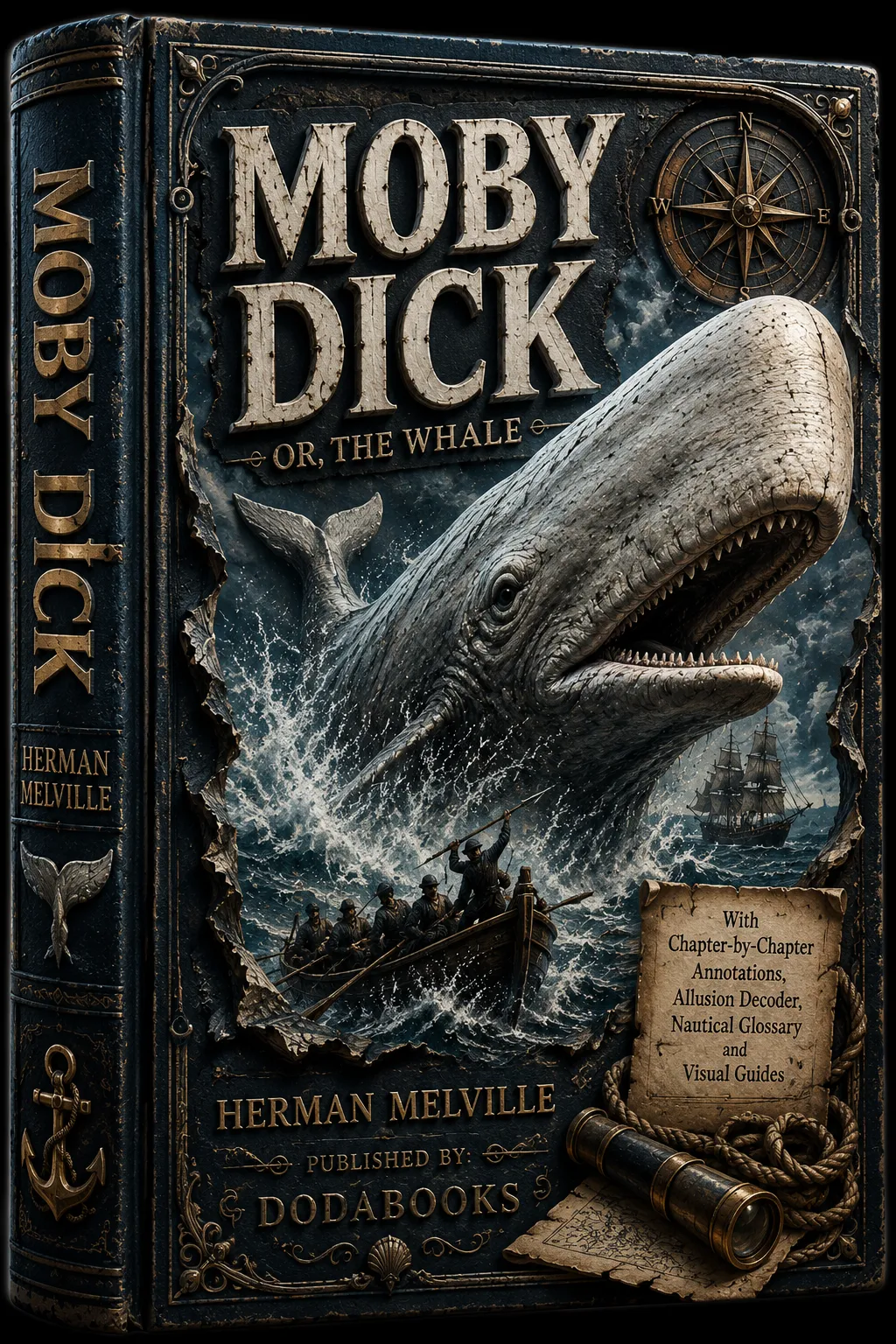
Discover the depth of Melville’s masterpiece with our annotated edition of Moby-Dick. Complete text with explanatory notes, historical context, and literary analysis.
📚 Related Articles
Frequently Asked Questions
Why is Melville's vocabulary in Moby-Dick so challenging?
Melville utilized over 17,000 unique words, drawing from 19th-century cetology, nautical seamanship, Shakespearean archaic English, and classical Latinate philosophy.
What are examples of obscure words found in Moby-Dick?
Words like 'anacharsis', 'ubiquitous', 'phrenology', 'erromango', and 'spermophile' frequently require contextual explanation for modern readers.
Did Herman Melville invent words in Moby-Dick?
Yes, Melville coined numerous compound words, portmanteaus, and poetic neologisms to capture the unprecedented scope of his maritime subject.
How can modern readers tackle Melville's vocabulary without losing immersion?
Using an annotated edition with in-line definitions prevents readers from constantly having to stop and consult external dictionaries.
How does the DodaBooks edition handle Melville's complex vocabulary?
DodaBooks provides instant, clear definitions for obsolete nautical terms, historical slang, and complex idioms directly within the reading layout.
🎯 Stop Struggling. Start Understanding.
The annotated edition of Moby-Dick gives you everything you need to finally get Melville’s masterpiece:
- ✅ Complete, unabridged text — every word of the original 1851 edition
- ✅ Hundreds of explanatory footnotes — no more Googling every other page
- ✅ Historical context — the Essex disaster, Nantucket whaling, Melville’s life
- ✅ Literary analysis — chapter-by-chapter commentary on themes and symbols
- ✅ Victorian vocabulary — obsolete words and nautical terms defined inline
- ✅ Biblical & literary references — every allusion traced to its source