Every Moby-Dick movie and TV adaptation ever made, from 1926 to the present.
🐋
Moby-Dick TV and Film Adaptations: Complete List
Every Moby-Dick movie and TV adaptation ever made, from 1926 to the present.
Silent Era
The first attempts to adapt Moby-Dick for the screen came in the earliest days of cinema, when filmmakers were still figuring out what movies could be.
The Sea Beast (1926) — John Barrymore gives the first great screen Ahab, delivering a performance of dramatic intensity even in a silent film. The movie takes significant liberties with the source material, most notably adding a happy ending in which Ahab survives and marries his beloved. This was a common practice in the silent era, when studios believed audiences needed uplift. Barrymore’s Ahab is less a mad tyrant than a romantic hero, and the whale is more obstacle than existential nemesis. Still, the film contains striking visual compositions — the storm at sea, the whale breaching — that influenced every adaptation that followed. The film’s success proved that literary adaptation could work on screen, paving the way for the hundreds of classic novel adaptations that followed in Hollywood’s golden age.
Moby-Dick (1930) — Barrymore reprised the role in one of the earliest sound adaptations of a major novel. The transition from silent to talkie allowed filmmakers to finally use Melville’s language, though the script was heavily condensed. Barrymore’s vocal delivery — his famous “to be or not to be” soliloquy was already legendary — brought new depth to Ahab’s madness. The film is considered lost today, with no known surviving prints, which makes it one of the great casualties of early cinema history.
Damon des Meeres (1931) — A German-language adaptation that followed shortly after Barrymore’s version. The film reflects the German Expressionist tradition, with dramatic lighting and exaggerated compositions that give the whaling scenes an almost nightmarish quality. It’s a reminder that Melville’s novel resonated internationally from the very beginning of the film era.
Classic Era
📖 Want the complete annotated experience?
👉 Get the Annotated Edition- Moby-Dick (1956) — Directed by John Huston and starring Gregory Peck as Ahab, this is widely considered the definitive film adaptation of Melville’s novel. Huston enlisted writer Ray Bradbury to work on the screenplay, though Bradbury’s name was eventually removed from the credits due to a contract dispute. The film was shot on location off the coast of Ireland, and the real ocean gives the whaling scenes a physicality that studio-bound productions could never match. Peck’s Ahab is a departure from his usual heroic roles — he wears a prosthetic leg, his face is weathered, and his voice carries the weight of monomaniacal purpose. The famous line “From hell’s heart I stab at thee” became iconic through Peck’s delivery. The film won an Academy Award for Best Art Direction and remains the version most people picture when they think of Moby-Dick on screen.
Television
Television has offered multiple attempts to capture the novel’s full scope, which is difficult to achieve in a two-hour film.
Moby-Dick (1954) — A live television broadcast starring Victor McLaglen, produced during the golden age of live TV drama. These broadcasts were ephemeral by nature — most were not recorded — but they demonstrate how early television embraced literary adaptations as prestige programming.
Moby-Dick (1978) — An Australian television movie that brought a Southern Hemisphere perspective to the whaling story. Shot with practical effects and real ships, it offers a grittier, less polished feel than the 1956 Huston film. The Australian production context gives the ocean scenes a raw authenticity.
Moby-Dick (1998) — Patrick Stewart brings dramatic gravitas to Ahab in this made-for-TV film. Stewart treats Melville’s dialogue with the same intensity he brings to classic dramatic roles. The television format allows for more of the novel’s secondary characters and subplots than a theatrical film could accommodate.
Moby-Dick (2011) — Starring William Hurt as Ahab and Ethan Hawke as Starbuck, this is the most complete adaptation of the novel, released as a two-part miniseries. The format allows the production to include scenes that every previous adaptation had cut — the cetology chapters, the philosophical dialogues, and the encounters with other ships. For viewers who want the closest experience to reading the full novel on screen, this is the version to watch. The miniseries also benefits from modern special effects that make the whale itself more convincing than in earlier productions, though it wisely keeps the creature partially obscured, preserving the mystery that Melville maintained throughout the novel. Hawke’s Starbuck is particularly effective — a man who sees the destruction coming but cannot bring himself to defy his captain, embodying the moral paralysis that makes the tragedy possible.
Animation
Moby Dick (1967) — An animated series that reimagines the story for children, featuring a heroic whale named Moby Dick who helps a young boy named Tom. The series bears almost no resemblance to Melville’s novel — it’s closer to Flipper with a whale — but it introduced the character name to an entire generation of young viewers.
Moby Dick (2005) — A direct-to-video animated feature that takes a more serious approach than the 1967 series, though it still simplifies the story significantly. The animation is competent but unremarkable, and the film serves primarily as an accessible entry point for younger viewers who aren’t ready for the full novel.
Radio and Stage
Audio and theatrical adaptations have a long history with Moby-Dick, perhaps because the novel’s language is so naturally dramatic.
Moby-Dick Rehearsed (1955) — Orson Welles wrote and directed this stage adaptation, in which he also played Ahab. Welles understood that Melville’s dramatic chapters — the quarter-deck scene, the soliloquies — were essentially plays embedded within a novel. His adaptation strips the story to its theatrical core, using minimal sets and relying on the power of the language. The production was a critical success, and recordings of Welles’s performance survive as one of the great documents of American theater.
BBC Radio adaptations with Sir Ian McKellen (2012) — McKellen brings his legendary vocal presence to Ahab in this multi-part radio dramatization. Radio is uniquely suited to Moby-Dick because the novel is so rich in soliloquy and interior monologue — the medium lets Melville’s language do the work that visual effects would handle on screen. McKellen’s Ahab whispers and roars with equal conviction, and the absence of images forces the listener to imagine the whale, the ocean, and the destruction — which, paradoxically, makes them more vivid than any special effect could achieve.
Why So Many?
The story is primal: a man against a whale. Obsession versus nature. The struggle against fate. Every generation finds new ways to tell it.
But there’s a deeper reason Moby-Dick keeps returning to screens and stages. The novel is structurally unfilmable — its cetology chapters, its philosophical digressions, its shifting narrative voices all resist the linear demands of visual storytelling. This means every adaptation must make choices about what to include and what to cut, and those choices reveal what each generation values most in Melville’s text. The 1956 Huston film emphasizes adventure and spectacle. The 2011 miniseries attempts completeness. The Welles stage version isolates the theatrical language. Each version is a partial truth, and the gaps between them point back to the novel itself, which contains all of these dimensions and more.
The sheer number of adaptations also testifies to the novel’s inexhaustibility. No single film can capture everything that Moby-Dick contains, which means there is always room for another version, another interpretation, another attempt to solve the problem Melville posed: how do you put infinity on screen?
The adaptations also reveal changing attitudes toward the novel’s themes. Early versions soften Ahab, making him more sympathetic and less terrifying. Later versions embrace his darkness. The shift from silent cinema to sound to television to streaming mirrors the novel’s own evolution from popular entertainment to literary monument. Every version teaches us something about Moby-Dick, and something about ourselves — about what we want from the story, and what we’re willing to see.
As new adaptations continue to appear — and they will, because the story is inexhaustible — the original novel remains the anchor. No film, however faithful, can replace the experience of reading Melville’s language on the page. But the adaptations serve a vital function: they draw new readers to the novel, and they remind us that great literature is not a museum piece but a living, evolving conversation between past and present.
Discover the depth of Melville’s masterpiece with our annotated edition of Moby-Dick. Complete text with explanatory notes, historical context, and literary analysis.
📚 Related Articles
Frequently Asked Questions
What are the most famous film adaptations of Moby-Dick?
Notable adaptations include John Barrymore's 1930 The Sea Beast, John Huston's 1956 classic starring Gregory Peck, and the 1998 TV miniseries starring Patrick Stewart.
How was Patrick Stewart's portrayal of Captain Ahab received?
Patrick Stewart received widespread acclaim for his intense, Shakespearean energy and psychological vulnerability as Ahab in the 1998 adaptation.
Are there animated or loose adaptations of Moby-Dick?
Yes, Disney's Treasure Planet, Star Trek II: The Wrath of Khan, and Peter Benchley's Jaws borrow heavily from Melville's central conflict.
Why is Moby-Dick notoriously difficult to adapt to screen?
Filmmakers must cut Melville's encyclopedic chapters on whaling, internal philosophical monologues, and shifting narrative perspectives to fit cinematic runtimes.
What is the best way to experience the complete vision of Melville?
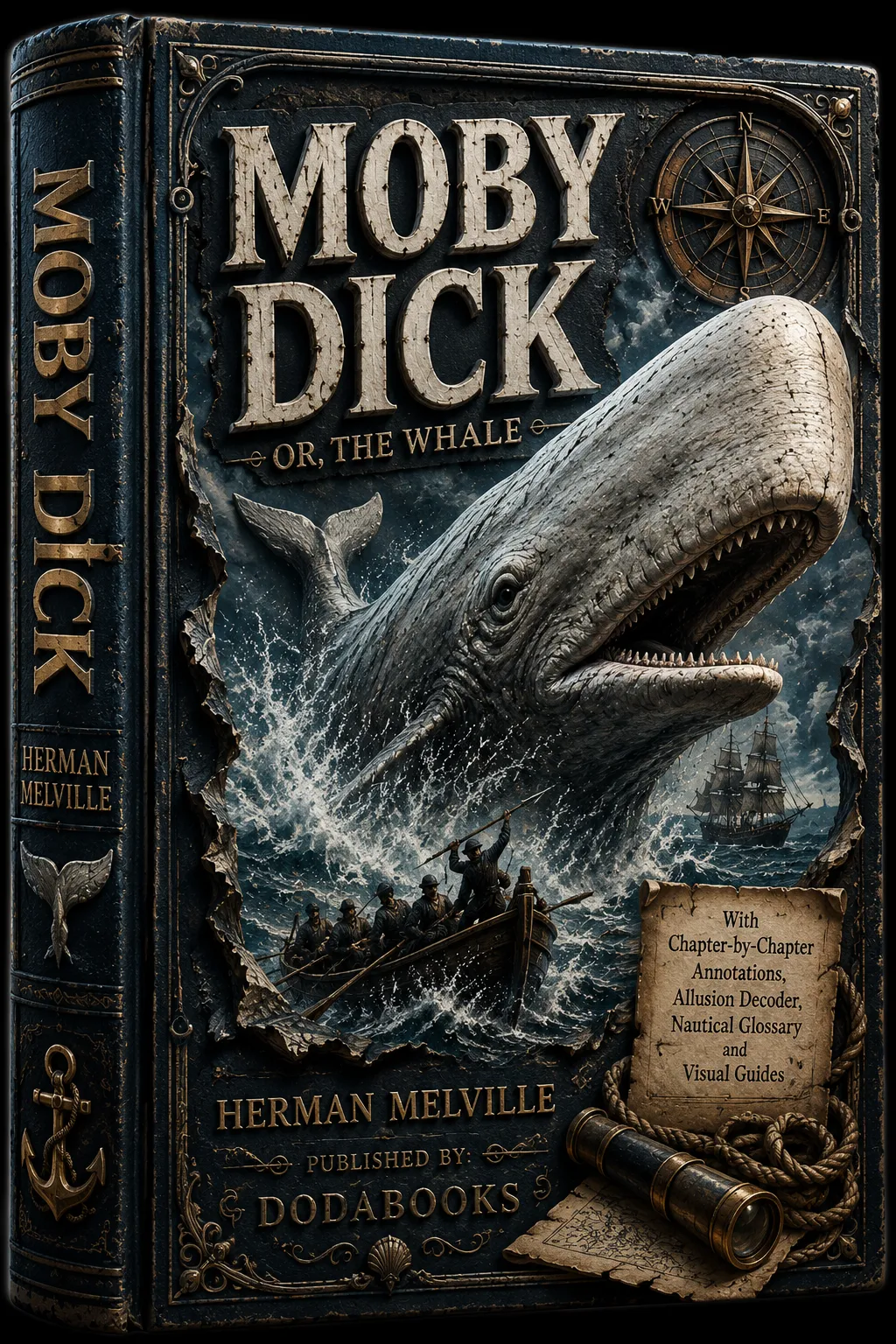
Reading the original text with the DodaBooks annotated edition delivers the full philosophical weight and linguistic majesty that cinema cannot replicate.
🎯 Stop Struggling. Start Understanding.
The annotated edition of Moby-Dick gives you everything you need to finally get Melville’s masterpiece:
- ✅ Complete, unabridged text — every word of the original 1851 edition
- ✅ Hundreds of explanatory footnotes — no more Googling every other page
- ✅ Historical context — the Essex disaster, Nantucket whaling, Melville’s life
- ✅ Literary analysis — chapter-by-chapter commentary on themes and symbols
- ✅ Victorian vocabulary — obsolete words and nautical terms defined inline
- ✅ Biblical & literary references — every allusion traced to its source