Moby-Dick is one of the most thematically rich novels ever written. Obsession, revenge, fate, the limits of knowledge — Melville weaves them all into a story that operates on multiple levels simultaneously. Here are the major themes explored in depth, with analysis for students and book clubs.
| Primary Themes | Obsession, Revenge, Fate vs Free Will |
| Secondary Themes | Man vs Nature, Limits of Knowledge, Isolation |
| Key Symbols | The White Whale, The Pequod, The Coffin |
| Central Question | Can we control the forces that govern our lives? |
| Key Chapters | 36 (The Quarter-Deck), 42 (Whiteness), 135 (The Chase) |
🔥
The Themes of Moby-Dick
A deep-dive into Melville’s exploration of obsession, revenge, fate, and the human condition — with analysis for students and readers.
🔥 Obsession: The Central Theme
The dominant theme of Moby-Dick is obsession — specifically, Ahab’s monomaniacal pursuit of the white whale. But Melville does not present obsession as a simple character flaw. He examines it from every angle: its origins, its psychology, its effects on others, and its ultimate cost.
Ahab’s obsession begins with a physical injury — the loss of his leg — but quickly becomes metaphysical. He does not merely want to kill the whale; he wants to destroy what the whale represents. “He tasks me; he heaps me,” Ahab says. The whale is not an animal but an agent of cosmic malice. By killing it, Ahab believes he is striking a blow against the universe itself.
Melville traces the pathology of obsession with extraordinary precision. Ahab isolates himself. He manipulates the crew. He refuses all counsel. He sacrifices his own safety and the safety of others. The novel shows that obsession is not a sudden madness but a gradual process — a series of choices, each one leading deeper into the abyss.
📘 Annotated Insight — The cetology chapters, often dismissed as digressions, serve a crucial thematic purpose here. They demonstrate what healthy curiosity looks like. Ishmael wants to understand whales the way a scientist does — by studying them, classifying them, learning about them. Ahab wants only to destroy them. The contrast between knowledge and domination is central to the novel’s meaning. The annotated edition traces this contrast through the full text.
⚔️ Revenge: War Against Existence
The engine of the plot is revenge. Ahab’s quest is fueled by a desire to retaliate against the whale that injured him. But Melville asks a difficult question: can you take revenge on a non-human animal? Is revenge ever justified, even against another person?
Starbuck raises this question explicitly. “Vengeance on a dumb brute!” he exclaims. “To be enraged with a dumb thing, Captain Ahab, seems blasphemous.” Ahab’s response — “I’d strike the sun if it insulted me” — reveals the terrifying scope of his rage. He is not seeking justice. He is seeking war against existence itself.
The Irony of Revenge — The novel suggests that revenge is ultimately self-destructive. Ahab harms no one but himself and his crew. The whale survives. The Pequod sinks. Revenge, in Moby-Dick, is not justice — it is suicide. Ahab’s quest to destroy the whale only destroys himself and everyone around him.
⚖️ Fate vs. Free Will
Is the destruction of the Pequod inevitable? The novel is filled with prophecies, omens, and warnings. Fedallah predicts Ahab’s death in specific detail. Ahab seems to move toward his doom with the inevitability of a character in a Greek tragedy.
Yet Ahab also makes deliberate choices that seal his fate. He refuses to help the Rachel. He smashes his quadrant. He ignores Starbuck’s pleas. These choices are not forced on him — he makes them freely.
Melville suggests that fate and free will are not opposites but partners. We are free to make choices, but those choices have consequences we cannot escape. Ahab freely chooses his obsession, but once chosen, it drives him with the force of fate.
📘 Annotated Insight — This paradox — that we are both free and determined — is one of the novel’s most profound insights. The annotated edition includes essays on Melville’s philosophical influences, showing how the novel engages with the theological debates of 19th-century America about predestination, free will, and divine providence.
🌊 Man vs. Nature
At its most basic level, Moby-Dick is the story of man trying to dominate nature — and nature refusing to be dominated. The whale is not evil; it is simply a whale. But Ahab’s need to see it as evil reveals something about human psychology: our desire to find meaning, even malevolent meaning, in the natural world.
The novel anticipates the environmental concerns of our own time. By showing the Pequod’s crew destroying whales for oil, and by showing Ahab’s hubristic attempt to conquer the natural world, Melville questions the human project of dominating the planet. Nature, he suggests, will always have the last word.
The Whale’s Indifference — The most unsettling aspect of Moby-Dick is that the whale does not care about Ahab’s quest. It is not a villain. It is not a hero. It is simply a whale. Ahab’s entire quest is directed at something that has no awareness of his existence. This is what makes the novel so powerful — it suggests that the universe is not hostile, merely indifferent.
🧠 The Limits of Knowledge
The cetology chapters represent humanity’s attempt to know and control the natural world through classification. But the whale always escapes complete understanding. “The Whiteness of the Whale” argues that some things resist explanation. The universe is ultimately inscrutable.
This is perhaps the most unsettling theme in Moby-Dick. The novel suggests that knowledge has limits — that there are things we cannot know and forces we cannot control. Learning to live with this uncertainty is the great challenge of being human.
🔗 How the Themes Connect
The five themes are not separate — they are facets of a single argument. Ahab’s obsession leads to his quest for revenge. His quest for revenge forces the question of fate versus free will. His confrontation with the whale forces the question of man versus nature. And the whale’s ultimate inscrutability forces the question of whether knowledge itself is possible.
Melville’s genius is that all these questions remain open. The novel does not answer them. It poses them with such power that they become permanent features of the human conversation.
📚 Related Articles
❓ Frequently Asked Questions
What are the main themes of Moby-Dick?
The five major themes are: obsession (Ahab’s monomaniacal pursuit of the whale), revenge (the self-destructive nature of vengeance), fate vs. free will (whether we control our destinies), man vs. nature (humanity’s hubristic attempt to dominate the natural world), and the limits of knowledge (the idea that some things resist understanding).
What does the white whale symbolize?
The white whale is deliberately ambiguous — it can represent nature, fate, evil, God, or the unknowable. No single reading exhausts it. That ambiguity is the point. Melville wanted a symbol that could hold multiple meanings simultaneously.
Why is Ahab obsessed with the white whale?
Ahab does not hate the whale as an animal. He hates what it represents — the inscrutable forces that govern human life: fate, nature, God, the universe. By killing the whale, Ahab believes he is striking back against the cosmos itself.
What is the significance of the cetology chapters?
The cetology chapters serve multiple purposes: they establish Melville’s authority as a writer who knows his subject, they provide breathing room between intense narrative chapters, and most importantly, they demonstrate the limits of human knowledge — the whale always escapes complete classification.
How does Moby-Dick relate to environmental concerns?
The novel anticipates modern environmental concerns by questioning the human project of dominating nature. Melville shows the whaling industry destroying whales for profit, and Ahab’s hubristic quest to conquer the natural world ends in destruction for everyone involved.
📚 What the Annotated Edition Unlocks
Theme Analysis
Chapter-by-chapter commentary on how each theme develops throughout the novel
Philosophical Context
Melville's engagement with 19th-century debates about free will, determinism, and divine providence
Symbolism Guide
The white whale, the Pequod, the coffin — every symbol decoded with scholarly analysis
Discussion Questions
Thought-provoking questions for book clubs, study groups, and essay writing
Key Passages
The most important thematic passages highlighted and explained in context
Essay Topics
Suggested essay topics and thesis statements for students writing papers
🎯 Stop Struggling. Start Understanding.
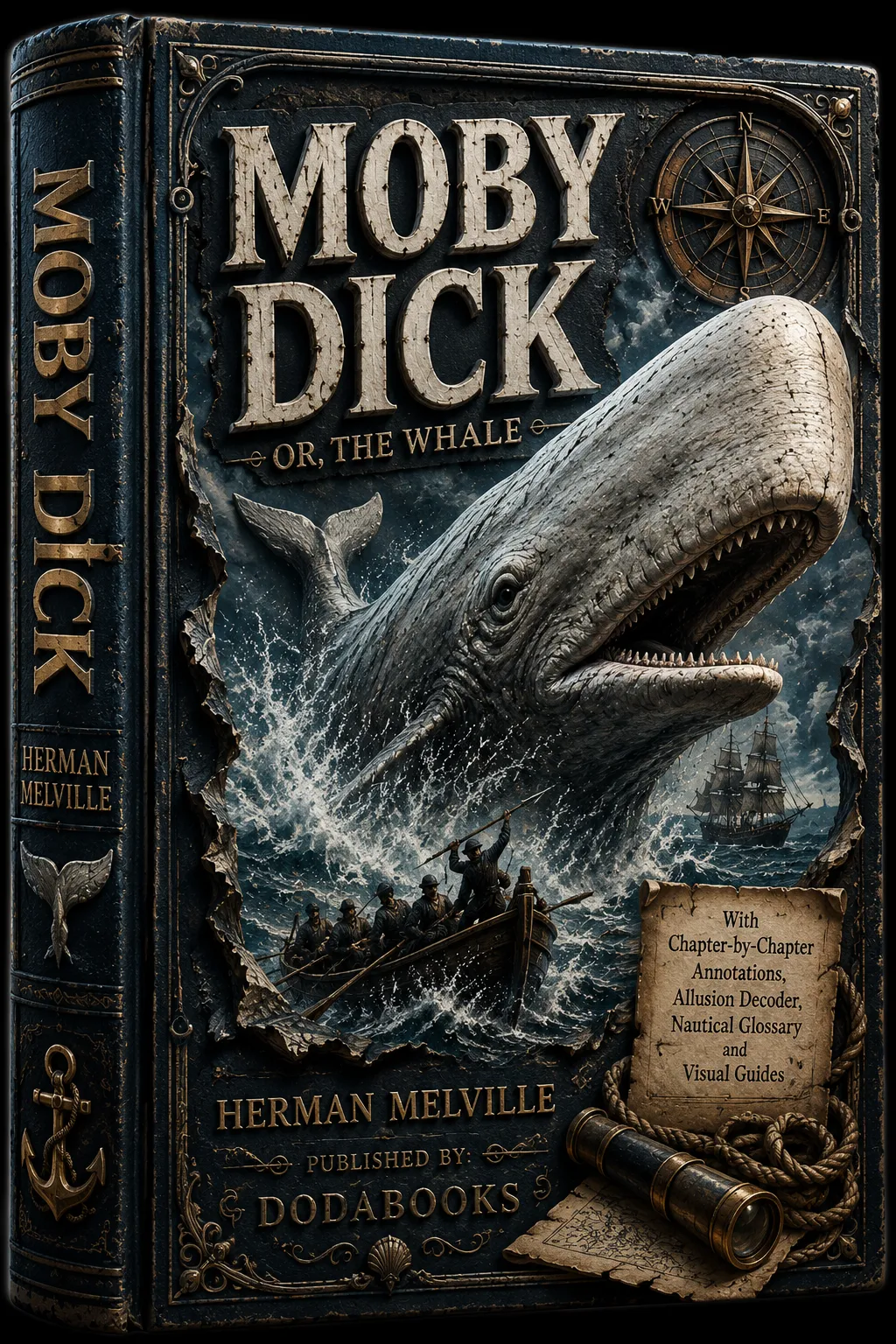
The annotated edition of Moby-Dick gives you everything you need to finally get Melville’s masterpiece:
- ✅ Complete, unabridged text — every word of the original 1851 edition
- ✅ Hundreds of explanatory footnotes — no more Googling every other page
- ✅ Historical context — the Essex disaster, Nantucket whaling, Melville’s life
- ✅ Literary analysis — chapter-by-chapter commentary on themes and symbols
- ✅ Victorian vocabulary — obsolete words and nautical terms defined inline
- ✅ Biblical & literary references — every allusion traced to its source