Moby-Dick chapters 51 through 135 explained. From the Indian Ocean encounters to the three-day chase and the sinking of the Pequod.
🐋
Moby-Dick Chapters 51-135: From the Indian Ocean to the Final Chase
Moby-Dick chapters 51 through 135 explained. From the Indian Ocean encounters to the three-day chase and the sinking of ...
Chapters 51-70: The Indian Ocean
The Pequod enters the Indian Ocean, and the tension escalates as the crew moves closer to Moby Dick’s hunting grounds. The most important chapter in this section — and one of the most important in the entire novel — is “The Whiteness of the Whale” (Chapter 42). Ishmael meditates on why white, a color universally associated with purity, innocence, and divinity, becomes terrifying when attached to the whale. He explores how whiteness can symbolize the blankness of meaning — the terrifying possibility that the universe is not malevolent but simply empty, indifferent, and devoid of purpose. This chapter is the philosophical heart of the novel, and it reframes everything that follows. When Ahab pursues the whale in the final chase, we understand that what he’s really pursuing is an answer to the question of whether the universe cares.
Other chapters in this section introduce the cetology — detailed descriptions of whale anatomy, whale species, and the mechanics of whaling. These chapters slow the narrative pace deliberately, building the sense that the Pequod is moving through a world that is becoming increasingly strange and charged with meaning. Ishmael describes the process of rendering whale blubber into oil with the precision of an engineer, but the descriptions also carry an undertone of violence and transformation that mirrors Ahab’s psychological state. The cetology chapters also include some of the novel’s most beautiful prose — meditations on the color white, the nature of truth, and the limits of human knowledge that rank among the finest passages in American literature.
Chapters 71-100: Encounters
📖 Want the complete annotated experience?
👉 Get the Annotated EditionThe Pequod meets other whaling ships, each with a story about the white whale. These encounters serve as warning signs that Ahab ignores — each ship represents a different possible fate, and each crew’s relationship with the whale offers a different answer to the question of how humans should respond to nature’s indifference.
The most devastating encounter is with The Rachel (Chapter 128), a whaling ship whose captain, Captain Gardiner, begs Ahab to help search for a lost boat carrying his own son. Ahab refuses. The boat is lost because of Moby Dick, and Gardiner’s desperate search mirrors Ahab’s own quest — both men are pursuing something they may never find. But where Gardiner’s quest is motivated by love, Ahab’s is motivated by vengeance, and the difference between the two is the novel’s moral center. Ahab’s refusal to help is one of the novel’s most chilling moments, the moment when we see that his obsession has consumed not just his judgment but his humanity.
The Delight also encounters the Pequod and reports that the white whale has already killed a crew member. The captain of the Delight has given up the hunt. Ahab has not. The contrast between the two captains crystallizes the novel’s central conflict: the rational response to the whale’s power versus Ahab’s irrational determination.
Chapters 101-120: Approaching the Whale
As the Pequod draws closer to Moby Dick, Ahab’s behavior becomes increasingly erratic. He smashes his quadrant — the navigational instrument that represents rational science and human mastery over nature — declaring that he will no longer rely on instruments when his own “unerring” instinct can guide him. This is a pivotal act of defiance against reason: Ahab rejects the tools that allow humans to orient themselves in the world because he believes his obsession provides a more reliable compass.
A typhoon strikes (Chapters 118-119), and the storm becomes a mirror of Ahab’s inner turmoil. The compass is damaged, further removing the crew’s rational navigational tools. Starbuck uses the storm as an argument to turn back — surely the storm is a sign from God that they should abandon the quest. Ahab refuses, interpreting the storm as a challenge to be overcome rather than a warning to be heeded. The crew is divided, frightened, and increasingly under Ahab’s thrall. The typhoon chapter is one of the novel’s most dramatic sequences, and it builds a sense of inevitability that makes the final chase feel both shocking and predestined.
During these chapters, Melville also explores the interior lives of the crew members — their fears, their doubts, their attempts to make sense of what is happening. The dramatic chapters, written in play format, allow the characters to speak without Ishmael’s mediation, creating moments of raw, unfiltered emotion that prepare us for the devastation of the final chase.
Chapters 121-135: The Chase
The three-day chase is the novel’s climactic sequence, and Melville orchestrates it with the precision of a Greek tragedy. Each day escalates the violence, the desperation, and the sense of inevitability that has been building since Ahab nailed his gold doubloon to the mast and declared his purpose.
On the first day, the whale boats are lowered and the chase begins. Moby Dick breaches the surface, and the crew gets their first clear look at the creature that has been the object of Ahab’s obsession for years. The whale is enormous, white, and terrifying — everything Ahab imagined and more. The whale fights back with startling intelligence, targeting the whale boats with what seems like deliberate strategy. It destroys one of the boats and scatters the crew across the ocean. Ahab’s harpoon strikes, but the whale dives, dragging the boat downward. Ahab is temporarily submerged but survives. The crew returns to the Pequod shaken but alive — and Ahab orders them to prepare for the next day’s hunt.
On the second day, the whale returns. The chase continues with increasing desperation. Ahab hurls his harpoon again, and again the whale fights back, this time destroying another boat and wounding several crew members. Starbuck, watching from the deck of the Pequod, sees the destruction and begs Ahab to stop. Ahab refuses. The crew members who survive the second day are exhausted, terrified, and fully aware that they are pursuing a creature that has already demonstrated its superiority. The second day’s destruction is more personal than the first — we see individual crew members killed, and we understand that Ahab’s quest has real human costs.
On the third day, the whale returns one final time. Ahab hurls his last harpoon. The whale rams the Pequod itself, and the ship begins to sink. Ahab, tangled in his harpoon line, is dragged overboard and pulled underwater by the whale. His final words — “From hell’s heart I stab at thee” — are addressed to the creature that has been both his obsession and his undoing. The Pequod goes down with all hands except Ishmael, who survives by floating on Queequeg’s coffin-buoy — the coffin that Queequeg had ordered built for himself, which was repurposed as a life buoy when he recovered from his illness. This detail is one of Melville’s great structural achievements: the coffin that was meant to hold a dead man saves a living one.
The sinking of the Pequod is one of the most dramatic scenes in all of literature. Melville describes the ship going down “like a lead weight” — Ahab’s creation, his instrument of vengeance, swallowed by the same ocean he tried to master. The image is both tragic and morally ambiguous: Ahab’s destruction feels like justice, but it also feels like waste. The crew members who died were innocent of Ahab’s obsession. Their deaths are the true cost of his monomania.
Ishmael survives alone on the ocean for two days before being rescued by The Rachel — the same ship whose captain Ahab had refused to help. The irony is deliberate and devastating: the ship Ahab turned away is the one that saves his narrator. Captain Gardiner, who was searching for his lost son, finds instead the only survivor of Ahab’s doomed quest. The circle closes. The story that began with “Call me Ishmael” ends with Ishmael floating on a coffin, rescued by the very compassion that Ahab refused to show.
The final chapters of Moby-Dick are among the most discussed in American literature. The coffin-buoy image — death becoming life, loss becoming salvation — resonates with the novel’s larger themes of transformation and meaning. Ishmael survives not because he is stronger or smarter than the others, but because Queequeg, in his quiet wisdom, had prepared for death and in doing so created the instrument of Ishmael’s survival. It is a profoundly hopeful ending to a story that has been building toward catastrophe, and it suggests that even in the darkest narrative, something unexpected can save us.
Discover the depth of Melville’s masterpiece with our annotated edition of Moby-Dick. Complete text with explanatory notes, historical context, and literary analysis.
📚 Related Articles
Frequently Asked Questions
What happens in the second half of Moby-Dick?
The Pequod encounters nine different ships ('gams'), Ahab rejects Starbuck's pleas to turn back, and the voyage crescendos into the catastrophic three-day chase.
What is the function of the nine 'gams' (ship meetings)?
Each gam acts as a thematic mirror and moral test, presenting contrasting philosophies—from hedonistic celebration to tragic grief—that Ahab obstinately ignores.
What is the 'Dying Whale' sequence in Chapter 65?
It reflects Melville's acute awareness of animal suffering and philosophical melancholy, contrasting whaling slaughter with spiritual reflection.
How does Starbuck nearly stop Ahab in Chapter 123?
Starbuck holds a loaded musket outside Ahab's cabin door during a typhoon, agonizing over whether to shoot the captain to save the crew.
Where can I find detailed chapter summaries and analyses?
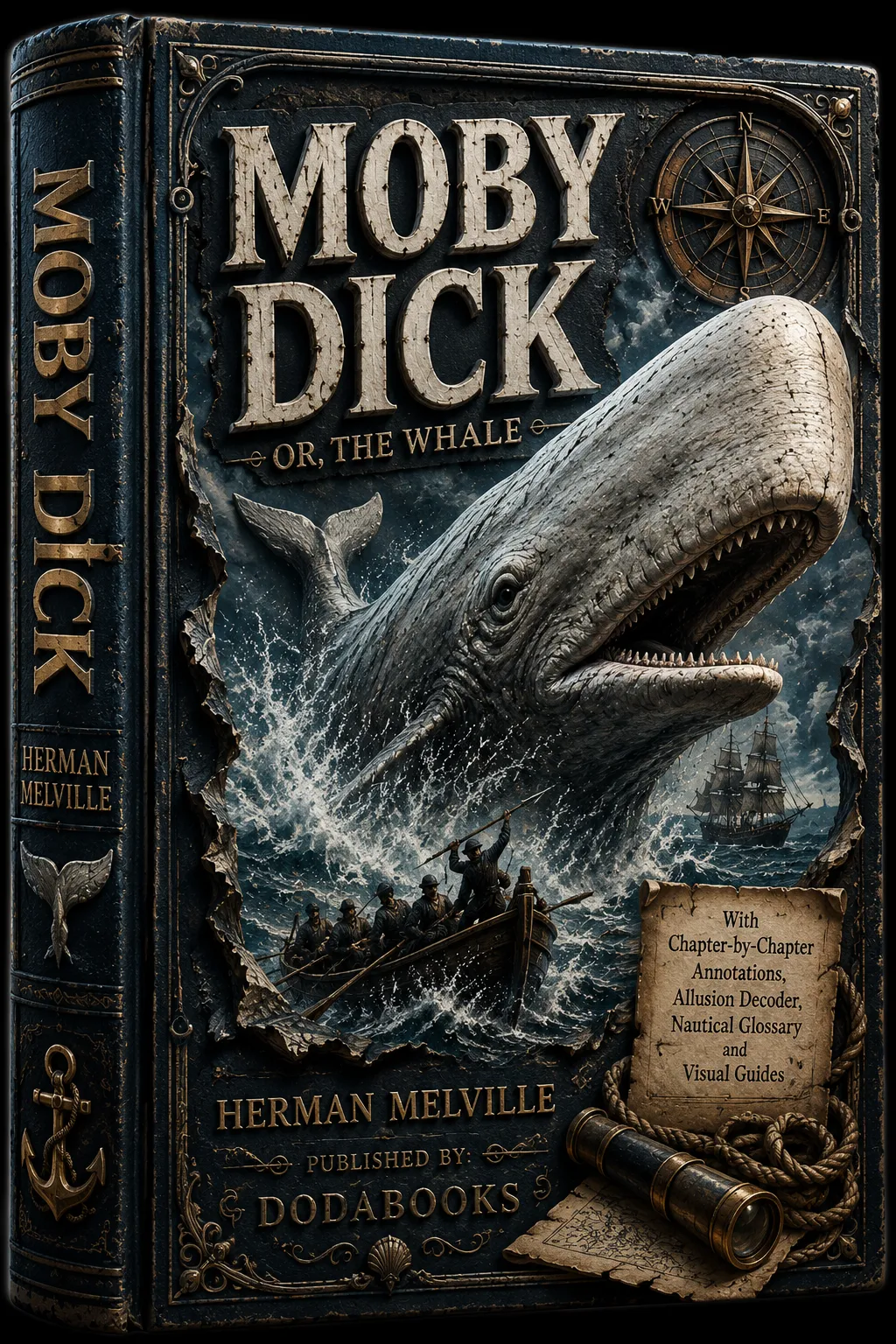
The DodaBooks annotated edition includes insightful chapter-by-chapter summaries and commentary to keep your reading momentum strong.
🎯 Stop Struggling. Start Understanding.
The annotated edition of Moby-Dick gives you everything you need to finally get Melville’s masterpiece:
- ✅ Complete, unabridged text — every word of the original 1851 edition
- ✅ Hundreds of explanatory footnotes — no more Googling every other page
- ✅ Historical context — the Essex disaster, Nantucket whaling, Melville’s life
- ✅ Literary analysis — chapter-by-chapter commentary on themes and symbols
- ✅ Victorian vocabulary — obsolete words and nautical terms defined inline
- ✅ Biblical & literary references — every allusion traced to its source