A 30-day reading schedule for Moby-Dick. Read 4-5 chapters per day and finish the complete novel in one month.
🐋
Moby-Dick Reading Schedule: How to Finish in 30 Days
A 30-day reading schedule for Moby-Dick. Read 4-5 chapters per day and finish the complete novel in one month.
The 30-Day Plan
Moby-Dick has 135 chapters — 4-5 per day, about 20-30 minutes of reading. That may sound like a lot, but consider this: most novels of comparable length are read in a week or two. What makes Moby-Dick different is its density. Melville embeds encyclopedic information about whaling, philosophy, and natural history alongside his narrative, which means you cannot rush through it the way you might rush through a thriller. You need time to absorb, to reflect, to let the language settle into your mind. A 30-day schedule gives you that time without letting the story slip away between readings.
The key to making this schedule work is consistency. Four to five chapters per day is manageable, but only if you do it every day. Miss a day, and you fall behind. Miss two days, and the novel starts to feel like a chore. The goal is to build a habit, a daily ritual of reading that becomes as automatic as brushing your teeth. Set aside the same time each day — morning, afternoon, or evening — and protect that time fiercely. The novel rewards regular engagement.
Week 1: Chapters 1-30
📖 Want the complete annotated experience?
👉 Get the Annotated EditionDays 1-7: Ishmael arrives in New Bedford, meets Queequeg, signs onto the Pequod, and Ahab appears on deck. The first week covers the novel’s expository section, where Melville establishes his narrator, his setting, and his central conflict. The opening chapters are among the most famous in literature — “Call me Ishmael” is a line every reader recognizes — and they reward careful attention.
Pay special attention to the chapters set in New Bedford and Nantucket, where Ishmael describes the whaling industry, the Spouter Inn, and his first encounter with Queequeg. These chapters establish the novel’s blend of humor, social observation, and philosophical reflection. The friendship between Ishmael and Queequeg is one of the novel’s most charming threads, and it develops quickly — within a few chapters, they are sharing a bed and declaring themselves bonded for life.
By the end of Week 1, the Pequod has set sail and Ahab has revealed his obsession. The crew has signed on for a three-year whaling voyage, but Ahab has secretly altered the course. The trap is sprung. You should feel the novel’s momentum building, the sense that something terrible is coming.
Week 2: Chapters 31-60
Days 8-14: Ahab’s speech, the doubloon, “The Whiteness of the Whale,” and early ship encounters. The second week takes you into the novel’s middle section, where Melville deepens the narrative and begins his philosophical digressions. Chapter 36, “The Quarter-Deck,” contains Ahab’s famous speech rallying the crew to hunt Moby Dick — one of the most dramatic scenes in the novel.
The doubloon chapter (Chapter 99) is worth special attention: Ahab nails an Ecuadorian gold coin to the mast as a reward for the man who first spots the white whale, and every crew member who looks at it sees something different. It is a brilliant meditation on perspective, meaning, and the subjectivity of interpretation.
“The Whiteness of the Whale” (Chapter 42) is one of the novel’s most famous chapters, where Ishmael meditates on why white inspires dread. It is dense, philosophical, and essential to understanding the novel’s themes. Don’t rush through it — let Melville’s argument unfold slowly.
Week 3: Chapters 61-100
Days 15-21: The cetology chapters (skip what you must), gams with other ships, Fedallah’s prophecies, and the approach to the whale. The third week is the novel’s most challenging section, containing the cetology chapters where Melville provides encyclopedic information about sperm whales. These chapters are famous for testing readers’ patience, but they are also fascinating if you approach them with curiosity rather than dread.
The cetology chapters serve multiple purposes: they establish Melville’s authority as a writer about the sea, they provide the factual foundation for the novel’s symbolism, and they slow the narrative pace to build tension. If you find them overwhelming, feel free to skim — but don’t skip them entirely. The information about whale anatomy, behavior, and classification enriches the reading experience in ways that become clear during the novel’s climax.
The gams with other ships — the Jeroboam, the Rachel, the Delight — are among the novel’s most poignant episodes. Each encounter reveals something about the Pequod’s isolation and the cost of Ahab’s obsession. The Rachel is searching for its lost crew, including the captain’s son. The Delight has just buried a man killed by a whale. These meetings foreshadow the Pequod’s own fate.
Week 4: Chapters 101-135
Days 22-28: Ahab smashes the quadrant, the typhoon, the three-day chase, and the sinking of the Pequod. The final week is the novel’s catastrophic climax, and it moves with extraordinary speed. Ahab’s destruction of the quadrant — the navigational instrument that tells him his position — is a symbolic act of defiance against the limitations of knowledge. He will navigate by passion alone.
The typhoon chapters are among the most dramatic at sea ever written, with lightning splitting the mast and the crew believing the ship is cursed. The three-day chase that follows is relentless, exhausting, and ultimately devastating. Ahab finally confronts Moby Dick, and the whale systematically destroys the Pequod and its crew.
Day 29-30: Catch up and reflect. Use these final days to finish any remaining chapters and to sit with the novel’s ending. The sinking of the Pequod is one of the most powerful scenes in literature, and Ishmael’s survival on Queequeg’s coffin is both miraculous and deeply symbolic.
Tips
- Set a specific time each day — consistency matters more than speed. Whether you read at dawn or before bed, make it a ritual.
- Track progress with a bookmark — physical progress markers help you see how far you’ve come and keep momentum.
- Don’t be afraid to skim dense chapters — the cetology sections are important, but they don’t require word-by-word reading on first pass.
- Use an annotated edition for help — Melville’s language is rich but sometimes archaic. Notes and commentary can clarify obscure references.
- Discuss what you read — whether with a book club or in your own journal, articulating your reactions deepens understanding.
- Revisit favorite chapters — some sections reward rereading even before you finish the novel.
Why 30 Days?
A month gives you time to absorb the novel without losing momentum. You will finish with a sense of accomplishment — and a new appreciation for one of the greatest works of American literature. The 30-day timeframe also mirrors the novel’s own structure: the Pequod’s voyage takes three years, but the most important events happen in the final weeks. Your reading experience will follow a similar pattern — a slow build in the first half, an accelerating intensity in the second half, and a climax that feels both inevitable and shocking.
Completing Moby-Dick is a genuine literary achievement. Few novels demand as much from their readers, and fewer still reward that demand as fully. By the time you reach the final chapter, you will understand why this novel has captivated readers for over 170 years — and why it continues to grow in stature with each generation.
🌊 The Story at a Glance
Before you set out on your 30 days, it helps to know the shape of the whole voyage. Moby-Dick follows Ishmael, a young sailor who signs onto the whaling ship Pequod out of Nantucket. Its captain, Ahab, lost a leg to the great white sperm whale Moby Dick on an earlier voyage, and he has secretly bent the entire three-year cruise toward a single purpose: revenge. Ahab’s obsession deepens and his crew is corrupted, building toward a three-day chase that ends in catastrophe.
If you want the full shape of every chapter before you begin, our complete plot overview lays out the narrative arc, while our character guide introduces the crew you will be sailing with for a month. Knowing who is who makes even the slower chapters feel purposeful.
🏛️ Historical Context: The Real Whaling World
Melville was not inventing the world of Moby-Dick from imagination. He spent years at sea on whaling and naval voyages, and the novel is dense with the real details of the nineteenth-century whale fishery: the ships, the try-works, the whaleboats, and the brutal work of the hunt. When he describes the profession, he writes as a man who has done it, which is why it carries such authority.
The novel was also shaped by a real disaster. In 1820, the whaling ship Essex was rammed and sunk by an enormous sperm whale in the Pacific, and the surviving crew drifted for months in small boats. Melville read the survivors’ account, and it gave him the seed of his catastrophic ending. Our account of the real Essex story and the history of 19th-century whaling show how much of the novel is rooted in fact — grounding that makes the fiction feel more immediate.
❓ Frequently Asked Questions
Is 30 days really enough time to read Moby-Dick?
Yes. The schedule works out to roughly 4-5 chapters and 20-30 minutes of reading per day. It is an ambitious but realistic pace for a novel of this density, and consistency matters more than speed.
What if I fall behind on the schedule?
Do not panic. Skim the most encyclopedic chapters — especially the cetology sections in Week 3 — and use the final two days of the plan to catch up. The goal is to finish, not to be perfect.
Do I have to read the cetology chapters?
Not all of them, word for word. They reward careful reading, but on a first pass you can skim the dense whale-anatomy lists and pause on the passages that connect the facts to the novel’s symbolism. Skipping a few of them will not stop you finishing in 30 days.
Should I use an annotated edition for this challenge?
It helps enormously. Melville’s 1851 language is rich but sometimes archaic, and footnotes that clarify nautical terms, biblical references, and historical context let you keep reading instead of stopping to look things up. An annotated edition keeps your pace on schedule.
What should I read after finishing Moby-Dick?
If the ending left you wanting more, our guide to what to read next offers excellent follow-ups before you decide.
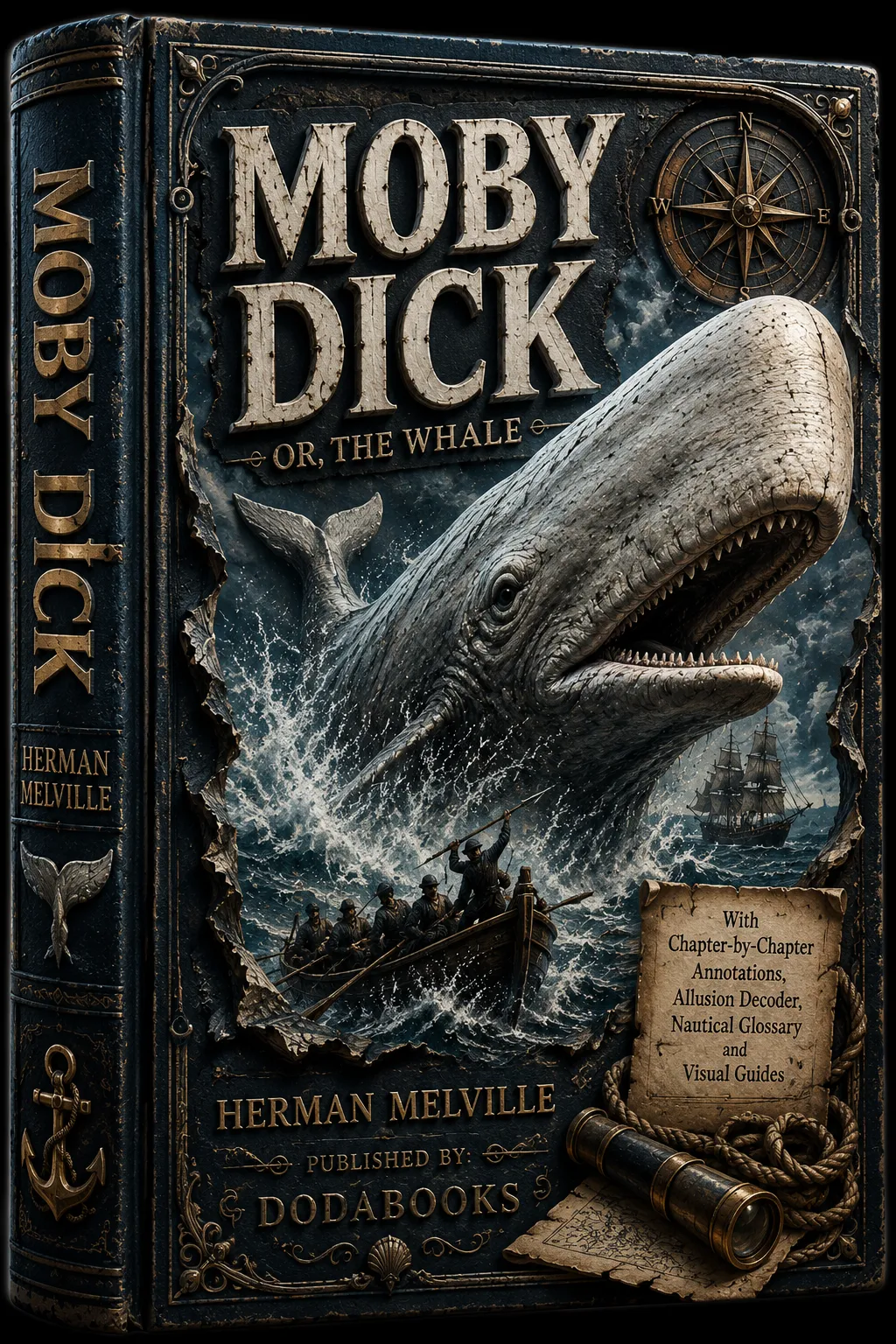
Discover the depth of Melville’s masterpiece with our annotated edition of Moby-Dick. Complete text with explanatory notes, historical context, and literary analysis.
📚 Related Articles
🎯 Stop Struggling. Start Understanding.
The annotated edition of Moby-Dick gives you everything you need to finally get Melville’s masterpiece:
- ✅ Complete, unabridged text — every word of the original 1851 edition
- ✅ Hundreds of explanatory footnotes — no more Googling every other page
- ✅ Historical context — the Essex disaster, Nantucket whaling, Melville’s life
- ✅ Literary analysis — chapter-by-chapter commentary on themes and symbols
- ✅ Victorian vocabulary — obsolete words and nautical terms defined inline
- ✅ Biblical & literary references — every allusion traced to its source