Why did Moby-Dick fail when published in 1851? And how did it become the Great American Novel? The remarkable story from failure to canonization.
🐋
Moby-Dick Published: Why It Bombed and Later Became a Classic
Why did Moby-Dick fail when published in 1851? And how did it become the Great American Novel? The remarkable story from...
The Publication
The publication of Moby-Dick in 1851 was a complex, transatlantic affair that foreshadowed the difficulties to come. The novel was first published in London in October 1851 by Richard Bentley under the title The Whale, in a three-volume format typical of Victorian publishing. The American edition followed in November from Harper & Brothers, this time under Melville’s preferred title, Moby-Dick; or, The Whale. The British edition contained significant differences from the American text — Bentley’s editors had made unauthorized cuts and alterations, most critically omitting the Epilogue, the passage explaining how Ishmael survived the sinking of the Pequod. This meant that early British readers encountered a narrative apparently told by a dead man, a problem that baffled reviewers and undermined the novel’s credibility from the start. The American edition restored the Epilogue and other passages, but the damage was done — British reviews, published first, shaped the initial reception and colored American reviewers’ expectations. The publication history reveals the precariousness of authorial control in the nineteenth-century publishing industry and the extent to which a novel’s fate could be determined by editorial decisions made without the author’s knowledge or consent.
Contemporary Reception
📖 Want the complete annotated experience?
👉 Get the Annotated EditionThe contemporary reception of Moby-Dick was largely bewildered, often hostile, and occasionally accidentally prescient. British reviewers — who encountered the novel first, as The Whale — were confounded by its structure. The London Athenaeum called it “an ill-compounded mixture of romance and matter-of-fact,” objecting that the cetology chapters disrupted the narrative flow and that the philosophical digressions seemed incongruous with the adventure story. American reviewers were even harsher. The New York United States Magazine and Democratic Review declared it “sad stuff, dull and dreary, or ridiculous,” while other American critics complained about the novel’s blasphemy, its structural irregularity, and Melville’s apparent descent from the accessible adventure-writing of Typee and Omoo into something incomprehensible and pretentious. A few reviewers recognized something extraordinary in the book — the New York Literary World, edited by Melville’s friend Evert Duyckinck, praised its “wild, weird power” while simultaneously objecting to its irreverent treatment of religious subjects — but these positive notices were overwhelmed by the negative consensus. The novel baffled nearly everyone, including Melville’s own readership, who had come to expect straightforward sea adventures and found instead a metaphysical tragedy disguised as a whaling manual.
Why It Failed
The novel’s failure can be attributed to several interconnected factors that combined to alienate its original audience. Genre confusion was the most immediate problem: readers who had loved Typee and Omoo — accessible, exotic adventure narratives based on Melville’s own voyages — expected another straightforward sea story and found instead a philosophical tragedy that questioned the nature of God, the limits of knowledge, and the meaning of existence. Length and digressions compounded the problem; the cetology chapters, which Melville intended as both scientific encyclopedia and metaphysical inquiry, baffled readers who wanted more plot and less taxonomy. Complexity was another barrier — Melville’s prose style in Moby-Dick had become theatrical in its density, its rhetorical flourishes, its willingness to sustain elaborate metaphors across entire paragraphs. This was not the accessible, first-person narration of Typee; it was something altogether more ambitious and more difficult. Finally, uncomfortable themes drove away readers who found Ahab’s blasphemy unsettling and the novel’s philosophical pessimism incompatible with the optimistic, providential worldview that dominated mid-nineteenth-century American culture. Melville had written a novel ahead of its time, and the time had not yet arrived. The novel’s failure was not a single event but a slow unraveling — each disappointing review made the next one more likely, each confused reader told a friend not to bother, and the word-of-mouth that might have sustained the book turned instead into word-of-avoidance.
The Rediscovery
The resurrection of Moby-Dick from obscurity to canonical status is one of the most remarkable stories in literary history. For decades after Melville’s death in 1891, the novel languished in near-total neglect — out of print, unread, unmentioned in histories of American literature. Then, in the 1920s, a generation of critics and scholars rediscovered Melville and began championing his work with evangelical fervor. D.H. Lawrence, in his Studies in Classic American Literature (1923), called Moby-Dick “one of the strangest and most wonderful books in the world,” praising its “broody, somber, indubitably American” quality. Carl Van Doren’s The American Novel (1921) included a chapter on Melville that helped spark renewed interest. But the most influential act of canonization came with F.O. Matthiessen’s American Renaissance (1941), which placed Moby-Dick at the center of the American literary canon alongside works by Hawthorne, Emerson, Thoreau, and Whitman. Matthiessen’s book argued that these authors constituted a distinctly American literary tradition of unprecedented artistic achievement, and Moby-Dick emerged as the crown jewel of that tradition. The rediscovery was driven by modernist sensibilities — readers in the aftermath of World War I, familiar with fragmentation, ambiguity, and existential doubt, were finally ready for a novel that had been baffling Victorian audiences for seventy years.
Why It Endures
The very qualities that alienated Melville’s original audience have become the reasons for the novel’s extraordinary endurance. Difficulty is now an asset, not a liability — in an age when readers have been trained by modernist and postmodernist fiction to expect fragmentation, ambiguity, and multiple narrative voices, Moby-Dick’s structural complexity feels not alienating but inviting. The novel rewards rereading like few other books in any language; each encounter reveals new layers, new connections, new meanings. It contains multiple books within a single volume: a gripping adventure story of the sea, an encyclopedic manual of nineteenth-century whaling, a philosophical dialogue about the nature of existence, a literary tragedy of hubris and destruction, a comedy of manners among the officers and crew, a series of prose poems about the beauty and terror of the ocean. No single reading exhausts it; no single interpretation contains it. Moby-Dick is the kind of book that grows as you grow, that means different things at different stages of your life, that continues to generate new meanings long after you think you have understood it. This inexhaustibility — this resistance to final interpretation — is what separates a great book from a merely good one, and it is why Moby-Dick will continue to be read, argued about, and loved for centuries to come. The novel’s endurance is also a testament to the power of the academic tradition that rescued it — university courses, scholarly editions, and critical studies have created generation after generation of readers prepared to engage with its complexity, ensuring that the novel’s audience grows rather than shrinks with time.
The Lesson
The story of Moby-Dick’s publication and rediscovery carries a lesson that every writer, every artist, every creator should engrave on their heart: literary greatness is not always recognized in its own time. Herman Melville died on September 28, 1891, in New York City, thinking his masterpiece was a failure. His obituary in the New York Times did not even mention Moby-Dick; it described him as the author of Typee and Omoo, the sea adventure writer who had never recaptured his early success. He was fifty-eight years old, broke, forgotten, and convinced that his best work had been wasted on an indifferent public. He could not have imagined that within thirty years of his death, critics would be calling Moby-Dick the Great American Novel, that scholars would devote entire careers to interpreting its pages, that it would be translated into dozens of languages and taught in universities around the world. The distance between failure and immortality, Melville’s story suggests, is not a measure of artistic quality but of cultural readiness — the audience simply was not yet prepared for what he had created. Moby-Dick was not ahead of its time; it was ahead of its readers. The novel’s journey from obscurity to canonical status is a reminder that the relationship between art and audience is not fixed but fluid, that great works can lie dormant for decades before finding the readers who are ready to receive them, and that the measure of a book’s worth is not its immediate reception but its capacity to endure and to grow. Every generation that encounters Moby-Dick discovers something new in it, and that inexhaustibility is the truest measure of literary greatness — not popularity, not sales, not critical acclaim, but the ability to speak to readers across centuries with undiminished power.
Discover the depth of Melville’s masterpiece with our annotated edition of Moby-Dick. Complete text with explanatory notes, historical context, and literary analysis.
📚 Related Articles
Frequently Asked Questions
Why was Moby-Dick a commercial failure upon its release in 1851?
Contemporary Victorian audiences expected a straightforward South Seas adventure like Typee; Melville's metaphysical digressions and dark cynicism alienated readers and critics.
How many copies of Moby-Dick were sold during Melville's lifetime?
Fewer than 4,000 copies sold worldwide before Melville died in obscurity in 1891, having earned very little royalty income from the masterpiece.
When and why did Moby-Dick become recognized as a masterpiece?
During the 'Melville Revival' in the 1920s, modernist scholars recognized Melville's avant-garde narrative technique, psychological complexity, and existential depth.
What role did the fire at Harper & Brothers play in Melville's career?
An 1853 fire destroyed unsold copies of Moby-Dick and other Melville works, virtually wiping out his public presence for decades.
How does the DodaBooks edition celebrate Melville's literary legacy?
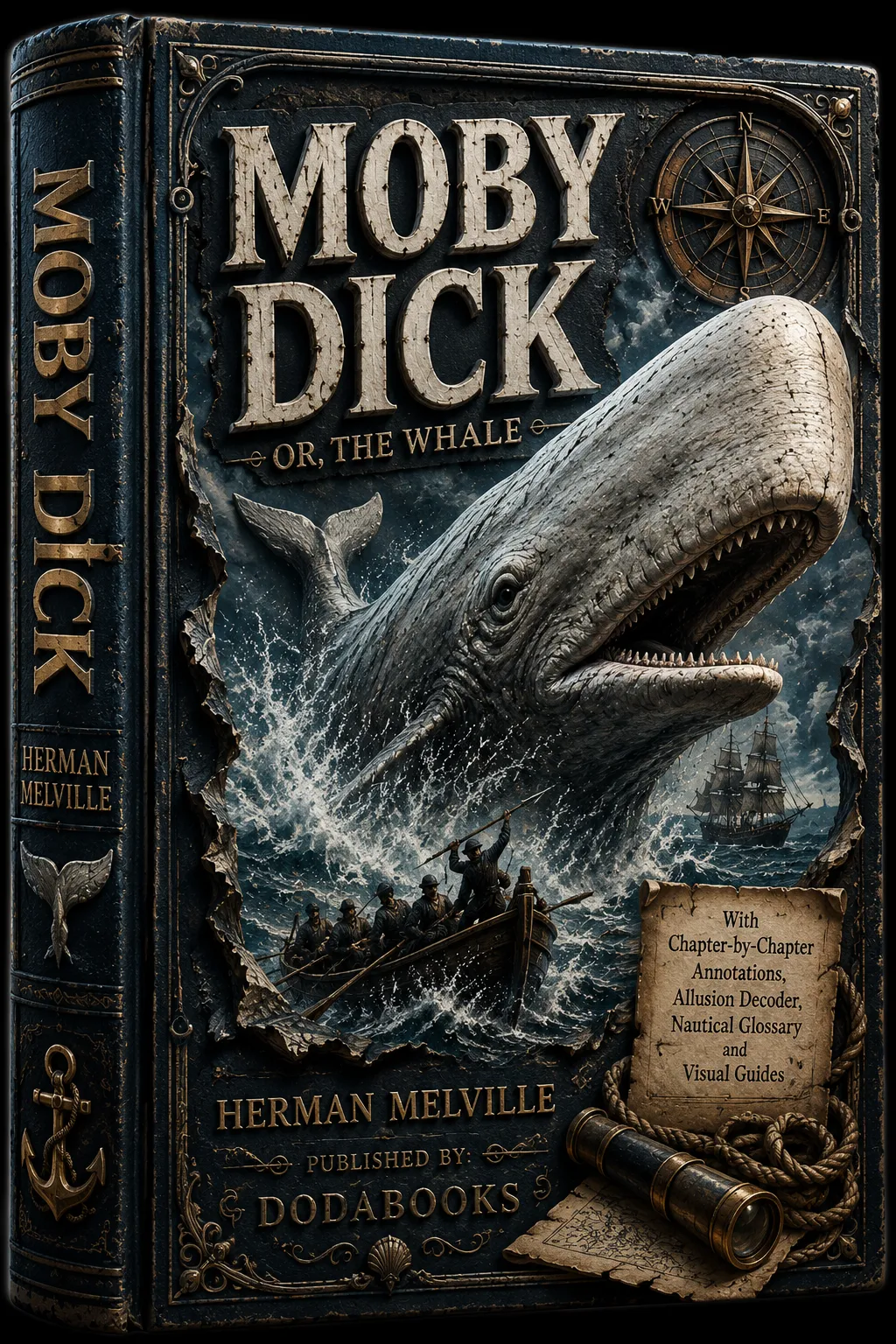
The DodaBooks annotated edition presents Melville's masterpiece with the scholarly reverence, historical context, and reading aids it deserves.
🎯 Stop Struggling. Start Understanding.
The annotated edition of Moby-Dick gives you everything you need to finally get Melville’s masterpiece:
- ✅ Complete, unabridged text — every word of the original 1851 edition
- ✅ Hundreds of explanatory footnotes — no more Googling every other page
- ✅ Historical context — the Essex disaster, Nantucket whaling, Melville’s life
- ✅ Literary analysis — chapter-by-chapter commentary on themes and symbols
- ✅ Victorian vocabulary — obsolete words and nautical terms defined inline
- ✅ Biblical & literary references — every allusion traced to its source