Need to understand Moby-Dick fast? The shortest possible summary — characters, plot, themes in under 5 minutes.
🐋
Moby-Dick in 5 Minutes: The Shortest Possible Summary
Need to understand Moby-Dick fast? The shortest possible summary — characters, plot, themes in under 5 minutes.
One Sentence
A young man joins a whaling ship whose one-legged captain is obsessively hunting the white whale that maimed him — a quest that ends in destruction for everyone except the narrator.
That single sentence captures the plot, but it can’t capture the experience. Moby-Dick is a novel that operates on multiple levels simultaneously: it’s a gripping sea adventure, a philosophical meditation on the nature of evil, a detailed encyclopedia of 19th-century whaling, and a literary tragedy played out on the Pacific Ocean. Melville wrote it as his masterpiece, and though it was ignored for decades after publication, it has since been recognized as one of the greatest achievements in American literature.
Characters
📖 Want the complete annotated experience?
👉 Get the Annotated EditionIshmael — the narrator, thoughtful and observant, who tells the story years after the events. He’s the only survivor, and his voice shifts between intimate reflection and philosophical speculation. His famous opening line, “Call me Ishmael,” establishes from the first words that this is a story told by someone who has survived something extraordinary and is still trying to understand it.
Captain Ahab — a one-legged captain who lost his leg to the white whale and now pursues it with monomaniacal fury. Ahab is one of literature’s great tragic figures — a man of enormous force and intelligence who destroys himself and everyone around him. He speaks in dramatic soliloquies and treats the whale as the embodiment of all evil in the universe.
Queequeg — a tattooed harpooneer from the South Pacific who becomes Ishmael’s closest companion. Their relationship is one of the novel’s most touching elements — two men from completely different cultures who form an unbreakable bond. Queequeg’s calm, steady presence provides a counterbalance to Ahab’s escalating madness.
Starbuck — the first mate of the Pequod, a Quaker from Nantucket who serves as the voice of reason and moral conscience. He repeatedly tries to turn the ship away from Ahab’s quest, knowing it will end in disaster. His inability to stop Ahab is one of the novel’s most heartbreaking elements — he sees the destruction coming but lacks the will to prevent it.
The White Whale — a sperm whale of enormous size and legendary ferocity. Whether the whale is a symbol of God, nature, evil, or meaninglessness depends on which chapter you’re reading. Melville refuses to settle the question, and the whale’s inscrutability is the point.
Plot
Ishmael meets Queequeg, signs onto the Pequod — In New Bedford, Massachusetts, Ishmael shares a room at an inn with Queequeg, a Polynesian harpooneer. Despite their cultural differences, they become fast friends and decide to ship together on the whaling vessel Pequod, captained by a man named Peleg.
Ahab reveals his true mission: revenge on the whale — The mysterious Captain Ahab has been keeping to his cabin. When he finally appears on deck, he nails a gold doubloon to the mast and declares that the ship’s mission is to hunt the white whale that took his leg. The crew is bound by the ship’s articles and cannot leave.
The Pequod sails around the world, encountering other ships — Over many months, the Pequod crosses the Pacific, meeting other whaling vessels. Each ship has its own story about the white whale — some fear it, some have survived encounters with it, and some warn Ahab to turn back. He ignores them all.
The whale is sighted; three days of chasing — When Moby Dick finally appears, Ahab lowers three boats and pursues the whale for three consecutive days. The whale fights back, destroying boats and wounding crew members. Ahab’s obsession reaches its peak.
The whale sinks the Pequod; everyone dies except Ishmael — On the third day, Moby Dick rams the Pequod and sinks it. Ahab, tangled in his harpoon line, is dragged under by the whale. The ship goes down with all hands except Ishmael, who survives by floating on Queequeg’s coffin.
Themes
Moby-Dick weaves four major themes throughout its 135 chapters, and understanding them transforms the novel from an adventure story into something far more profound.
Obsession and monomania — Ahab’s hunt for the whale is the novel’s central obsession, but Melville shows how obsession distorts everything around it. Ahab sacrifices his crew, his first mate’s better judgment, and ultimately his own life for a quest that may be fundamentally meaningless. The word “monomania” was a medical term in Melville’s time, referring to a fixation on a single idea that coexists with apparent rationality in other areas. Ahab can plan, strategize, and command — but everything serves the whale. His obsession is not madness in the clinical sense; it’s something worse: a perfectly rational mind in the service of an irrational goal.
Revenge and justice — Is Ahab justified in seeking revenge against the whale? The novel presents compelling arguments on both sides, never resolving the question. The whale may be an innocent creature, or it may be a deliberate agent of destruction. Melville leaves the moral calculus deliberately unclear, forcing readers to confront their own assumptions about justice, proportion, and the limits of vengeance.
Fate vs. free will — The Pequod’s crew includes characters from many different religions and philosophies, each with their own understanding of destiny. Ahab believes he can defy fate; Starbuck believes in submission to God’s will; Ishmael observes both positions without committing to either. The novel suggests that the question may be unanswerable — that whether fate exists or not, we act as if we have choices, and those choices have consequences.
Man vs. nature — The ocean in Moby-Dick is not a backdrop — it’s a character. Melville describes its beauty, its terror, its indifference to human ambition. The whale represents the ultimate challenge to humanity’s belief that it can dominate the natural world. In an era of climate crisis, this theme resonates with uncomfortable force: Ahab’s insistence on mastering nature, regardless of the cost, feels disturbingly modern.
Famous Lines
“Call me Ishmael.”
The most famous opening in American literature. Three words that establish a narrator, a tone, and a sense of mystery. Why “Call me”? Is Ishmael his real name? The uncertainty sets the stage for a novel that questions everything.
“From hell’s heart I stab at thee.”
Ahab’s final cry as he hurls his harpoon at the whale. It’s a line that captures his rage, his defiance, and his acceptance of death all at once. Gregory Peck’s delivery of this line in the 1956 film made it one of cinema’s most quoted moments.
Why It Matters
Moby-Dick was a commercial failure when it was published in 1851. Melville had been a popular author with his earlier adventure novels — Typee and Omoo sold well and made him famous — but Moby-Dick’s philosophical depth and structural complexity bewildered readers expecting another seafaring romp. The British edition, titled The Whale, was published first and received mixed reviews; the American edition followed and sold even worse. The book went out of print, and Melville spent the last three decades of his life in obscurity, working as a customs inspector in New York while writing novels that almost no one read.
The literary rediscovery began in the 1920s, when scholars and critics recognized in Moby-Dick something that 19th-century readers had missed: a novel that anticipated modernism by decades. Its stream-of-consciousness passages, its unreliable narrator, its encyclopedic ambition, and its refusal to offer easy moral answers all felt startlingly modern. The centennial of Melville’s birth in 1919 sparked renewed interest, and by the 1940s and 1950s, Moby-Dick was firmly established as a candidate for the Great American Novel. Since then, it has been continuously in print and is now taught in virtually every American literature course.
It has never been out of print since its rediscovery, and it continues to inspire new adaptations, new criticism, and new readings. The novel’s refusal to be fully explained — its resistance to any single interpretation — is precisely why it endures. Each generation finds something new in it: the Romantics saw a nature myth, the New Critics saw symbolic density, the Freudians saw a study in obsession, and contemporary readers see climate allegory, colonial critique, and existential meditation. The novel grows with its readers, which is why it remains, nearly two centuries after publication, the book against which all other American novels are measured.
Discover the depth of Melville’s masterpiece with our annotated edition of Moby-Dick. Complete text with explanatory notes, historical context, and literary analysis.
📚 Related Articles
Frequently Asked Questions
What is the basic plot of Moby-Dick in brief?
Ishmael signs onto the whaling ship Pequod, led by Captain Ahab, who hijacks the voyage to hunt down the white whale that severed his leg, culminating in disaster.
Why does the Pequod sink at the end?
Moby Dick retaliates against the harpooners by violently ramming the ship's bow, sinking the vessel and drowning everyone except Ishmael.
Can you summarize the main themes of Moby-Dick?
The central themes are human obsession, the limits of knowledge, the power of nature, fate versus free will, and democracy versus tyranny.
Is Moby-Dick worth reading if I already know the summary?
Yes! Melville's genius lies not in plot twists, but in poetic prose, philosophical digressions, unforgettable humor, and psychological depth.
What is the easiest way to read the full book without getting bogged down?
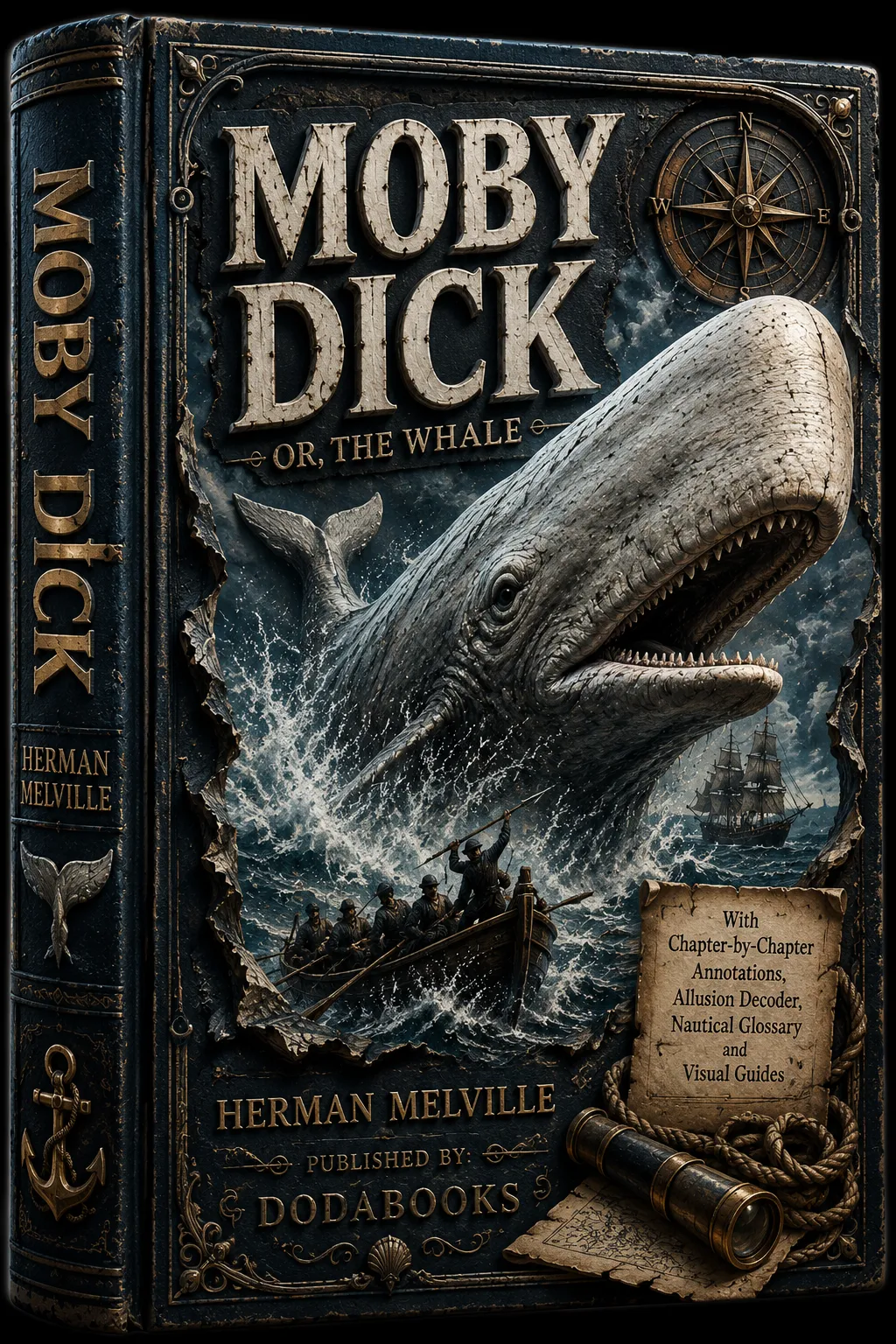
Using the DodaBooks annotated edition gives you immediate on-page clarity for 19th-century terms, whaling taxonomy, and complex metaphors.
🎯 Stop Struggling. Start Understanding.
The annotated edition of Moby-Dick gives you everything you need to finally get Melville’s masterpiece:
- ✅ Complete, unabridged text — every word of the original 1851 edition
- ✅ Hundreds of explanatory footnotes — no more Googling every other page
- ✅ Historical context — the Essex disaster, Nantucket whaling, Melville’s life
- ✅ Literary analysis — chapter-by-chapter commentary on themes and symbols
- ✅ Victorian vocabulary — obsolete words and nautical terms defined inline
- ✅ Biblical & literary references — every allusion traced to its source