Compare Moby-Dick and Heart of Darkness — two novels about obsession, darkness, and journeys into the unknown.
🐋
Moby-Dick and Heart of Darkness: Obsession in Literature Compared
Compare Moby-Dick and Heart of Darkness — two novels about obsession, darkness, and journeys into the unknown.
Two Journeys into Darkness
Moby-Dick (1851) and Heart of Darkness (1899) share a deep structure: both send a narrator toward a figure consumed by monomania. At first glance, these novels could not seem more different — one is a sprawling American epic about whaling, the other a compressed British novella about colonial Africa. Yet beneath the surface, they ask the same terrifying question: what happens when a man refuses to accept the limits of human knowledge and power? Both novels answer that question with catastrophe. The comparison reveals something essential about the Western literary tradition’s fascination with obsession, darkness, and the price of transcendence.
What makes this pairing so rich is the way each novel reflects the anxieties of its era. Melville wrote in the age of American expansion, when the young republic believed it could conquer nature itself. Conrad wrote at the height of European imperialism, when the civilizing mission was revealing its moral rot. Both authors saw through the optimism of their times, and both chose the ocean — that vast, indifferent expanse — as the stage for their reckoning.
The Quest
📖 Want the complete annotated experience?
👉 Get the Annotated EditionIshmael sails toward Ahab, a captain obsessively hunting a whale. Marlow sails up the Congo toward Kurtz, a trader who has set himself up as a god. Both journeys are descents into darkness — literal and metaphorical. The Pequod moves across the Pacific, deeper into isolation, while Marlow’s steamboat creeps upriver into a landscape that grows more oppressive with every mile.
In both novels, the journey itself transforms the narrator. Ishmael begins as a casual adventurer seeking escape from boredom on land. By the novel’s end, he has witnessed the destruction of an entire crew and the death of a man he admired. Marlow begins as a professional sailor with a pragmatic worldview. By the time he reaches Kurtz’s station, he has seen what humanity becomes when all restraint is stripped away. The quests are not just physical voyages — they are psychological pilgrimages into the darkest corners of human ambition.
The geography matters too. Melville’s ocean is horizontal, boundless, indifferent. Conrad’s river is vertical, narrowing, suffocating. Both landscapes mirror the obsessive minds of the men being pursued. Ahab’s white whale exists on the open sea, impossible to contain. Kurtz exists in the interior, hidden behind layers of jungle and darkness. The narrator must cross these hostile spaces to reach them, and the crossing changes everything.
The Obsessed Man
Ahab’s obsession is metaphysical — revenge on the forces of the universe. He believes Moby Dick is not merely a whale but an embodiment of all the evil and injustice in the world. “All visible objects, man, are but as pasteboard masks,” he tells Starbuck. “But in the event of each event, in every act that happens in the world, that which is inscrutable, it smites me.” Ahab wants to strike through the mask to the malignancy behind it.
Kurtz’s obsession is power — he abandoned all moral restraint. He went to Africa as an emissary of civilization, a painter, a musician, a man of extraordinary talent. What he found was that the jungle stripped away every pretense. “The wilderness had taken him, loved him,” Marlow observes. Kurtz became a god to the local people, demanding worship and sacrifice. His famous report for the International Society for the Suppression of Savage Customs begins eloquently and ends with scrawled marginalia: “Exterminate all the brutes!”
The difference between these two obsessions is telling. Ahab fights against something external — the universe, the whale, the forces that took his leg. Kurtz surrenders to something internal — his own capacity for evil. Ahab is a rebel. Kurtz is a conqueror. Yet both men share a fundamental refusal to accept human limitation. They both believe they can transcend the boundaries that govern ordinary lives, and they both pay the ultimate price for that belief.
The Narrator
Both Ishmael and Marlow survive to tell the story. Both are changed by what they witness. But their survival means different things in each novel. Ishmael survives because Queequeg’s coffin — built as a burial vessel, sealed watertight — becomes a life raft. He floats alone on the ocean for days, rescued at last by the Rachel, another whaling ship searching for its lost crew. His survival is accidental, almost miraculous. He did nothing to earn it.
Marlow survives because he is a professional. He completes his mission, brings Kurtz’s report back to the Company, and lives to tell the tale. But the telling nearly destroys him. When he visits Kurtz’s Intended back in Europe, he lies to her about her beloved’s final words, unable to face her with the truth. Marlow’s survival is haunted — he carries the weight of what he saw in the darkness.
The narrators also differ in their relationship to the obsessed man. Ishmael admires Ahab, even as he recognizes the madness. He describes the captain with a mixture of awe and horror that makes Ahab one of literature’s most compelling figures. Marlow is drawn to Kurtz but ultimately repulsed. “He had no restraint, no restraint — just Kurtz,” Marlow says, and the repetition suggests both fascination and disgust.
The Last Words
Kurtz: “The horror! The horror!” Ahab: “From hell’s heart I stab at thee.” Both die in the grip of obsession. But Ahab dies fighting, tangled in his own harpoon line as the whale drags him into the deep. Kurtz dies broken, wasting away on his cot, murmuring final words that have puzzled readers for over a century.
What do these last words mean? For Kurtz, “The horror” seems to encompass everything — the evil he has witnessed, the evil he has committed, the recognition that the darkness was inside him all along. It is a moment of terrible clarity. For Ahab, the final words are a curse — defiant to the last, he attacks the whale even as death claims him. There is no moment of recognition, no surrender. Ahab dies as he lived: in rage.
The contrast is significant. Kurtz’s last words suggest that obsession can lead to self-knowledge, however devastating. Ahab’s last words suggest that some men never learn, never stop fighting, even when the fight is meaningless. Both endings are tragic, but they offer different kinds of tragedy — one of recognition, one of defiance.
The Legacy
Both were initially misunderstood. Moby-Dick failed commercially and was out of print by the time of Melville’s death in 1891. It was rediscovered in the 1920s during the “Melville Revival,” when scholars recognized it as perhaps the greatest American novel ever written. Heart of Darkness became a classic after Eliot used Kurtz’s quote in The Waste Land (1922), embedding it in the consciousness of modernist literature.
Both works have also attracted controversy. Chinua Achebe’s famous 1975 lecture “An Image of Africa” accused Conrad of racism, arguing that Heart of Darkness dehumanizes Africans by rendering them as background scenery rather than characters. This critique sparked decades of debate about how to read colonial texts. Moby-Dick has faced fewer accusations of prejudice, though some critics have examined its treatment of race, class, and labor aboard the Pequod.
The cultural impact of both novels is immense. Moby-Dick gave us the archetype of the obsessive captain — from Star Trek’s Ahab-obsessed Khan to countless film villains. Heart of Darkness gave us the template for stories about journeys into moral darkness — from Apocalypse Now to countless war narratives. Together, they form a kind of double helix of Western literature’s obsession with obsession itself.
What They Teach
The human capacity for obsession is also the capacity for greatness. Ahab and Kurtz are warnings, but also, in some dark sense, inspirations. They show us what happens when a man refuses to accept the ordinary — when he demands meaning from a universe that may have none to give. The tragedy is not that they fail. The tragedy is that their failure is magnificent.
Both novels ultimately suggest that the greatest danger is not the monster outside but the darkness within. The whale may or may not be a symbol of evil. Kurtz may or may not have been corrupted by Africa. What matters is that both men chose to confront the abyss — and the abyss, as Nietzsche warned, looked back. For readers today, these two novels remain essential reading because they force us to ask: what are we willing to sacrifice for our obsessions? And is the answer ever worth the cost?
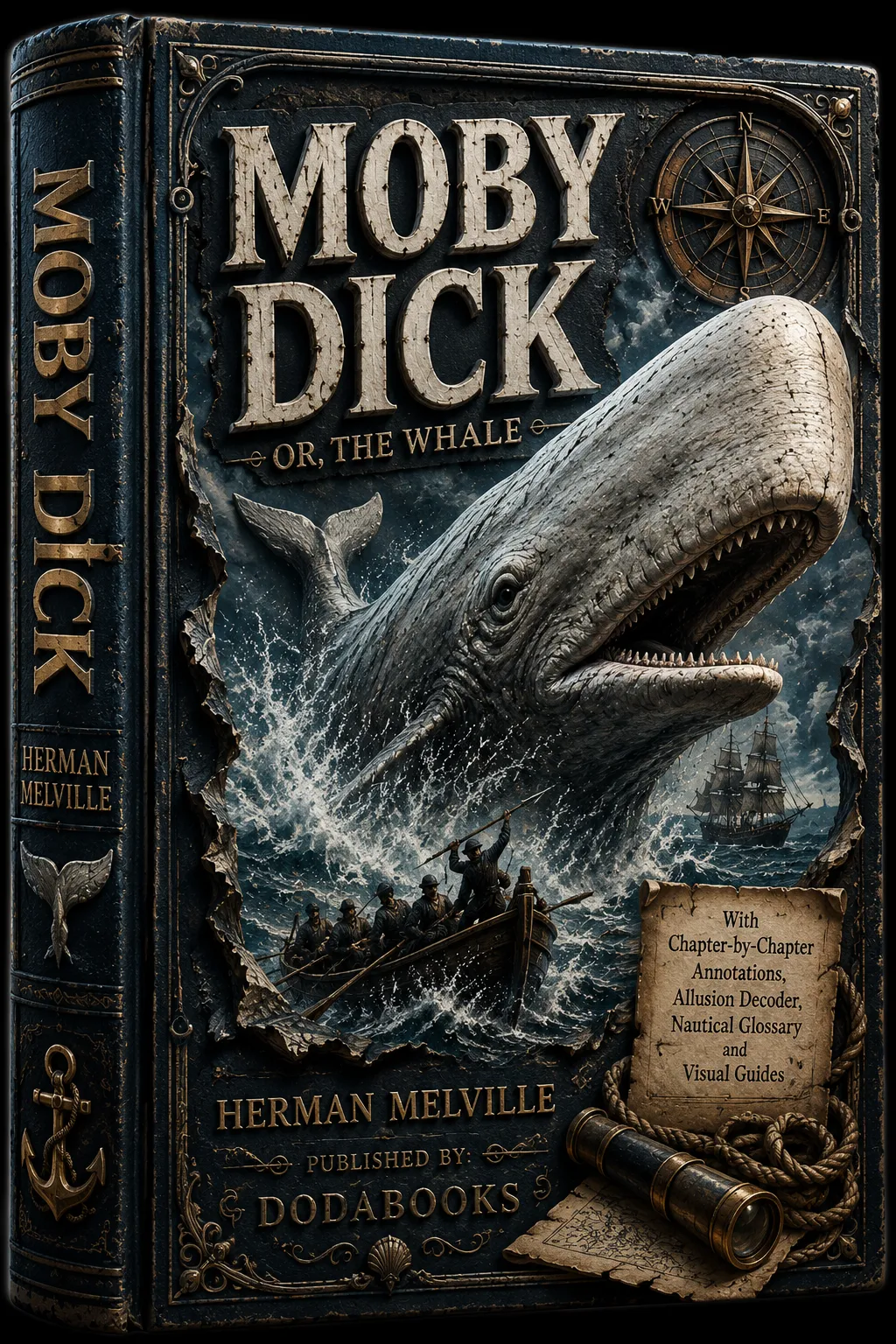
Discover the depth of Melville’s masterpiece with our annotated edition of Moby-Dick. Complete text with explanatory notes, historical context, and literary analysis.
📚 Related Articles
Frequently Asked Questions
How do Captain Ahab and Kurtz compare?
Both are brilliant, charismatic men whose obsessive pursuits lead them to abandon civilized morality, descending into madness and devastation.
How do the maritime journeys in both books compare?
Melville's ocean voyage and Conrad's river journey into the Congo both function as symbolic descents into the subconscious and primal human darkness.
What are the key philosophical differences between Melville and Conrad?
Melville is metaphysical and cosmic in his inquiry, while Conrad focuses more cynically on imperialist corruption, psychological breakdown, and existential void.
Which book should I read first: Moby-Dick or Heart of Darkness?
Heart of Darkness is much shorter (a novella), making it a quick gateway to themes of obsession, while Moby-Dick provides an expansive epic experience.
Where can I get high-quality editions of both maritime classics?
DodaBooks offers beautifully typeset, annotated digital editions of both classic works with exhaustive historical and literary notes.
🎯 Stop Struggling. Start Understanding.
The annotated edition of Moby-Dick gives you everything you need to finally get Melville’s masterpiece:
- ✅ Complete, unabridged text — every word of the original 1851 edition
- ✅ Hundreds of explanatory footnotes — no more Googling every other page
- ✅ Historical context — the Essex disaster, Nantucket whaling, Melville’s life
- ✅ Literary analysis — chapter-by-chapter commentary on themes and symbols
- ✅ Victorian vocabulary — obsolete words and nautical terms defined inline
- ✅ Biblical & literary references — every allusion traced to its source