What genre is Moby-Dick? Melville’s masterpiece defies classification. Is it a novel, an epic poem, an encyclopedia, or something new?
🐋
Moby-Dick Genre: Is It a Novel, Epic, or Encyclopedia?
What genre is Moby-Dick? Melville's masterpiece defies classification. Is it a novel, an epic poem, an encyclopedia, or ...
The Genre Problem
What is Moby-Dick? The Library of Congress calls it fiction. Bookstores shelve it under classics. Neither captures what it actually is. Ask a hundred readers to describe the genre of Moby-Dick, and you will get a hundred different answers. Some call it an adventure novel. Others call it a philosophical treatise. Still others insist it is an encyclopedia of whaling disguised as a story. The truth is that Moby-Dick resists classification — and that resistance is one of its most radical qualities.
This genre problem has confused readers since the novel’s publication in 1851. Early critics were baffled by its structure: why does a novel about a whale hunt include chapters on the anatomy of cetaceans, the history of whaling, and the philosophical meaning of white? Modern readers are equally perplexed by its shifts in tone, from comedy to tragedy, from natural history to metaphysical meditation. The novel seems to contain everything Melville knew and thought, poured into a single, enormous vessel. The result is something that no existing genre can adequately describe.
It Is a Novel
📖 Want the complete annotated experience?
👉 Get the Annotated EditionIt has characters, plot, setting, and narrator. It tells a story. In the most basic sense, Moby-Dick is a novel — a sustained work of prose fiction that follows a group of characters through a series of events. The narrative has a beginning (Ishmael’s decision to go to sea), a middle (the voyage of the Pequod), and an end (the destruction of the ship and crew).
But the cetology chapters and play-script sections sit uneasily in the novel tradition. Chapter 32, “Cetology,” is a systematic classification of whales that reads like a natural history textbook. Chapters 60 through 67 are written in dramatic form, complete with stage directions, as if Melville were composing a play rather than a novel. These sections violate the conventions of novelistic storytelling — they break the narrative flow, disrupt the illusion of reality, and remind the reader that they are reading a constructed text.
This violation is deliberate. Melville was not incapable of writing conventional fiction — his earlier novels, Typee and Omoo, follow traditional narrative structures. He chose to break those structures because he believed the story he wanted to tell could not be contained within them. The novel, as a genre, was too limited for his purposes. He needed something larger, more inclusive, more capacious — a form that could hold both narrative and exposition, story and essay, fiction and fact.
It Is an Epic
Like Homer’s Odyssey, it is a long narrative about a heroic journey. Ahab is an epic hero — larger than life, driven by a quest that transcends personal interest. The voyage of the Pequod mirrors the epic journey of Odysseus, with its encounters with strange creatures, its visits to distant lands, and its climactic confrontation with a supernatural force.
But the hero is not clearly heroic. Ahab is not a figure of virtue — he is a man consumed by obsession, willing to sacrifice his crew for his personal vendetta. The quest is not noble — it is selfish, destructive, and ultimately meaningless. There is no homecoming at the end of Moby-Dick, no reunion with family, no restoration of order. The epic ends in catastrophe.
This subversion of the epic tradition is one of Melville’s most significant achievements. He takes the oldest story in Western literature — the hero’s journey — and reveals its darkest implications. What happens when the hero is wrong? What happens when the quest is evil? What happens when the journey leads not to glory but to destruction? Moby-Dick asks these questions and refuses to provide easy answers.
It Is an Encyclopedia
The cetology chapters are an encyclopedia of whaling — anatomy, behavior, history. Melville provides detailed descriptions of the whale’s body, its habits, its reproductive cycle, its place in the natural order. He describes the process of whaling from start to finish: the hunt, the capture, the rendering of blubber, the storage of oil. He traces the history of whaling from ancient times to the nineteenth century.
This encyclopedic impulse makes Moby-Dick a predecessor of novels like Joyce’s Ulysses, Pynchon’s Gravity’s Rainbow, and Wallace’s Infinite Jest — works that attempt to contain the totality of human knowledge within a single narrative. Melville was not the first writer to include factual information in a novel, but he was perhaps the first to make the inclusion of facts into a philosophical statement. The cetology chapters are not digressions — they are arguments about the limits of human knowledge. By including everything he knew about whales, Melville was asking: can a novel contain the world? The answer, he suggests, is no — but the attempt is what gives literature its power.
It Is a Tragedy
The arc of classical tragedy: noble hero, fatal flaw, catastrophic fall. Ahab’s pride (hubris) leads to destruction. In the strictest sense, Moby-Dick follows the pattern of Athenian tragedy, with Ahab as the tragic hero whose greatness is inseparable from his flaw. His refusal to accept limitation, his determination to challenge the forces of the universe, leads inevitably to his destruction — and the destruction of everyone around him.
But Melville complicates the tragic model in important ways. Classical tragedy typically involves a fall from grace — a noble figure brought low by a single, catastrophic mistake. Ahab’s fall is not a mistake — it is a choice, sustained over years, pursued with full knowledge of its consequences. He knows he is doomed. He knows the whale will destroy him. He hunts it anyway. This transforms the tragedy from a story of error into a story of defiance — a distinction that makes Moby-Dick more disturbing and more modern than any classical tragedy.
The novel also complicates the audience’s response. In classical tragedy, we feel pity and fear for the hero. In Moby-Dick, we feel admiration and horror — admiration for Ahab’s magnificence, horror at his madness. This double response is what makes Ahab one of literature’s most compelling figures: he is both hero and villain, both admirable and terrifying, both human and superhuman.
The Answer
Moby-Dick is all of these and none. It is a hybrid — a genre of one. Melville invented a form that could contain everything he wanted to say, and that form defies classification. The genre problem is not a flaw but a feature. It is precisely because Moby-Dick cannot be categorized that it remains fresh, challenging, and inexhaustible.
Every generation finds something new in the novel. In the 1920s, readers discovered its psychological depth. In the 1940s, critics recognized its philosophical complexity. In the 1960s, readers found political relevance in its treatment of labor and power. Today, readers see ecological concerns in its depiction of the whaling industry and existential questions in its treatment of obsession and meaning. The novel’s resistance to genre classification is what allows it to speak to every age — because it is not bound by the conventions of any single genre, it can speak to all of them simultaneously.
The genre of Moby-Dick is Moby-Dick. That is its deepest truth and its greatest achievement. Melville did not write within a tradition — he created one. And that tradition remains as vital and as unsettling as it was when the novel first appeared in 1851.
🧭 Why Melville Broke the Rules
Melville’s restless ambition explains the novel’s strange form. Before Moby-Dick he wrote conventional adventure narratives — Typee and Omoo — that sold well and made him famous. Then, meeting his friend Nathaniel Hawthorne, he decided to write something far more ambitious: a book that could hold everything he knew about the sea, God, evil, and the human soul.
The result did not fit the market. Moby-Dick sold poorly in Melville’s lifetime and was largely forgotten until the 1920s, when critics rediscovered it. Its hybrid form — part novel, part epic, part encyclopedia — was precisely why it failed commercially and precisely why it endured. If you want an overview of that sprawling story first, our complete plot summary walks through every major event in order.
📚 Reading the Hybrid Without Getting Lost
Because Moby-Dick keeps switching between narrative and science, it helps to understand what each kind of chapter is doing. The plot chapters drive the story of Ahab and the Pequod forward. The cetology and essay chapters pull the camera back, giving you the broader world of whaling and Melville’s philosophical musings. You do not need to master every encyclopedia entry — you can skim the most technical material and focus on the story, or linger over it if you want the full experience.
The key is to read with permission to move at your own pace. Many new readers feel they must understand everything on the first pass. You don’t. Moby-Dick rewards returning readers, and struggling is part of the point. For practical pacing advice, our beginner’s guide to reading Moby-Dick offers a chapter-by-chapter approach.
❓ Frequently Asked Questions
Is Moby-Dick hard to read?
It can be, especially the encyclopedia-like chapters on whaling and the shifts in tone and voice. Many readers find it challenging on a first pass. The good news is that the narrative chapters are exciting and readable, and you can skim the technical ones.
Why does Moby-Dick have encyclopedia chapters?
Melville deliberately included factual material on whales and whaling to create a philosophical argument about the limits of human knowledge. The cetology chapters are not filler — they are part of the novel’s point.
Is Moby-Dick an adventure story?
Partially, but that is only one layer. The whaling voyage, the hunt, and the final chase give it adventure energy. Beneath that sits an epic quest, a philosophical meditation, and an encyclopedia — which is exactly why the genre question has so many answers.
Do I need to know about whaling before reading it?
No. Melville teaches you everything as you go, and the novel includes its own explanations of the whaling industry. When a term or process confuses you, the annotated edition defines it inline.
Where should I start if Moby-Dick seems intimidating?
Start with the story chapters and the early scenes with Ishmael and Queequeg, which are warm and funny. Give yourself permission to skim the encyclopedic sections. A good reading plan and the right edition make a huge difference.
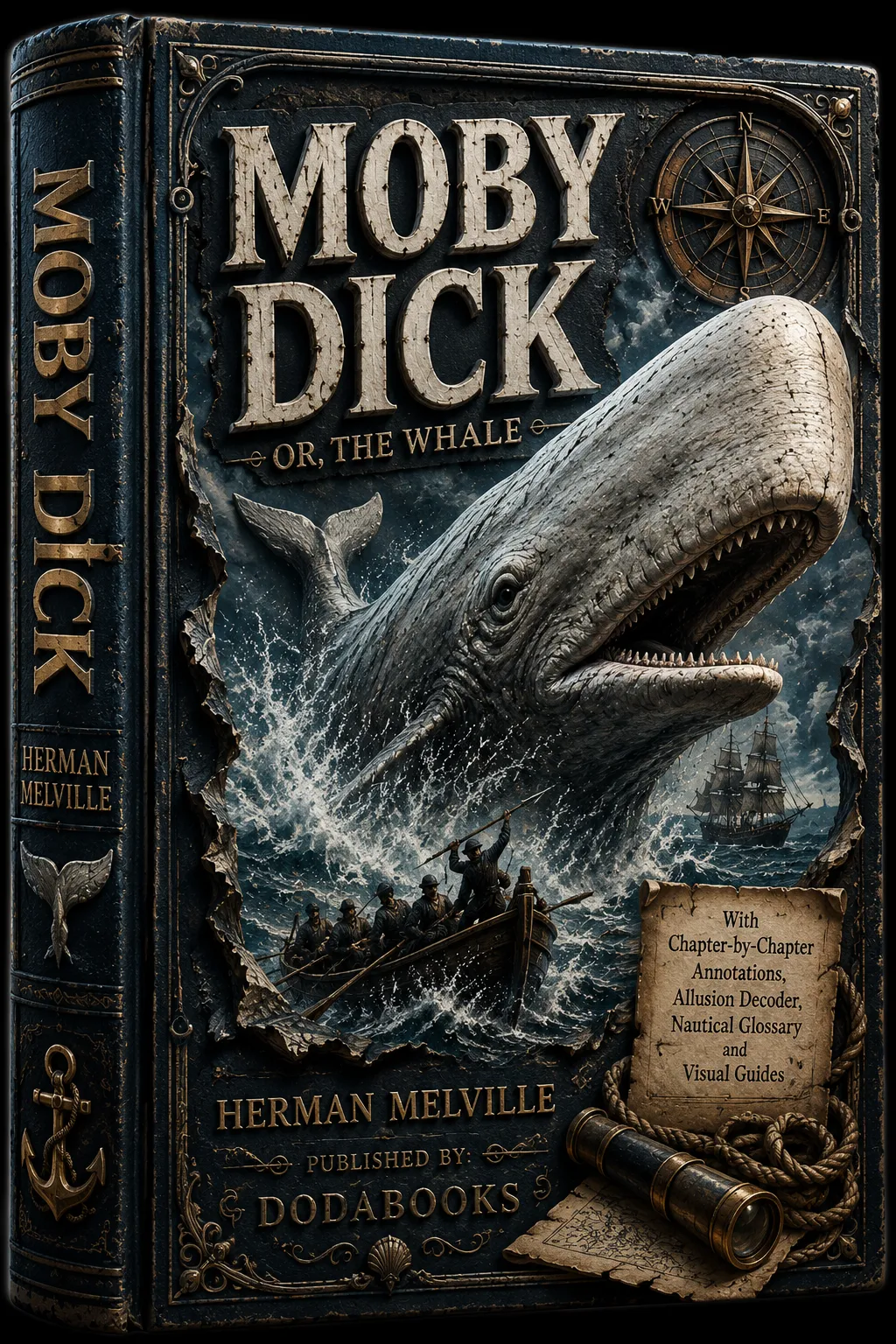
Discover the depth of Melville’s masterpiece with our annotated edition of Moby-Dick. Complete text with explanatory notes, historical context, and literary analysis.
📚 Related Articles
🎯 Stop Struggling. Start Understanding.
The annotated edition of Moby-Dick gives you everything you need to finally get Melville’s masterpiece:
- ✅ Complete, unabridged text — every word of the original 1851 edition
- ✅ Hundreds of explanatory footnotes — no more Googling every other page
- ✅ Historical context — the Essex disaster, Nantucket whaling, Melville’s life
- ✅ Literary analysis — chapter-by-chapter commentary on themes and symbols
- ✅ Victorian vocabulary — obsolete words and nautical terms defined inline
- ✅ Biblical & literary references — every allusion traced to its source