Everything you need to know before reading Moby-Dick for the first time. A spoiler-free introduction for beginners.
🐋
Moby-Dick for Beginners: What You Need to Know Before Reading
Everything you need to know before reading Moby-Dick for the first time. A spoiler-free introduction for beginners.
What Is Moby-Dick About?
Captain Ahab, a whaling captain who lost his leg to a white whale, sets out from Nantucket on a secret mission: find and kill the whale. Narrated by Ishmael, a young man who survives to tell the tale.
But it is also about whaling, obsession, the limits of knowledge, and humanity’s place in nature. At its core, Moby-Dick is a story about the human need to impose meaning on a universe that offers none. Ahab sees the white whale as the embodiment of all evil — a malignant force that must be destroyed. Ishmael, by contrast, keeps his mind open, willing to learn from the sea rather than conquer it. The tension between these two perspectives drives the novel forward and gives it its extraordinary philosophical depth.
The book is also, quite simply, a fascinating portrait of the whaling industry in the 1840s. Melville spent nearly four years on whaling ships, and he drew on that experience to create a documentary-level account of how whales were hunted, processed, and turned into the oil that lit lamps and lubricated machines across America. The cetology chapters — Ishmael’s attempts to classify whales — are not digressions; they are the novel’s way of saying that knowledge itself is an adventure.
Do I Need to Know Whaling?
No. Melville explains everything. The cetology chapters teach you more about sperm whales than you ever expected.
In fact, one of the joys of reading Moby-Dick is discovering how much you never knew about the most industrialized hunt in nineteenth-century America. Melville explains the entire process: how ships were outfitted, how crews were recruited, how whales were spotted from the masthead, how boats were lowered, how the animal was killed with lance and harpoon, and how the blubber was rendered into oil in massive try-pots on deck. He describes the social hierarchy of a whaling ship, the system of shares that determined how much each crew member earned, and the strange democracy of men from thirty different nations working side by side.
The cetology chapters — often cited as the reason readers abandon the book — are actually among its most innovative passages. In “Cetology,” Ishmael attempts to classify whales as if he were a naturalist, dividing them into “Folios” and “Chapters.” The exercise is deliberately absurd: the whale resists categorization, just as it resists every other human attempt at mastery. Melville uses these chapters to suggest that the world is larger than any system we impose on it — a radical idea that anticipates twentieth-century philosophy by nearly a hundred years.
Is It Really That Hard?
The difficulty is real but manageable. The language is 19th-century English. An annotated edition solves most problems. The bigger challenge is the shifting structure — but that is part of what makes it great.
Melville’s prose is more complex than modern bestsellers, but it is not impenetrable. His sentences tend to be long and rhythmic, often building to dramatic crescendos. The trick is to read them aloud — Melville wrote for the ear as much as the eye. Many passages have the cadence of sermons, speeches, or sea shanties. Once you find the rhythm, the language becomes a pleasure rather than a barrier.
The real challenge for most readers is the novel’s willingness to change genres without warning. One chapter might be a thrilling chase scene; the next might be a meditation on the color white; the next might be a technical description of whale anatomy. Melville is doing this on purpose — he wants you to experience the same disorientation that Ishmael feels on the Pequod. The structure mirrors the content: just as the sea cannot be predictable, neither can the story. Embrace the shifts, and you will find that the book rewards your patience with insights that stay with you for a lifetime.
How Long Does It Take?
Approximately 200,000 words. At 30 minutes per day, about a month.
That estimate might sound daunting, but consider this: a typical modern novel runs about 80,000 to 100,000 words. Moby-Dick is roughly two to three novels’ worth of material — and every page counts. The cetology chapters that many readers skip contain some of Melville’s most inventive writing. The philosophical digressions that seem tangential often contain the book’s deepest insights. There are no filler chapters in Moby-Dick.
If you are worried about maintaining momentum, try reading in thirty-minute daily sessions. This keeps the story fresh in your mind without overwhelming you. Many readers find that the novel builds its own momentum — once you pass Chapter 30 (Ahab’s quarter-deck speech), the pacing accelerates dramatically. The second half of the book reads faster than the first, as the Pequod closes in on the white whale and the consequences of Ahab’s obsession become impossible to ignore.
Should I Read Anything First?
A basic understanding of the Book of Job and King Lear will help. A brief biography of Melville enriches the experience.
The Book of Job provides the novel’s philosophical backbone. Job is a righteous man who suffers terribly, demanding to know why God allows injustice. Ahab makes the same demand — but instead of accepting mystery, he declares war on it. Reading Job first gives you a framework for understanding Ahab’s defiance and the novel’s ultimate answer: some questions cannot be answered, only endured.
Classic tragedy offers parallels: King Lear is a king who loses everything — power, family, sanity — and must confront his own mortality. Ahab undergoes a similar stripping away: his leg, his reason, his crew, his life. Both works ask whether human dignity survives total loss. Both answer with ambiguity.
As for Melville himself: he lived a life marked by success followed by obscurity. Typee and Omoo made him famous; Moby-Dick and Pierre made him forgotten. Understanding this trajectory adds poignancy to the novel’s themes of ambition, failure, and the gap between vision and reality. Melville poured his deepest doubts into Ahab’s character — doubts about God, about purpose, about whether the search for meaning is itself meaningful.
Is It Worth It?
Yes. Moby-Dick is not just a book to be read; it is a book to be experienced. It is called the Great American Novel for a reason.
The novel’s reputation rests on its extraordinary range. It is simultaneously a sea adventure, a philosophical treatise, a comedy, a tragedy, a work of natural history, and a meditation on the nature of art itself. No other novel attempts so much — and so few succeed so completely. When you finish Moby-Dick, you will have lived through an entire world: the deck of a whaling ship, the depth of the Pacific, the interior of a whale’s skull, the architecture of human obsession.
But the real reason to read Moby-Dick is that it will change how you think about reading itself. Modern novels often promise efficiency — every sentence moves the plot forward, every chapter serves a purpose. Melville rejects that model. He insists that literature should do what the sea does: immerse you completely, without apology or abbreviation. Reading Moby-Dick teaches you to slow down, to pay attention, to let a book be its own world rather than a vehicle for a message. That is a gift worth the effort.
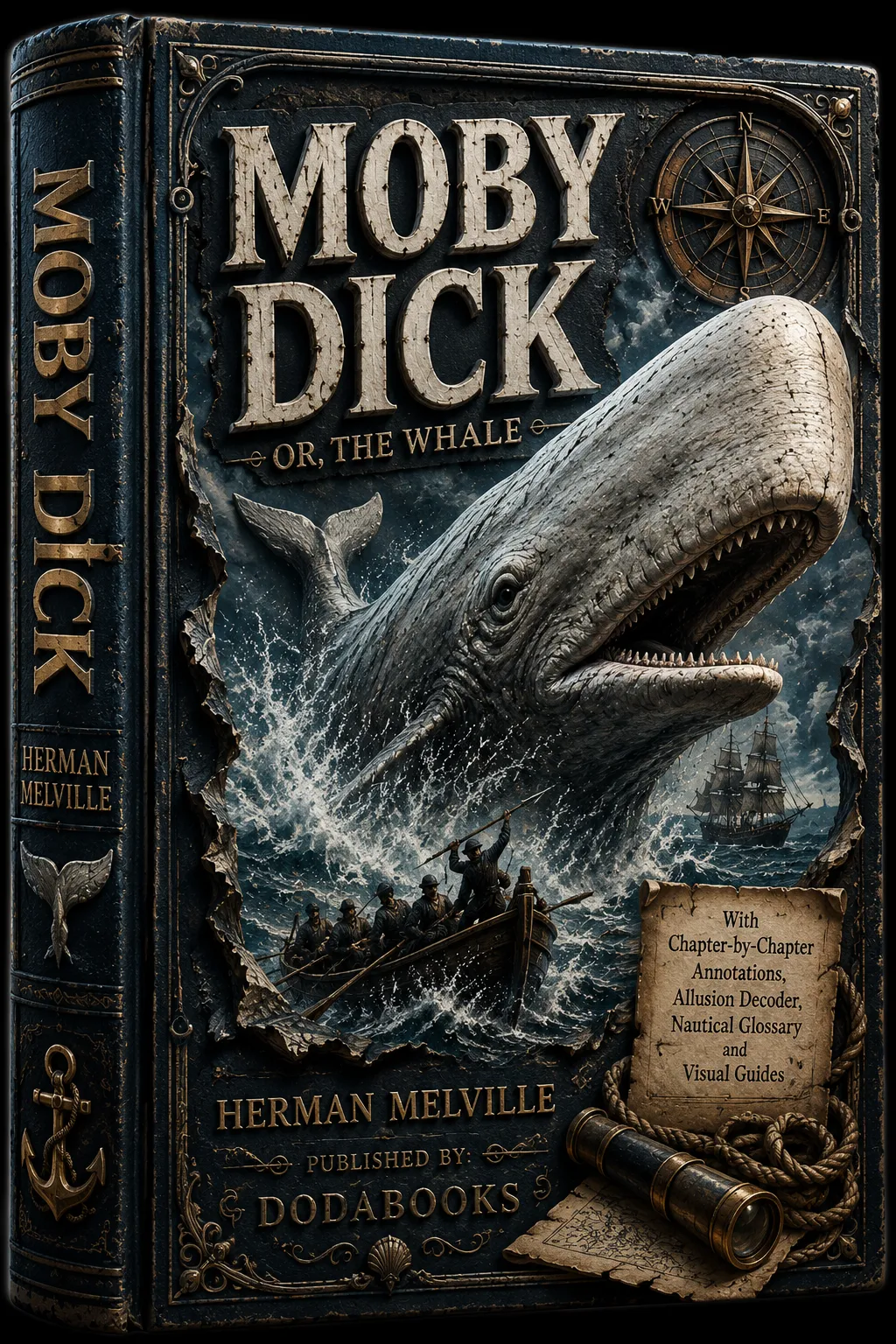
Discover the depth of Melville’s masterpiece with our annotated edition of Moby-Dick. Complete text with explanatory notes, historical context, and literary analysis.
🧭 The Story, Without Spoilers
Here is the shape of the story so you can approach it with confidence. Ishmael, the narrator, is a young man who goes to sea to escape life on land. In the whaling port of New Bedford he befriends Queequeg, a tattooed Pacific-island harpooner, and together they sign onto the Pequod. The crew has no idea their captain, Ahab, has been secretly planning a different voyage.
Ahab lost his leg to a great white whale and wants revenge, nailing a gold coin to the mast as a reward for the first man to spot it. From there the novel becomes an episodic journey across the world’s oceans, mixing thrilling hunts with philosophical reflection, building toward a three-day final chase. It is a deceptively simple adventure wrapped in some of the densest prose ever written. Our complete plot summary fills in every chapter if you want the full map first.
📜 The History Behind the Novel
Moby-Dick was published in 1851, when whaling was the engine of the American economy, and Melville knew the industry from the inside — he had spent years at sea. He was partly inspired by the real 1820 disaster of the whaleship Essex, which was rammed and sunk by an angry sperm whale. Knowing this makes the novel feel less like fantasy than a portrait of a real, dangerous world. For the full account, see our guide to the real story of the whaleship Essex.
🎓 How to Read It for the Joy, Not the Homework
The best advice for a first-time reader is to stop worrying about understanding everything. Melville throws enormous amounts of information at you — whale anatomy, rope-making, shipboard hierarchy — and it is fine to let much wash over you on a first read; the plot is simple, the texture is what overwhelms. Skim the cetology chapters and let the big set pieces carry you along.
Read slowly enough to appreciate the famous passages, but not so slowly that you lose momentum — the book clicks into place around Chapter 30, when the chase formally begins. If vintage vocabulary becomes a barrier, our vocabulary guide to Moby-Dick and beginner’s guide to reading Moby-Dick both help before you begin.
❓ Frequently Asked Questions
Is Moby-Dick a hard book to read?
It has a reputation for being difficult, but the difficulty is mostly language and density, not a confusing plot. The story is simple; Melville’s encyclopedic digressions are what slow readers down. With an annotated edition and a light touch on the denser chapters, most readers manage fine.
How long is Moby-Dick?
The novel runs to about 200,000 words across 135 chapters plus an epilogue. Read at a relaxed pace of thirty minutes a day, you can finish it in roughly a month.
Do I need to know anything about whaling before reading?
No. Melville explains the whaling industry in extraordinary detail within the book itself. You will finish knowing more about sperm whales than you ever expected.
Is there a movie I could watch instead?
There are several adaptations, most famously the 1956 version starring Gregory Peck, plus a 2010 BBC miniseries. They capture the drama of the final chase but not the novel’s philosophical depth. Treat the movie as a companion, not a replacement.
Should I read the annotated edition as a beginner?
It is the best choice for most first-time readers, because the notes remove the frustration of constantly looking things up. The original text is preserved in full, with context and definitions available exactly when you need them.
📚 Related Articles
🎯 Stop Struggling. Start Understanding.
The annotated edition of Moby-Dick gives you everything you need to finally get Melville’s masterpiece:
- ✅ Complete, unabridged text — every word of the original 1851 edition
- ✅ Hundreds of explanatory footnotes — no more Googling every other page
- ✅ Historical context — the Essex disaster, Nantucket whaling, Melville’s life
- ✅ Literary analysis — chapter-by-chapter commentary on themes and symbols
- ✅ Victorian vocabulary — obsolete words and nautical terms defined inline
- ✅ Biblical & literary references — every allusion traced to its source