Detailed summary of Moby-Dick chapters 1 through 50, from Ishmael’s arrival in New Bedford to the Pequod rounding the Cape of Good Hope.
🐋
Moby-Dick Chapters 1-50: Complete Summary of the First Half
Detailed summary of Moby-Dick chapters 1 through 50, from Ishmael's arrival in New Bedford to the Pequod rounding the Ca...
Chapters 1-15: Setting Sail
Moby-Dick opens with Ishmael arriving in New Bedford, Massachusetts, seeking a whaling ship. He shares a bed at the Spouter-Inn with the tattooed harpooneer Queequeg — an awkward first meeting that leads to a deep friendship. They sign onto the Pequod, captained by the mysterious Ahab.
The opening chapters establish the novel’s dual nature: part travelogue, part philosophical meditation. Ishmael’s arrival in New Bedford introduces readers to the whaling industry’s economic heart — a city built on whale oil, where every street and shop reflects the trade that fuels American prosperity. Melville lingers on details: the darkness of the Spouter-Inn’s interior, the “cannibal” serving food, the strange paintings on the walls. These details create a world that is simultaneously familiar and alien, grounding the reader in nineteenth-century reality while hinting at the strangeness to come.
Ishmael’s decision to share a bed with Queequeg — a man he initially fears as a “cannibal” — becomes the novel’s first lesson in cross-cultural connection. Queequeg is not the savage Ishmael expected. He is dignified, generous, and deeply spiritual. Their friendship, born from forced proximity, becomes one of the book’s most enduring relationships. Melville uses their bond to suggest that human connection transcends race, culture, and appearance — a radical idea in the 1850s.
The journey to Nantucket aboard the Katy introduces another key theme: the sea as equalizer. On land, Ishmael and Queequeg would never share a room. At sea, they become brothers. This transformation mirrors the broader social leveling that whaling voyages produced, where men of different nationalities worked side by side under the same flag.
Chapters 16-30: Captain Ahab
The Pequod departs on Christmas Day. Ahab remains below deck for several days, finally emerging in Chapter 28. In “The Quarter-Deck,” he nails a gold doubloon to the mast, promising it to the first man to sight the white whale. The crew drinks a toast to the hunt, sealing their fate.
The delayed appearance of Captain Ahab is one of Melville’s most brilliant narrative decisions. By withholding the protagonist for twenty-seven chapters, Melville builds anticipation and mystery through the whispered words of other characters. Starbuck, Stubb, and Flask all carry their own impressions of Ahab, creating a composite portrait before the reader ever sees him. This technique mirrors the way legends grow — through the stories of those who serve under great (or terrible) men.
When Ahab finally emerges in Chapter 28, the moment carries the weight of prophecy. His appearance is described in language borrowed from the Book of Job: a man “cut away from the stake, when the fire has overrunningly wasted all the limbs without consuming them.” His ivory leg, carved from a sperm whale’s jaw, is a constant reminder of what he has lost — and what he intends to destroy. The scar running from crown to sole marks him as a man branded by fate.
The quarter-deck scene itself is a masterclass in dramatic tension. Ahab’s speech is deliberately ritualistic — he nails the doubloon, raises a glass, and demands the crew join him. “Drink, ye harpooneers!” he commands, and they obey. Starbuck objects, arguing that the ship’s business is to hunt whales generally, not one specific whale. Ahab dismisses him. The crew’s consent is not asked; it is assumed. This moment transforms the Pequod from a commercial vessel into an instrument of obsession.
Melville uses the quarter-deck scene to raise a question that haunts the entire novel: can individuals be held responsible for a collective enterprise they did not choose? The harpooneers are bound by contract and custom. They cannot simply walk away. Yet their participation in Ahab’s hunt makes them complicit in what will become a catastrophic pursuit.
Chapters 31-40: Early Voyage
The Pequod encounters its first whales, demonstrating the dangerous process of lowering boats and harpooning. These chapters establish the rhythm of whaling life: long periods of boredom punctuated by moments of terror.
These middle chapters serve as a crash course in whaling operations. Melville devotes entire chapters to explaining how a whale is sighted, how boats are lowered, how the line pays out as the whale runs, and how the animal is finally killed and towed back to the ship. The level of technical detail is extraordinary — and deliberate. Melville wanted readers to understand that whaling was not romantic adventure but dangerous, methodical work requiring skill, courage, and patience.
Chapter 36, “The Quarter-Deck,” gives way to chapters like “Sunset,” where Ahab stands alone, speaking to the sky. His soliloquies reveal a man wrestling with cosmic questions: Why did the white whale take his leg? Is there meaning in suffering, or only chance? These moments of introspection prevent Ahab from becoming a simple villain. He is a tragic figure, driven by grief and rage to seek answers that the universe may not provide.
The cetology chapters interspersed here — Ishmael’s attempts to classify whales scientifically — serve a double purpose. On one level, they provide information about the animals the crew hunts. On another, they represent humanity’s desperate need to categorize and control a natural world that resists understanding. The whale cannot be fully known, classified, or tamed. It remains, as Ishmael repeatedly suggests, “inscrutable.”
Chapters 41-50: The South Atlantic
Ahab reveals more of his history. The ship sails south, rounding the Cape of Good Hope. Ishmael reflects on the nature of whaling and the strange brotherhood of the multinational crew.
As the Pequod moves into southern waters, Melville deepens the psychological portrait of obsession. Ahab’s private conversations with Starbuck reveal the full scope of his suffering: years of sleepless nights, a wife and child left behind on Nantucket, a marriage he abandoned for the sea. Starbuck, the chief mate, becomes the novel’s voice of reason — a family man who questions whether the pursuit of one whale justifies risking the lives of an entire crew. His opposition to Ahab is moral, not practical: he argues that revenge is not worth the cost.
The multinational composition of the crew takes on new significance in these chapters. Melville describes the ship as a “Nantucket world” — a microcosm of humanity drawn from every corner of the globe. Polynesian harpooneers, African boat-steerers, American officers, and European sailors all serve under one flag. This diversity is not idealized; Melville acknowledges the tensions and hierarchies that exist aboard. But the Pequod’s crew nonetheless demonstrates that shared labor creates bonds across cultural lines.
The rounding of the Cape of Good Hope marks a turning point. The Pequod has now committed to the southern seas, where whaling grounds are rich and the risk of storms is high. Ishmael reflects on the strange psychology of whaling voyages: months of monotony broken by moments of extreme danger, the peculiar intimacy of men living in close quarters, and the ever-present awareness that the ocean could kill them at any moment. These reflections anticipate the novel’s later, more philosophical chapters, where the sea becomes a metaphor for the vastness and indifference of the universe itself.
🧭 Where the Pequod Is by Chapter 50
It helps to picture the map. The Pequod leaves Nantucket on Christmas Day, sails down the Atlantic, and by Chapter 50 is rounding the Cape of Good Hope and turning east into the Indian Ocean — the classic route to the great sperm-whale grounds. By now Ahab has nailed the gold doubloon to the mast, sworn the crew to the hunt, and shown his private face to Starbuck; he has also smuggled aboard a mysterious crew of Parsee rowers whose leader the officers barely trust. Ishmael spends Chapter 41 explaining the demonic reputation the white whale already carries. In short: the ship has left the known world of routine whaling and committed itself, crew included, to a personal quest.
🎭 The First Half’s Big Questions
These fifty chapters lay down every question the second half will answer. Can a man claim his shipmates’ lives for a private grievance? Ahab believes fate chose him; Starbuck insists a voyage is a business, not a vendetta. Can friendship survive across cultures? Ishmael and Queequeg’s bond says yes, while the Pequod’s international crew is a working model of the idea. And what is the whale? To the cetology chapters, Moby Dick is a biological specimen; to Ahab he is a face of malice; to Ishmael he is “inscrutable” — and the mismatch among those views is exactly Melville’s point about the limits of human knowledge.
✍️ Reading Tips for Chapters 1-50
First, pace yourself: the novel is episodic and reads well in short bursts of two or three chapters. Second, when the encyclopedic chapters arrive — the classifications, the whaling how-tos — skim rather than skip, because their rhythms are part of the book’s strange music. Third, remember that Melville alternates action with essay on purpose; the whale is his excuse to think about everything. If the first half hooks you, our guide to the second half picks up exactly where Chapter 50 leaves off, and our beginner’s reading method gives a practical chapter-by-chapter strategy.
❓ Frequently Asked Questions
Why does Captain Ahab take so long to appear?
Melville deliberately withholds Ahab for the first twenty-seven chapters, letting the crew’s whispers build a portrait before we meet him in Chapter 28. The delay is a masterstroke of suspense — by the time Ahab appears on deck, you already believe in his legend.
Who is Fedallah and when does he come aboard?
Fedallah is a mysterious Parsee leader who boards the Pequod with a crew of silent rowers in the closing chapters of the first half. He attaches himself to Ahab and delivers the prophecy that frames the book’s ending, adding a supernatural undertone to the hunt.
Do I need to understand the whaling chapters?
Not in technical detail. The cetology and whaling chapters are worth reading lightly — they establish why men signed aboard and give the book’s obsession a physical stage. You can skim the densest ones and lose almost nothing of the story.
What is the gold doubloon nailed to the mast?
In Chapter 36 Ahab nails a Spanish gold coin worth sixteen dollars to the mast and promises it to the first man to sight Moby Dick. The doubloon becomes a monument to the hunt — watched, interpreted, and worshipped differently by every member of the crew.
Where does the first half leave off?
The Pequod has rounded the Cape of Good Hope and entered the Indian Ocean, the hunt formally proclaimed and the crew ritually committed. Everything after Chapter 50 is the slow, terrible tightening of the chase.
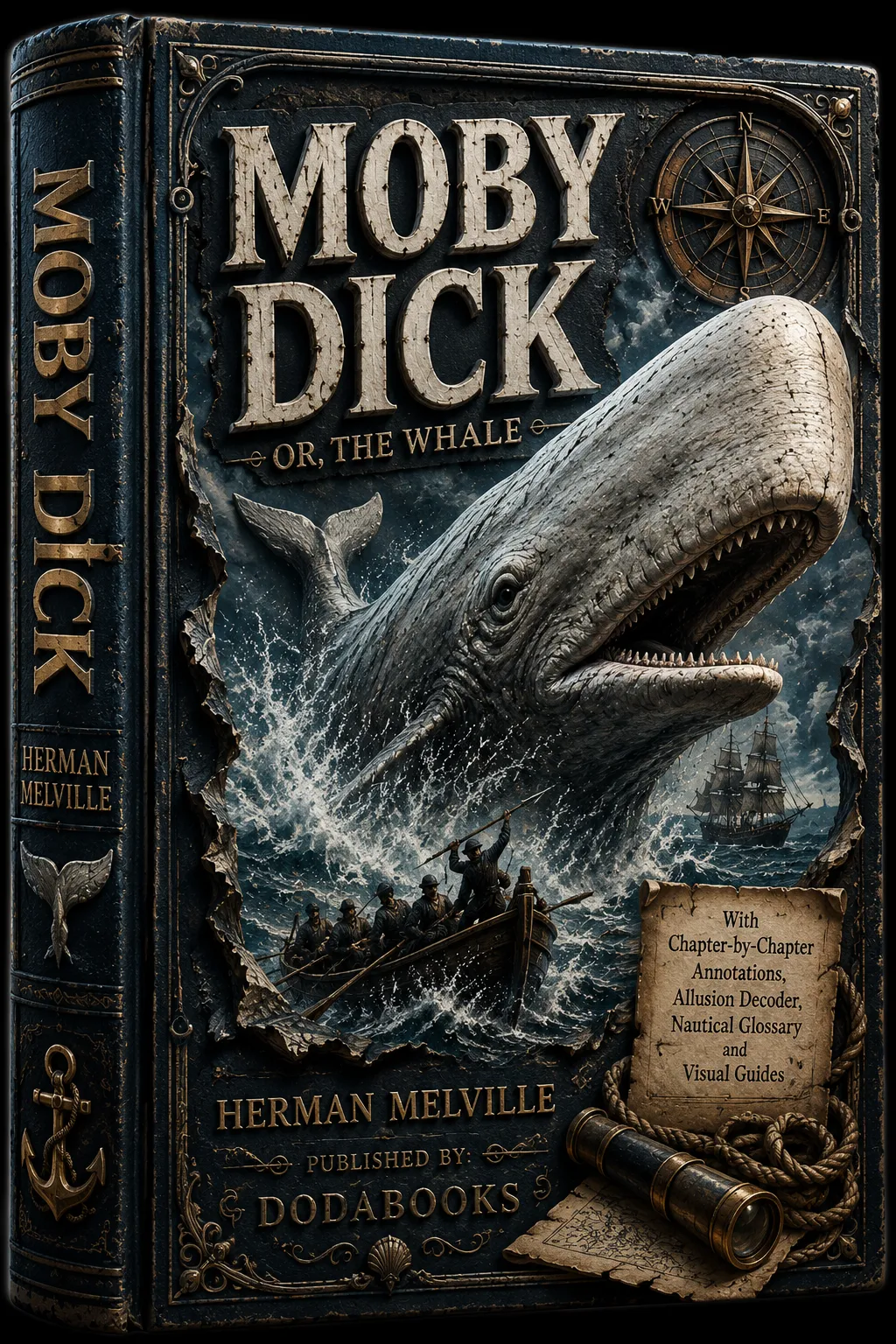
Discover the depth of Melville’s masterpiece with our annotated edition of Moby-Dick. Complete text with explanatory notes, historical context, and literary analysis.
📚 Related Articles
🎯 Stop Struggling. Start Understanding.
The annotated edition of Moby-Dick gives you everything you need to finally get Melville’s masterpiece:
- ✅ Complete, unabridged text — every word of the original 1851 edition
- ✅ Hundreds of explanatory footnotes — no more Googling every other page
- ✅ Historical context — the Essex disaster, Nantucket whaling, Melville’s life
- ✅ Literary analysis — chapter-by-chapter commentary on themes and symbols
- ✅ Victorian vocabulary — obsolete words and nautical terms defined inline
- ✅ Biblical & literary references — every allusion traced to its source