Analysis of Moby-Dick Chapter 41, when the white whale is finally described. Why Melville waited and what it reveals.
🐋
Moby-Dick Chapter 41: The White Whale Revealed — Analysis
Analysis of Moby-Dick Chapter 41, when the white whale is finally described. Why Melville waited and what it reveals.
The Delayed Revelation
Chapter 41 of Moby-Dick, titled “Moby Dick,” is the first extended description of the white whale. Melville has spent 40 chapters building toward this moment, and the decision to wait is one of the most brilliant structural choices in the novel. By withholding the whale’s physical appearance for so long, Melville transforms Moby Dick from a creature into a myth. The reader has heard rumors, legends, sailor’s yarns — but never seen the whale itself. When the description finally arrives, it carries the weight of everything that has come before.
This delayed revelation mirrors the way obsession works in the human mind. Ahab has been talking about the whale for chapters, but his Moby Dick is not a real animal — it is a symbol, a projection of his rage and metaphysical rebellion. When Melville finally describes the actual whale, the reader must reconcile the legend with the reality. The physical description is both less and more than expected: less dramatic than the myth suggests, yet more unsettling in its quiet, alien intelligence.
The Physical Description
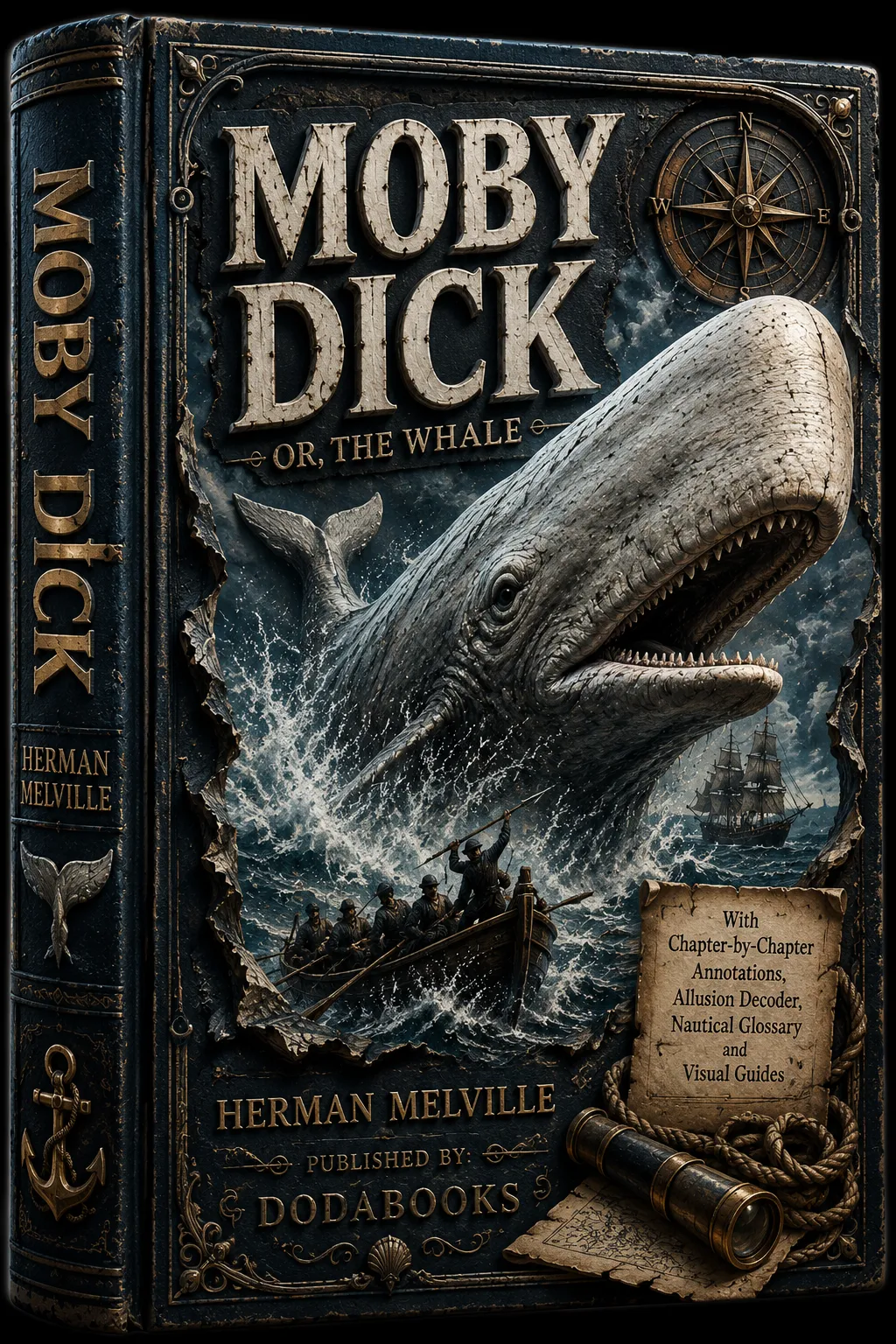
📖 Want the complete annotated experience?
👉 Get the Annotated EditionThe whale is “a sperm whale of uncommon magnitude” with a “peculiar snow-white wrinkled forehead.” Melville describes it as unusually large, powerful, and intelligent — a creature that seems to possess an almost supernatural awareness. The whiteness of the whale is central to its terror. In the famous Chapter 42, “The Whiteness of the Whale,” Ishmael meditates on why white inspires dread: it suggests absence, void, the emptiness behind the mask of reality.
What makes the description so effective is its restraint. Melville does not exaggerate the whale into a sea monster. He describes a real animal — a sperm whale — but one that has been marked by time and conflict. The whale’s body is covered in scars and harpoon wounds, evidence of countless encounters with men who tried to kill it and failed. Each scar is a story, a testament to the whale’s resilience and, perhaps, its intelligence. The white color itself seems almost unnatural, as if the whale has been bleached by exposure to something beyond the physical world.
The description also emphasizes the whale’s inscrutability. Unlike Ahab, who wears his obsession on his face, Moby Dick’s expression is blank, unreadable. This is what makes the whale so terrifying to Ahab — he cannot know whether the whale is evil, indifferent, or something else entirely. The whale’s inscrutability mirrors the inscrutability of the universe itself, which is precisely what Ahab cannot accept.
The Reputation
The whale has a name — unusual for a wild animal. Sailors tell stories: ships attacked without provocation, boats shattered, men killed. It is a force of nature, a living legend. The name “Moby Dick” itself carries weight — it sounds like something from a fairy tale or a nightmare, a name that belongs to a monster rather than an animal.
The stories about the whale accumulate across the novel, each one adding to its mythic stature. Some say the whale is immortal. Others claim it has supernatural powers. Ahab believes the whale is the embodiment of all evil in the world. Whether any of these claims are true is beside the point — what matters is that the sailors believe them, and belief shapes reality aboard the Pequod.
The whale’s reputation also serves a narrative function. It creates anticipation and dread. The reader knows the whale is coming, knows the confrontation will be catastrophic, but cannot look away. This is Melville’s genius: he turns a natural history lesson about sperm whales into a suspense story, a horror story, a philosophical meditation on evil. The reputation of the whale is, in many ways, more powerful than the whale itself.
Ahab’s Injury
The chapter describes Ahab’s encounter during a previous voyage. The whale destroyed his boat and leg, leaving him crippled and consumed by rage. Ahab’s response — dedicating his life to revenge — is both understandable and insane. The injury is real, the pain is real, the loss is real. But the scale of Ahab’s response is wildly disproportionate to the injury. He wants not just to kill the whale but to strike through it, to attack the source of all suffering in the universe.
This disproportion is what makes Ahab a tragic hero rather than a simple madman. His wound is genuine. His desire for justice — or at least retribution — is human. But his refusal to accept limitation, his insistence on projecting his rage onto a single creature, transforms a reasonable grievance into an apocalyptic obsession. Ahab does not merely want to kill the whale. He wants to prove that human will can triumph over the forces of nature and fate.
The description of the injury also reveals something about the whale’s intelligence. Moby Dick did not attack Ahab randomly — it destroyed his boat with what seems like deliberate precision. This raises the question that haunts the entire novel: is the whale a mindless animal, or is it something more? Ahab believes it is intelligent, malevolent, purposeful. Ishmael is less certain. The reader is left to decide.
The Crew’s Response
Some crew members are eager, drawn by Ahab’s charisma and the promise of glory. Others are uneasy, sensing that the voyage has shifted from a commercial expedition to a personal vendetta. Starbuck, the first mate, argues most forcefully against the change of course. He reminds Ahab that they signed on for profit, not for revenge. He appeals to reason, to duty, to the welfare of their families back home. He is overruled.
The crew’s response reveals the power dynamics aboard the Pequod. Ahab has absolute authority as captain, and he wields it with a combination of charisma and intimidation. He does not argue with Starbuck so much as override him. He does not explain his motives — he simply declares them. And the crew, caught between loyalty and fear, follows him.
This is one of the novel’s most disturbing themes: the way charismatic leaders can lead ordinary men to their destruction. The crew of the Pequod are not villains. They are whalers, doing a dangerous job for money. But they are seduced by Ahab’s vision, coerced by his authority, and ultimately destroyed by his obsession. It is a pattern that repeats throughout human history, and Melville captures it with devastating clarity.
The Mood
The chapter ends with inevitability. The Pequod is committed. The crew has been seduced or coerced. There is no turning back. The mood is one of dread mixed with exhilaration — the same mixture that Ahab himself feels. The hunt has begun, and everyone aboard knows it will end badly. But there is a terrible beauty in the commitment, a fascination with watching fate unfold.
Melville captures this mood through Ishmael’s narration, which shifts between awe and horror, admiration and judgment. Ishmael understands that Ahab is leading them to destruction, but he cannot look away. He is seduced like everyone else, drawn into the orbit of Ahab’s obsession. This is the novel’s deepest horror: not that one man is mad, but that madness is contagious. Ahab’s obsession infects the entire crew, transforming a routine whaling voyage into a journey toward annihilation.
The mood of Chapter 41 sets the tone for everything that follows. From this point forward, the novel accelerates toward its catastrophic conclusion. The cetology chapters and philosophical digressions continue, but they are now shadowed by the knowledge of what is coming. The white whale has been described. The obsession has been declared. The trap is sprung.
Discover the depth of Melville’s masterpiece with our annotated edition of Moby-Dick. Complete text with explanatory notes, historical context, and literary analysis.
📚 Related Articles
Frequently Asked Questions
What is revealed about Moby Dick in Chapter 41?
Melville details the white whale's legendary history, unusual albino hue, deformed jaw, and terrifying intelligence reported by previous whalers.
Why is Chapter 41 considered the turning point of the novel?
It explains the psychological origin of Ahab's madness, revealing how Ahab came to view Moby Dick as the embodiment of all cosmic malice.
Did other whalers believe Moby Dick was immortal or ubiquitous?
Yes, superstitious 19th-century sailors circulated rumors that Moby Dick could appear simultaneously in separate oceans and could not be killed.
How does Ishmael react to Ahab's quest in Chapter 41?
Ishmael admits that Ahab's wild frenzy ignited a sympathetic flame in his own soul, binding him spiritually to the dark hunt.
Where can I find in-depth analysis of Chapter 41's themes?
The DodaBooks annotated edition features in-depth critical commentary on Melville's psychological insights and theological implications in Chapter 41.
🎯 Stop Struggling. Start Understanding.
The annotated edition of Moby-Dick gives you everything you need to finally get Melville’s masterpiece:
- ✅ Complete, unabridged text — every word of the original 1851 edition
- ✅ Hundreds of explanatory footnotes — no more Googling every other page
- ✅ Historical context — the Essex disaster, Nantucket whaling, Melville’s life
- ✅ Literary analysis — chapter-by-chapter commentary on themes and symbols
- ✅ Victorian vocabulary — obsolete words and nautical terms defined inline
- ✅ Biblical & literary references — every allusion traced to its source