Analysis of Moby-Dick Chapter 28, when Captain Ahab first appears. Why Melville delayed his entrance and what it reveals.
🐋
Moby-Dick Chapter 28: Ahab First Appears — Analysis
Analysis of Moby-Dick Chapter 28, when Captain Ahab first appears. Why Melville delayed his entrance and what it reveals...
The Delayed Entrance
Ahab does not appear until Chapter 28 of Moby-Dick, over 100 pages in. Melville builds anticipation through crew whispers. When Ahab emerges, the moment is electric.
This structural choice is one of the most daring in American literature. In most novels, the protagonist appears in the opening pages. Melville waits until nearly a quarter of the way through the book to introduce the man whose obsession will drive the entire plot. The effect is extraordinary: by the time Ahab walks onto the deck, the reader has already heard him described by Starbuck, Stubb, and Flask — each offering a different perspective on a captain they both respect and fear. The reader has heard his tapping foot echoing through the cabin below, a sound that seems to measure out time itself. The reader has felt the weight of an absence that shapes every conversation aboard the Pequod.
The delay serves another purpose: it establishes that Moby-Dick is Ishmael’s story before it is Ahab’s. The narrator’s voice — curious, digressive, philosophical — must earn the reader’s trust before the novel shifts into darker, more tragic territory. If Ahab appeared in Chapter 1, the book would be a revenge tale. By delaying him, Melville ensures that the reader experiences the Pequod’s world through Ishmael’s eyes — the same world that will make the tragedy comprehensible, even inevitable.
When Ahab finally appears, the moment carries the force of myth. He does not walk so much as materialize, as if he has always been there, waiting to be seen. The crew freezes. The world holds its breath. And then the novel pivots — from comedy, from friendship, from the daily routines of whaling — into something far more dangerous and far more profound.
The Description
Ahab “looked like a man cut away from the stake, when the fire has overrunningly wasted all the limbs without consuming them.” His face bears a scar like a bolt of lightning. His leg is whale ivory. He has been physically and spiritually marked by the whale.
This description is deliberately apocalyptic. The image of a man burned but not consumed evokes the three Hebrew boys in the fiery furnace of Daniel — survivors of divine punishment who emerge transformed. Ahab has been through his own furnace, and what survived is not the man he was but something harder, stranger, and more dangerous. His body is a map of suffering: the scar, the missing leg, the deep lines carved by rage and sleepless nights. Every physical detail tells the same story: this man has been to the edge of the world and returned with a single purpose.
The ivory leg is the most telling detail. Made from the jawbone of a sperm whale — the very species that took his original leg — it is a trophy turned prosthetic, a reminder that Ahab has already defeated the enemy he now hunts again. But there is something perverse about it too: he has fashioned his instrument of mobility from the body of the creature he hates. Every step he takes is a collaboration with his enemy, a constant reminder of his wound and his rage. The leg is not just a physical support; it is a psychological prison.
Melville’s description also emphasizes what Ahab is not: he is not whole, not healed, not at peace. He is a man defined by what has been taken from him — and by what he has chosen to become in response. The scar, the leg, the lightning-bolt mark: these are not decorations but brands of obsession, visible signs of an inner transformation that has made Ahab something more (or less) than human.
The Scar
Ahab’s scar runs “from his crown to the sole of his foot” — a biblical reference to Job, a man tested by inexplicable suffering. Unlike Job, Ahab responds with defiance, not submission.
The scar’s vertical orientation is significant. It connects Ahab’s head (the seat of reason and will) to his foot (the instrument of action). In between, it passes through his heart — the seat of emotion and moral judgment. The scar is thus a line drawn through every faculty of human consciousness, suggesting that Ahab’s experience has affected not just his body but his entire being. He is scarred in his thinking, in his feeling, in his moving through the world.
The Book of Job allusion is central to understanding Ahab’s character. Job is a righteous man who suffers terrible losses — children, health, wealth — and demands to know why God allows such punishment. God answers from the whirlwind, not with explanations but with questions: “Where were you when I laid the earth’s foundation?” Job accepts the mystery. Ahab does not. Instead, he declares war on the power that wounded him — the white whale, which becomes his proxy for every unjust force in the universe.
This defiance makes Ahab a Promethean figure: a mortal who challenges the gods. But unlike Prometheus, who steals fire for humanity’s benefit, Ahab’s rebellion is entirely personal. He does not seek to liberate mankind; he seeks to avenge his own suffering. The scar is the mark of that singular purpose — a wound that has become a mission, a伤疤 that has become a weapon.
The Ivory Leg
Made from a sperm whale’s jaw. Ahab cannot walk without being reminded of the whale. Every step is a step of revenge.
The ivory leg is the novel’s most powerful symbol. On the most literal level, it replaces what Moby Dick took — Ahab’s natural leg, torn away in a previous encounter. But the leg’s material — whalebone — means that Ahab has literally incorporated his enemy into his own body. He cannot separate himself from the whale; he carries it with him, step by step, across the deck and across the ocean.
This physical dependency creates a psychological paradox: the thing that enables Ahab to move forward is also the thing that chains him to his obsession. Without the leg, he cannot walk. Without the whale, he has no reason to walk. The prosthetic is thus both freedom and prison, both the instrument of his mobility and the anchor of his rage.
The leg also serves as a visible warning to the crew. Every man aboard the Pequod can see what the whale did to Ahab. The ivory is unmistakable — bright white against the dark deck, gleaming in the light of the try-works. It is a constant reminder of what Ahab has lost and what he intends to reclaim. When Ahab speaks of hunting Moby Dick, the crew need only look at his leg to understand the depth of his commitment. The prosthetic is not a medical device; it is a recruitment tool.
Melville uses the leg to explore a deeper question: can a wound become a weapon? Ahab has transformed his injury into motivation, his loss into purpose. The leg that should have ended his career has instead given him a reason to sail farther, fight harder, and push past every reasonable limit. In this sense, the ivory leg is not just a symbol of revenge — it is a symbol of the human capacity to transform suffering into action, for better or worse.
The Significance
Chapter 28 transforms the novel. Before Ahab, the Pequod is normal. After Ahab, it is a ship on a revenge mission. The stakes change completely.
The transformation is immediate and irreversible. Before Ahab appears, the Pequod operates as a commercial vessel: it hunts whales for profit, follows the seasons, returns to port. After Ahab appears, the ship becomes something else entirely — an instrument of one man’s will, bent on a single purpose that has nothing to do with commerce and everything to do with cosmic justice.
This shift changes the novel’s genre. The first twenty-seven chapters are essentially a realistic novel of manners — Ishmael’s adjustment to shipboard life, the social dynamics of the crew, the rhythms of whaling. After Chapter 28, Moby-Dick becomes a tragedy in the classical sense: a story of a great man brought low by a fatal flaw. Ahab’s flaw is not weakness but strength — his refusal to accept the limits of human power. He will not rest until he has confronted the force that wounded him, even if that confrontation destroys him and everyone around him.
The chapter also establishes the novel’s moral architecture. Ahab is not a simple villain; he is a man of extraordinary will and intelligence who has been twisted by suffering. The reader is meant to admire him even while recognizing his madness. This complexity is what elevates Moby-Dick above a simple adventure story: the antagonist is not the whale but the human capacity for obsession, and the protagonist is not Ahab but the question of whether any individual has the right to impose their will on others — especially when the stakes are life and death.
Melville’s Technique
Melville understood the power of delayed revelation: keeping the central figure offstage builds anticipation and makes the entrance more powerful.
The comparison to Hamlet is apt but incomplete. Hamlet’s ghost appears briefly, delivering a message and disappearing. Ahab does the opposite: once he appears, he never leaves. His presence fills the novel like water filling a hull, rising steadily until it submerges everything else. The delay is thus not just a dramatic device but a structural metaphor: Ahab’s obsession is a force that grows from absence into totality, from whisper into shout, from possibility into inevitability.
Melville also draws on the tradition of the Byronic hero — the brooding, isolated figure who defies social convention in pursuit of a private vision. Like Byron’s Manfred or Childe Harold, Ahab is magnetic precisely because he refuses to be controlled. He is larger than life, not despite his flaws but because of them. The reader is drawn to him the same way the crew is drawn: by the sheer force of his personality and the terrible grandeur of his purpose.
The delayed entrance also serves a practical narrative function: it allows Melville to establish the world before introducing its central conflict. By the time Ahab appears, the reader knows the Pequod’s crew, understands the whaling trade, and has formed a relationship with Ishmael. This foundation makes Ahab’s impact more devastating — we see not just a dramatic entrance but the disruption of an entire world. The Pequod will never be the same, and neither will the reader.
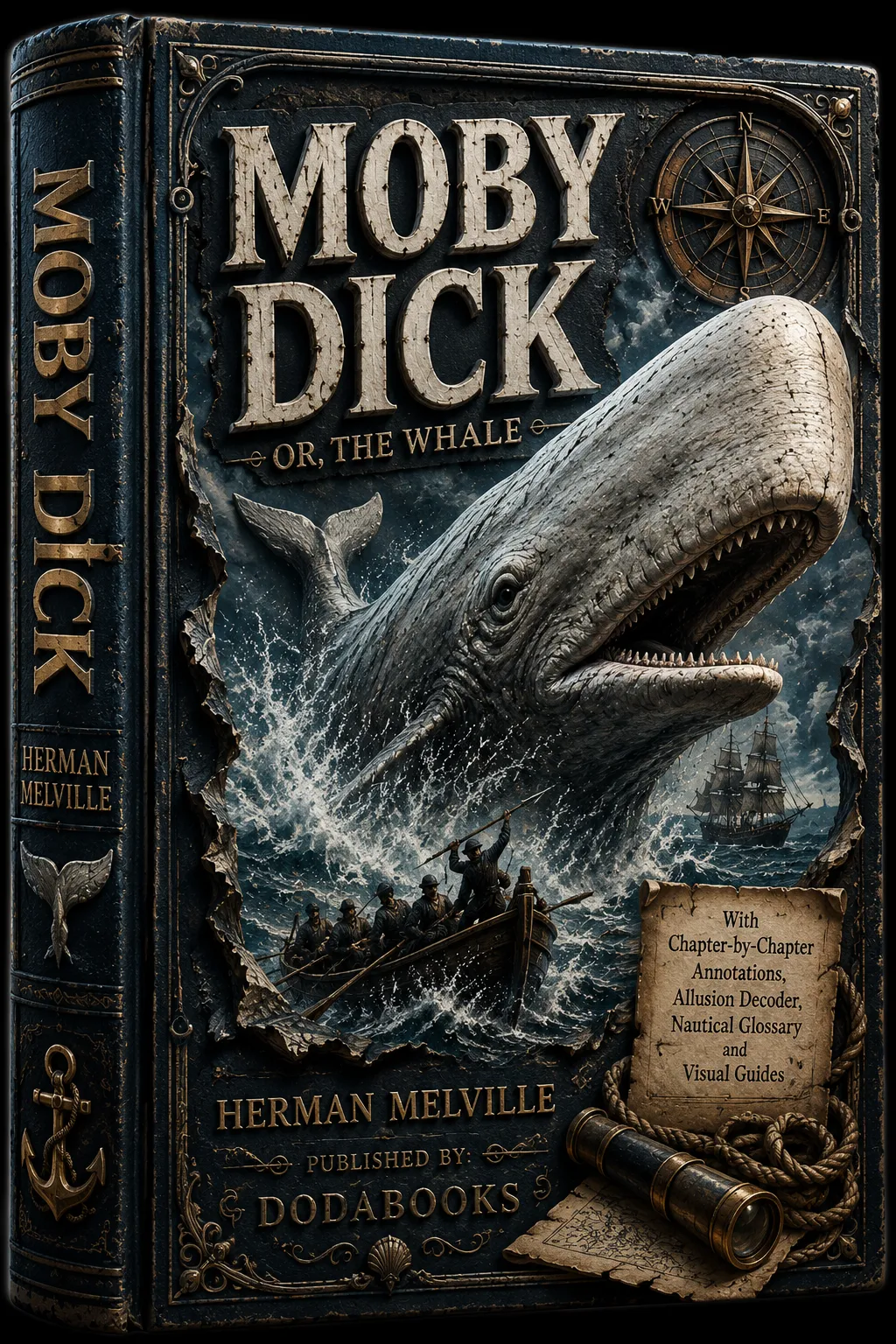
Discover the depth of Melville’s masterpiece with our annotated edition of Moby-Dick. Complete text with explanatory notes, historical context, and literary analysis.
📚 Related Articles
Frequently Asked Questions
When does Captain Ahab first appear on deck in Moby-Dick?
Ahab does not appear until Chapter 28, building agonizing suspense over several weeks while the Pequod is already far out at sea.
How does Melville describe Ahab's physical appearance?
Melville describes Ahab as looking like a man cut away from the stake, with a pale bronze visage, a grim cruciform scar, and a whalebone peg leg.
What is the mysterious scar that marks Ahab?
Melville leaves the scar's origin ambiguous, describing it as an elemental livid mark running from crown to sole, resembling lightning striking a tree.
How does Ahab's late entrance affect the pacing of the novel?
It shifts the narrative from lighthearted Nantucket picaresque to dark, ominous gothic tragedy, signaling the crew's descent into doom.
How does DodaBooks clarify the symbolic imagery in Chapter 28?
It annotates Melville's alchemical, botanical, and mythological references, providing total clarity on Ahab's symbolic portrait.
🎯 Stop Struggling. Start Understanding.
The annotated edition of Moby-Dick gives you everything you need to finally get Melville’s masterpiece:
- ✅ Complete, unabridged text — every word of the original 1851 edition
- ✅ Hundreds of explanatory footnotes — no more Googling every other page
- ✅ Historical context — the Essex disaster, Nantucket whaling, Melville’s life
- ✅ Literary analysis — chapter-by-chapter commentary on themes and symbols
- ✅ Victorian vocabulary — obsolete words and nautical terms defined inline
- ✅ Biblical & literary references — every allusion traced to its source